Mineral
Sugilite
KNa₂(Fe,Mn,Al)₂Li₃Si₁₂O₃₀Sugilit
A vivid purple jewellery stone from a South African manganese mine, which reached the market in 1979.
Also known as: Lavulite (trade name) · Luvulite (trade name) · Royal Azel (trade name)
- Popularly: Semi-precious stone
- Ornamental

In short
Sugilite is a rare silicate mineral containing potassium, sodium and lithium. The vivid purple jewellery-grade material is an aggregate of tiny grains that contains about 1–3% manganese oxide, and in commercial quantities it comes only from the Wessels mine in South Africa. At the place in Japan that gave the mineral its name it forms small brownish-yellow grains that are not used in jewellery.
Photos

How does it form?
At its first locality in Japan (Iwagi Islet), sugilite occurs as small grains in a syenite body containing the mineral aegirine. It is found in a similar setting at Mont Saint-Hilaire in Canada. The jewellery-grade purple material formed in a broad, layered manganese ore deposit at the Wessels mine in the Northern Cape province of South Africa; the purple colour comes from the manganese in the sugilite. At the mine, sugilite is met with while manganese ore is being mined; miners separate it by hand and stockpile it for sale.
What is it used for?
Sugilite is mainly an ornamental and jewellery stone: cabochons, beads, pendants, small carvings and ring stones are made from it. In cutting, carving and polishing it behaves like jade; it does not break or crack easily, which makes it useful in jewellery. Quality grades are set by colour (tone and saturation), texture, hardness and translucency.
What determines its value?
What matters most in sugilite is the saturation and evenness of the purple, the evenness of the texture (mottled, veined or banded pieces are less sought after), crack-free and large pieces, and translucency. Because purple sugilite in commercial quantities comes only from the Wessels mine, supply is limited; in 1987 GIA unofficially estimated the total amount in the mine at 12 to 15 tons. No colour-enhancing treatment is known to be applied.
This information is educational, not buying, selling or investment advice. Value varies enormously with quality and treatment.
How to recognise it
- 1
Its colour is purple or bluish purple, looking more reddish in incandescent (yellowish) light. It ranges from opaque to translucent, with a glassy or resinous lustre.
- 2
The texture can be even, or mottled, veined or banded; under a microscope tiny interlocking grains can be seen.
- 3
Its hardness is 5.5–6.5. Being an aggregate of tiny grains, it is durable in jewellery: it does not crack easily and resists heat and light.
- 4
It can be confused with charoite, but sugilite lacks charoite's swirling fibrous texture and chatoyancy.
- 5
It is hard to tell by eye from similar stones such as purple jadeite, amethyst-coloured chalcedony or dumortierite; it is separated by measuring the refractive index and the light-absorption spectrum.
Fakes and imitations
What shops usually don’t tell you:
- Sugilite mixed with chalcedony: some material from the Wessels mine contains an important amount of chalcedony; its colour is paler and it is slightly harder (6–6.5).
- Purple jadeite, amethyst-coloured chalcedony, dumortierite and charoite look similar enough to pass for sugilite; their refractive index and specific gravity are different.
Myths and misconceptions
MythSugilite and charoite are the same stone.
FactBoth are purple, but they are different minerals. Sugilite occurs in places such as South Africa, Japan and Canada and does not show a swirling fibrous texture; charoite occurs only in Siberia and is recognised by that texture.
MythThe vivid purple of sugilite is produced by dye.
FactThe colour is natural: it comes from about 1–3% manganese oxide in the structure. None of the samples GIA examined in 1987 had been dyed or colour-enhanced, and the colour proved stable to heat and light.
What is it believed to be good for?
This section reports beliefs; it is not health information. There is no scientific evidence for these claims and no stone replaces medical treatment.
The meanings people give this stone, and who holds them:
- Today crystal-therapy practitioners claim that sugilite is linked with the third eye and crown chakras, helps meditation, “absorbs negative energy”, supports people through difficult periods, brings sleep without nightmares, and strengthens confidence and imagination.
- The same circles claim that sugilite relieves headaches, toothache and back pain, strengthens immunity and the heart, regulates blood circulation and “purifies” the body fluids, and helps scars heal.
What science says
There is no scientific evidence that sugilite relieves pain, strengthens immunity or the heart, heals scars, “absorbs energy” or improves sleep; for pain, sleeplessness or heart complaints, see a doctor rather than relying on a stone. The stone's purple comes from about 1–3% manganese oxide in its structure.
Did you know?
Jewellery-quality purple sugilite reached the market in 1979; at first it was wrongly taken for sogdianite, another mineral.
It was also sold under trade names such as “Royal Lavulite” and “Royal Azel”.
It is named after the Japanese petrologist Ken-ichi Sugi (1901–1948), who found the mineral.
Where is it found?
Loading map…
- Iwagi Islet, Ehime Prefecture, Japan · Type localityThe type locality; small brownish-yellow grains in an aegirine syenite body, not used in jewellery
- Wessels mine, Hotazel, Northern Cape, South Africa · Major depositIn the Kalahari manganese field; according to GIA (1987), the only place that yields jewellery-grade purple sugilite in commercial quantities
- Mont Saint-Hilaire, Quebec, Canada · Known localityA rock setting similar to that at Iwagi (aegirine syenite)
- Liguria (Cerchiara mine, near Faggiona), Italy · Known localityA manganese mine named in the Handbook of Mineralogy
- Woods mine, near Tamworth, New South Wales, Australia · Known localityA manganese mine about 30 km north-northeast of Tamworth
Locations are approximate to protect sites. Red dots mark places in Türkiye. Open in the big map →
Frequently asked questions
What is sugilite?
Sugilite is a rare silicate mineral containing potassium, sodium and lithium. The vivid purple jewellery-grade material is an aggregate of tiny grains that contains about 1–3% manganese oxide, and in commercial quantities it comes only from the Wessels mine in South Africa. At the place in Japan that gave the mineral its name it forms small brownish-yellow grains that are not used in jewellery.
What is sugilite used for?
Sugilite is mainly an ornamental and jewellery stone: cabochons, beads, pendants, small carvings and ring stones are made from it. In cutting, carving and polishing it behaves like jade; it does not break or crack easily, which makes it useful in jewellery. Quality grades are set by colour (tone and saturation), texture, hardness and translucency.
How hard is sugilite?
It has a hardness of 5.5–6.5 on the Mohs scale. It can scratch glass; a steel knife scratches it only with difficulty. Its specific gravity is 2.74–2.8 g/cm³.
Where is sugilite found?
Its best-known localities: Iwagi Islet, Ehime Prefecture, Japan; Wessels mine, Hotazel, Northern Cape, South Africa; Mont Saint-Hilaire, Quebec, Canada; Liguria (Cerchiara mine, near Faggiona), Italy; Woods mine, near Tamworth, New South Wales, Australia.
How can you tell if sugilite is real?
Its colour is purple or bluish purple, looking more reddish in incandescent (yellowish) light. It ranges from opaque to translucent, with a glassy or resinous lustre. The texture can be even, or mottled, veined or banded; under a microscope tiny interlocking grains can be seen. Its hardness is 5.5–6.5. Being an aggregate of tiny grains, it is durable in jewellery: it does not crack easily and resists heat and light. Sugilite mixed with chalcedony: some material from the Wessels mine contains an important amount of chalcedony; its colour is paler and it is slightly harder (6–6.5).
Is sugilite valuable?
On the “street to diamond” value ladder it sits on step 6 of nine: Fine ornamental and collector stone. What matters most in sugilite is the saturation and evenness of the purple, the evenness of the texture (mottled, veined or banded pieces are less sought after), crack-free and large pieces, and translucency. Because purple sugilite in commercial quantities comes only from the Wessels mine, supply is limited; in 1987 GIA unofficially estimated the total amount in the mine at 12 to 15 tons. No colour-enhancing treatment is known to be applied.
What is sugilite good for?
Today crystal-therapy practitioners claim that sugilite is linked with the third eye and crown chakras, helps meditation, “absorbs negative energy”, supports people through difficult periods, brings sleep without nightmares, and strengthens confidence and imagination. The same circles claim that sugilite relieves headaches, toothache and back pain, strengthens immunity and the heart, regulates blood circulation and “purifies” the body fluids, and helps scars heal. There is no scientific evidence that sugilite relieves pain, strengthens immunity or the heart, heals scars, “absorbs energy” or improves sleep; for pain, sleeplessness or heart complaints, see a doctor rather than relying on a stone. The stone's purple comes from about 1–3% manganese oxide in its structure. This section reports beliefs; it is not health information. There is no scientific evidence for these claims and no stone replaces medical treatment.
Sources
- The Occurrence and Gemological Properties of Wessels Mine Sugilite (Shigley, Koivula, Fryer), Gems & Gemology 23(2) · GIA, 1987
- Handbook of Mineralogy: Sugilite · Mineralogical Society of America
- Sugilite · Wikipedia
- Sugilite Mineral Data · Webmineral
- Charoite · Wikipedia
External links
Draft: awaiting expert reviewReport an error ↗
On the same step
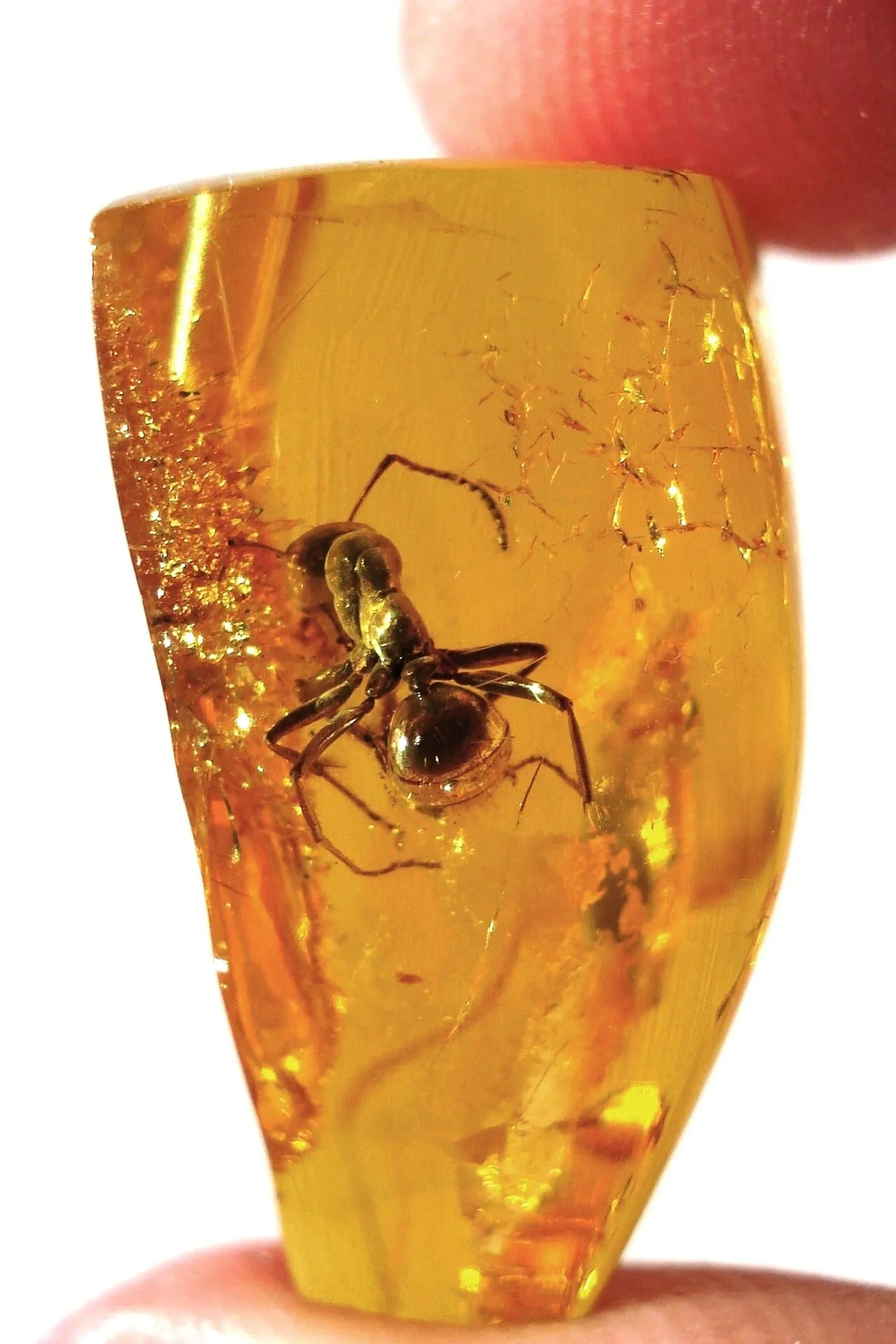
Amber
Tree resin fossilised over millions of years: a light, warm organic gem that sometimes holds prehistoric insects.
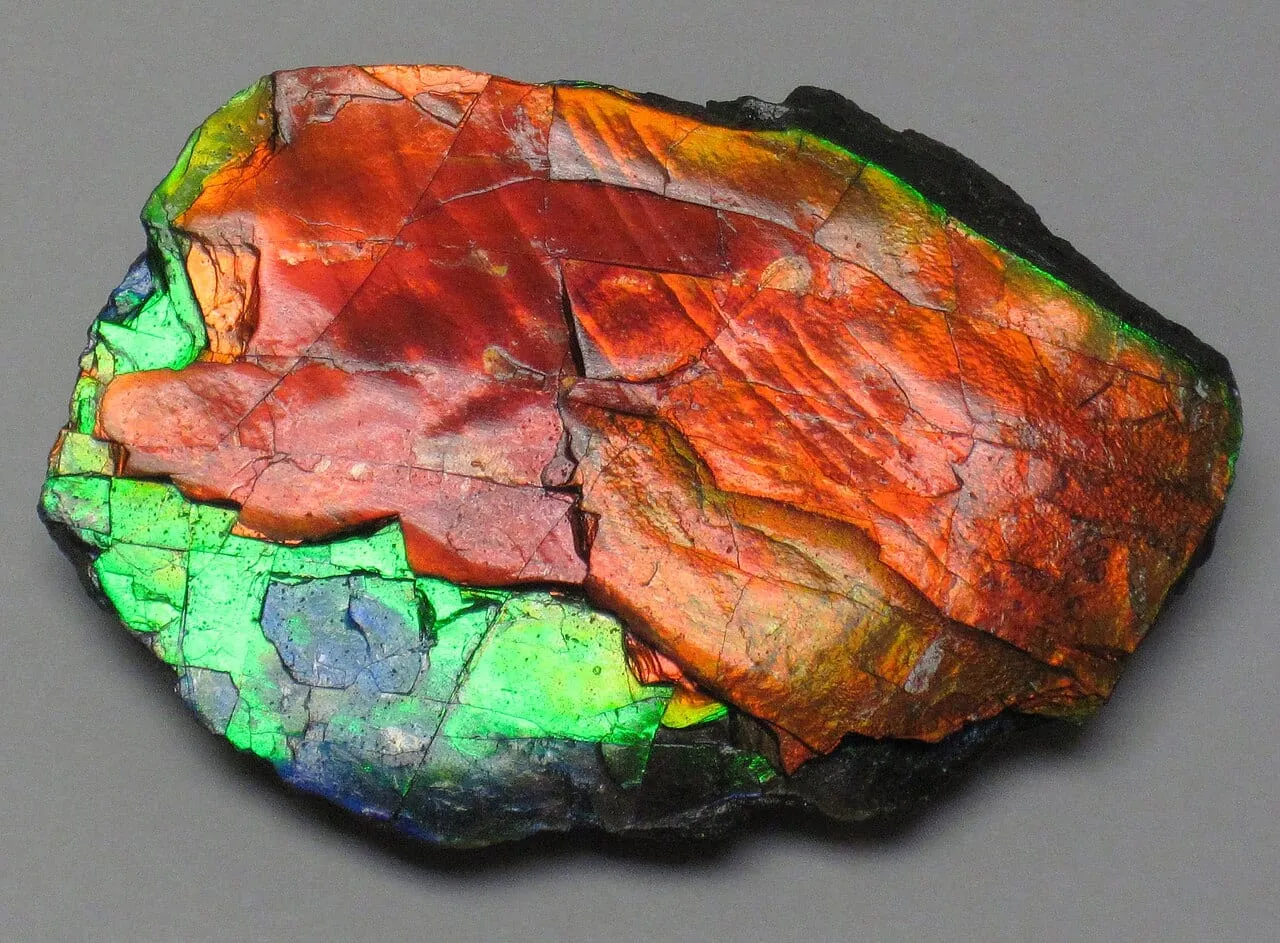
Ammolite
The rainbow-bright layer of fossil ammonite shell; of gem quality it comes only from the Canadian province of Alberta.
Aquamarine
The blue member of the beryl family, named after seawater: often found as large, clear, nearly flawless crystals.