Meteorite
Achondrite
Akondrit
Stony meteorites with no chondrules: rock from melted asteroids, the Moon and Mars, and hard to recognise because they look like Earth rocks.
- Popularly: Meteorite

In short
Achondrites are stony meteorites that contain no chondrules, the round grains found in chondrites. They broke off bodies that once melted and separated into layers (asteroids, the Moon and Mars), so they resemble igneous rocks on Earth such as basalt. They make up about 8% of the meteorites seen to fall.
Photos
.jpg)
How does it form?
Achondrites come from bodies that once melted, wholly or partly. In the Solar System’s first period some asteroids melted from the heat of short-lived radioactive elements; heavy metal sank to the centre, lighter silicates stayed outside, and the layers near the surface solidified into rocks like Earth’s basalt. This layering is called differentiation. The round chondrules of chondrites were destroyed by the melting, so achondrites have none. Collisions break pieces off the crust and mantle of such bodies, and after drifting through space some of them fall to Earth. Pieces of rock blasted off the Moon and Mars also count as achondrites.
What is it used for?
Achondrites have no everyday use; their value is scientific:
- Rocks from other worlds: They let us study pieces of the crust and mantle of asteroids, the Moon and Mars directly in the laboratory. The HED group is thought to come from the crust of the asteroid Vesta.
- A calendar of the early Solar System: Some achondrites, such as the angrites, crystallised about 4.56 billion years ago; they show how early planetesimals melted and built crusts.
- Matching an asteroid to a meteorite: Pieces of asteroid 2008 TC3, observed in space, were found and studied on the ground; for the first time an asteroid class (F-type) and a meteorite type could be linked directly.
- Museums and collections: Cut and polished slices and pieces from documented falls are held by museums and collectors.
Main types
Achondrites make up about 8% of the meteorites seen to fall, far fewer than chondrites. The main groups are:
- Primitive achondrites: Partly melted stones whose chemistry is still close to that of chondrites but whose texture is igneous; the acapulcoites (named after the Acapulco meteorite), lodranites, winonaites, brachinites and ureilites belong here. Ureilites are rich in carbon and contain graphite and tiny diamond grains.
- Differentiated asteroid achondrites: The largest group, more than half of all achondrites, is the HED meteorites (see the eucrite (HED meteorites) page). There are also the angrites (type specimen Angra dos Reis) and the aubrites, rich in the mineral enstatite (Norton County, Cumberland Falls).
- Lunar meteorites: described on the lunar meteorite page.
- Martian meteorites: described on the Martian meteorite page.
For stony meteorites mixed with metal, see pallasite and mesosiderite; for their chondrule-bearing relatives, chondrite; for those made almost entirely of metal, iron meteorite.
Why are they hard to recognise?
Achondrites look like Earth rocks to the naked eye, most do not attract a magnet and they show no chondrules; the three easy clues that help with chondrites do not work for them. Usually only the thin fusion crust is left. So achondrites that are not seen to fall are easier to overlook than other meteorites. To work out whether a stone is a meteorite, see the Is my stone valuable? guide.
Achondrites in Türkiye
The best-documented meteorite to fall in Türkiye is an achondrite: on 2 September 2015 a shower of howardite (an HED type) fell around the village of Sarıçiçek in Bingöl. 343 stones weighing about 15.24 kg in all were documented; the fall was caught on many security cameras, and the footage made it possible to work out the meteoroid’s orbit. Researchers linked the pieces to the impact that formed the Antonia crater on Vesta about 22 million years ago. Details are on the eucrite (HED meteorites) page.
What determines its value?
The value of an achondrite is determined first by its subgroup and its paperwork. Pieces from the Moon and Mars carry a special rarity and are the most sought after, while relatively common groups such as the HEDs are easier to obtain. In every case it matters that the name and class are registered in the Meteoritical Society’s database, that the fall was witnessed, that the fusion crust is fresh, and how large the piece is. Because achondrites look like Earth rocks, a stone that has not been confirmed as a meteorite in a laboratory cannot be given any value.
This information is educational, not buying, selling or investment advice. Value varies enormously with quality and treatment.
How to recognise it
- 1
A freshly fallen achondrite is covered by a fusion crust, usually thinner than 1–2 millimetres; in some types the crust is shiny and glassy. A rock with no fusion crust is unlikely to be a meteorite.
- 2
Most contain no iron–nickel metal, so they do not attract a magnet, which sets them apart from most chondrites. The magnet test rules achondrites out, so it cannot settle the question on its own.
- 3
Inside, they look much like Earth rocks such as basalt or granite to the naked eye. A cut surface may show pale feldspar, dark pyroxene or greenish olivine grains, but no chondrules.
- 4
Which group a stone belongs to cannot be told by eye: it takes laboratory measurements such as oxygen isotope ratios and mineral chemistry. And only a meteorite laboratory can confirm that a rock is a meteorite at all.
Fakes and imitations
What shops usually don’t tell you:
- Basalt and other igneous Earth rocks: they resemble achondrites so closely that telling them apart by eye is unreliable; only laboratory measurements separate the two.
- Slag, magnetite and hematite: the Earth materials most often offered as “meteor stones”. The step-by-step screening is in this site’s “Is my stone valuable?” guide.
- Undocumented pieces said to come from the Moon or Mars: genuine lunar and Martian meteorites have registered names and classes in the Meteoritical Society’s database, so a piece without a name, class and documented source should not be trusted.
Myths and misconceptions
MythA stone that does not attract a magnet cannot be a meteorite.
FactAbout 95% of meteorites attract a magnet because most contain iron–nickel metal. But types with no metal, such as achondrites, do not, just like most Earth rocks. So the magnet test is only a first screen; even so, an ordinary non-magnetic stone is very unlikely to turn out to be a meteorite.
MythA meteorite looks nothing like Earth rocks and is obvious at a glance.
FactTo the naked eye achondrites look very much like Earth rocks, which is why they are noticed and found far less often than other meteorites. A definite identification needs a laboratory.
Did you know?
On 7 October 2008 a small asteroid, 2008 TC3, entered the atmosphere over Sudan. Because it had been found about 20 hours earlier, it was the first asteroid whose impact was predicted before it happened. The pieces were recorded as “Almahata Sitta” (“Station Six”, after a nearby railway station); most of them are an achondrite type called ureilite.
The Acapulco meteorite, which fell in Mexico in 1976, was still cool to the touch when it was dug out of a 30-centimetre hole 15 minutes after the fall.
Erg Chech 002, found in the Sahara in 2020, is about 4.565 billion years old and is regarded as the oldest known piece of volcanic rock; it comes from the crust of a body that melted in the Solar System’s first days and has since vanished.
Where is it found?
Loading map…
- Norton County, Kansas and Nebraska, USA · Major depositAn aubrite that fell on 18 February 1948; about 1,100 kg of fragments were recovered, and the main mass (about 1,070 kg) is held at the University of New Mexico in Albuquerque.
- Almahata Sitta, Nubian Desert, Sudan · Known localityFragments of the small asteroid 2008 TC3, which entered the atmosphere on 7 October 2008, the first time an asteroid impact was predicted before it happened. About 600 pieces, 10.5 kg in all, were collected; most are ureilites.
- Angra dos Reis, Rio de Janeiro, Brazil · Type localityThe 1.5 kg meteorite that fell into a bay about 2 m deep on 20 January 1869 is the type specimen of the angrites; a diver found two fragments the next day.
- Acapulco, Guerrero, Mexico · Type localityThe 1,914 g meteorite that fell on 11 August 1976; when dug out of a 30 cm hole 15 minutes later it was cool to the touch. It gives its name to the acapulcoites, a group of primitive achondrites.
- Juvinas (Libonès), Ardèche, France · Historic sourceA eucrite (HED) that fell on 15 June 1821; about half of the recovered material is kept in the Muséum national d'histoire naturelle in Paris.
- Erg Chech, Sahara, Algeria · Known localityErg Chech 002, found in May 2020 (not an observed fall; about 31.8 kg in all), is an ungrouped achondrite; at about 4.565 billion years old it is regarded as the oldest known piece of volcanic rock.
- Sarıçiçek, Bingöl, Türkiye · Known localityA howardite (HED) that fell on 2 September 2015; 343 stones, about 15.24 kg in all, were documented and the fall was caught on security cameras. Details are on the eucrite (HED) page.
Locations are approximate to protect sites. Red dots mark places in Türkiye. Open in the big map →
Frequently asked questions
What is achondrite?
Achondrites are stony meteorites that contain no chondrules, the round grains found in chondrites. They broke off bodies that once melted and separated into layers (asteroids, the Moon and Mars), so they resemble igneous rocks on Earth such as basalt. They make up about 8% of the meteorites seen to fall.
What is achondrite used for?
Achondrites have no everyday use; their value is scientific: Rocks from other worlds: They let us study pieces of the crust and mantle of asteroids, the Moon and Mars directly in the laboratory. The HED group is thought to come from the crust of the asteroid Vesta. A calendar of the early Solar System: Some achondrites, such as the angrites, crystallised about 4.56 billion years ago; they show how early planetesimals melted and built crusts.
How hard is achondrite?
It has a hardness of 5–7 on the Mohs scale. It can scratch glass; a steel knife scratches it only with difficulty. Its specific gravity is 2.8–3.3 g/cm³.
Where is achondrite found?
Its best-known localities: Angra dos Reis, Rio de Janeiro, Brazil; Acapulco, Guerrero, Mexico; Norton County, Kansas and Nebraska, USA; Juvinas (Libonès), Ardèche, France; Almahata Sitta, Nubian Desert, Sudan.
Where is achondrite found in Türkiye?
Known localities in Türkiye: Sarıçiçek, Bingöl, Türkiye.
How can you tell if achondrite is real?
A freshly fallen achondrite is covered by a fusion crust, usually thinner than 1–2 millimetres; in some types the crust is shiny and glassy. A rock with no fusion crust is unlikely to be a meteorite. Most contain no iron–nickel metal, so they do not attract a magnet, which sets them apart from most chondrites. The magnet test rules achondrites out, so it cannot settle the question on its own. Inside, they look much like Earth rocks such as basalt or granite to the naked eye. A cut surface may show pale feldspar, dark pyroxene or greenish olivine grains, but no chondrules. Basalt and other igneous Earth rocks: they resemble achondrites so closely that telling them apart by eye is unreliable; only laboratory measurements separate the two.
Is achondrite valuable?
On the “street to diamond” value ladder it sits on step 6 of nine: Fine ornamental and collector stone. The value of an achondrite is determined first by its subgroup and its paperwork. Pieces from the Moon and Mars carry a special rarity and are the most sought after, while relatively common groups such as the HEDs are easier to obtain. In every case it matters that the name and class are registered in the Meteoritical Society’s database, that the fall was witnessed, that the fusion crust is fresh, and how large the piece is. Because achondrites look like Earth rocks, a stone that has not been confirmed as a meteorite in a laboratory cannot be given any value.
Sources
- Achondrite · Wikipedia
- Achondrites · Buseck Center for Meteorite Studies, Arizona State University
- Meteorite fall statistics · Wikipedia
- HED meteorite · Wikipedia
- Meteorite porosities and densities: a review of trends in the data (D. T. Britt & G. J. Consolmagno), Lunar and Planetary Science XXXV, abstract 2108 · Lunar and Planetary Institute, 2004
- Density, porosity, and magnetic susceptibility of achondritic meteorites (Macke, Britt & Consolmagno), Meteoritics & Planetary Science 46(2): 311–326 · Wiley, 2011
- Handbook of Mineralogy: Pigeonite · Mineralogical Society of America
- Handbook of Mineralogy: Anorthite · Mineralogical Society of America
- Handbook of Mineralogy: Forsterite · Mineralogical Society of America
- Ureilite · Wikipedia
- Angrite · Wikipedia
- Aubrite · Wikipedia
- Norton County (meteorite) · Wikipedia
- Almahata Sitta · Wikipedia
- Angra dos Reis (meteorite) · Wikipedia
- Acapulco (meteorite) · Wikipedia
- Juvinas · Wikipedia
- The Sarıçiçek howardite fall in Turkey: Source crater of HED meteorites on Vesta and impact risk of Vestoids (Unsalan et al.), Meteoritics & Planetary Science 54(5) · Wiley, 2019
- Some meteorite realities (Randy Korotev) · Washington University in St. Louis, Some Meteorite Information
- Erg Chech 002 · Wikipedia
- A 4,565-My-old andesite from an extinct chondritic protoplanet (Barrat et al.), Proceedings of the National Academy of Sciences 118(11) · PNAS, 2021
- 2008 TC3 · Wikipedia
- Turkish Meteorite Traced To Impact Crater On Asteroid Vesta · SETI Institute
External links
Draft: awaiting expert reviewReport an error ↗
On the same step
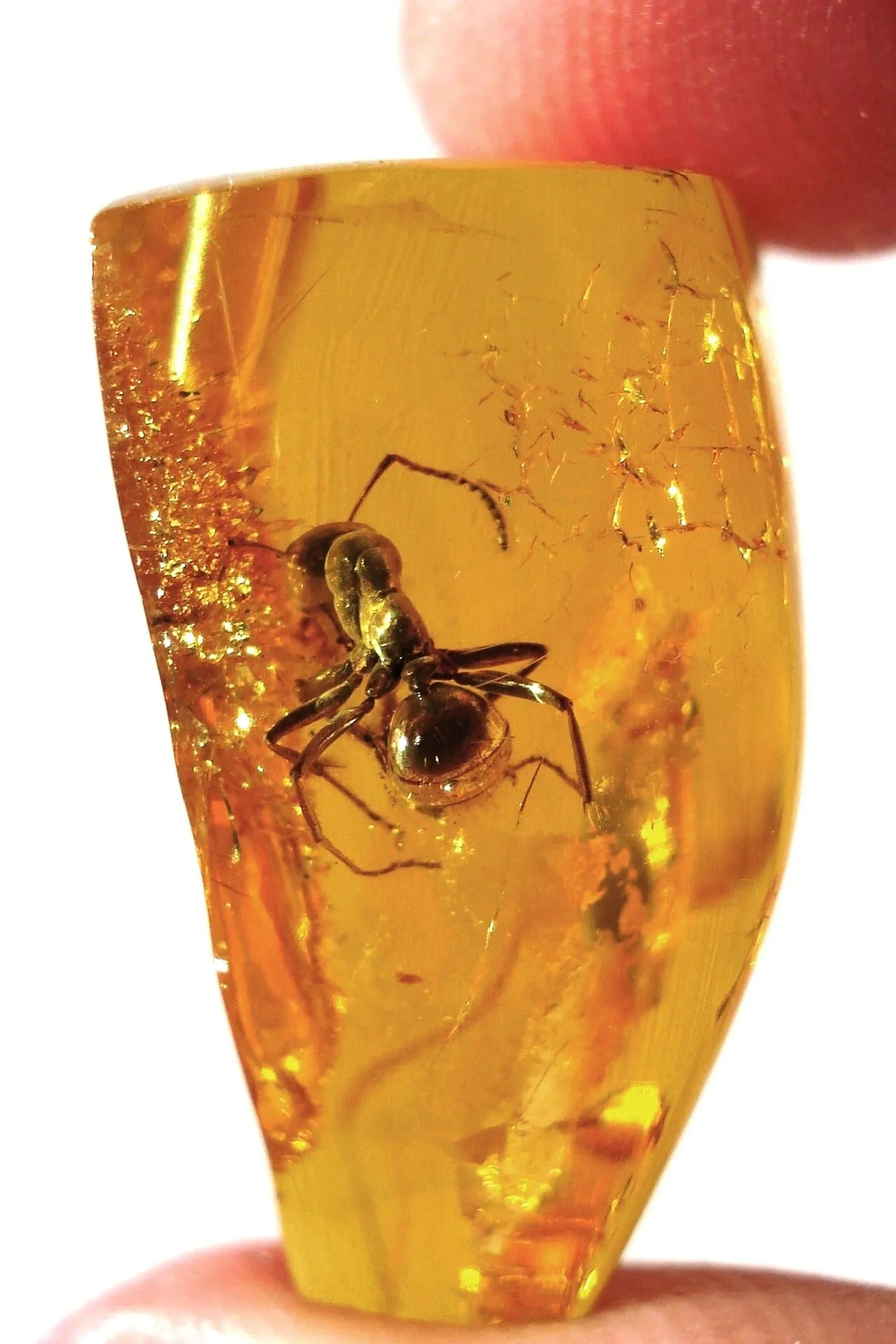
Amber
Tree resin fossilised over millions of years: a light, warm organic gem that sometimes holds prehistoric insects.
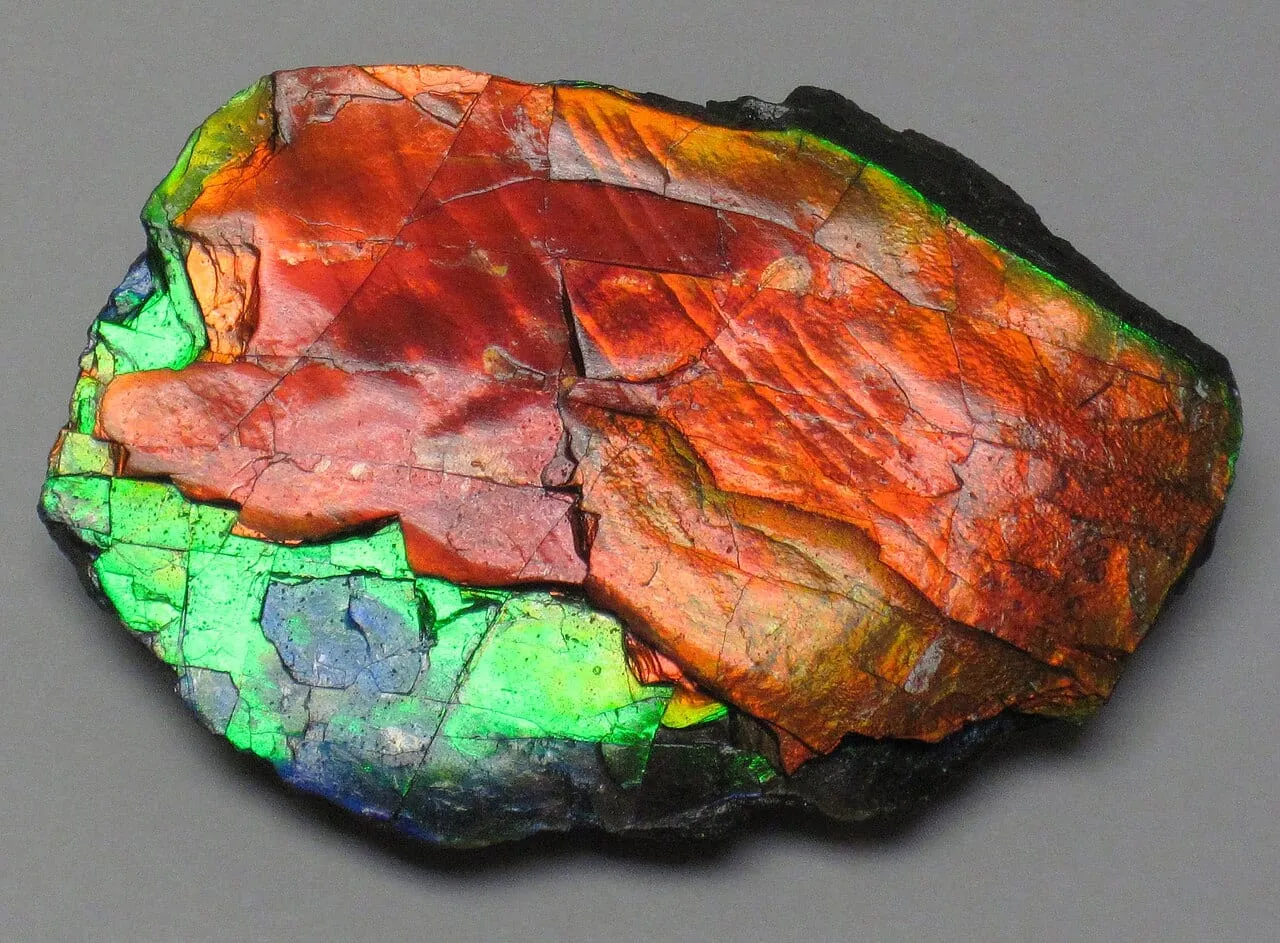
Ammolite
The rainbow-bright layer of fossil ammonite shell; of gem quality it comes only from the Canadian province of Alberta.
Aquamarine
The blue member of the beryl family, named after seawater: often found as large, clear, nearly flawless crystals.