Meteorite
Allende meteorite
Allende meteoriti
The most studied meteorite in history: the largest carbonaceous chondrite, which fell in Mexico in 1969 carrying the first solids of the Solar System.
Also known as: Allende · Pueblito de Allende
- Popularly: Meteorite

In short
The Allende meteorite fell on the night of 8 February 1969 in the Mexican state of Chihuahua and is the largest carbonaceous chondrite ever found. It broke up in the atmosphere, and more than 2 tonnes of fragments were recovered. Such plentiful samples let scientists study this rare and important kind of meteorite in detail, which is why Allende is often called “the best-studied meteorite in history”. Its 4.567-billion-year-old white inclusions are the oldest known solids formed in the Solar System.
Photos

How does it form?
Allende formed at the very start of the Solar System from the cloud of gas and dust around the young Sun (the solar nebula). Its white calcium–aluminium-rich inclusions (CAIs) and chondrules are among the first solids formed in the Solar System. They later came together with dust to build the meteorite’s parent body. Allende’s “type 3” label shows that its parent body never went through significant later heating.
Isotope analyses in 1977 showed that some elements, such as calcium, barium and neodymium, came from outside the early Solar System cloud. Short-lived aluminium-26 in the meteorite also supports the idea that a nearby supernova exploded no more than 2 million years before the Solar System formed.
What is it used for?
- Age of the Solar System: Its CAIs and chondrules are 4.567 billion years old, and the age of carbonaceous chondrites is often taken as the age of the Solar System.
- Stardust: Unusual isotope ratios and presolar grains carry traces of stars and supernovae from before the Sun.
- New minerals: Previously unknown minerals such as panguite, found in 2012, have been described from Allende.
History
At 01:05 on 8 February 1969 a huge, brilliant fireball came in from the southwest, lit up the sky and ground for hundreds of kilometres, then exploded into thousands of pieces. The fragments fell in northern Mexico near the village of Pueblito de Allende, over an area about 50 kilometres long and 8 kilometres wide. Many museums, including the Smithsonian Institution, sent teams to Mexico. Individual pieces range from 1 gram to 110 kilograms, and more than 50 years later pieces are still found there now and then.
What determines its value?
Allende's value is above all scientific: it carries the first solids of the Solar System in abundance. Because so much was recovered, it is one of the most widely distributed meteorites, which makes it relatively accessible to collectors. A piece's value depends on its mass, how complete its fusion crust is, whether CAIs show in a cut face, and its documented origin.
This information is educational, not buying, selling or investment advice. Value varies enormously with quality and treatment.
How to recognise it
- 1
Most pieces are covered by a shiny, black, glassy fusion crust formed as the surface melted on the way through the atmosphere.
- 2
Cut and polished, it shows millimetre-sized light chondrules and white, irregular inclusions up to a few centimetres across in a dark grey matrix.
- 3
Unlike many chondrites, it contains almost no grains of iron–nickel metal.
Myths and misconceptions
MythA protein from space was found in Allende.
FactIn 2020 an extraterrestrial protein called “hemoglycin” was claimed to have been found in Allende, but the study was not published in a peer-reviewed journal and has not been confirmed. What has been shown in Allende is organic compounds, including amino acids, some not known on Earth.
MythMeteorites are made of iron.
FactMost meteorites that fall are stony. Allende is a stony meteorite too: it is mainly olivine and pyroxene and contains almost no iron–nickel metal.
Did you know?
Allende fell just months before the Apollo missions brought back the first Moon rocks. At a time when planetary scientists were ready and eager, laboratories set to work on it right away.
Before entering the atmosphere the meteoroid is thought to have been roughly the size of a car, travelling at more than 16 kilometres per second.
In 2012 a previously unknown titanium dioxide mineral was found in Allende and named “panguite”.
Where is it found?
Loading map…
- Pueblito de Allende, Chihuahua, Mexico · Type localityThe fall was seen at 01:05 at night on 8 February 1969. Fragments were scattered over a strewn field of about 50 × 8 km, one of the largest known; 2–3 tonnes were collected over more than 25 years.
Locations are approximate to protect sites. Red dots mark places in Türkiye. Open in the big map →
Frequently asked questions
What is allende meteorite?
The Allende meteorite fell on the night of 8 February 1969 in the Mexican state of Chihuahua and is the largest carbonaceous chondrite ever found. It broke up in the atmosphere, and more than 2 tonnes of fragments were recovered. Such plentiful samples let scientists study this rare and important kind of meteorite in detail, which is why Allende is often called “the best-studied meteorite in history”. Its 4.567-billion-year-old white inclusions are the oldest known solids formed in the Solar System.
Why is Allende so important?
Allende's calcium–aluminium-rich inclusions (CAIs) are 4.567 billion years old: the oldest known solids formed in the Solar System, 30 million years older than Earth. That makes them key to dating the Solar System. Their unusual isotopes also carry traces of events in nearby stars before the Solar System formed.
What is allende meteorite used for?
Age of the Solar System: Its CAIs and chondrules are 4.567 billion years old, and the age of carbonaceous chondrites is often taken as the age of the Solar System. Stardust: Unusual isotope ratios and presolar grains carry traces of stars and supernovae from before the Sun. New minerals: Previously unknown minerals such as panguite, found in 2012, have been described from Allende.
How hard is allende meteorite?
It has a hardness of 5–7 on the Mohs scale. It can scratch glass; a steel knife scratches it only with difficulty. Its specific gravity is 2.69–3.21 g/cm³.
Where is allende meteorite found?
Its best-known localities: Pueblito de Allende, Chihuahua, Mexico.
How can you tell if allende meteorite is real?
Most pieces are covered by a shiny, black, glassy fusion crust formed as the surface melted on the way through the atmosphere. Cut and polished, it shows millimetre-sized light chondrules and white, irregular inclusions up to a few centimetres across in a dark grey matrix. Unlike many chondrites, it contains almost no grains of iron–nickel metal.
Is allende meteorite valuable?
On the “street to diamond” value ladder it sits on step 6 of nine: Fine ornamental and collector stone. Allende's value is above all scientific: it carries the first solids of the Solar System in abundance. Because so much was recovered, it is one of the most widely distributed meteorites, which makes it relatively accessible to collectors. A piece's value depends on its mass, how complete its fusion crust is, whether CAIs show in a cut face, and its documented origin.
Sources
- Allende meteorite · Wikipedia
- Meteorite porosities and densities: a review of trends in the data (D. T. Britt & G. J. Consolmagno), Lunar and Planetary Science XXXV, abstract 2108 · Lunar and Planetary Institute, 2004
- Handbook of Mineralogy: Forsterite · Mineralogical Society of America
- Handbook of Mineralogy: Enstatite · Mineralogical Society of America
External links
Draft: awaiting expert reviewReport an error
On the same step
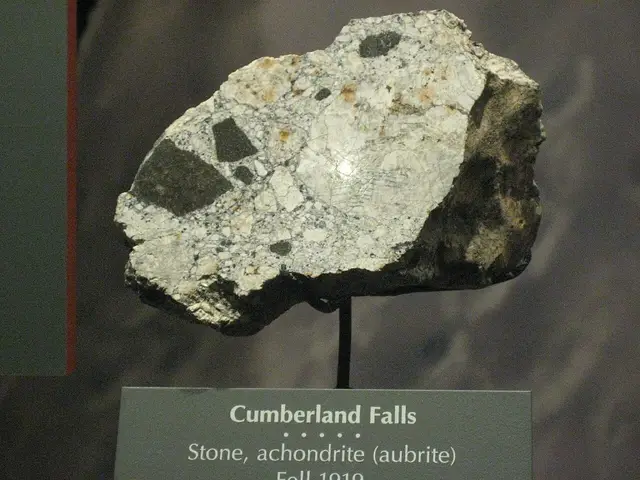
Achondrite
Stony meteorites with no chondrules: rock from melted asteroids, the Moon and Mars, and hard to recognise because they look like Earth rocks.
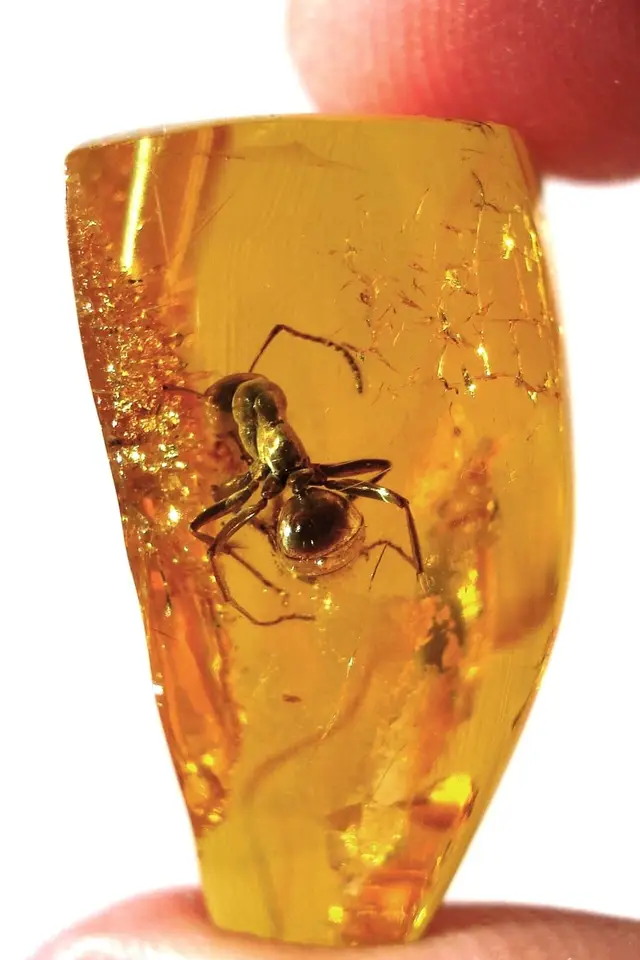
Amber
Tree resin fossilised over millions of years: a light, warm organic gem that sometimes holds prehistoric insects.
Ammolite
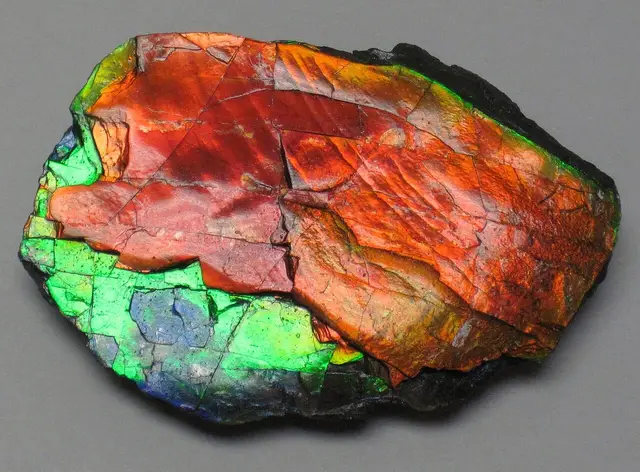
The rainbow-bright layer of fossil ammonite shell; of gem quality it comes only from the Canadian province of Alberta.