Mineral
Grossular
Ca₃Al₂(SiO₄)₃Grossular
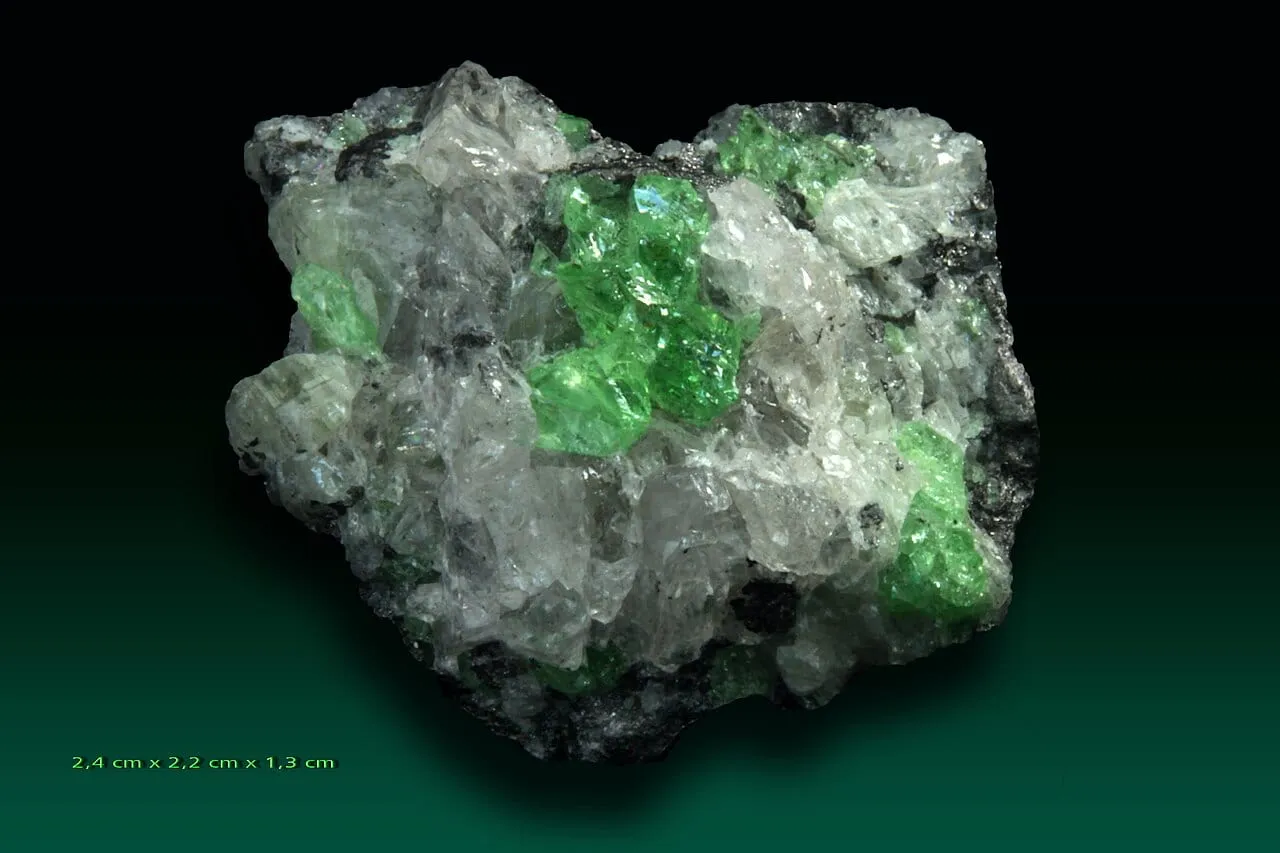
The garnet named after the gooseberry: it comes in almost every colour but blue, and cinnamon-coloured hessonite and green tsavorite belong to it.
Also known as: Grossularite (older name) · Hessonite or cinnamon stone (orange variety) · Gomed (hessonite in Indian literature) · Merelani mint garnet (pale green, Tanzania) · Rosolite (pink, Mexico) · Leuco garnet (colourless) · Transvaal jade, African jade, garnet jade (misleading names for massive hydrogrossular)
- Popularly: Semi-precious stone
- Gemstone
In short
Grossular is the garnet that contains calcium and aluminium. Its name comes from Siberian specimens whose colour resembled the green gooseberry. It is the most colourful garnet species: from colourless to green, yellow, orange and pink, it occurs in almost every colour except blue. Cinnamon-coloured hessonite and emerald-green tsavorite are varieties of this species.
Photos
How does it form?
Grossular forms where limestone and dolomite, rocks rich in calcium, meet hot magma (skarn), and in calcareous rocks transformed by metamorphism. It is accompanied by minerals such as calcite, dolomite, epidote, wollastonite, vesuvianite, diopside and tremolite, and is also seen in some schists and serpentinites. When the host rock weathers, it passes into river gravels; the gem gravels of Sri Lanka are an example.
Its colour comes from trace elements such as iron, manganese, chromium and vanadium: stones low in iron are pale or colourless, more iron brings brown and green tones, and chromium gives a vivid green. The emerald green of tsavorite comes mainly from vanadium. Grossular also forms mixtures with andradite and uvarovite; Mali garnet is a grossular–andradite mixture. For the family as a whole, see garnet, and for its calcium-bearing sister, andradite.
What is it used for?
- Jewellery: Its varieties are used as gems: green tsavorite, cinnamon-coloured hessonite, colourless “leuco” garnet and pale mint-green Merelani garnet. Because hardness varies, a protective setting is advised for some stones.
- Cabochons and carving: Massive green and pink grossular is cut into large cabochons; the American Museum of Natural History in New York holds a 61.5-carat carved hessonite cameo head of Christ.
- Traditional jewellery: Hessonite is used in the nine-gem navaratna jewellery of the Hindu tradition.
Varieties and names
- Hessonite (cinnamon stone): yellowish orange to reddish orange. Sri Lanka, Canada and Tanzania are the main sources.
- Tsavorite: emerald green; described on its own page.
- Merelani mint garnet: pale mint green from Tanzania.
- Leuco garnet: colourless grossular.
- Rosolite: pinkish, in marble, from Mexico.
- Hydrogrossular: water-bearing massive material; South Africa’s green hydrogrossular is sold as “Transvaal jade” but is not jade.
- Mali garnet: a grossular–andradite mixture.
What determines its value?
The value of grossular varies greatly with the variety. Emerald-green tsavorite is the most sought-after variety and has a page of its own; cinnamon-coloured hessonite is regarded as relatively inexpensive. Colour, clarity and cut matter; in hessonite the whisky-in-water look is normal and does not lower the value much. Because hardness varies between 6.5 and 7.5, some stones can be scratched by everyday dust, so the hardness should be asked about if a stone is to be used in a ring. Grossular is usually untreated, though dyeing and fracture filling are occasionally met.
This information is educational, not buying, selling or investment advice. Value varies enormously with quality and treatment.
How to recognise it
- 1
Crystals are twelve- or twenty-four-faced, and their faces often show fine lines (striations).
- 2
The colour is often uneven; zones of colour or traces of twinning may show inside the stone.
- 3
Its hardness varies between 6.5 and 7.5; some examples can be scratched by everyday dust, others cannot.
- 4
It is told from the zircon it resembles by specific gravity: 3.64–3.69 for hessonite against about 4.6 for zircon. Hessonite often shows a turbid look inside, like whisky swirled in water.
Fakes and imitations
What shops usually don’t tell you:
- Synthetic grossular is not used in jewellery, but green YAG (a laboratory-made material with the garnet structure) has turned up among stones sold as tsavorite.
- A rare colourless grossular was once dyed to look like ruby.
- Stones with a symbolic meaning such as hessonite can be sold as dyed glass, plastic or synthetic quartz imitations; extra care is needed when buying online.
- Names such as “Transvaal jade”, “African jade” and “garnet jade” are misleading; this material is not jade but massive hydrogrossular.
Myths and misconceptions
Myth“Transvaal jade” or “African jade” is real jade.
FactThese are misleading trade names for green, massive hydrogrossular from South Africa; the material is not jade but a garnet of the grossular group.
MythHessonite, the cinnamon-coloured stone, is a kind of zircon.
FactHessonite is grossular garnet; it was once confused with zircon because of its look. Zircon is much heavier (specific gravity about 4.6, against 3.64–3.69 for hessonite).
MythGrossular is only green.
FactAlthough its name comes from green specimens, grossular ranges from colourless to orange, pink and brown; only blue does not occur.
What is it believed to be good for?
This section reports beliefs; it is not health information. There is no scientific evidence for these claims and no stone replaces medical treatment.
The meanings people give this stone, and who holds them:
- In the Hindu and Vedic astrological tradition, hessonite (gomed) is the stone that stands for Rahu, the ascending lunar node, in nine-gem navaratna jewellery.
- Today crystal-therapy websites claim that grossular supports the immune system, breathing, heart and liver, cleanses the body and boosts fertility.
- The same circles say that grossular brings abundance, wealth and good luck.
What science says
There is no scientific evidence that grossular affects immunity, breathing, the heart, the liver or fertility, that it “cleanses” the body or that it brings wealth; someone with a health problem should not rely on a stone but see a doctor. The navaratna tradition is a matter of belief and custom; stones with a symbolic meaning such as hessonite, however, are prone to imitation.
Did you know?
The name hessonite comes from the Ancient Greek word hēssōn, meaning “inferior”, a reference to its being softer and lighter than other garnets.
Arthur Herbert Church showed, from their specific gravity, that many engraved stones thought to be zircon were actually hessonite.
In 1991 Vermont named grossular garnet its official state gemstone.
Where is it found?
Loading map…
- Jeffrey mine, Asbestos (Val-des-Sources), Quebec, Canada · Major depositClear orange to pinkish grossular (hessonite) crystals up to 5 cm in an asbestos mine; gems up to about 25 carats have been cut from them
- Ala valley, Piedmont, Italy · Known localityAn Alpine valley cited in the mineralogical literature as a grossular locality
- Vilyuy (Wilui) River, near Chernyshevsky, Yakutia, Russia · Historic sourceThe Siberian region that gave green grossular its variety name “viluite”; the name grossular comes from the gooseberry-green garnet found in Siberia
- Merelani Hills, Simanjiro, Manyara Region, Tanzania · Major depositTsavorite, pale mint-green “Merelani mint garnet” and grossular in other colours
- Taita Hills, near Voi, Kenya · Known localityGem-quality grossular, above all green tsavorite
- Sri Lanka's gem gravels (Ratnapura area) · Historic sourceOrange and brown grossular (hessonite) pebbles of up to several hundred carats
- Eden Mills, Vermont, USA · Known localityFine orange crystals with green diopside; grossular has been Vermont's official state gemstone since 1991
- Ocna de Fier (Vaskő), Banat, Romania · Known localityA Banat district whose name means “Iron Mine”; cited in the mineralogical literature as a grossular locality
Locations are approximate to protect sites. Red dots mark places in Türkiye. Open in the big map →
Frequently asked questions
What is grossular?
Grossular is the garnet that contains calcium and aluminium. Its name comes from Siberian specimens whose colour resembled the green gooseberry. It is the most colourful garnet species: from colourless to green, yellow, orange and pink, it occurs in almost every colour except blue. Cinnamon-coloured hessonite and emerald-green tsavorite are varieties of this species.
What is grossular used for?
Jewellery: Its varieties are used as gems: green tsavorite, cinnamon-coloured hessonite, colourless “leuco” garnet and pale mint-green Merelani garnet. Because hardness varies, a protective setting is advised for some stones. Cabochons and carving: Massive green and pink grossular is cut into large cabochons; the American Museum of Natural History in New York holds a 61.5-carat carved hessonite cameo head of Christ. Traditional jewellery: Hessonite is used in the nine-gem navaratna jewellery of the Hindu tradition.
How hard is grossular?
It has a hardness of 6.5–7.5 on the Mohs scale. It scratches glass and steel; a steel knife cannot scratch it. Its specific gravity is 3.55–3.73 g/cm³.
Where is grossular found?
Its best-known localities: Jeffrey mine, Asbestos (Val-des-Sources), Quebec, Canada; Merelani Hills, Simanjiro, Manyara Region, Tanzania; Vilyuy (Wilui) River, near Chernyshevsky, Yakutia, Russia; Sri Lanka's gem gravels (Ratnapura area); Ala valley, Piedmont, Italy.
How can you tell if grossular is real?
Crystals are twelve- or twenty-four-faced, and their faces often show fine lines (striations). The colour is often uneven; zones of colour or traces of twinning may show inside the stone. Its hardness varies between 6.5 and 7.5; some examples can be scratched by everyday dust, others cannot. Synthetic grossular is not used in jewellery, but green YAG (a laboratory-made material with the garnet structure) has turned up among stones sold as tsavorite.
Is grossular valuable?
On the “street to diamond” value ladder it sits on step 5 of nine: Ornamental stone. The value of grossular varies greatly with the variety. Emerald-green tsavorite is the most sought-after variety and has a page of its own; cinnamon-coloured hessonite is regarded as relatively inexpensive. Colour, clarity and cut matter; in hessonite the whisky-in-water look is normal and does not lower the value much. Because hardness varies between 6.5 and 7.5, some stones can be scratched by everyday dust, so the hardness should be asked about if a stone is to be used in a ring. Grossular is usually untreated, though dyeing and fracture filling are occasionally met.
What is grossular good for?
In the Hindu and Vedic astrological tradition, hessonite (gomed) is the stone that stands for Rahu, the ascending lunar node, in nine-gem navaratna jewellery. Today crystal-therapy websites claim that grossular supports the immune system, breathing, heart and liver, cleanses the body and boosts fertility. The same circles say that grossular brings abundance, wealth and good luck. There is no scientific evidence that grossular affects immunity, breathing, the heart, the liver or fertility, that it “cleanses” the body or that it brings wealth; someone with a health problem should not rely on a stone but see a doctor. The navaratna tradition is a matter of belief and custom; stones with a symbolic meaning such as hessonite, however, are prone to imitation. This section reports beliefs; it is not health information. There is no scientific evidence for these claims and no stone replaces medical treatment.
Varieties


Sources
- Handbook of Mineralogy: Grossular · Mineralogical Society of America
- Grossular Garnet Value, Price, and Jewelry Information · International Gem Society
- Hessonite Garnet Value, Price, and Jewelry Information · International Gem Society
- Grossular · Wikipedia
- Garnet · Wikipedia
- Navaratna · Wikipedia
External links
Draft: awaiting expert reviewReport an error ↗
On the same step
Agate
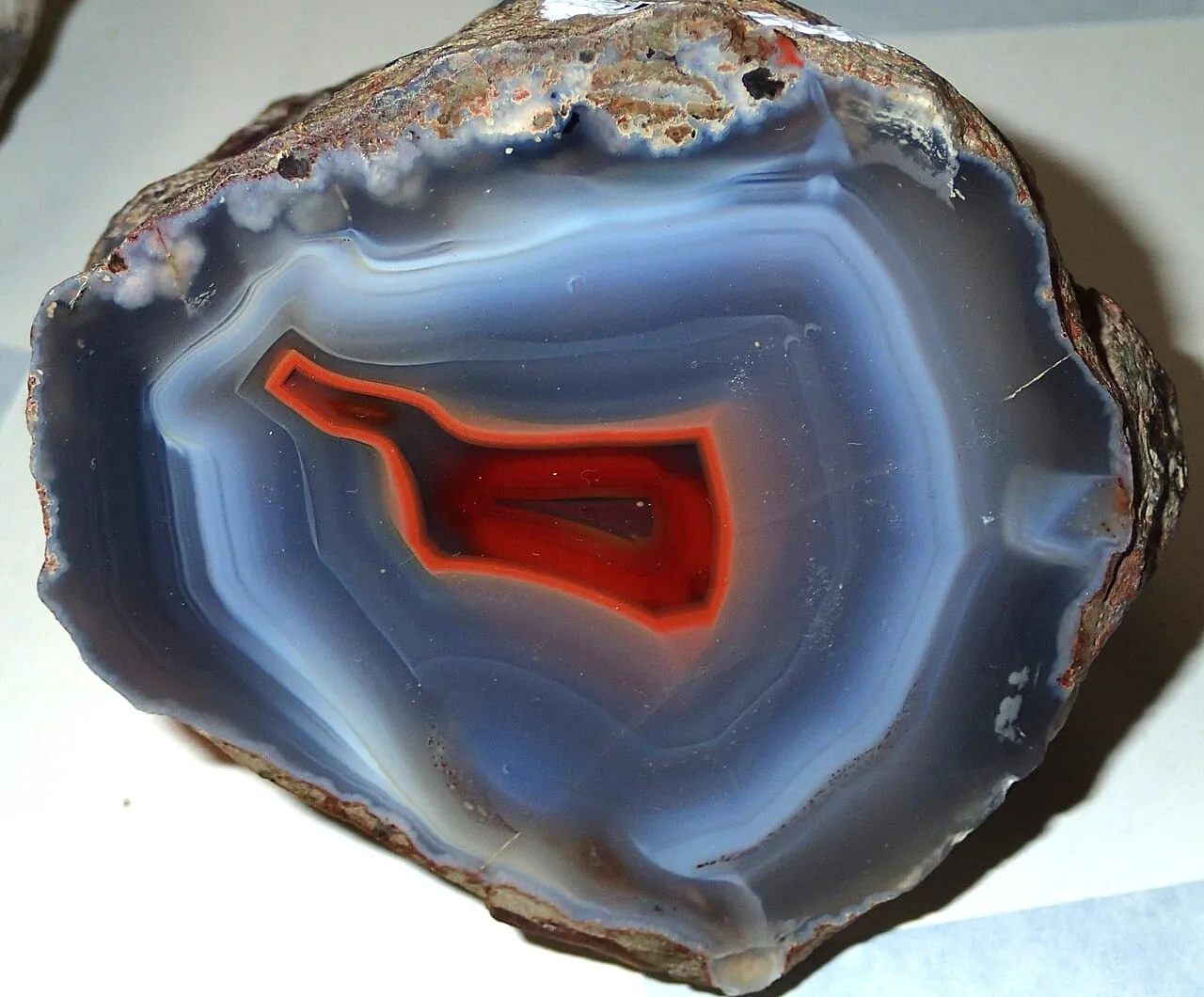
The banded variety of chalcedony: it grows layer by layer in hollows in volcanic rock and shows a new pattern every time it is cut.
Almandine
The commonest garnet: a deep red, iron-rich stone named after the ancient city of Alabanda in Anatolia, used in jewellery and in sandpaper alike.
Amazonite
A turquoise-like green-blue feldspar: a variety of microcline worn as jewellery for more than three thousand years, but it can release lead.