Meteorite
H chondrite
H kondrit
The commonest meteorite group: iron-rich ordinary chondrites that look like stone but strongly attract a magnet because of their metal grains.
Also known as: Bronzite chondrite (obsolete) · Olivine bronzite chondrite (obsolete)
- Popularly: Meteorite

In short
H chondrites are the most common meteorite group, making up about 40% of all catalogued meteorites and 46% of ordinary chondrites. The “H” stands for “high”, as they hold more iron than other ordinary chondrites. Although they look stony, more than half of their iron is metallic, so they strongly attract a magnet. Their probable parent body is the asteroid 6 Hebe.
Photos

How does it form?
H chondrites come from an asteroid that formed at the start of the Solar System from dust and chondrules but never fully melted. Material in this asteroid was heated to different degrees at different depths, so most H chondrites are petrologic types 4, 5 and 6, markedly heated and recrystallised. Only about 2.5% are the little-altered type 3.
This parent body is thought to be the asteroid 6 Hebe. As smaller asteroids that broke off Hebe in the past are themselves shattered by collisions, their fragments reach Earth.
What is it used for?
- Inside asteroids: The petrologic types help show how temperature changed with depth inside the parent asteroid.
- Meteorite–asteroid links: Spectral comparisons with Hebe and similarities with IIE iron meteorites help study how asteroid families are related.
- Collections and teaching: As the commonest meteorite group, they are among the meteorites most often seen in museums and school collections.
Famous H chondrites
Weston (H4, 1807, Connecticut), Sylacauga (H4, 1954, Alabama), Gao-Guenie (H5, 1960, Burkina Faso) and Peekskill (H6, 1992, New York) are the best-known examples.
What determines its value?
Being the commonest meteorites, H chondrites are the most readily found among meteorites. A piece's value depends on its mass, the freshness of its fusion crust, how rusted it is and above all whether it belongs to a famous observed fall.
This information is educational, not buying, selling or investment advice. Value varies enormously with quality and treatment.
How to recognise it
- 1
A black fusion crust outside; inside grey, with shiny metal specks.
- 2
It strongly attracts a magnet and is clearly heavier than an ordinary stone of the same size.
- 3
Chondrules can be seen on a cut face, but in most specimens they are partly blurred by heating.
Myths and misconceptions
MythA meteorite that looks like stone won't attract a magnet; if it does, it must be an iron meteorite.
FactH chondrites look stony, but with 15–19% nickel–iron metal by weight they strongly attract a magnet. Attracting a magnet alone does not show that a stone is an iron meteorite, or even a meteorite at all.
Did you know?
They used to be called “bronzite chondrites” or “olivine bronzite chondrites” after their dominant minerals; these names are now obsolete.
H chondrites have trace-element abundances and oxygen isotope ratios very like the IIE iron meteorites, so the two probably come from the same parent body.
The Weston meteorite, which fell on Connecticut in 1807, is an H4 chondrite; the fall was widely witnessed and reported in the newspapers of the day.
Where is it found?
Loading map…
- Weston (now Easton), Connecticut, USA · Historic sourceAn H4 chondrite that fell on the morning of 14 December 1807; widely witnessed, with three loud explosions and fragments falling in at least six places.
- Oak Grove, near Sylacauga, Alabama, USA · Known localityThe H4 chondrite that came through a roof in 1954 and struck Ann Hodges.
- Peekskill, New York, USA · Known localityAn H6 chondrite documented by 16 video recordings in 1992 that struck a parked car.
- Gao and Guenie, Burkina Faso · Known localityAn H5 chondrite that fell in 1960; one of the largest meteorite showers observed in Africa.
Locations are approximate to protect sites. Red dots mark places in Türkiye. Open in the big map →
Frequently asked questions
What is h chondrite?
H chondrites are the most common meteorite group, making up about 40% of all catalogued meteorites and 46% of ordinary chondrites. The “H” stands for “high”, as they hold more iron than other ordinary chondrites. Although they look stony, more than half of their iron is metallic, so they strongly attract a magnet. Their probable parent body is the asteroid 6 Hebe.
Where do H chondrites come from?
The most likely parent body is the S-type asteroid 6 Hebe, with 3 Juno and 7 Iris as less likely candidates. The meteorites are thought to come not directly from Hebe but from impacts on small near-Earth asteroids that broke off it in the past.
What is h chondrite used for?
Inside asteroids: The petrologic types help show how temperature changed with depth inside the parent asteroid. Meteorite–asteroid links: Spectral comparisons with Hebe and similarities with IIE iron meteorites help study how asteroid families are related. Collections and teaching: As the commonest meteorite group, they are among the meteorites most often seen in museums and school collections.
How hard is h chondrite?
It has a hardness of 5–7 on the Mohs scale. It can scratch glass; a steel knife scratches it only with difficulty. Its specific gravity is 3.22–3.58 g/cm³.
Where is h chondrite found?
Its best-known localities: Weston (now Easton), Connecticut, USA; Oak Grove, near Sylacauga, Alabama, USA; Peekskill, New York, USA; Gao and Guenie, Burkina Faso.
How can you tell if h chondrite is real?
A black fusion crust outside; inside grey, with shiny metal specks. It strongly attracts a magnet and is clearly heavier than an ordinary stone of the same size. Chondrules can be seen on a cut face, but in most specimens they are partly blurred by heating.
Is h chondrite valuable?
On the “street to diamond” value ladder it sits on step 5 of nine: Ornamental stone. Being the commonest meteorites, H chondrites are the most readily found among meteorites. A piece's value depends on its mass, the freshness of its fusion crust, how rusted it is and above all whether it belongs to a famous observed fall.
Sources
- H chondrite · Wikipedia
- Weston meteorite · Wikipedia
- Peekskill meteorite · Wikipedia
- Gao–Guenie meteorite · Wikipedia
- Sylacauga (meteorite) · Wikipedia
- Meteorite porosities and densities: a review of trends in the data (D. T. Britt & G. J. Consolmagno), Lunar and Planetary Science XXXV, abstract 2108 · Lunar and Planetary Institute, 2004
- Handbook of Mineralogy: Enstatite · Mineralogical Society of America
External links
Draft: awaiting expert reviewReport an error
On the same step
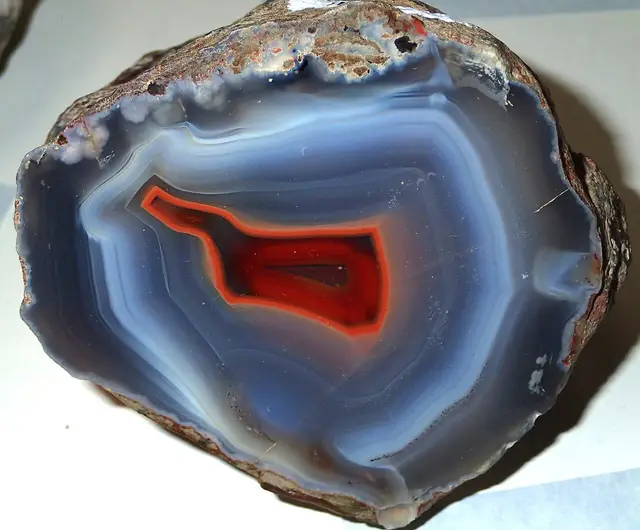
Agate
The banded variety of chalcedony: it grows layer by layer in hollows in volcanic rock and shows a new pattern every time it is cut.

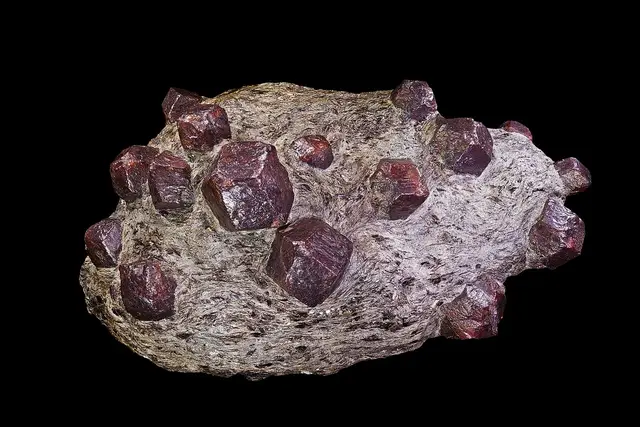
Almandine
The commonest garnet: a deep red, iron-rich stone named after the ancient city of Alabanda in Anatolia, used in jewellery and in sandpaper alike.
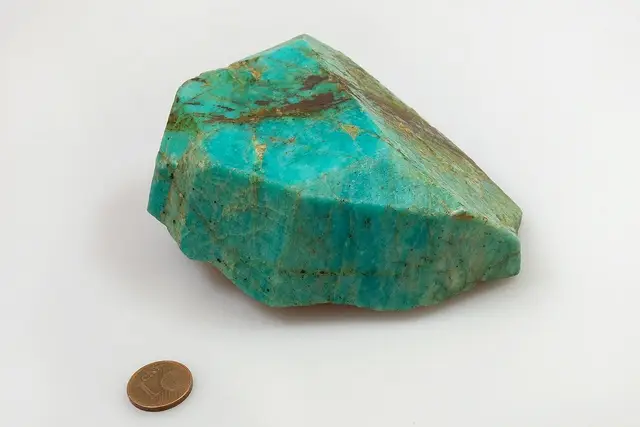
Amazonite
A turquoise-like green-blue feldspar: a variety of microcline worn as jewellery for more than three thousand years, but it can release lead.