Meteorite
Mesosiderite
Mezosiderit
A rare stony-iron meteorite, about half metal and half stone, broken apart and welded back together in a collision between asteroids.
Also known as: Stony-iron meteorite (mesosiderite group)
- Popularly: Meteorite
.jpg)
In short
Mesosiderites are stony-iron meteorites that contain roughly equal amounts of iron–nickel metal and silicate, welded together from broken fragments. The silicate part resembles basalt-like rocks such as eucrites and diogenites, while the metal comes from the core of a planetary body. They are very rare: in November 2014 only 208 mesosiderites were known, and only 7 of them had been seen to fall.
Photos

How does it form?
Mesosiderites are impact breccias: pieces of basalt and pyroxenite from the crust of a planetary body were mixed and welded together with metal from its core in a collision, and they contain no mantle material. A collision between a metal-rich body and a silicate-rich body is the likely cause. Because the silicate part resembles eucrites and diogenites, mesosiderites are thought to be related to the basaltic achondrites; which asteroid they came from is not settled (16 Psyche has been suggested, but spectral observations point to asteroids of the Maria family).
The name comes from the Greek mesos (middle) and sideros (iron): a kind halfway between stone and iron.
What is it used for?
Mesosiderites have no everyday use; their value is scientific:
- A trace of collisions: They are among the few direct samples showing that layered bodies (with a crust and a core) collided and mixed in the early Solar System.
- Crust and core in one rock: They let scientists study material from a body’s crust and core in the same stone.
- Crater research: Fragments found around Dalgaranga crater proved that it is the only crater known to have been made by a mesosiderite.
- Museums and collections: Cut and polished slices are displayed in museums and collections because they show the mixture of metal and silicate.
Mesosiderites and pallasites
Stony-iron meteorites fall into two groups. In pallasites the metal forms a continuous network holding large olivine crystals (see the pallasite page). In mesosiderites the metal occurs as fragments inside a breccia. Together, stony-iron meteorites make up about 1% of all known meteorites.
For the other stony meteorites see achondrite and chondrite, and for those made almost entirely of metal, iron meteorite.
Known mesosiderites
In November 2014, 208 mesosiderites were known; 56 of them came from Antarctica and only 7 had been seen to fall.
- Vaca Muerta (Chile, in or before 1861): The famous find from the Atacama Desert, known from about 4 tonnes of material.
- Estherville (Iowa, USA, 1879): A witnessed fall weighing 320 kg in all.
- Łowicz (Poland, 1935): More than 50 fragments, 59 kg in all.
- Dong Ujimqin Qi (China, 1995): The most recent witnessed mesosiderite fall, on 7 September 1995; three pieces weighing 129 kg.
- Bondoc (Philippines, 1956): About 887 kg in all.
What determines its value?
Mesosiderites are rare and few have been seen to fall, so their value depends less on rarity than on documentation and condition. Collectors look for pieces whose name and class are registered in the Meteoritical Society’s database and whose source is documented. Slices from witnessed falls (such as Estherville, Łowicz or Dong Ujimqin Qi) or from a famous stone like Vaca Muerta, with an attractive spread of metal and silicate on the cut face and without rust, attract more interest. Because they contain metal, they can rust in damp conditions. A stone that has not been confirmed as a meteorite in a laboratory cannot be valued.
This information is educational, not buying, selling or investment advice. Value varies enormously with quality and treatment.
How to recognise it
- 1
A cut and polished surface shows silvery metal fragments and grey and brownish silicate fragments in an irregular mixture (a breccia); the metal and silicate often form lumps or pebbles.
- 2
Because about half of it is metal, it attracts a magnet and feels noticeably heavier than an ordinary rock of the same size; its density is around 4.3 g/cm³ (ordinary chondrites are 3.0–3.7, iron meteorites 7–8).
- 3
The outside may be covered by a black fusion crust; specimens that lay in the open for a long time are rusty brown.
- 4
How it differs from a pallasite: in pallasites, olivine crystals sit in a continuous metal network; in mesosiderites the metal occurs as fragments and the silicates are mostly pyroxene and plagioclase. Only a meteorite laboratory can confirm that a piece is a mesosiderite.
Fakes and imitations
What shops usually don’t tell you:
- Pallasite: another kind of stony-iron meteorite, with large, clear, yellowish-green olivine crystals in a metal network. It is a genuine meteorite, but not a mesosiderite. See the [pallasite](/en/stones/pallasite/) page.
- Slag: slag with metal grains can attract a magnet and be heavy, but it is full of gas bubble holes and looks glassy.
- Magnetite and hematite: these heavy, dark iron-oxide minerals resemble meteorites, but they show no silvery metal lumps; hematite leaves a reddish-brown streak and magnetite a blackish-grey one. Details are in this site’s “Is my stone valuable?” guide.
- Undocumented “meteorite” slices: a genuine mesosiderite has a registered name and class in the database of the Meteoritical Society; be wary of any piece sold without a name, a class and a documented source.
Myths and misconceptions
MythEvery meteorite with metal and stone in it is a pallasite; a mesosiderite and a pallasite are the same thing.
FactBoth are stony-iron meteorites, but their structure differs: in pallasites olivine crystals sit in a continuous metal network, while in mesosiderites the metal occurs as fragments and the silicate part is made of impact-broken crustal rock rich in pyroxene and plagioclase.
MythA heavy stone with shiny metal flecks that sticks to a magnet is a meteorite.
FactAccording to the Buseck Center for Meteorite Studies at Arizona State University, over 90% of people who write in believing they have found a meteorite have found Earth materials such as slag, magnetite or hematite. Only a laboratory can give a firm identification.
Did you know?
The prospectors who first found Vaca Muerta took the shiny metal in it for silver ore; only when an analysis showed iron–nickel did it turn out to be a meteorite. The name comes from the nearby dry riverbed called “Vaca Muerta” (“dead cow”). Its site was forgotten for about a hundred years until a mining-engineering student, Edmundo Martínez, found it again in 1985 and recovered about 4 tonnes of material.
Dalgaranga crater in Western Australia (24 m across and 3 m deep) is the only crater known to have been made by a mesosiderite; the mesosiderite fragments found around it proved its impact origin.
When the Estherville meteorite fell in 1879, one piece buried itself about 4.5 metres (15 feet) in the ground and a well digger had to be called in to retrieve it.
Where is it found?
Loading map…
- Vaca Muerta, Atacama Desert, Antofagasta, Chile · Major depositFound in or before 1861, Vaca Muerta is known from about 4 tonnes of material in all. Prospectors took the shiny metal for silver ore; its site was forgotten for about a century and rediscovered in 1985.
- Estherville, Iowa, USA · Major depositA mesosiderite that fell on 10 May 1879; several large masses and many small fragments weighed 320 kg in all. Pieces are kept at the Smithsonian and in museums in Vienna and Munich.
- Łowicz, Łódź Voivodeship, Poland · Known localityA mesosiderite that fell shortly after midnight on 12 March 1935; more than 50 fragments, 59 kg in all, were collected.
- Dalgaranga crater, Western Australia · Known localityThis crater, 24 m wide and about 75 km north-west of Mount Magnet, is the only one known to have been made by a mesosiderite. An Aboriginal stockman, Billy Seward, noticed it in 1921.
- Bondoc Peninsula, Luzon, Philippines · Known localityFound in 1956 and weighing about 887 kg in all, Bondoc is an unusual B-type mesosiderite: according to the Meteoritical Bulletin, 70% of its polished surface is stony, 11% iron and 17% stony-iron.
Locations are approximate to protect sites. Red dots mark places in Türkiye. Open in the big map →
Frequently asked questions
What is mesosiderite?
Mesosiderites are stony-iron meteorites that contain roughly equal amounts of iron–nickel metal and silicate, welded together from broken fragments. The silicate part resembles basalt-like rocks such as eucrites and diogenites, while the metal comes from the core of a planetary body. They are very rare: in November 2014 only 208 mesosiderites were known, and only 7 of them had been seen to fall.
What is mesosiderite used for?
Mesosiderites have no everyday use; their value is scientific: A trace of collisions: They are among the few direct samples showing that layered bodies (with a crust and a core) collided and mixed in the early Solar System. Crust and core in one rock: They let scientists study material from a body’s crust and core in the same stone. Crater research: Fragments found around Dalgaranga crater proved that it is the only crater known to have been made by a mesosiderite.
How hard is mesosiderite?
It has a hardness of 4–6.5 on the Mohs scale. It can scratch glass; a steel knife scratches it only with difficulty. Its specific gravity is 4.04–4.76 g/cm³.
Where is mesosiderite found?
Its best-known localities: Vaca Muerta, Atacama Desert, Antofagasta, Chile; Estherville, Iowa, USA; Łowicz, Łódź Voivodeship, Poland; Dalgaranga crater, Western Australia; Bondoc Peninsula, Luzon, Philippines.
How can you tell if mesosiderite is real?
A cut and polished surface shows silvery metal fragments and grey and brownish silicate fragments in an irregular mixture (a breccia); the metal and silicate often form lumps or pebbles. Because about half of it is metal, it attracts a magnet and feels noticeably heavier than an ordinary rock of the same size; its density is around 4.3 g/cm³ (ordinary chondrites are 3.0–3.7, iron meteorites 7–8). The outside may be covered by a black fusion crust; specimens that lay in the open for a long time are rusty brown. Pallasite: another kind of stony-iron meteorite, with large, clear, yellowish-green olivine crystals in a metal network. It is a genuine meteorite, but not a mesosiderite. See the [pallasite](/en/stones/pallasite/) page.
Is mesosiderite valuable?
On the “street to diamond” value ladder it sits on step 6 of nine: Fine ornamental and collector stone. Mesosiderites are rare and few have been seen to fall, so their value depends less on rarity than on documentation and condition. Collectors look for pieces whose name and class are registered in the Meteoritical Society’s database and whose source is documented. Slices from witnessed falls (such as Estherville, Łowicz or Dong Ujimqin Qi) or from a famous stone like Vaca Muerta, with an attractive spread of metal and silicate on the cut face and without rust, attract more interest. Because they contain metal, they can rust in damp conditions. A stone that has not been confirmed as a meteorite in a laboratory cannot be valued.
Sources
- Mesosiderite · Wikipedia
- Mesosiderit · Vikipedi
- Stony–iron meteorite · Wikipedia
- Mesosiderite · Encyclopaedia Britannica
- Mesosiderites · Buseck Center for Meteorite Studies, Arizona State University
- How can I find a meteorite? · Buseck Center for Meteorite Studies, Arizona State University
- Investigation and reclassification of four mesosiderites—Implications for their formation (Zachén, Alwmark, Alwmark, Ferrière & Hewins), Meteoritics & Planetary Science · Wiley, 2025
- Vaca Muerta (Meteoritical Bulletin entry, background) · IMCA Encyclopedia of Meteorites
- Vaca Muerta (M18.20110131) · Royal Astronomical Society of Canada, Meteorite Collection
- Estherville, Iowa · Wikipedia
- Łowicz (meteorite) · Wikipedia
- Dalgaranga crater · Wikipedia
- Bondoc (Meteoritical Bulletin entry) · IMCA Encyclopedia of Meteorites
- Dong Ujimqin Qi (Meteoritical Bulletin entry) · IMCA Encyclopedia of Meteorites
- Meteorite porosities and densities: a review of trends in the data (D. T. Britt & G. J. Consolmagno), Lunar and Planetary Science XXXV, abstract 2108 · Lunar and Planetary Institute, 2004
- Kamacite Mineral Data · Webmineral.com
- Handbook of Mineralogy: Augite · Mineralogical Society of America
- Handbook of Mineralogy: Anorthite · Mineralogical Society of America
External links
Draft: awaiting expert reviewReport an error ↗
On the same step
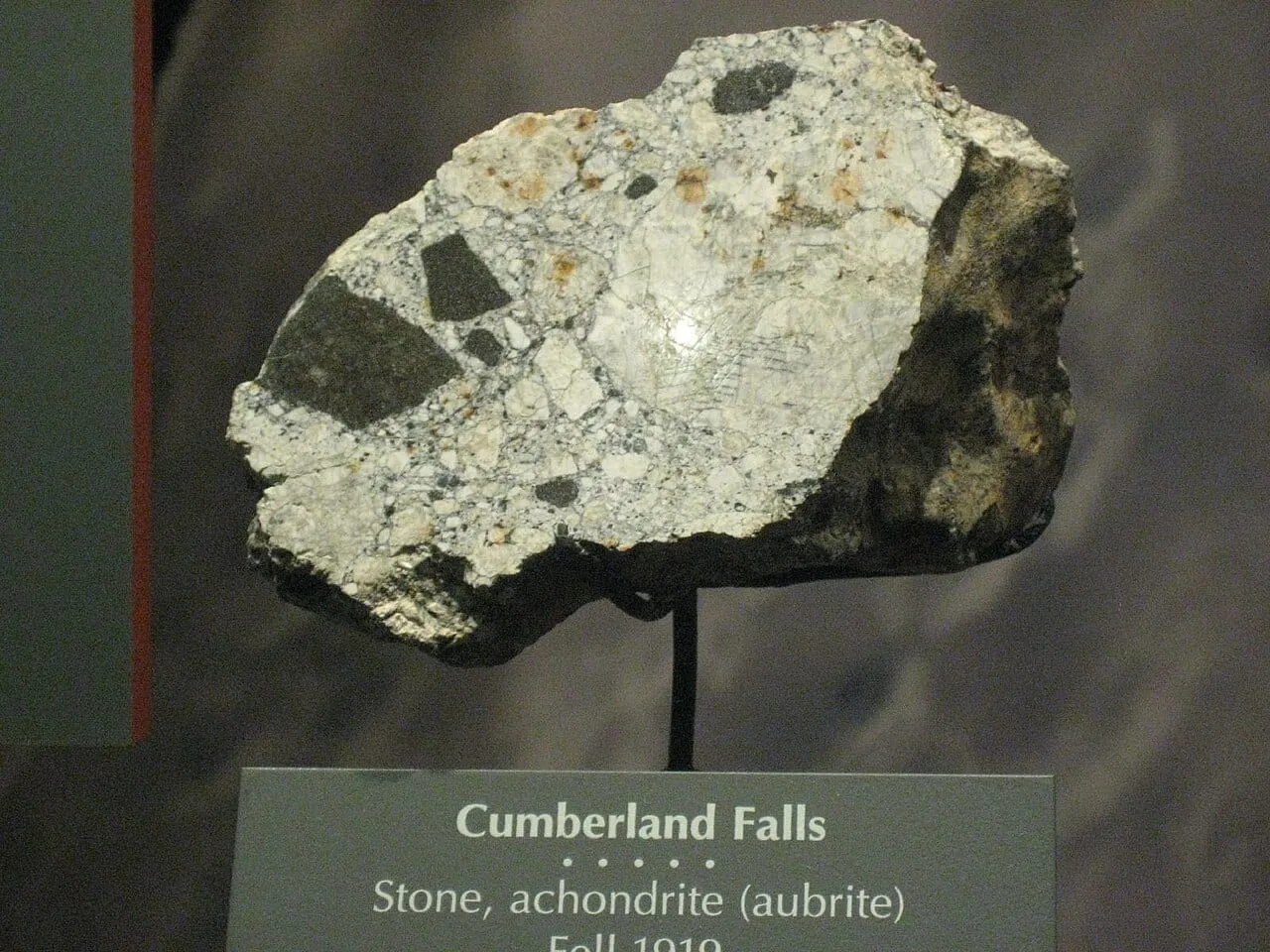
Achondrite
Stony meteorites with no chondrules: rock from melted asteroids, the Moon and Mars, and hard to recognise because they look like Earth rocks.
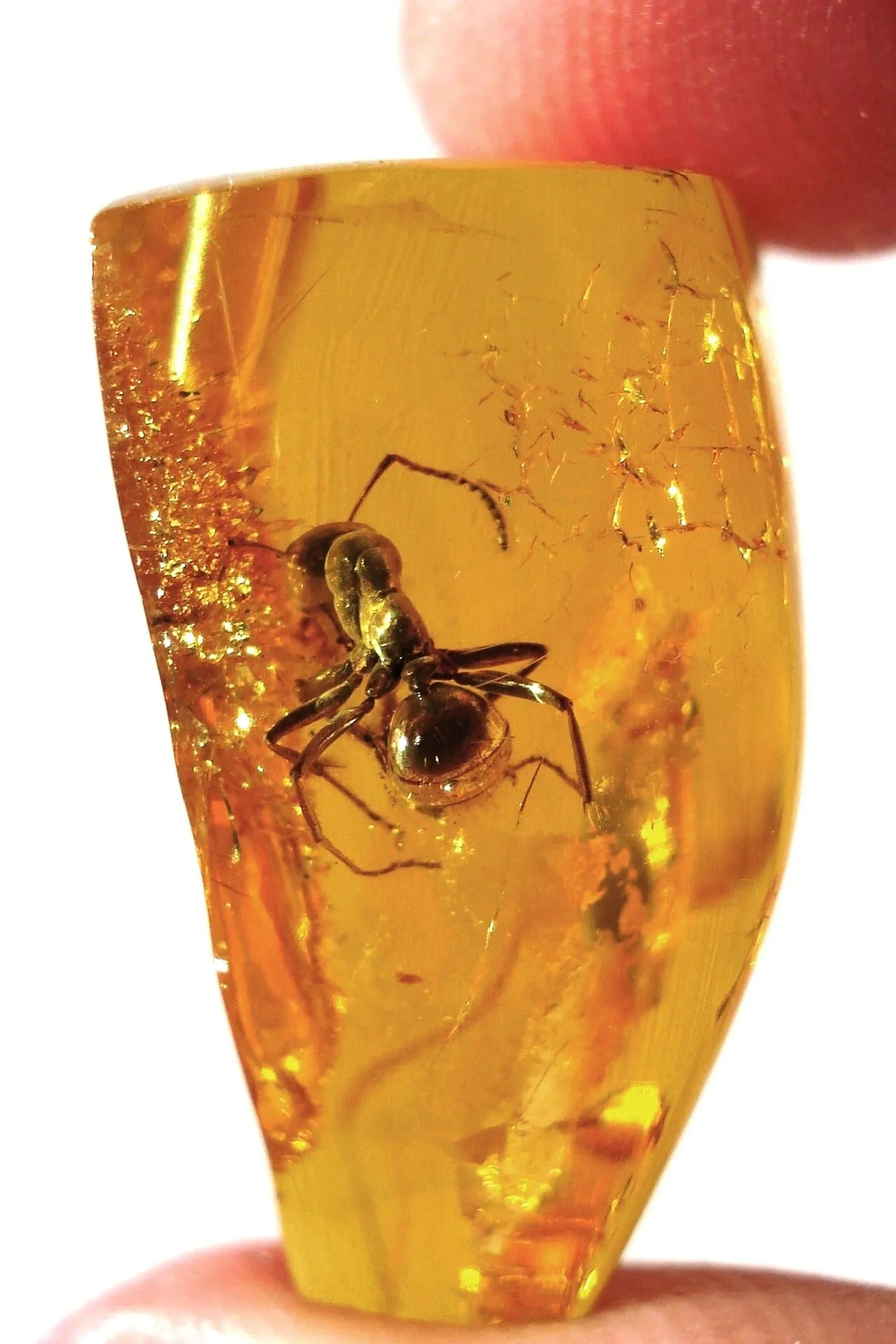
Amber
Tree resin fossilised over millions of years: a light, warm organic gem that sometimes holds prehistoric insects.
Ammolite
The rainbow-bright layer of fossil ammonite shell; of gem quality it comes only from the Canadian province of Alberta.