Meteorite
Martian meteorite
Mars göktaşı
Pieces of rock blasted off the surface of Mars by impacts, drifting through space for millions of years before falling to Earth: stones from another planet.
Also known as: Mars meteorite · SNC meteorite (shergottite, nakhlite, chassignite)
- Popularly: Meteorite

In short
Martian meteorites are pieces of rock that large impacts threw off the surface of Mars and that fell to Earth after drifting through space for millions of years. Most are basalt-like volcanic rocks. Fewer than 0.5% of classified meteorites come from Mars; in September 2020 there were 277 of them.
Photos

How does it form?
Martian meteorites come from the volcanic rocks of Mars. When an asteroid or comet hits Mars hard enough, some of the debris escapes Mars’s gravity and is thrown into orbits that cross Earth’s. After drifting through space for roughly 0.7 to 20 million years, pieces of rock fall to Earth. Their Martian origin was recognised when the gases trapped in their impact glass were found to match the Martian atmosphere.
What is it used for?
Martian meteorites have no everyday use; their value is scientific:
- Rocks of Mars: They are the main source of Martian rock that can be studied in laboratories on Earth; they are used to measure its composition, age and volcanic history.
- Water on Mars: Carbonates and hydrous minerals in stones such as Nakhla show that Martian rock came into contact with water; Black Beauty (NWA 7034) has the highest water content measured in a Martian meteorite.
- The geological history of Mars: Their ages range from about 150 million to 4.4 billion years, so they sample very different periods of Mars’s history.
- The search for life: The ALH 84001 debate energised astrobiology. In Tissint, compounds containing carbon and nitrogen were found alongside hydrothermal minerals; researchers note that they could also come from volcanic processes or from meteorites.
- Museums and collections: Cut slices and pieces from documented falls are held by museums and collectors.
Main groups
The three main groups of Martian meteorites are called SNC, after the initials of their names:
- Shergottites: About three-quarters of Martian meteorites belong to this group. They are basalt-like rocks, and many are surprisingly young for Mars, with ages between 150 and 575 million years; because most of Mars’s surface looks much older, this is called the “shergottite age paradox”.
- Nakhlites: A small number of stones (at least 13 distinct ones are known); rocks that contain augite and olivine and formed from basaltic magma about 1.3 billion years ago. They were soaked by liquid water about 620 million years ago.
- Chassignites: Only 3 stones; dunites made almost entirely of olivine.
- Set apart: ALH 84001 (an orthopyroxenite about 4.09 billion years old) and NWA 7034 “Black Beauty” (a breccia made of many kinds of fragments, about 4.4 billion years old) fit none of these three groups.
For the other groups of achondrites see the achondrite page, and for stones from the Moon the lunar meteorite page.
ALH 84001 and the “life on Mars” debate
ALH 84001, a 1.93 kg stone found in the Allan Hills of Antarctica on 27 December 1984, is an orthopyroxenite that crystallised about 4.09 billion years ago. It contains carbonate globules calculated to have formed at about 18 ± 4 °C in a watery environment near the Martian surface, and magnetite crystals of an unusual rectangular-prism shape. In 1996 a NASA team led by David McKay interpreted structures 20–100 nanometres across in the stone as fossilised bacteria. Most of the scientific community disagreed; a study published in 2022 reported that its organic molecules were associated with reactions that need no life, such as serpentinisation and carbonation. Life on Mars has not been proven to this day.
What determines its value?
Martian meteorites are rare: they make up fewer than 0.5% of classified meteorites and number only a few hundred in all, which is the main factor in their value. It is essential that their Martian origin has been confirmed in a laboratory and that their name is registered in the Meteoritical Society’s database. Pieces of falls that were witnessed and have a fresh fusion crust, such as Tissint, and pieces of rare types such as nakhlites, chassignites or Black Beauty are more sought after; because they are mostly shared as small slices, the name and paperwork of the stone a piece comes from matter above all.
This information is educational, not buying, selling or investment advice. Value varies enormously with quality and treatment.
How to recognise it
- 1
Specimens seen to fall are covered by a black, glossy fusion crust; a fresh specimen such as Tissint shows a light grey interior beneath the crust.
- 2
Martian meteorites are achondrites too, and to the naked eye they look like Earth rocks. Colour or appearance cannot show a Martian origin; a laboratory does.
- 3
Their Martian origin is established by their chemical and mineral composition, their ages and the gases trapped in impact glass, which match the Martian atmosphere as measured by NASA’s Viking mission in 1976.
- 4
A piece said to be Martian should have its name and class registered in the Meteoritical Society’s database; a piece without a documented name, class and source should not be trusted.
Fakes and imitations
What shops usually don’t tell you:
- Earth basalt and slag: only about 5 in 1000 meteorites come from Mars, so a dark, heavy stone found on the ground is extremely unlikely to be a Martian meteorite. For slag and iron ores see the “Is my stone valuable?” guide.
- Lunar meteorites and HED meteorites: these are basalt-like too and cannot be told from a Martian meteorite by eye; only laboratory measurements reveal the source.
- Undocumented “Mars stone” pieces: a genuine Martian meteorite has a registered name and class; saying “it came from Mars” is not evidence.
Myths and misconceptions
MythA Martian meteorite proved that there is life on Mars.
FactIn 1996 a NASA team suggested that structures 20–100 nanometres across in the meteorite ALH 84001 might be fossilised bacteria; most of the scientific community rejected that reading. Later studies explained the structures and organic molecules by processes that need no life.
MythThat a stone comes from Mars is only a guess.
FactIn 1983 gases trapped in the impact glass of the meteorite EETA 79001 were reported to closely resemble the Martian atmosphere as measured by the Viking mission. The compositions also match data from Mars orbiters, landers and rovers.
Did you know?
The Nakhla meteorite, which fell in Egypt in 1911, is said to have vaporised a dog; but no remains of the dog were found and there was no other eyewitness, so the story remains unconfirmed.
The Zagami meteorite, which fell in Nigeria in 1962, landed about 3 metres from a farmer and buried itself about 60 centimetres deep.
The fireball of Tissint, which fell in Morocco in 2011, turned green and lit up the whole area according to witnesses; it is the fifth Martian meteorite seen to fall and the first since 1962.
Where is it found?
Loading map…
- Tissint, Tata Province, Morocco · Major depositA shergottite that fell on 18 July 2011 after a fireball that witnesses said turned green and lit up the whole area; nomads found fragments in October 2011 and roughly 12–15 kg was collected. It is the fifth Martian meteorite seen to fall and the first since 1962.
- Nakhla (Abu Hommos), Egypt · Type localityFell on 28 June 1911; about 40 pieces with an estimated combined weight of 10 kg were collected. It gives its name to the nakhlites. It contains carbonates and hydrous minerals formed in water, and is calculated to have formed about 1.3 billion years ago at a volcano on Mars.
- Shergotty (Sherghati), Gaya, Bihar, India · Type localityThe meteorite of about 5 kg that fell on 25 August 1865 gives its name to the shergottites; witnesses retrieved it almost at once.
- Chassigny, Haute-Marne, France · Type localityA dunite made almost entirely of olivine that fell on the morning of 3 October 1815; it gives its name to the chassignites and is the source of the “C” in SNC.
- Zagami, Katsina State, Nigeria · Known localityA basaltic shergottite of about 18 kg that fell on 3 October 1962; it landed about 3 m from a farmer and buried itself about 60 cm deep.
- Allan Hills, Antarctica · Known localityALH 84001, a 1.93 kg orthopyroxenite found on 27 December 1984, crystallised about 4.09 billion years ago. In 1996 tiny structures in it were proposed to be fossil bacteria; most of the scientific community rejected that interpretation.
Locations are approximate to protect sites. Red dots mark places in Türkiye. Open in the big map →
Frequently asked questions
What is martian meteorite?
Martian meteorites are pieces of rock that large impacts threw off the surface of Mars and that fell to Earth after drifting through space for millions of years. Most are basalt-like volcanic rocks. Fewer than 0.5% of classified meteorites come from Mars; in September 2020 there were 277 of them.
What is martian meteorite used for?
Martian meteorites have no everyday use; their value is scientific: Rocks of Mars: They are the main source of Martian rock that can be studied in laboratories on Earth; they are used to measure its composition, age and volcanic history. Water on Mars: Carbonates and hydrous minerals in stones such as Nakhla show that Martian rock came into contact with water; Black Beauty (NWA 7034) has the highest water content measured in a Martian meteorite.
How hard is martian meteorite?
It has a hardness of 5.5–7 on the Mohs scale. It can scratch glass; a steel knife scratches it only with difficulty. Its specific gravity is 3.06–3.22 g/cm³.
Where is martian meteorite found?
Its best-known localities: Nakhla (Abu Hommos), Egypt; Shergotty (Sherghati), Gaya, Bihar, India; Chassigny, Haute-Marne, France; Tissint, Tata Province, Morocco; Zagami, Katsina State, Nigeria.
How can you tell if martian meteorite is real?
Specimens seen to fall are covered by a black, glossy fusion crust; a fresh specimen such as Tissint shows a light grey interior beneath the crust. Martian meteorites are achondrites too, and to the naked eye they look like Earth rocks. Colour or appearance cannot show a Martian origin; a laboratory does. Their Martian origin is established by their chemical and mineral composition, their ages and the gases trapped in impact glass, which match the Martian atmosphere as measured by NASA’s Viking mission in 1976. Earth basalt and slag: only about 5 in 1000 meteorites come from Mars, so a dark, heavy stone found on the ground is extremely unlikely to be a Martian meteorite. For slag and iron ores see the “Is my stone valuable?” guide.
Is martian meteorite valuable?
On the “street to diamond” value ladder it sits on step 7 of nine: Precious stone. Martian meteorites are rare: they make up fewer than 0.5% of classified meteorites and number only a few hundred in all, which is the main factor in their value. It is essential that their Martian origin has been confirmed in a laboratory and that their name is registered in the Meteoritical Society’s database. Pieces of falls that were witnessed and have a fresh fusion crust, such as Tissint, and pieces of rare types such as nakhlites, chassignites or Black Beauty are more sought after; because they are mostly shared as small slices, the name and paperwork of the stone a piece comes from matter above all.
Sources
- Martian meteorite · Wikipedia
- Martian meteorites · Buseck Center for Meteorite Studies, Arizona State University
- Some meteorite realities (Randy Korotev) · Washington University in St. Louis, Some Meteorite Information
- Types of meteorites · Natural History Museum, London
- Shergottite · Wikipedia
- Nakhlite · Wikipedia
- Tissint meteorite · Wikipedia
- Nakhla meteorite · Wikipedia
- Shergotty meteorite · Wikipedia
- Chassigny meteorite · Wikipedia
- Zagami meteorite · Wikipedia
- Allan Hills 84001 · Wikipedia
- Northwest Africa 7034 · Wikipedia
- Meteorite porosities and densities: a review of trends in the data (D. T. Britt & G. J. Consolmagno), Lunar and Planetary Science XXXV, abstract 2108 · Lunar and Planetary Institute, 2004
- Handbook of Mineralogy: Augite · Mineralogical Society of America
- Handbook of Mineralogy: Pigeonite · Mineralogical Society of America
- Handbook of Mineralogy: Forsterite · Mineralogical Society of America
External links
Draft: awaiting expert reviewReport an error ↗
On the same step

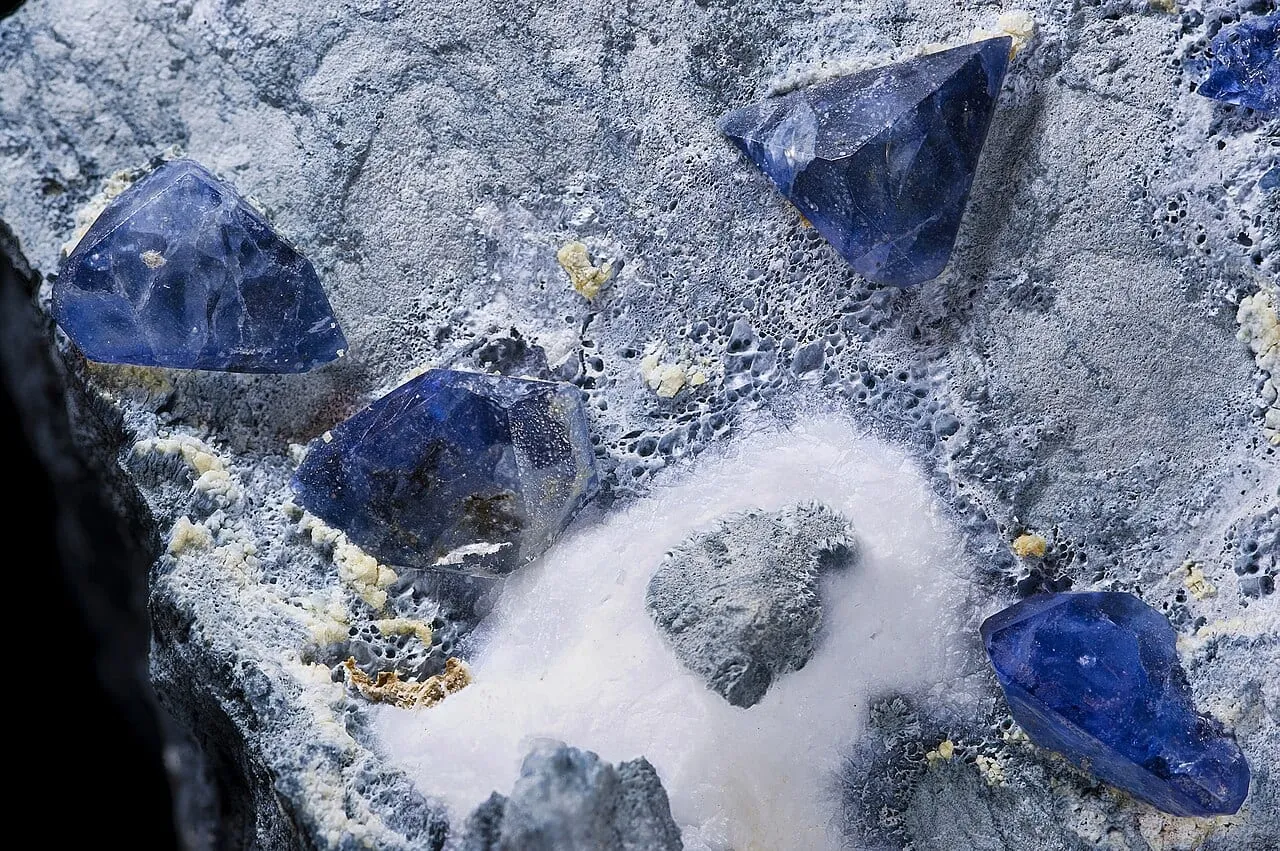
Benitoite
A sapphire-like blue stone whose gem crystals come from a single mine in the world: the official state gem of California.

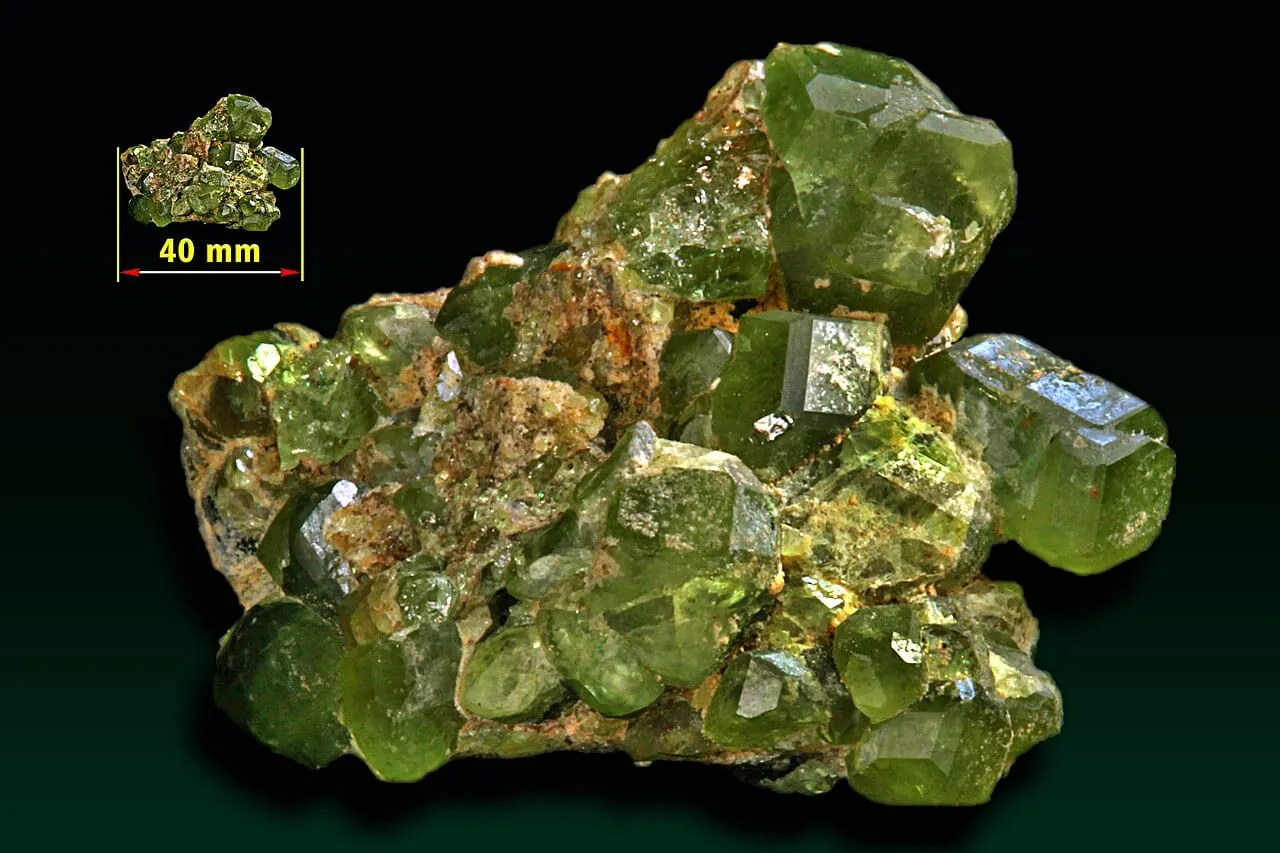
Demantoid
Its name means “diamond-like”: an emerald-green garnet that splits light more than diamond does, known since the 1850s from the Urals; a rare and valuable stone.
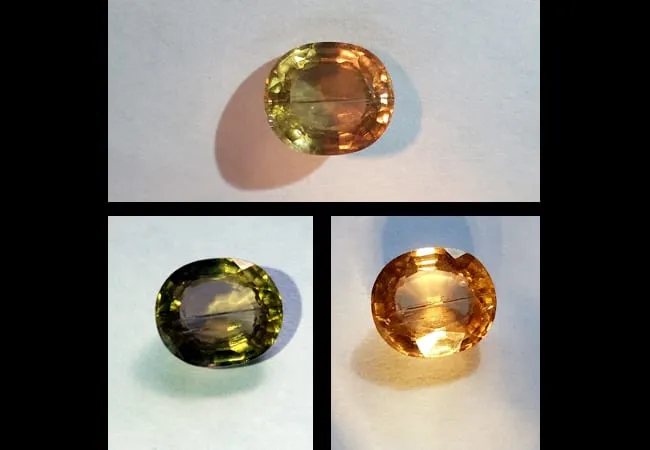
Diaspore
A rare mineral that looks greenish in daylight and pinkish under incandescent light; gem-quality material comes almost only from Muğla.