Meteorite
Eucrite (HED meteorites)
Ökrit (HED)
A meteorite from the basalt-like crust of the asteroid Vesta, the best-known member of the HED family and a relative of the Sarıçiçek stones that fell on Bingöl.
Also known as: HED meteorite (howardite–eucrite–diogenite clan) · Howardite and diogenite (sister types)
- Popularly: Meteorite

In short
Eucrites are stony meteorites that broke off the shallow, basaltic crust of the asteroid Vesta and reached Earth. Together with howardites and diogenites they form the HED family, which makes up about 5% of the meteorites seen to fall and about 60% of the achondrites. They bring us volcanic rock from a body that melted in the first million years of the Solar System.
Photos
_(Millbillillie_Meteorite,_4.564-4.566_Ga).jpg)
How does it form?
Eucrites come from the crust of the asteroid Vesta. Vesta is about 525 km across and is the second most massive body in the asteroid belt after Ceres. It melted early in the Solar System’s history and separated into layers: an iron–nickel core, an olivine-rich mantle and a basaltic crust. Eucrites are basalt-like rocks from the shallow part of that crust; diogenites are rocks that cooled slowly at greater depth; howardites are heaps of debris that impacts crushed and piled up on the surface and that later welded together. HED rocks are calculated to have formed between 4.43 and 4.55 billion years ago.
The giant impact basin Rheasilvia in Vesta’s southern hemisphere (about 500 km wide and about 1 billion years old) is the most likely main source of HED stones. The ejected pieces circled Vesta as V-type asteroids (vestoids); smaller impacts then knocked stones off these, and they reached Earth after spending roughly 6 to 73 million years in space. Sarıçiçek, however, has been linked to a much smaller crater, Antonia.
What is it used for?
Eucrites have no everyday use; their value is scientific:
- The crust of another body: They belong to the meteorite groups whose parent body is known: Vesta’s surface, observed by the Dawn spacecraft, and laboratory measurements on Earth support each other.
- The early history of planetesimals: They are direct samples that show when a body like Vesta melted, how it separated into layers and how it built a crust.
- Meteoritics: The Stannern eucrite, which fell on Moravia in 1808 and was documented straight away by the naturalist Karl Schreibers, is an early, well-recorded example of a stone shower.
- Museums and collections: Cut and polished slices and pieces from documented falls are held by museums and collectors.
The HED family
The name HED comes from the initials of three subtypes:
- Eucrite: a basalt-like rock made of calcium-poor pyroxene (pigeonite) and calcium-rich plagioclase (anorthite). The name comes from the Greek eukritos, “easily distinguished”. About 3.4% of the meteorites seen to fall are eucrites (34 falls, 2012 data), making them the most numerous achondrite group.
- Diogenite: a rock made mainly of magnesium-rich orthopyroxene that crystallised slowly at depth.
- Howardite: an impact breccia of eucrite and diogenite fragments. Sarıçiçek was a howardite.
For the other groups of achondrites see the achondrite page, and for stones from bodies other than Vesta the lunar meteorite and Martian meteorite pages.
In Türkiye: the Sarıçiçek howardite
The best-documented meteorite to fall in Türkiye is an HED stone. At about 11:10 p.m. on 2 September 2015 a shower of stones fell around the village of Sarıçiçek in Bingöl; the next morning people found pea-sized stones on the streets and in yards. 343 stones weighing about 15.24 kg in all were documented, and the meteorite was entered in the Meteoritical Society’s database in 2016 under the name “Sariçiçek”.
The fall was caught on many security cameras, and the footage showed that the meteoroid entered the atmosphere at about 17.3 km/s from the north-west and broke up at altitudes of 37, 33, 31 and 27 km. According to a 2019 study by an international team led by Ozan Ünsalan of Ege University, Sarıçiçek is the first documented howardite fall; the stones were linked to the impact, about 22 million years ago, that formed the Antonia crater, about 16.7 km across, on Vesta. For what happened after the fall, including fake buyers who asked for pieces as “samples”, see the Is my stone valuable? guide.
What determines its value?
Eucrites are the most numerous group of achondrites, so their value depends less on rarity than on documentation and condition. Collectors look for pieces whose name and class are registered in the Meteoritical Society’s database and whose source is documented; specimens from a witnessed fall (few eucrite falls have been witnessed), with a fresh fusion crust and a cut face that shows an attractive texture, are more sought after. Rare subtypes such as cumulate eucrites, and pieces of well-documented falls, are of special interest to collectors.
This information is educational, not buying, selling or investment advice. Value varies enormously with quality and treatment.
How to recognise it
- 1
A freshly fallen eucrite may be covered by a thin black fusion crust; the crust is sometimes shiny and shows flow lines. Under the crust the interior is light to dark grey.
- 2
A broken surface looks like basalt: in coarse-grained eucrites, pale plagioclase and dark pyroxene grains can be told apart by eye. Howardites show a breccia texture of angular fragments in different colours.
- 3
Because their metal content is very low, they often do not attract a magnet. Their average density (about 2.86 g/cm³ for eucrites) is lower than that of ordinary chondrites, so a eucrite feels lighter than a chondrite of the same size.
- 4
Only a laboratory can say that a stone is a eucrite, or which HED type it is: mineral chemistry, the iron/manganese ratio and oxygen isotope ratios act as “fingerprints” that show which body a stone came from.
Fakes and imitations
What shops usually don’t tell you:
- Earth basalt: a eucrite is also a basaltic rock and may look so similar that the naked eye cannot tell them apart. The difference shows only in laboratory measurements of mineral chemistry and isotopes.
- Slag, magnetite and hematite: the Earth materials most often offered as “meteor stones”; unlike a eucrite, they often attract a magnet and feel heavy. The details are in this site’s “Is my stone valuable?” guide.
- Lunar and Martian basalts: meteorites from those bodies are also basalt-like and cannot be told from a eucrite by eye; only laboratory measurements reveal the source.
Myths and misconceptions
MythA meteorite is always clearly heavier than ordinary rocks.
FactIron meteorites and chondrites are, but eucrites are light, basalt-like rocks: their average density of about 2.86 g/cm³ is below that of ordinary chondrites (about 3.2–3.4 g/cm³). Weight alone is neither proof nor disproof.
MythA falling meteorite digs a big crater.
FactCraters are made by the impact of very large bodies. Small meteoroids such as those that deliver eucrites break up and slow down in the atmosphere and fall as a shower of stones: at Sarıçiçek the stones rained on roofs and streets and the first ones found were pea-sized; at Stannern 66 fragments were documented and nobody was hurt or any building damaged. Even Johnstown’s 23.5 kg piece made only a hole about 1.7 metres deep.
Did you know?
The Johnstown diogenite fell in Colorado in 1924 during an outdoor funeral service, with more than 200 people watching. Its largest piece weighed 23.5 kg and buried itself about 1.7 metres deep.
NASA’s Dawn spacecraft orbited Vesta in 2011–2012 and studied the body that eucrites come from at close range.
Diogenites are named after Diogenes of Apollonia, the ancient Greek philosopher who was the first to suggest that meteorites come from outer space; howardites honour Edward Howard, a pioneer of meteoritics.
Where is it found?
Loading map…
- Juvinas (Libonès), Ardèche, France · Historic sourceA eucrite that fell on 15 June 1821; about half of the recovered material is kept in the Muséum national d'histoire naturelle in Paris, and the rest was handed out to local families and has largely been lost.
- Stannern (Stonařov), Vysočina, Czechia · Historic sourceA eucrite that fell on the village of Stonařov (German: Stannern) in Moravia on the morning of 22 May 1808; 66 fragments, about 52 kg in all, were collected and nobody was hurt. The naturalist Karl Schreibers documented the fall straight away.
- Millbillillie, Wiluna district, Western Australia · Major depositA eucrite that fell in October 1960; two station workers saw a fireball “with sparks coming off it”. About 330 kg in all is known, and the largest stone (20 kg) is in the Western Australian Museum.
- Johnstown (Elwell), Colorado, USA · Known localityA diogenite that fell on 6 July 1924 during an outdoor funeral service, witnessed by more than 200 people. The largest piece weighed 23.5 kg and buried itself about 1.7 m deep.
- Tataouine, Tunisia · Known localityA diogenite that fell about 4 km north of the city of Tataouine at 1:30 a.m. on 27 June 1931; about 12 kg of fragments were found from an estimated 50 kg fall. In the international records it appears as “Tatahouine” because of a transcription error.
- Sarıçiçek, Bingöl, Türkiye · Known localityA howardite that fell on 2 September 2015; 343 stones, about 15.24 kg in all, were documented and the fall was caught on security cameras. According to the researchers it is the first documented howardite fall.
Locations are approximate to protect sites. Red dots mark places in Türkiye. Open in the big map →
Frequently asked questions
What is eucrite?
Eucrites are stony meteorites that broke off the shallow, basaltic crust of the asteroid Vesta and reached Earth. Together with howardites and diogenites they form the HED family, which makes up about 5% of the meteorites seen to fall and about 60% of the achondrites. They bring us volcanic rock from a body that melted in the first million years of the Solar System.
What is eucrite used for?
Eucrites have no everyday use; their value is scientific: The crust of another body: They belong to the meteorite groups whose parent body is known: Vesta’s surface, observed by the Dawn spacecraft, and laboratory measurements on Earth support each other. The early history of planetesimals: They are direct samples that show when a body like Vesta melted, how it separated into layers and how it built a crust. Meteoritics: The Stannern eucrite, which fell on Moravia in 1808 and was documented straight away by the naturalist Karl Schreibers, is an early, well-recorded example of a stone shower.
How hard is eucrite?
It has a hardness of 5–6.5 on the Mohs scale. It can scratch glass; a steel knife scratches it only with difficulty. Its specific gravity is 2.86–3.26 g/cm³.
Where is eucrite found?
Its best-known localities: Millbillillie, Wiluna district, Western Australia; Juvinas (Libonès), Ardèche, France; Stannern (Stonařov), Vysočina, Czechia; Johnstown (Elwell), Colorado, USA; Tataouine, Tunisia.
Where is eucrite found in Türkiye?
Known localities in Türkiye: Sarıçiçek, Bingöl, Türkiye.
How can you tell if eucrite is real?
A freshly fallen eucrite may be covered by a thin black fusion crust; the crust is sometimes shiny and shows flow lines. Under the crust the interior is light to dark grey. A broken surface looks like basalt: in coarse-grained eucrites, pale plagioclase and dark pyroxene grains can be told apart by eye. Howardites show a breccia texture of angular fragments in different colours. Because their metal content is very low, they often do not attract a magnet. Their average density (about 2.86 g/cm³ for eucrites) is lower than that of ordinary chondrites, so a eucrite feels lighter than a chondrite of the same size. Earth basalt: a eucrite is also a basaltic rock and may look so similar that the naked eye cannot tell them apart. The difference shows only in laboratory measurements of mineral chemistry and isotopes.
Is eucrite valuable?
On the “street to diamond” value ladder it sits on step 6 of nine: Fine ornamental and collector stone. Eucrites are the most numerous group of achondrites, so their value depends less on rarity than on documentation and condition. Collectors look for pieces whose name and class are registered in the Meteoritical Society’s database and whose source is documented; specimens from a witnessed fall (few eucrite falls have been witnessed), with a fresh fusion crust and a cut face that shows an attractive texture, are more sought after. Rare subtypes such as cumulate eucrites, and pieces of well-documented falls, are of special interest to collectors.
Sources
- HED meteorite · Wikipedia
- Eucrite · Wikipedia
- Howardite · Wikipedia
- Diogenite · Wikipedia
- 4 Vesta · Wikipedia
- Meteorite fall statistics · Wikipedia
- Achondrites · Buseck Center for Meteorite Studies, Arizona State University
- Meteorite porosities and densities: a review of trends in the data (D. T. Britt & G. J. Consolmagno), Lunar and Planetary Science XXXV, abstract 2108 · Lunar and Planetary Institute, 2004
- Handbook of Mineralogy: Pigeonite · Mineralogical Society of America
- Handbook of Mineralogy: Anorthite · Mineralogical Society of America
- Handbook of Mineralogy: Enstatite · Mineralogical Society of America
- Juvinas · Wikipedia
- Stannern meteorite · Wikipedia
- Millbillillie (meteorite) · Wikipedia
- Johnstown (meteorite) · Wikipedia
- Tatahouine · Wikipedia
- The Sariçiçek howardite fall in Turkey: Source crater of HED meteorites on Vesta and impact risk of Vestoids (Unsalan et al.), Meteoritics & Planetary Science 54(5) · Wiley, 2019
- Turkish Meteorite Traced To Impact Crater On Asteroid Vesta · SETI Institute
External links
Draft: awaiting expert reviewReport an error ↗
On the same step
Achondrite
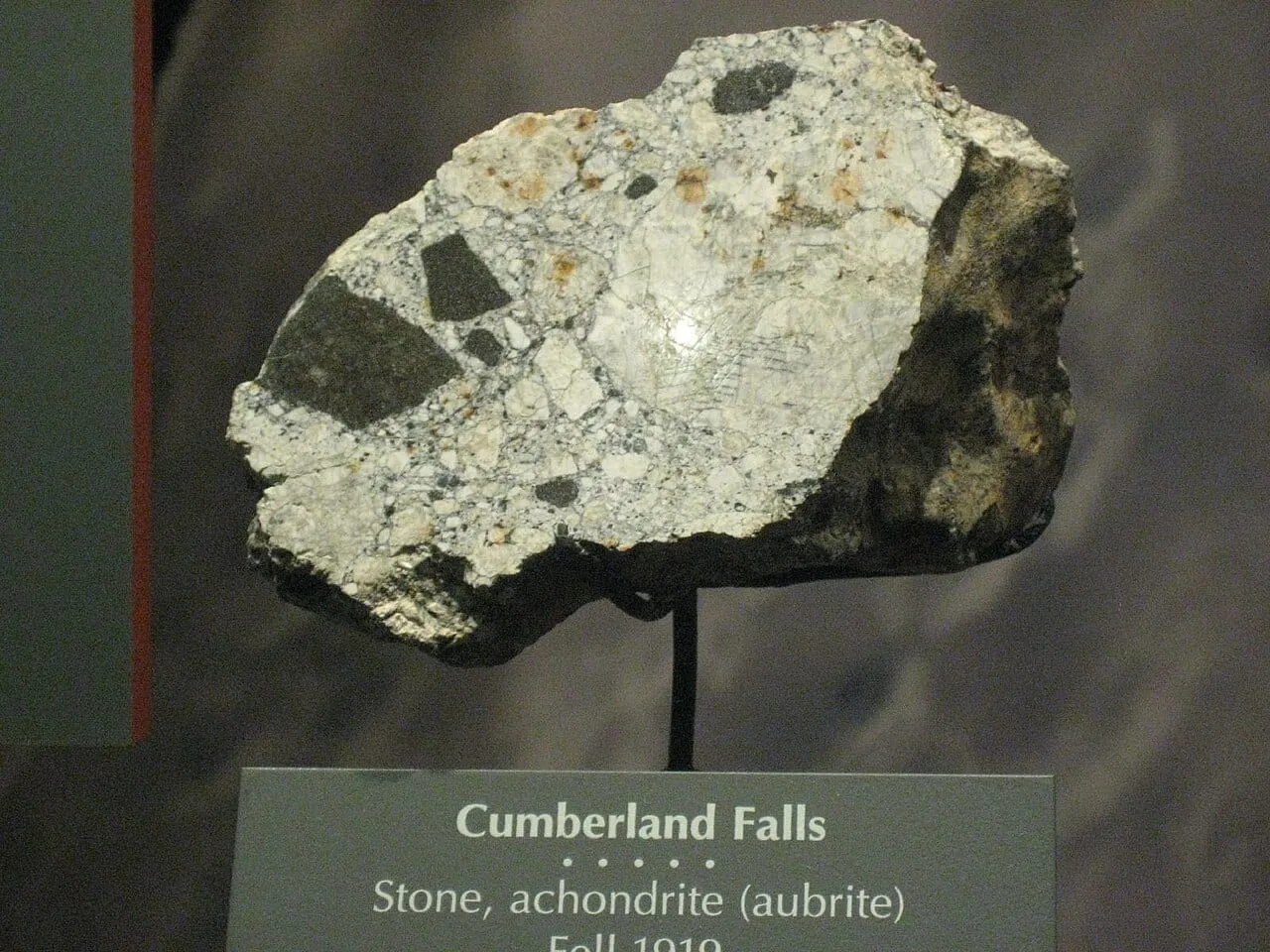
Stony meteorites with no chondrules: rock from melted asteroids, the Moon and Mars, and hard to recognise because they look like Earth rocks.
Amber
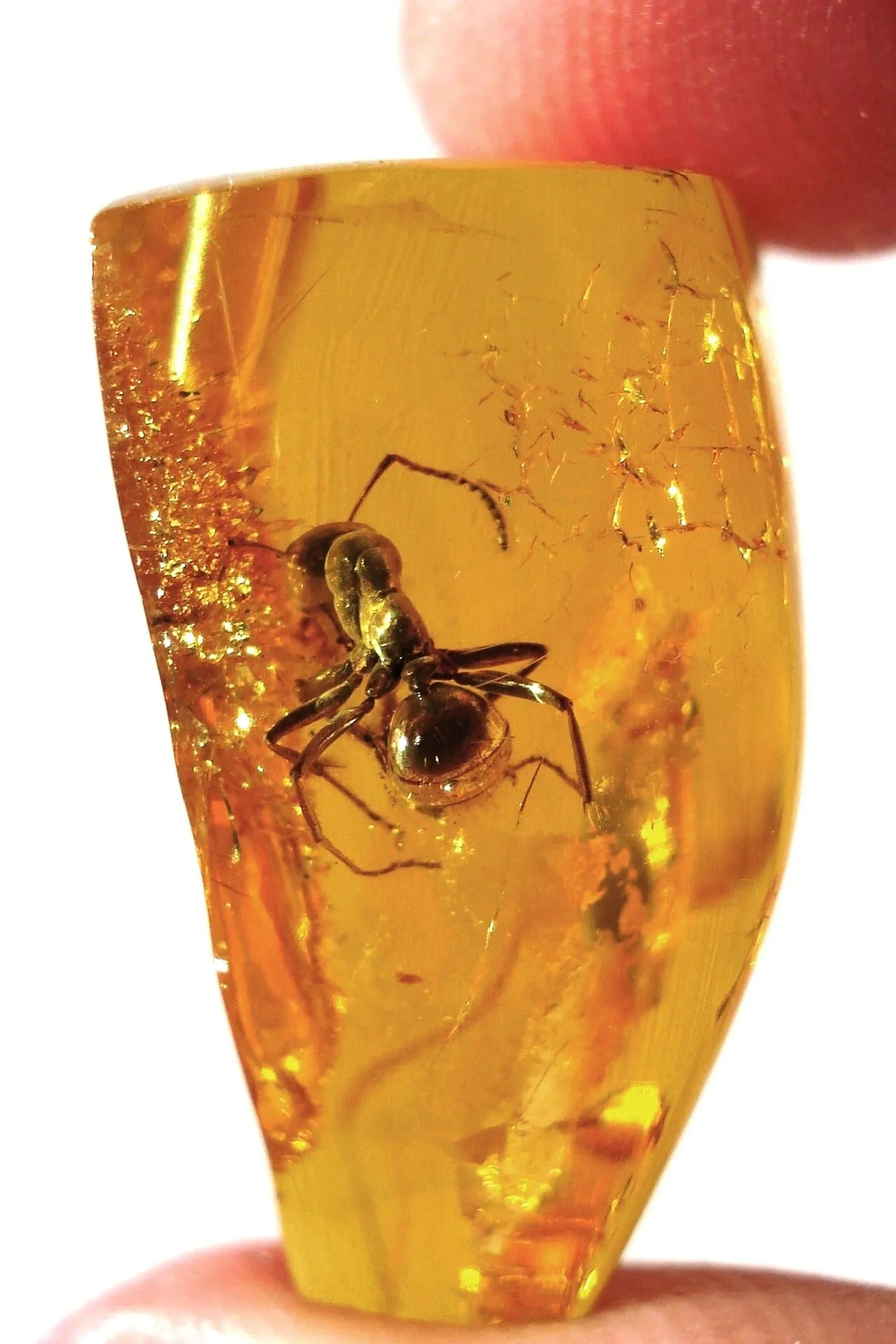
Tree resin fossilised over millions of years: a light, warm organic gem that sometimes holds prehistoric insects.
Ammolite
The rainbow-bright layer of fossil ammonite shell; of gem quality it comes only from the Canadian province of Alberta.