Rock
Shatter cone
Çarpma konisi
Cone-shaped fractures in rock, covered with grooves that fan out from the tip: not a stone from space but the ground-level signature of a meteorite impact.
- Popularly: Common stone

In short
Shatter cones are cone-shaped fractures that the shock wave of a large meteorite or asteroid impact leaves in rock, their surfaces covered with fine grooves fanning out from the tip. They range from a few centimetres to a few metres in length. They are one of the few signs visible to the naked eye that show a place to be an impact structure. The cone itself is Earth rock; it is not a meteorite.
Photos

How does it form?
When a large body hits the ground, the shock wave races through the rocks. The rocks right next to the impact point are vaporised, melted or thrown out; the cones form a little further out, in rock that was shocked without melting. As the shock wave meets small irregularities in the rock, fine, branching fractures open and give cone-shaped surfaces. Shock pressures of about 2 to 30 gigapascals (GPa), tens of thousands to hundreds of thousands of times atmospheric pressure, are thought to be needed. How the cones form is still debated: researchers have proposed that the fractures are tension cracks running at extremely high speed.
Shatter cones develop best in fine-grained rocks, but they can occur in many rocks, including limestone, dolomite, sandstone, quartzite, granite and gabbro.
What is it used for?
Shatter cones have no everyday use; their value is scientific:
- Recognising impact structures: They are one of the few signs of impact visible to the naked eye. They can show that an eroded, buried or otherwise unrecognisable old structure was made by an impact; the origin of structures such as Vredefort and Charlevoix was recognised this way.
- Direction of the impact: Because the tips of the cones mostly point towards the impact point, they are used to find where the centre of a structure lies.
- Shock physics: They are studied to understand how rock responds to very fast, very high stresses.
- Museums and collections: Cones from famous places such as Steinheim are displayed in museums and collections.
Main places
Shatter cones have been found in many impact structures around the world. The best known are:
- Steinheim Basin (Germany): The type locality of shatter cones, famous for its examples in Jurassic limestone.
- Ries (Germany): About 40 km east of Steinheim, a crater about 24 km across.
- Sudbury (Canada): A structure 130 km across and about 1.85 billion years old; cones have been reported up to about 15 km from its edge.
- Vredefort (South Africa): One of the largest known impact structures; cones occur up to about 90 km from the centre.
- The Slate Islands and Charlevoix (Canada), and Kentland (USA): All have fine cones; the many cones at Charlevoix led to the structure’s impact origin being recognised in 1965.
For stones that really do come from space, see the chondrite and iron meteorite pages, and for the glass made of Earth rock melted and flung out by an impact, the tektite page. For the host rocks, see limestone, dolomite, sandstone, quartzite and granite.
Why are they hard to recognise?
Shatter cones can be confused with ordinary cracked and scratched rocks in the same area, or with sedimentary structures such as cone-in-cone. Fully developed cones are rare; often only pieces of cones or clusters are seen. To decide whether a rock is a shatter cone, geologists weigh together whether it lies within an impact structure, which way the tips point and whether other traces of shock are present. To work out what a stone you have found is, see the How to identify a stone guide.
What determines its value?
Shatter cones are not a gem or an ornamental stone; interest is mostly scientific and among collectors. What determines their value is whether the impact structure and host rock they came from are documented, whether the horse-tail grooves are sharp and the cones fully developed (fully developed cones are rare), the size and completeness of the piece, and whether it comes from a famous place such as Steinheim. A piece with no known locality means very little, scientifically or to a collector.
This information is educational, not buying, selling or investment advice. Value varies enormously with quality and treatment.
How to recognise it
- 1
The surface is covered with fine, rounded grooves that fan out from the tip of the cone. In fine-grained rocks the pattern looks like a horse’s tail. Fully developed cones are rare; they are more often seen nested or side by side in clusters.
- 2
The tips of the cones mostly point towards the impact point, but irregular orientations are also common. To find the direction of the impact you also have to check whether the rock has been tilted since.
- 3
Where it was found matters: shatter cones occur only in and around known impact structures. A grooved, cone-like stone found on an ordinary outcrop is usually not a shatter cone.
- 4
A geologist confirms the impact origin: other traces of shock in the same rocks, such as planar deformation lines in quartz grains, support it.
Fakes and imitations
What shops usually don’t tell you:
- Cone-in-cone structures: nested, cone-shaped sedimentary structures in calcite-bearing shale and limestone layers, formed as calcite grew while the sediments were being buried. They have nothing to do with shock waves, have a fibrous internal structure and also occur far from impact structures.
- Fault surfaces and glacial scratches: parallel grooves made by movement on a fault or by the grinding of a glacier; unlike the rounded, fanning grooves of shatter cones, they look stepped in one direction.
- Pieces with no documented place: a piece whose impact structure and rock of origin are unknown cannot be confirmed as a shatter cone.
Safety
Most impact structures are protected areas, working quarries or private land: Vredefort is a UNESCO World Heritage Site, the Slate Islands are a provincial park, and the quarry at Kentland is still worked. Before looking for cones or taking a piece, find out the rules and the owner of the site; for the legal position, ask the relevant authority or a lawyer. Fragments flying off when you break rock with a hammer can injure your eyes; wear safety glasses.
Myths and misconceptions
MythAny cone-shaped, grooved rock is a shatter cone.
FactSedimentary structures unrelated to impacts, such as cone-in-cone structures, can look similar; they form as calcite grows while sediments are buried, and have a fibrous internal structure. Shatter cones are the product of very high, instantaneous stresses and occur only in and around impact structures.
MythEvery impact crater has shatter cones; no cones means no impact.
FactCones form in rocks where the impact’s shock wave stayed strong enough; they do not occur in craters smaller than a few kilometres across, and even in large structures they do not develop in every rock. A shatter cone is evidence of an impact, but their absence does not show that there was none.
Did you know?
When shatter cones were first described at Steinheim in 1905, they were attributed to a “cryptovolcanic” (hidden volcanic) explosion. The geologist R. S. Dietz argued from the 1940s onwards that they were made by impacts; cones are now used to recognise impact structures.
At the Vredefort structure in South Africa, shatter cones occur up to about 90 km from the centre. On the Slate Islands in Canada there is a cone about 9 m long, one of the largest in the world.
Shatter cones have also been made in experiments: in explosions of 5 and 100 tonnes of TNT, and by firing high-speed projectiles into limestone at more than 3 km per second, which produced striated surfaces a few millimetres across that strongly resemble cones.
Where is it found?
Loading map…
- Steinheim Basin, Baden-Württemberg, Germany · Type localityThe type locality of shatter cones: they were first described here in 1905, when they were attributed to a “cryptovolcanic” (hidden volcanic) explosion. The crater, famous for its cones in Jurassic limestone, is 3.8 km across, about 14 million years old, and lies about 40 km west of the Ries crater.
- Ries crater, Nördlingen, Bavaria, Germany · Known localityShatter cones occur in this crater, about 24 km across; the same impact also created the moldavite tektites.
- Sudbury Basin, Ontario, Canada · Major depositAn impact structure 130 km across and about 1.85 billion years old. Shatter cones have been reported up to about 15 km from the edge of the melt sheet, and their tips point towards the centre of the basin.
- Vredefort Dome, Free State, South Africa · Major depositAn impact structure about 2.02 billion years old and one of the largest known (170–300 km across when formed). Shatter cones occur up to about 90 km from the centre; Dietz and Hargraves found them in 1961 and so confirmed the structure’s impact origin. It has been a UNESCO World Heritage Site since 2005.
- Slate Islands, Lake Superior, Ontario, Canada · Known localityThe centre of an impact structure about 32 km across. One of the largest shatter cones in the world, about 9 m long, is here. The islands are a provincial park, reached only by boat or floatplane.
- Charlevoix, Quebec, Canada · Known localityAn impact structure about 54 km across and about 450 million years old. The discovery of numerous shatter cones led to its impact origin being recognised in 1965.
- Kentland, Indiana, USA · Known localityAn impact structure about 13 km across. Shatter cones and deformed bedrock revealed its impact origin, and fine cones in dolomite are known from the quarry. The quarry is still being worked today.
Locations are approximate to protect sites. Red dots mark places in Türkiye. Open in the big map →
Frequently asked questions
What is shatter cone?
Shatter cones are cone-shaped fractures that the shock wave of a large meteorite or asteroid impact leaves in rock, their surfaces covered with fine grooves fanning out from the tip. They range from a few centimetres to a few metres in length. They are one of the few signs visible to the naked eye that show a place to be an impact structure. The cone itself is Earth rock; it is not a meteorite.
What is shatter cone used for?
Shatter cones have no everyday use; their value is scientific: Recognising impact structures: They are one of the few signs of impact visible to the naked eye. They can show that an eroded, buried or otherwise unrecognisable old structure was made by an impact; the origin of structures such as Vredefort and Charlevoix was recognised this way. Direction of the impact: Because the tips of the cones mostly point towards the impact point, they are used to find where the centre of a structure lies. Shock physics: They are studied to understand how rock responds to very fast, very high stresses.
How hard is shatter cone?
It has a hardness of 3–7 on the Mohs scale. It can scratch glass; a steel knife scratches it only with difficulty. Its specific gravity is 2.2–3.2 g/cm³.
Where is shatter cone found?
Its best-known localities: Steinheim Basin, Baden-Württemberg, Germany; Sudbury Basin, Ontario, Canada; Vredefort Dome, Free State, South Africa; Ries crater, Nördlingen, Bavaria, Germany; Slate Islands, Lake Superior, Ontario, Canada.
How can you tell if shatter cone is real?
The surface is covered with fine, rounded grooves that fan out from the tip of the cone. In fine-grained rocks the pattern looks like a horse’s tail. Fully developed cones are rare; they are more often seen nested or side by side in clusters. The tips of the cones mostly point towards the impact point, but irregular orientations are also common. To find the direction of the impact you also have to check whether the rock has been tilted since. Where it was found matters: shatter cones occur only in and around known impact structures. A grooved, cone-like stone found on an ordinary outcrop is usually not a shatter cone. Cone-in-cone structures: nested, cone-shaped sedimentary structures in calcite-bearing shale and limestone layers, formed as calcite grew while the sediments were being buried. They have nothing to do with shock waves, have a fibrous internal structure and also occur far from impact structures.
Is shatter cone valuable?
On the “street to diamond” value ladder it sits on step 5 of nine: Ornamental stone. Shatter cones are not a gem or an ornamental stone; interest is mostly scientific and among collectors. What determines their value is whether the impact structure and host rock they came from are documented, whether the horse-tail grooves are sharp and the cones fully developed (fully developed cones are rare), the size and completeness of the piece, and whether it comes from a famous place such as Steinheim. A piece with no known locality means very little, scientifically or to a collector.
Is shatter cone dangerous?
Most impact structures are protected areas, working quarries or private land: Vredefort is a UNESCO World Heritage Site, the Slate Islands are a provincial park, and the quarry at Kentland is still worked. Before looking for cones or taking a piece, find out the rules and the owner of the site; for the legal position, ask the relevant authority or a lawyer. Fragments flying off when you break rock with a hammer can injure your eyes; wear safety glasses.
Sources
- Shatter cone · Wikipedia
- Shatter cones: Branched, rapid fractures formed by shock impact (Sagy, Fineberg & Reches), Journal of Geophysical Research 109, B10209 · American Geophysical Union, 2004
- Cone-in-cone structures · Wikipedia
- The shatter cone page · Impact Structures (impact-structures.com)
- Shatter cones · Crater Explorer (craterexplorer.ca)
- United States Meteorite Impact Craters, Chapter 3: Shatter Cones · impactcraters.us
- Steinheim crater · Wikipedia
- Sudbury Basin · Wikipedia
- Vredefort impact structure · Wikipedia
- Slate Islands (Ontario) · Wikipedia
- Charlevoix impact structure · Wikipedia
- Kentland crater · Wikipedia
External links
Draft: awaiting expert reviewReport an error ↗
On the same step
Agate
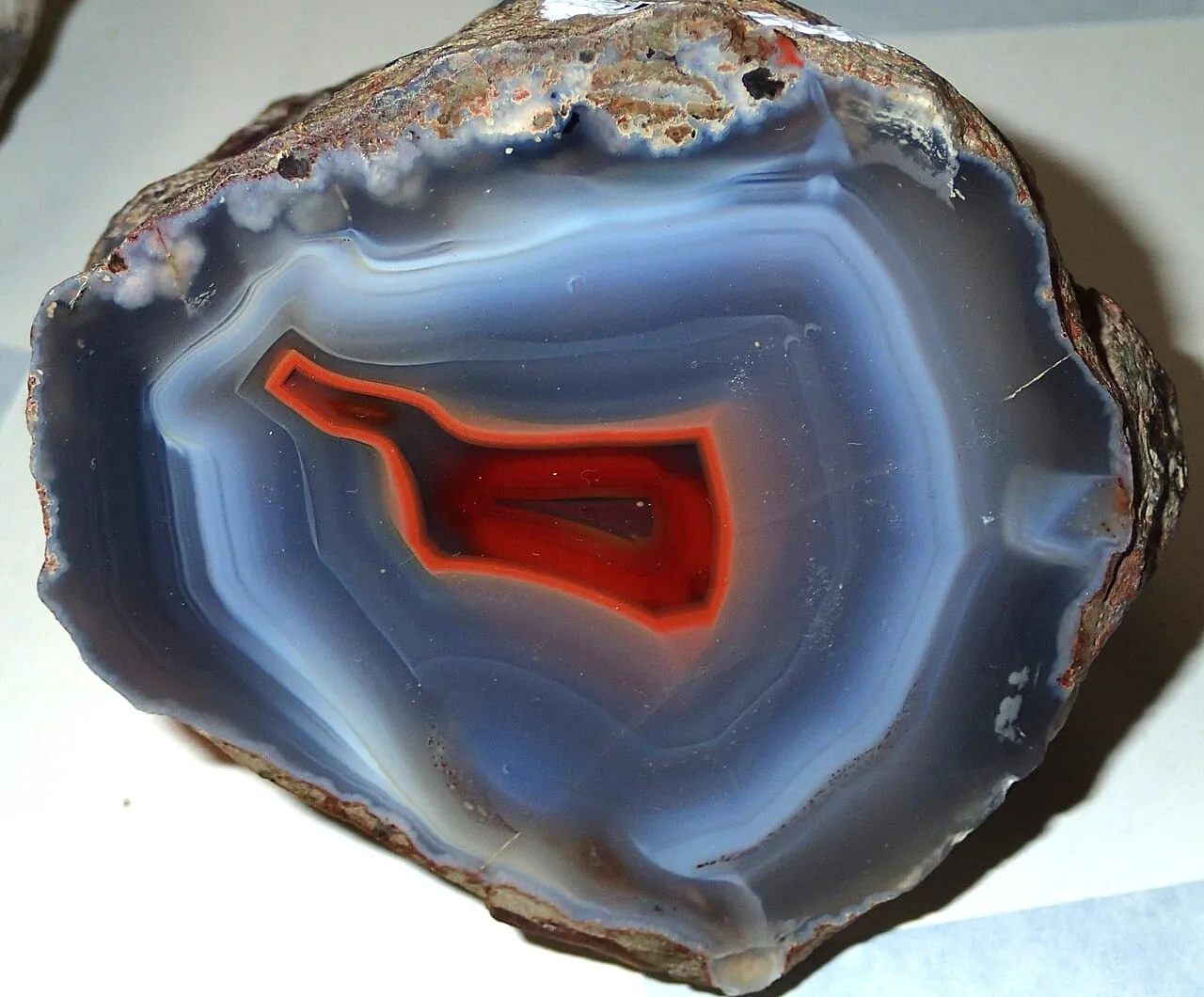
The banded variety of chalcedony: it grows layer by layer in hollows in volcanic rock and shows a new pattern every time it is cut.

Almandine
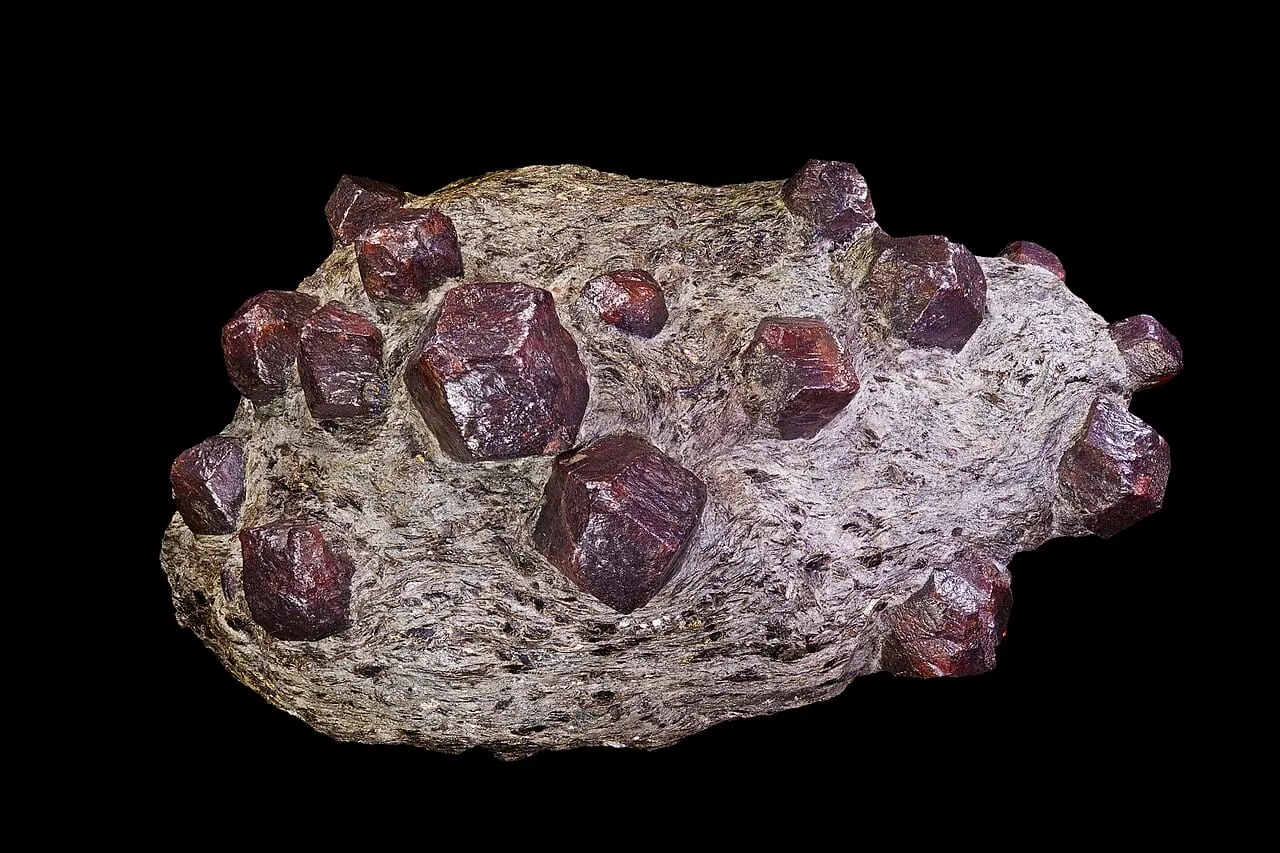
The commonest garnet: a deep red, iron-rich stone named after the ancient city of Alabanda in Anatolia, used in jewellery and in sandpaper alike.
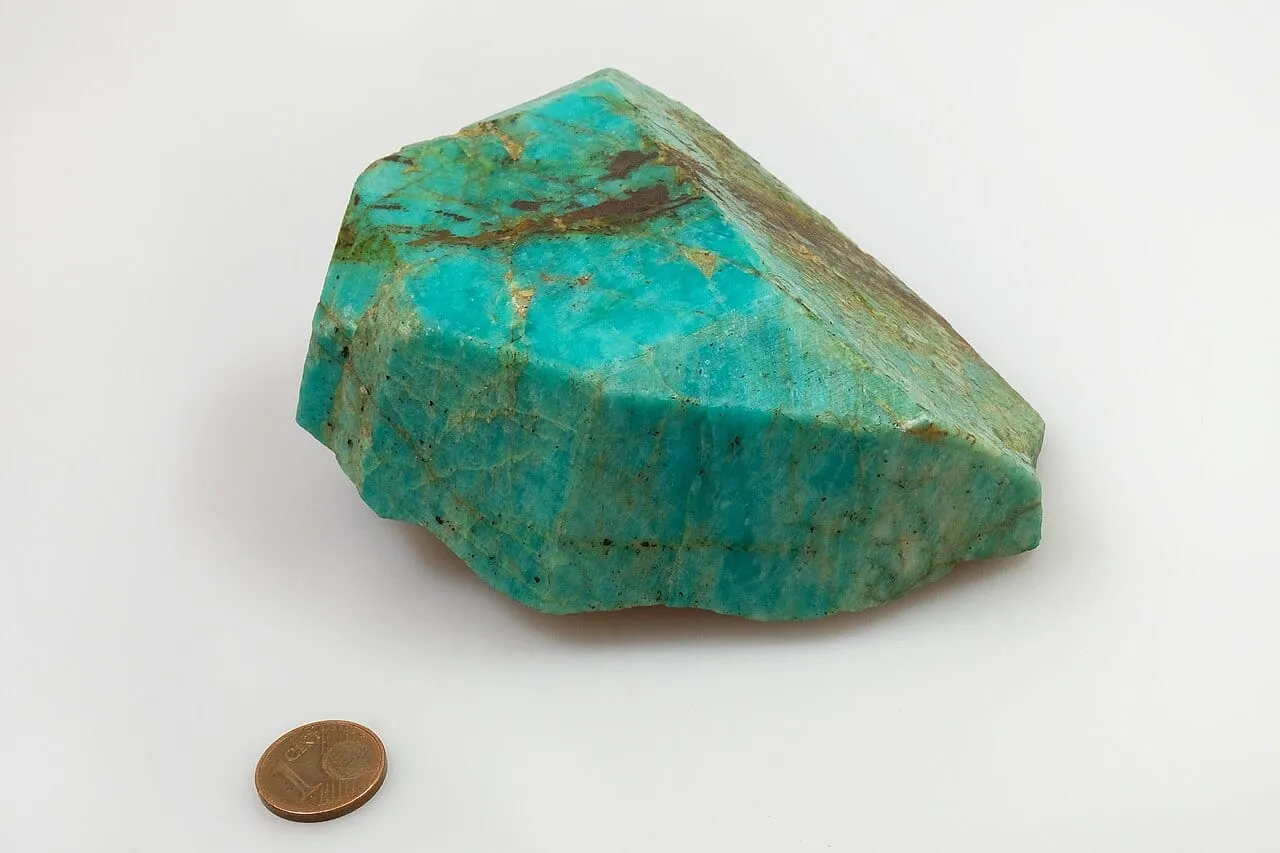
Amazonite
A turquoise-like green-blue feldspar: a variety of microcline worn as jewellery for more than three thousand years, but it can release lead.