Mineral
Pyrope
Mg₃Al₂(SiO₄)₃Pirop
Its name means “fire-like”: a red garnet formed mostly in rocks from deep in the Earth, the stone of Bohemian garnets and a pointer in the hunt for diamonds.
Also known as: Bohemian garnet (Czech pyrope; the name is discouraged by GIA) · Chrome pyrope · Anthill garnet (chrome pyrope from Arizona) · Cape ruby, Arizona ruby, Colorado ruby, California ruby, Rocky Mountain ruby (misleading trade names)
- Popularly: Semi-precious stone
- Gemstone
In short
Pyrope is the magnesium-bearing red garnet; its name means “fire-like” in Greek. It is found mostly in rocks that come from deep in the Earth and in the kimberlite that carries them to the surface, which is why it is used as a pointer in diamond exploration. The famous “Bohemian garnets” of Czechia are pyrope. Pyrope cut as a gem always contains some almandine and other garnets.
Photos
How does it form?
Pyrope forms in rocks rich in magnesium and poor in silica (ultramafic rocks), that is, in rocks from deep in the Earth such as peridotite, kimberlite and eclogite. The pyrope in these rocks is carried to the surface by kimberlite, the volcanic rock that carries diamonds. Pyrope also occurs in ultrahigh-pressure metamorphic rocks and in serpentinite, which makes it a high-pressure indicator for geologists. Pyropes found with diamond are rich in chromium (3–8% Cr₂O₃) and range in colour from violet to deep purple. Even when erosion has destroyed the diamond-bearing pipe itself, these grains remain in the surrounding sands and gravels.
Pyrope forms mixtures (solid solutions) with almandine and spessartine; for the family as a whole see garnet, and for its iron-bearing sister see almandine. The rose-pink to purplish mixture of pyrope and almandine goes by the name rhodolite.
What is it used for?
- Jewellery: Red pyropes have been used in jewellery for centuries. Bohemian chromium-bearing pyropes are found even in Migration Period jewellery from about AD 400–600, and in the second half of the 19th century more than 3,000 gem cutters worked in Bohemia. The grains are mostly under 8 millimetres, so Bohemian garnets were cut as small stones.
- Diamond exploration: Chrome pyropes serve as pointer minerals in the search for diamond-bearing kimberlite pipes, because even if the pipe itself has eroded away, pyrope grains leave a trail in the surrounding sands and gravels.
- Science: Pyrope’s stability at high pressure helps geologists understand the conditions deep in the Earth under which pyrope-bearing rocks formed.
Colour-change pyrope
Some pyropes change colour with the light. Stones from Norway look wine red in lamplight and violet in daylight, but are very small. Pyrope–spessartine garnets from the Umba valley in Tanzania look greenish blue in daylight and magenta (purple-pink) in lamplight; according to Wikipedia, blue examples of this type were found in the late 1990s at Bekily in Madagascar and have also turned up in the USA, Russia, Kenya, Tanzania and Türkiye. See also spessartine for these mixtures.
What determines its value?
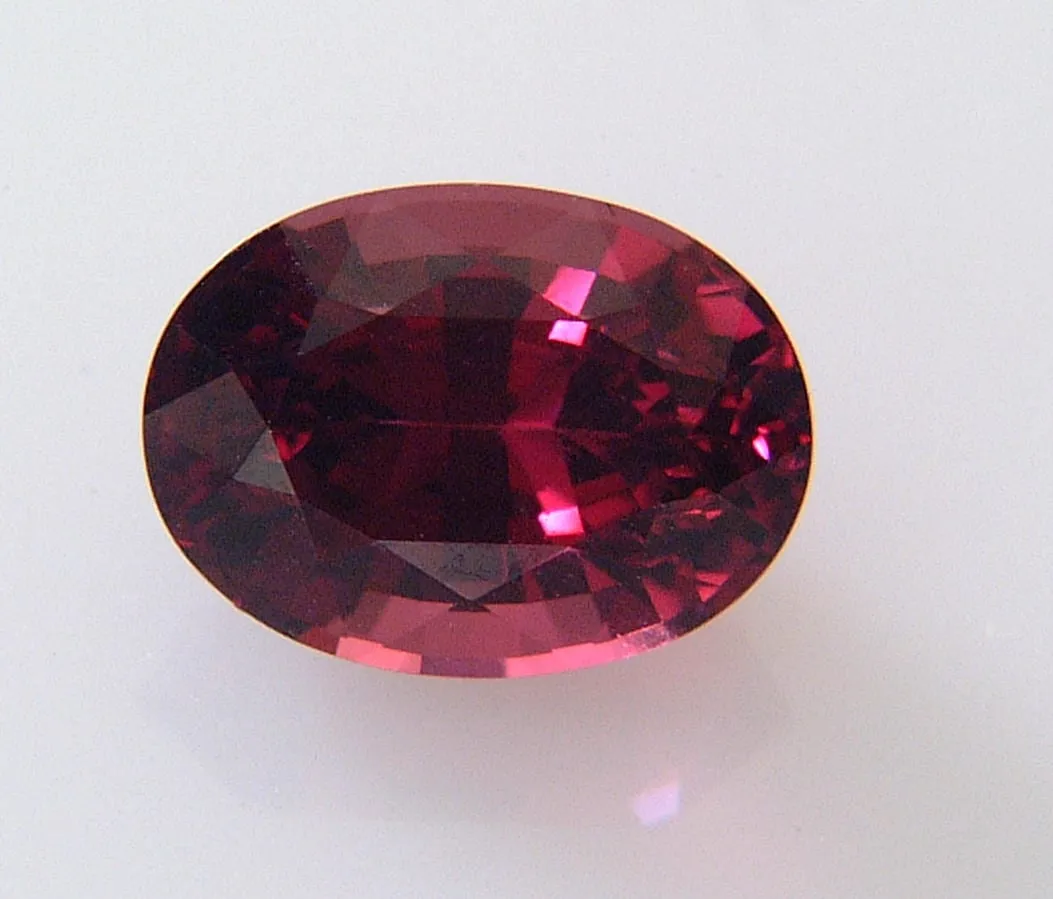
Colour matters most for pyrope: vivid, blood-red stones are sought after. Chrome pyropes can rival ruby in colour, but their tone is very dark; and since most pyrope looks very dark in large sizes, cut stones over one or two carats are rare. Colour-change pyropes and those in pastel pinks, oranges or purples are less common. Clarity and cut also count, and a historic origin such as “Bohemian” appeals in antique jewellery. Pyrope is usually not treated.
This information is educational, not buying, selling or investment advice. Value varies enormously with quality and treatment.
How to recognise it
- 1
Crystals can be twelve- or twenty-four-faced; small grains look like red dots in the rock.
- 2
The colour is red, pinkish red, orange-red or purplish red; some examples look bluish green in daylight and wine red in lamplight.
- 3
It is very hard to tell from almandine; pyrope usually has fewer flaws and inclusions. A red garnet found in rocks from great depth such as peridotite, kimberlite or eclogite, or in the gravels that come from their weathering, is most often pyrope.
- 4
It scratches glass (hardness 7–7.5) and has no cleavage. Telling for certain which garnet species a stone is needs a gem laboratory.
Fakes and imitations
What shops usually don’t tell you:
- Misleading names: “Cape ruby”, “Arizona ruby”, “Colorado ruby”, “California ruby”, “Rocky Mountain ruby” and “Bohemian ruby” have all been used for pyrope garnet; these stones are not rubies.
- Large, dark red stones sold as “pyrope” are mostly almandine with a pyrope component.
- Red glass, cubic zirconia and other red natural stones may be sold as pyrope; laboratory-made pyrope is rarely met in jewellery.
Myths and misconceptions
MythEvery stone sold as “pyrope” is pure pyrope.
FactPure pyrope almost never occurs in nature: even the purest gem-quality stone found is only about 83% pyrope, and pyropes always contain some almandine and spessartine. Large stones sold as “pyrope” are often mostly almandine.
MythBohemian garnet is a separate mineral found only in Bohemia.
FactThe name is a trade name for pyrope garnet from the Czech Republic; the mineral’s name is pyrope. In the trade, almandine from Tyrol and Carinthia was also sold as “Bohemian garnet”, and GIA discourages the use of the trade name.
What is it believed to be good for?
This section reports beliefs; it is not health information. There is no scientific evidence for these claims and no stone replaces medical treatment.
The meanings people give this stone, and who holds them:
- In writings about Bohemian garnets, it is told that a lamp made of garnets lit Noah’s ark in the dark and that knights fitted their weapons with garnets in the hope of protective power.
- The same accounts say that Bohemian garnet protects friendship and gives courage, confidence and vitality.
- Today crystal-therapy websites claim that pyrope charges the root chakra with energy and gives passion and creativity.
What science says
The tale that garnet lit Noah’s ark is a legend; garnet does not shine with its own light, it only reflects the light that falls on it. There is no scientific evidence that pyrope protects friendship, gives courage, vitality or passion, or balances the chakras.
Did you know?
In Arizona, ants bring chrome pyrope crystals to the surface when building their nests; these stones are called “anthill garnets”.
In the Dora-Maira massif in Italy, the place where ultrahigh-pressure rocks were first described on Earth, nearly pure pyrope crystals reach 25 centimetres; these rocks were buried to about 100 kilometres depth and then came back to the surface.
Pyrope sometimes occurs as crystal inclusions inside diamond; because it forms alongside diamond, it serves as a guide in diamond exploration.
A huge pyrope said to be the size of a pigeon’s egg is kept in the Green Vault in Dresden.
Where is it found?
Loading map…
- Třebenice area, Central Bohemian Highlands, Czechia · Historic sourceThe “Bohemian garnet” deposits in volcanic breccia, tuffs and conglomerates; for centuries a source of chromium-bearing pyrope that fed a large cutting industry in the 19th century, still worked today on a smaller scale
- Dora-Maira massif (Varaita valley), Piedmont, Italy · Major depositNear-pure pyrope megacrysts (up to 25 cm) with coesite inclusions in ultrahigh-pressure metamorphic whiteschist
- Kimberley, Northern Cape, South Africa · Major depositBlood-red but small pyrope grains in the kimberlite and eclogite that accompany diamonds
- Pare Mountains and Umba River valley, Tanzania · Known localityPyrope and colour-change pyrope–spessartine garnets
- Buell Park area, Apache County, Arizona, USA · Known localityChrome pyrope crystals from a volcanic pipe, brought to the surface by ants: “anthill garnets”
- Bingara area, New South Wales, Australia · Known localityListed in the mineralogical literature among places that produced substantial amounts of gem-quality pyrope
- Zöblitz, Saxony, Germany · Known localityListed in the mineralogical literature among places that produced substantial amounts of gem-quality pyrope
Locations are approximate to protect sites. Red dots mark places in Türkiye. Open in the big map →
Frequently asked questions
What is pyrope?
Pyrope is the magnesium-bearing red garnet; its name means “fire-like” in Greek. It is found mostly in rocks that come from deep in the Earth and in the kimberlite that carries them to the surface, which is why it is used as a pointer in diamond exploration. The famous “Bohemian garnets” of Czechia are pyrope. Pyrope cut as a gem always contains some almandine and other garnets.
What is pyrope used for?
Jewellery: Red pyropes have been used in jewellery for centuries. Bohemian chromium-bearing pyropes are found even in Migration Period jewellery from about AD 400–600, and in the second half of the 19th century more than 3,000 gem cutters worked in Bohemia. The grains are mostly under 8 millimetres, so Bohemian garnets were cut as small stones. Diamond exploration: Chrome pyropes serve as pointer minerals in the search for diamond-bearing kimberlite pipes, because even if the pipe itself has eroded away, pyrope grains leave a trail in the surrounding sands and gravels.
How hard is pyrope?
It has a hardness of 7–7.5 on the Mohs scale. It scratches glass and steel; a steel knife cannot scratch it. Its specific gravity is 3.58–3.87 g/cm³.
Where is pyrope found?
Its best-known localities: Dora-Maira massif (Varaita valley), Piedmont, Italy; Kimberley, Northern Cape, South Africa; Třebenice area, Central Bohemian Highlands, Czechia; Pare Mountains and Umba River valley, Tanzania; Buell Park area, Apache County, Arizona, USA.
How can you tell if pyrope is real?
Crystals can be twelve- or twenty-four-faced; small grains look like red dots in the rock. The colour is red, pinkish red, orange-red or purplish red; some examples look bluish green in daylight and wine red in lamplight. It is very hard to tell from almandine; pyrope usually has fewer flaws and inclusions. A red garnet found in rocks from great depth such as peridotite, kimberlite or eclogite, or in the gravels that come from their weathering, is most often pyrope. Misleading names: “Cape ruby”, “Arizona ruby”, “Colorado ruby”, “California ruby”, “Rocky Mountain ruby” and “Bohemian ruby” have all been used for pyrope garnet; these stones are not rubies.
Is pyrope valuable?
On the “street to diamond” value ladder it sits on step 5 of nine: Ornamental stone. Colour matters most for pyrope: vivid, blood-red stones are sought after. Chrome pyropes can rival ruby in colour, but their tone is very dark; and since most pyrope looks very dark in large sizes, cut stones over one or two carats are rare. Colour-change pyropes and those in pastel pinks, oranges or purples are less common. Clarity and cut also count, and a historic origin such as “Bohemian” appeals in antique jewellery. Pyrope is usually not treated.
What is pyrope good for?
In writings about Bohemian garnets, it is told that a lamp made of garnets lit Noah’s ark in the dark and that knights fitted their weapons with garnets in the hope of protective power. The same accounts say that Bohemian garnet protects friendship and gives courage, confidence and vitality. Today crystal-therapy websites claim that pyrope charges the root chakra with energy and gives passion and creativity. The tale that garnet lit Noah’s ark is a legend; garnet does not shine with its own light, it only reflects the light that falls on it. There is no scientific evidence that pyrope protects friendship, gives courage, vitality or passion, or balances the chakras. This section reports beliefs; it is not health information. There is no scientific evidence for these claims and no stone replaces medical treatment.
Varieties



Sources
- Handbook of Mineralogy: Pyrope · Mineralogical Society of America
- Pyrope Garnet Value, Price, and Jewelry Information · International Gem Society
- Pyrope · Wikipedia
- Garnet · Wikipedia
- The ultrahigh-pressure unit of the Dora-Maira Massif · IUGS Geoheritage Sites
- History of Garnet Mining and Cutting in the Austro-Hungarian Monarchy (Karl Schmetzer), 38th International Gemmological Conference · International Gemmological Conference, 2025
- Field geology and petrology of the minette diatreme at Buell Park, Apache County, Arizona · International Kimberlite Conference abstracts, University of Alberta
- Bohemian Garnet – The Crown Jewel of Czechia · Three Seas Europe
External links
Draft: awaiting expert reviewReport an error ↗
On the same step
Agate
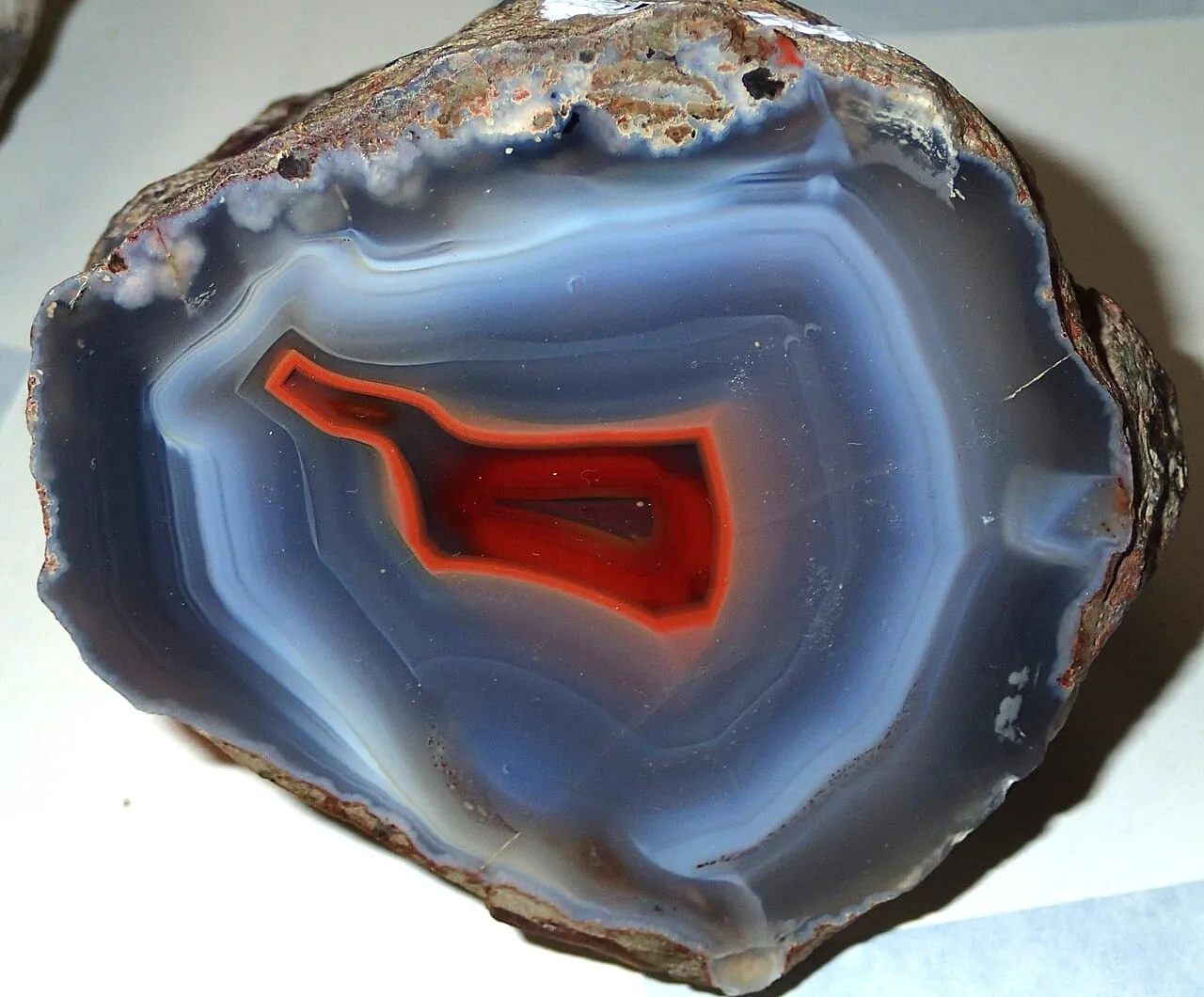
The banded variety of chalcedony: it grows layer by layer in hollows in volcanic rock and shows a new pattern every time it is cut.

Almandine
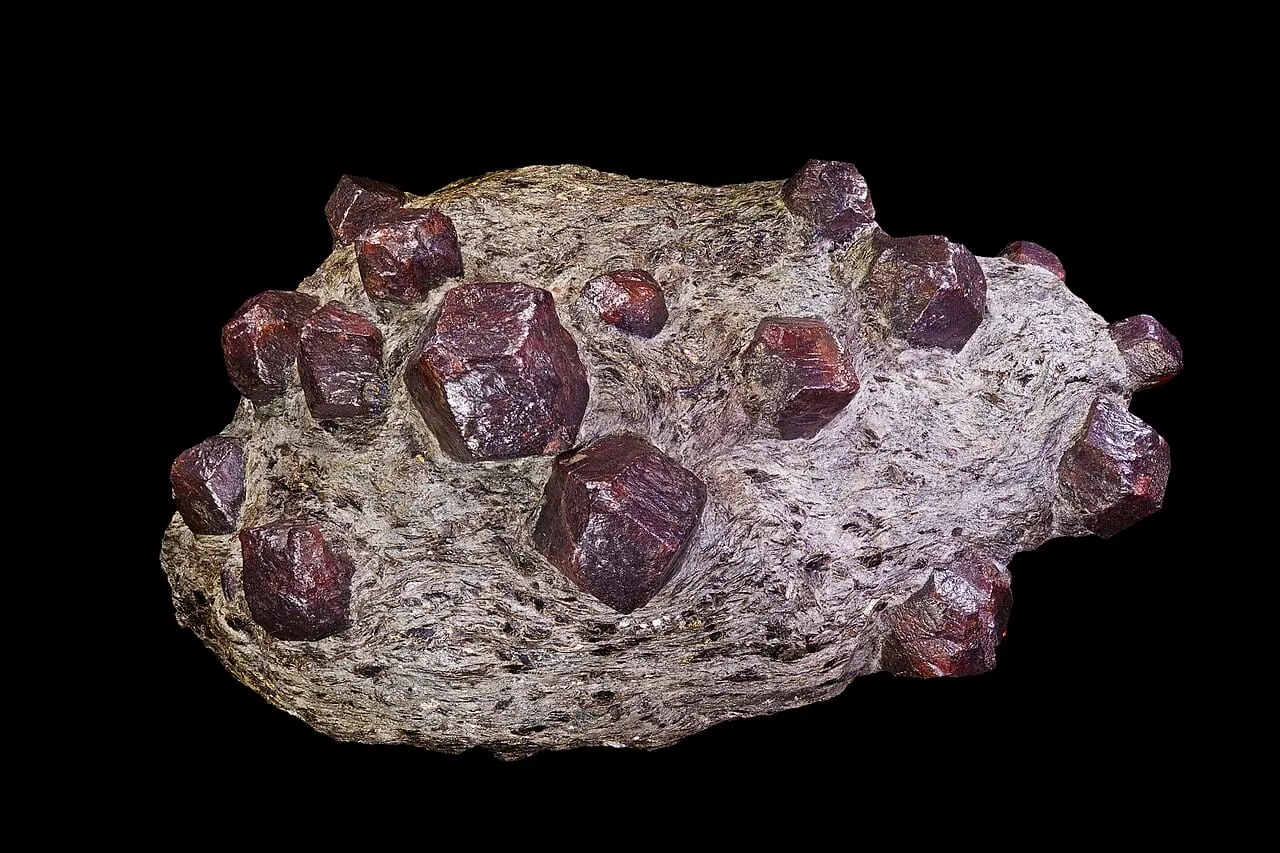
The commonest garnet: a deep red, iron-rich stone named after the ancient city of Alabanda in Anatolia, used in jewellery and in sandpaper alike.
Amazonite
A turquoise-like green-blue feldspar: a variety of microcline worn as jewellery for more than three thousand years, but it can release lead.