VarietyA variety of Andradite
Demantoid
Ca₃Fe₂(SiO₄)₃Demantoid
Its name means “diamond-like”: an emerald-green garnet that splits light more than diamond does, known since the 1850s from the Urals; a rare and valuable stone.
Also known as: Uralian emerald, Siberian emerald (misleading trade names) · Siberian chrysolite, Ural chrysolite, “olivine” (misleading trade names)
- Popularly: Semi-precious stone
- Gemstone
In short
Demantoid is the emerald-green variety of andradite garnet. Its name comes from the old German word Demant, “diamond”, because it splits light even more strongly than diamond and gives fiery flashes. It was found in the mid-19th century in Russia’s Ural Mountains. It is usually small; stones over one carat are rare and it counts among the most valuable garnets.
Photos
How does it form?
Demantoid forms in rocks that contain iron and chromium. It is found in serpentinite in the Urals and in the Valmalenco area of Italy, in serpentinite schist at Baft in Iran, and in skarn at Takab. Chromium gives the green colour and ferric iron adds a yellow tone. Demantoid from serpentinite contains fine fibres of fibrous minerals such as chrysotile; these radiate from a small chromite crystal and form the “horsetail” inclusion. Its parent species, andradite, and the family as a whole, garnet, are described on their own pages.
What is it used for?
- Jewellery: Its emerald-green colour and diamond-like brilliance make it a gem for rings, brooches and earrings. Because hardness is 6.5–7, a protective setting is advised for rings; being sensitive to heat, it should not be cleaned in an ultrasonic cleaner.
- Collecting: Crystal groups in serpentinite and stones with horsetail inclusions are sought after by collectors.
Discovery and history
Demantoid was found in 1851 in the west-central Ural Mountains of Russia, about 110 kilometres north-north-west of Yekaterinburg, in an alluvial deposit along the Bobrovka River near the village of Elizavetinskoye. The miners, struck by how unusually strongly the stone bent light, compared it to diamond and named it “demantoid” from the old German word Demant, “diamond”. A second find was made about 75 kilometres south of Yekaterinburg, on the Chusovaya and Chrisolitka rivers south-west of the village of Poldnevaya.
Demantoid was very popular in Russia from its discovery until 1919 and went out of fashion in Soviet times. New sources emerged from the 1990s: the “Green Dragon” mine in Namibia was found in 1996 and the Antetezambato deposit in Madagascar around 2009. Demantoid also comes from Italy, Iran and Afghanistan.
What determines its value?
Colour matters most for demantoid: intense green close to emerald is much sought after, while yellowish-green stones show more “fire”, so the choice is a matter of taste. Size has a large effect: most cut stones are under one carat, stones over two carats are rare and stones over three carats are very rare. Clarity, cut and origin also count; the “horsetail” inclusion, taken as a sign of Russian origin, is prized by collectors but is not proof of origin. Heat treatment may have been applied and should be disclosed.
This information is educational, not buying, selling or investment advice. Value varies enormously with quality and treatment.
How to recognise it
- 1
The green ranges from yellowish green to a vivid green close to emerald; some stones have a brownish tone that comes from iron.
- 2
Its lustre is diamond-like (adamantine) and, because it splits light so strongly, it gives coloured “fire”; the green body colour can sometimes hide this effect.
- 3
Russian demantoids often show golden, curving fibres radiating from a tiny chromite crystal, called “horsetail” inclusions. They are a classic clue to demantoid, but not every demantoid has them.
- 4
Its hardness is 6.5–7. It is told from emerald by not being doubly refractive, and from tsavorite and uvarovite by its higher specific gravity (3.82–3.88).
Fakes and imitations
What shops usually don’t tell you:
- Old trade names such as “Uralian emerald”, “Siberian emerald”, “Siberian chrysolite” and “olivine” are misleading; demantoid is a garnet, not an emerald or a peridot (olivine).
- Demantoid has not been synthesised; green glass and green YAG have been used as imitations.
- Around 2003 reports appeared that Russian demantoids were routinely heat-treated to improve their colour; the treatment is believed to be done at low temperature and is thought to be undetectable by gemological tests.
Myths and misconceptions
MythDemantoid is a kind of emerald, also called “Uralian emerald”.
FactDemantoid is not emerald but the green variety of andradite garnet; old trade names such as “Uralian emerald” and “Siberian emerald” are misleading. It is more brilliant than emerald and differs from it in not being doubly refractive.
MythAny stone with “horsetail” inclusions is Russian demantoid.
FactHorsetail inclusions are classic in Russian demantoid, but not every Russian demantoid has them; some stones from Italy and Iran show them too. A 2018 study also found them in brown andradite that is not demantoid.
What is it believed to be good for?
This section reports beliefs; it is not health information. There is no scientific evidence for these claims and no stone replaces medical treatment.
The meanings people give this stone, and who holds them:
- Today crystal-therapy websites claim that demantoid brings vitality and renewal and attracts abundance and prosperity.
- The same circles say that demantoid supports the eyes, immune system and breathing, and that it protects travellers and lifts the spirits.
What science says
Demantoid was found in the mid-19th century in the Urals, so there is no tradition of belief reaching back to ancient times. There is no scientific evidence that the stone brings vitality or abundance, supports the eyes, immunity or breathing, or protects travellers; someone with a health problem should see a doctor.
Did you know?
Demantoid was found in 1851 in a riverbed in Russia’s Ural Mountains, about 110 kilometres north-north-west of Yekaterinburg. The miners were struck by how unusually strongly the stone bent light for a garnet and compared it to diamond; in 1854 the mineralogist Nils Gustaf Nordenskiöld identified it as a variety of andradite garnet.
Demantoid was highly popular in Russia until 1919: the famous jeweller Peter Carl Fabergé made jewellery with it. In the Belle Époque (1890–1915) it was also a favourite in Art Nouveau jewellery.
The Smithsonian displays an 11.24-carat faceted demantoid; the largest rough demantoid from the Urals weighed 252.5 carats.
Where is it found?
Loading map…
- Bobrovka River (near Elizavetinskoye), Nizhny Tagil district, Ural Mountains, Russia · Historic sourceThe classic alluvial deposit where demantoid was found in 1851; Russian demantoid with horsetail inclusions
- Valmalenco, Sondrio, Lombardy, Italy · Known localityDemantoid with asbestos-fibre inclusions in serpentinite
- Ala valley, Piedmont, Italy · Known localityDark apple-green demantoid and yellowish-green topazolite
- Green Dragon mine, near Karibib, Erongo Region, Namibia · Major depositA commercially important deposit found in 1996
- Antetezambato, Ambanja District, Diana Region, Madagascar · Major depositA mine found around 2009 that yields fine demantoid and topazolite
- Baft, Kerman Province, Iran · Known localityDemantoid in serpentinite schist
- Takab, West Azerbaijan Province, Iran · Known localityDemantoid in skarn
- San Benito County, California, USA · Known localityA county that yields gem-quality demantoid alongside topazolite and melanite
Locations are approximate to protect sites. Red dots mark places in Türkiye. Open in the big map →
Frequently asked questions
What is demantoid?
Demantoid is the emerald-green variety of andradite garnet. Its name comes from the old German word Demant, “diamond”, because it splits light even more strongly than diamond and gives fiery flashes. It was found in the mid-19th century in Russia’s Ural Mountains. It is usually small; stones over one carat are rare and it counts among the most valuable garnets.
What is demantoid used for?
Jewellery: Its emerald-green colour and diamond-like brilliance make it a gem for rings, brooches and earrings. Because hardness is 6.5–7, a protective setting is advised for rings; being sensitive to heat, it should not be cleaned in an ultrasonic cleaner. Collecting: Crystal groups in serpentinite and stones with horsetail inclusions are sought after by collectors.
How hard is demantoid?
It has a hardness of 6.5–7 on the Mohs scale. It scratches glass and steel; a steel knife cannot scratch it. Its specific gravity is 3.82–3.88 g/cm³.
Where is demantoid found?
Its best-known localities: Green Dragon mine, near Karibib, Erongo Region, Namibia; Antetezambato, Ambanja District, Diana Region, Madagascar; Bobrovka River (near Elizavetinskoye), Nizhny Tagil district, Ural Mountains, Russia; Valmalenco, Sondrio, Lombardy, Italy; Ala valley, Piedmont, Italy.
How can you tell if demantoid is real?
The green ranges from yellowish green to a vivid green close to emerald; some stones have a brownish tone that comes from iron. Its lustre is diamond-like (adamantine) and, because it splits light so strongly, it gives coloured “fire”; the green body colour can sometimes hide this effect. Russian demantoids often show golden, curving fibres radiating from a tiny chromite crystal, called “horsetail” inclusions. They are a classic clue to demantoid, but not every demantoid has them. Old trade names such as “Uralian emerald”, “Siberian emerald”, “Siberian chrysolite” and “olivine” are misleading; demantoid is a garnet, not an emerald or a peridot (olivine).
Is demantoid valuable?
On the “street to diamond” value ladder it sits on step 7 of nine: Precious stone. Colour matters most for demantoid: intense green close to emerald is much sought after, while yellowish-green stones show more “fire”, so the choice is a matter of taste. Size has a large effect: most cut stones are under one carat, stones over two carats are rare and stones over three carats are very rare. Clarity, cut and origin also count; the “horsetail” inclusion, taken as a sign of Russian origin, is prized by collectors but is not proof of origin. Heat treatment may have been applied and should be disclosed.
What is demantoid good for?
Today crystal-therapy websites claim that demantoid brings vitality and renewal and attracts abundance and prosperity. The same circles say that demantoid supports the eyes, immune system and breathing, and that it protects travellers and lifts the spirits. Demantoid was found in the mid-19th century in the Urals, so there is no tradition of belief reaching back to ancient times. There is no scientific evidence that the stone brings vitality or abundance, supports the eyes, immunity or breathing, or protects travellers; someone with a health problem should see a doctor. This section reports beliefs; it is not health information. There is no scientific evidence for these claims and no stone replaces medical treatment.
Family
_Region,_Antsiranana_Province,_Madagaskar.jpg)
.jpg)
Sources
- Demantoid Garnet Value, Price, and Jewelry Information · International Gem Society
- Demantoid · Wikipedia
- Andradite Garnet Value, Price, and Jewelry Information · International Gem Society
- Handbook of Mineralogy: Andradite · Mineralogical Society of America
- Garnet Description · GIA
External links
Draft: awaiting expert reviewReport an error ↗
On the same step

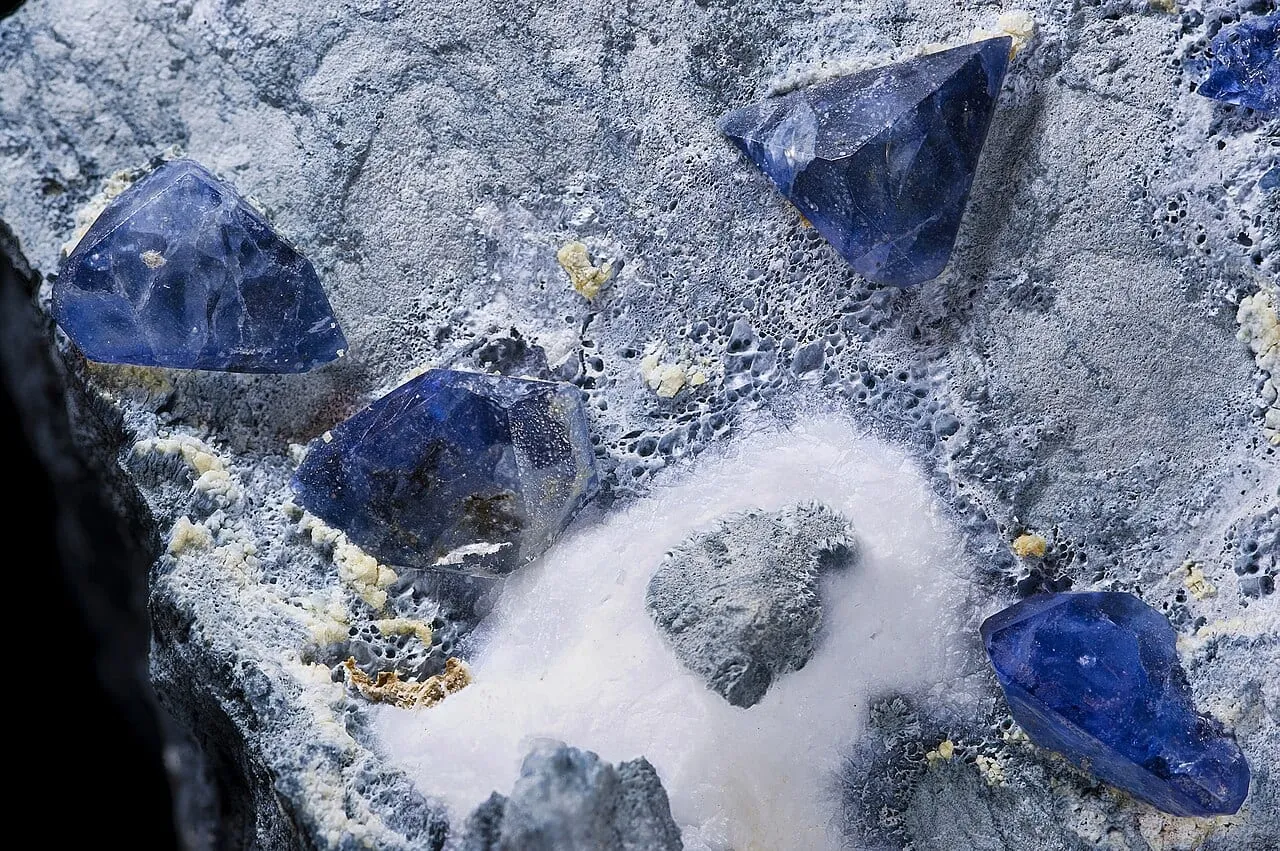
Benitoite
A sapphire-like blue stone whose gem crystals come from a single mine in the world: the official state gem of California.
Diaspore
A rare mineral that looks greenish in daylight and pinkish under incandescent light; gem-quality material comes almost only from Muğla.
Gold
A heavy, bright yellow metal that occurs pure in nature, never tarnishes and can be hammered into sheets or drawn into wire.