Meteorite
Angrite
Angrit
The oldest known igneous rocks: rare basaltic meteorites that crystallised about 4.56 billion years ago, in the very earliest days of the Solar System.
- Popularly: Meteorite

In short
Angrites are a rare group of achondrites made mostly of aluminium- and titanium-bearing pyroxene, olivine and anorthite. They are named after the meteorite that fell at Angra dos Reis on the coast of Brazil in 1869. With crystallisation ages of about 4.56 billion years they are the oldest igneous rocks known. More than 30 angrites have been classified so far.
Photos

How does it form?
Angrites formed from molten rock on a differentiated planetary body. There are two main subgroups. Quenched angrites cooled and solidified rapidly at the surface of the parent body; plutonic angrites cooled much more slowly, deeper in the crust. The meteorite NWA 10463 has been suggested to represent an intermediate stage between the two.
Their oxygen isotope compositions set angrites apart from all other meteorite groups. The manganese–iron ratios of their pyroxenes and other isotopic compositions place their origin in the inner Solar System, although some material from elsewhere may have been mixed in. Oxygen isotope disequilibrium in the meteorites Asuka-12209, Asuka-88371 and NWA 12320 points to mixing on a planetary scale.
What is it used for?
- The earliest Solar System: With crystallisation ages of about 4.56 billion years, angrites show that planetary bodies began melting and forming igneous rocks in the very earliest days of the Solar System.
- The size of the parent body: High-pressure minerals inside them suggest that the parent body was at least as large as the Moon. For comparison, the pressure in the core of Ceres is under 0.2 GPa and in that of Vesta under 0.4 GPa.
- Comparison with asteroids: Their spectra are compared with asteroids such as 289 Nenetta and 3819 Robinson.
Famous angrites
Angra dos Reis (Brazil, 1869) is the observed fall that gave the group its name. It weighed 1.5 kg, but most of it has been lost over time; the largest remaining piece, of 101 grams, is kept in Rio de Janeiro. It is about 93 per cent fassaite. The only other meteorite samples that contain fassaite are the calcium–aluminium-rich inclusions of the Allende meteorite. D’Orbigny (Argentina, 1979), at 16.55 kg, is the largest angrite found to date.
What determines its value?
Angrites are among the rarest meteorite groups; only a little over 30 specimens have been classified so far. A piece's value depends on its mass, its freshness, and whether it belongs to an observed fall such as Angra dos Reis or a well-known find such as D'Orbigny.
This information is educational, not buying, selling or investment advice. Value varies enormously with quality and treatment.
How to recognise it
- 1
The outside may be covered by a brown fusion crust; the inside of some angrites, such as NWA 2999, is very dark brown.
- 2
Some angrites, such as D'Orbigny, show prominent vesicles (gas bubbles), which are rarely seen in meteorites.
- 3
Only laboratory analyses such as oxygen isotope measurements can confirm that a stone is an angrite.
Myths and misconceptions
MythA group's type specimen is its most typical member.
FactThe type specimen is simply the first example, which gives the group its name. Angra dos Reis is the type specimen of the angrites, yet it is very different from most other angrites: it consists almost entirely of a rare pyroxene called fassaite and is more like a pyroxenite than a basalt.
Did you know?
The Angra dos Reis meteorite fell in 1869 into a bay about 2 metres deep, and two fragments were recovered from the water by a diver the next day.
The D'Orbigny angrite in Argentina was found by a farm worker ploughing a maize field. The landowner who took it stored it for about twenty years, until reading an article on meteorites prompted him to have it analysed.
After the 2018 fire at the National Museum of Brazil there were fears that the Angra dos Reis meteorite had been lost in the rubble; it was among the meteorites found on 19 October 2018.
Where is it found?
Loading map…
- Angra dos Reis, Rio de Janeiro, Brazil · Type localityThe meteorite that fell on 20 January 1869 into a bay where the water was about 2 metres deep and gave the group its name; two fragments were found by a diver the next day. It weighed 1.5 kg in all.
- D'Orbigny, Buenos Aires Province, Argentina · Known localityStruck by a farm worker ploughing a maize field in September 1979; at 16.55 kg it is the largest angrite found to date.
Locations are approximate to protect sites. Red dots mark places in Türkiye. Open in the big map →
Frequently asked questions
What is angrite?
Angrites are a rare group of achondrites made mostly of aluminium- and titanium-bearing pyroxene, olivine and anorthite. They are named after the meteorite that fell at Angra dos Reis on the coast of Brazil in 1869. With crystallisation ages of about 4.56 billion years they are the oldest igneous rocks known. More than 30 angrites have been classified so far.
Which body do angrites come from?
This is not known for certain. Their chemistry shows that they come from a differentiated, that is layered, planetary body. Their reflectance spectra link them to the main-belt asteroids 289 Nenetta and 3819 Robinson, and it has also been suggested that they could be ejecta from Mercury. A 2026 study found minerals formed at pressures of at least 1.75 GPa at relatively shallow depths and concluded that the parent body was at least as large as the Moon.
What is angrite used for?
The earliest Solar System: With crystallisation ages of about 4.56 billion years, angrites show that planetary bodies began melting and forming igneous rocks in the very earliest days of the Solar System. The size of the parent body: High-pressure minerals inside them suggest that the parent body was at least as large as the Moon. For comparison, the pressure in the core of Ceres is under 0.2 GPa and in that of Vesta under 0.4 GPa. Comparison with asteroids: Their spectra are compared with asteroids such as 289 Nenetta and 3819 Robinson.
How hard is angrite?
It has a hardness of 5.5–7 on the Mohs scale. It can scratch glass; a steel knife scratches it only with difficulty. Its specific gravity is 2.72–3.56 g/cm³.
Where is angrite found?
Its best-known localities: Angra dos Reis, Rio de Janeiro, Brazil; D'Orbigny, Buenos Aires Province, Argentina.
How can you tell if angrite is real?
The outside may be covered by a brown fusion crust; the inside of some angrites, such as NWA 2999, is very dark brown. Some angrites, such as D'Orbigny, show prominent vesicles (gas bubbles), which are rarely seen in meteorites. Only laboratory analyses such as oxygen isotope measurements can confirm that a stone is an angrite.
Is angrite valuable?
On the “street to diamond” value ladder it sits on step 7 of nine: Precious stone. Angrites are among the rarest meteorite groups; only a little over 30 specimens have been classified so far. A piece's value depends on its mass, its freshness, and whether it belongs to an observed fall such as Angra dos Reis or a well-known find such as D'Orbigny.
Sources
- Angrite · Wikipedia
- Angrit · Vikipedi
- Angra dos Reis meteorite · Wikipedia
- D'Orbigny meteorite · Wikipedia
- D'Orbigny meteorite, fragment.jpg (photo and description by Jon Taylor) · Wikimedia Commons
- Angrite (NWA 2999 Meteorite) (photo and description by James St. John) · Wikimedia Commons
- Fezzou-002 meteorite (photo and description) · Wikimedia Commons
- Handbook of Mineralogy: Diopside · Mineralogical Society of America
- Handbook of Mineralogy: Hedenbergite · Mineralogical Society of America
- Handbook of Mineralogy: Anorthite · Mineralogical Society of America
- Handbook of Mineralogy: Forsterite · Mineralogical Society of America

External links
Draft: awaiting expert reviewReport an error
On the same step
Acapulcoite
Stony meteorites that began to melt but never fully did: metal-veined primitive achondrites, named after a stone that fell near Acapulco in 1976.
Allan Hills 84001
The stone that sparked the Mars-life debate: a 4-billion-year-old Martian meteorite from Antarctica whose tiny structures were likened to fossil bacteria in 1996.

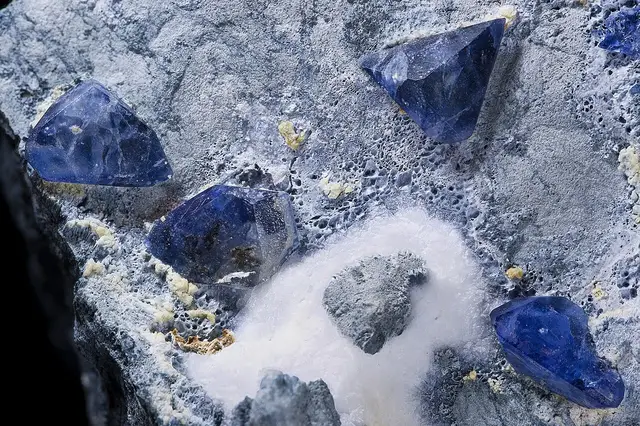
Benitoite
A sapphire-like blue stone whose gem crystals come from a single mine in the world: the official state gem of California.