Meteorite
Allan Hills 84001
ALH 84001 (Allan Hills 84001)
The stone that sparked the Mars-life debate: a 4-billion-year-old Martian meteorite from Antarctica whose tiny structures were likened to fossil bacteria in 1996.
Also known as: ALH84001 · ALH 84001
- Popularly: Meteorite

In short
ALH 84001 is a 1.93-kilogram Martian meteorite found on 27 December 1984 in the Allan Hills of Antarctica by a team from the US ANSMET programme. It crystallised from molten rock on Mars about 4.09 billion years ago and is known as the only meteorite from the time when Mars may have had liquid surface water. In 1996 NASA scientists announced structures in it resembling fossil bacteria, and it made headlines worldwide; but most of the scientific community concluded that these features could be explained without life.
Photos

How does it form?
ALH 84001 formed about 4.09 billion years ago when molten rock on Mars cooled and crystallised; it is one of the oldest known Martian meteorites. Made mainly of orthopyroxene, the rock was later shocked by impacts. At a time when Mars had liquid surface water, groundwater deposited carbonate globules in its cracks.
About 17 million years ago an impact on Mars blasted the rock into space. After a long journey it fell to Antarctica about 13,000 years ago and was preserved in the ice. These dates were set by radiometric methods such as samarium–neodymium, rubidium–strontium and potassium–argon dating. A 2005 study suggested it may have come from Eos Chasma in the Valles Marineris canyon, though this is not certain.
What is it used for?
ALH 84001 is a scientific specimen. It is studied to understand the climate, water and chemistry of early Mars. In 2020 nitrogen-bearing organic molecules were found in it. The 1996 “life on Mars” debate pushed science to sharpen its standards for how signs of life beyond Earth should be sought and confirmed.
In popular culture
The meteorite inspired a 1996 episode of The X-Files and Dan Brown’s 2001 novel “Deception Point”. The 1997 film “Contact” used footage of Clinton’s speech about it.
What determines its value?
ALH 84001 is not for sale: it is kept for research in the collection of the US Antarctic meteorite programme. Its value is purely scientific; being the only sample from Mars's watery past and its place in the history of astrobiology make it unique. Martian meteorites in general are so rare that they are among the most sought-after meteorites in science and collecting.
This information is educational, not buying, selling or investment advice. Value varies enormously with quality and treatment.
How to recognise it
- 1
A stone of about 1.9 kilograms, about 80% covered by a dull, dark fusion crust.
- 2
Its interior is mainly greenish-grey orthopyroxene crystals, with iron-rich carbonate globules.
- 3
Its Martian origin shows in gases and isotope ratios that match Mars, which only laboratory analysis can reveal.
Myths and misconceptions
MythALH 84001 proved there was life on Mars.
FactThe 1996 claim was controversial from the start, and most of the scientific community rejected it once all the meteorite's unusual features had been explained without life. Still, the paper and the attention it drew are seen as turning points in the development of astrobiology.
Did you know?
The 1996 announcement caused such a stir that US President Bill Clinton marked it with a formal televised statement.
The rock is calculated to have been blasted off Mars by an impact about 17 million years ago and to have fallen to Earth about 13,000 years ago.
Isotope analyses in 2011 showed that its carbonates formed at about 18 °C, from water and carbon dioxide from the Martian atmosphere, in an evaporating body of groundwater some tens of metres below the surface.
Where is it found?
Loading map…
- Allan Hills, Far Western Icefield, Antarctica · Type localityFound on 27 December 1984 by Roberta Score of the ANSMET programme team.
Locations are approximate to protect sites. Red dots mark places in Türkiye. Open in the big map →
Frequently asked questions
What is allan Hills 84001?
ALH 84001 is a 1.93-kilogram Martian meteorite found on 27 December 1984 in the Allan Hills of Antarctica by a team from the US ANSMET programme. It crystallised from molten rock on Mars about 4.09 billion years ago and is known as the only meteorite from the time when Mars may have had liquid surface water. In 1996 NASA scientists announced structures in it resembling fossil bacteria, and it made headlines worldwide; but most of the scientific community concluded that these features could be explained without life.
Was life on Mars found in ALH 84001?
No, there is no convincing evidence. In 1996, structures like fossil bacteria, unusually shaped magnetite crystals and organic molecules were interpreted as signs of life. But similar structures were later made in the lab without life, and a 2022 study concluded that the organic molecules formed without life, when hot waters altered basalt rock on early Mars.
What is allan Hills 84001 used for?
ALH 84001 is a scientific specimen. It is studied to understand the climate, water and chemistry of early Mars. In 2020 nitrogen-bearing organic molecules were found in it. The 1996 "life on Mars" debate pushed science to sharpen its standards for how signs of life beyond Earth should be sought and confirmed.
How hard is allan Hills 84001?
It has a hardness of 5–6 on the Mohs scale. It can scratch glass; a steel knife scratches it only with difficulty. Its specific gravity is 3.2–3.9 g/cm³.
Where is allan Hills 84001 found?
Its best-known localities: Allan Hills, Far Western Icefield, Antarctica.
How can you tell if allan Hills 84001 is real?
A stone of about 1.9 kilograms, about 80% covered by a dull, dark fusion crust. Its interior is mainly greenish-grey orthopyroxene crystals, with iron-rich carbonate globules. Its Martian origin shows in gases and isotope ratios that match Mars, which only laboratory analysis can reveal.
Is allan Hills 84001 valuable?
On the “street to diamond” value ladder it sits on step 7 of nine: Precious stone. ALH 84001 is not for sale: it is kept for research in the collection of the US Antarctic meteorite programme. Its value is purely scientific; being the only sample from Mars's watery past and its place in the history of astrobiology make it unique. Martian meteorites in general are so rare that they are among the most sought-after meteorites in science and collecting.
Sources
- Allan Hills 84001 · Wikipedia
- ALH 84001 · Vikipedi
- Handbook of Mineralogy: Enstatite · Mineralogical Society of America
External links
Draft: awaiting expert reviewReport an error
On the same step
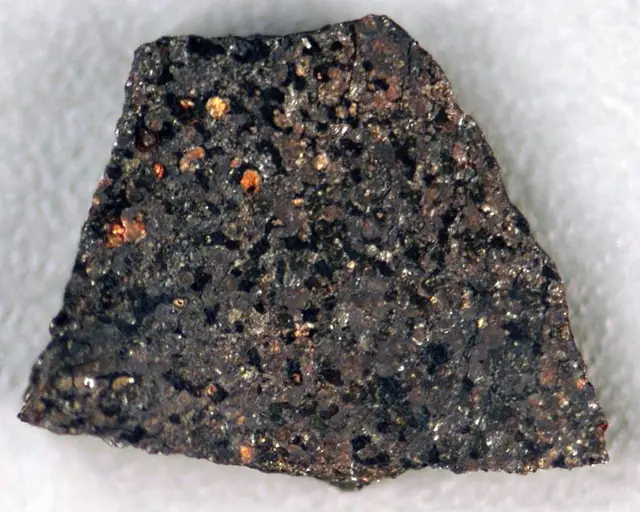
Acapulcoite
Stony meteorites that began to melt but never fully did: metal-veined primitive achondrites, named after a stone that fell near Acapulco in 1976.
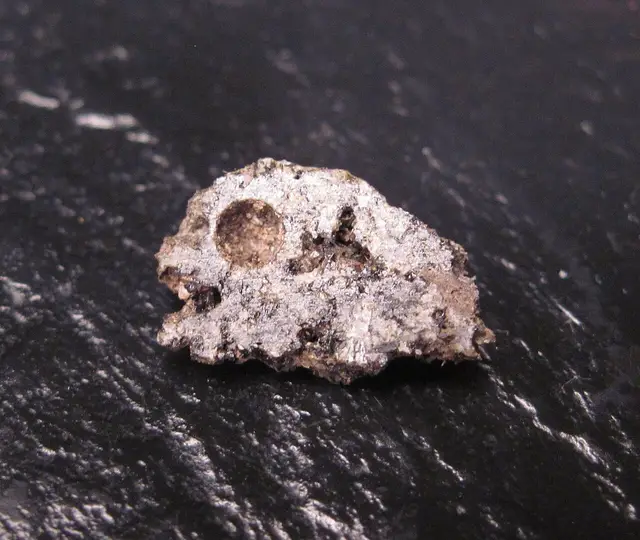
Angrite
The oldest known igneous rocks: rare basaltic meteorites that crystallised about 4.56 billion years ago, in the very earliest days of the Solar System.

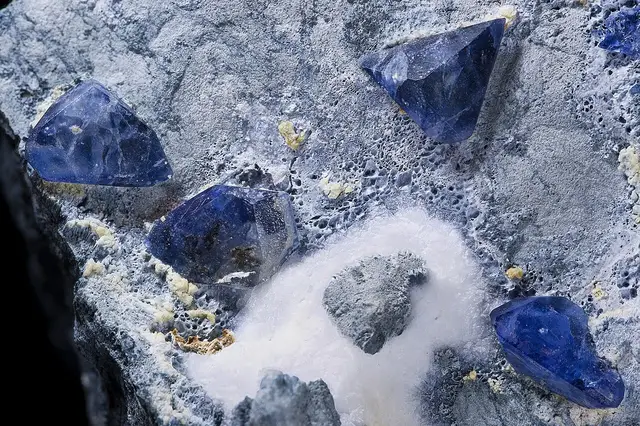
Benitoite
A sapphire-like blue stone whose gem crystals come from a single mine in the world: the official state gem of California.