Meteorite
CI chondrite
CI kondrit
Black stones carrying the make-up of the Sun: watery, chondrule-free meteorites, the most primitive known.
Also known as: C1 chondrite · Ivuna-type carbonaceous chondrite
- Popularly: Meteorite

In short
CI chondrites (C1 or Ivuna-type carbonaceous chondrites) are a very rare group of carbonaceous chondrites, named after their type specimen, the Ivuna meteorite from Tanzania. They are the most chemically primitive meteorites known: their elemental composition, apart from gases, closely matches the Sun's. That makes them the standard reference for cosmic element abundances in planetary science. Orgueil, Alais, Ivuna, Tonk and Revelstoke are the known members of the group.
Photos

How does it form?
CI chondrites come from an asteroid that formed at the start of the Solar System and never melted. On their parent body, liquid water seeped in through cracks and altered the rock almost completely: chondrules, calcium–aluminium-rich inclusions and olivine aggregates disappeared, replaced by clay-like water-bearing minerals. The water left veins filled with sulfate minerals in the cracks.
Despite this heavy alteration, CI chondrites have kept the Solar System’s original elemental composition. Their oxygen isotopes clearly set them apart from other meteorite groups. Which asteroid is their parent body is still debated.
What is it used for?
- Cosmic element abundances: They are the standard reference material for the composition of the Solar System.
- Water and organic matter: They help study how water and carbon compounds formed in the early Solar System.
- Origin of life: Their organic compounds are studied in debates on the origin of life’s building blocks.
Known CI chondrites
The known falls of this group are Orgueil (France, 1864), Alais (France, 1806), Ivuna (Tanzania), Tonk (India) and Revelstoke (Canada), together with CI-like specimens found in Antarctica. The largest and most studied is the 14-kilogram Orgueil.
What determines its value?
CI chondrites are extremely rare: the number of known specimens is debated (between 5 and a little over 10), and their total known weight is about 17 kilograms. Their scientific value is very high, and their specimens are kept in museums and research institutions.
This information is educational, not buying, selling or investment advice. Value varies enormously with quality and treatment.
How to recognise it
- 1
A coal-black stone made of a fine, clay-like matrix.
- 2
Heavily altered by water, they contain no visible chondrules.
- 3
Only laboratory study of its chemistry and oxygen isotopes can show that a stone is a CI chondrite.
Myths and misconceptions
MythCarbonaceous chondrites are the most carbon-rich meteorites.
FactCI chondrites hold the most carbon among carbonaceous chondrites (3–5% by weight), but some ureilites carry even more. The name “carbonaceous” was given to set them apart from the ordinary chondrites.
Did you know?
They hold 18–20% water by weight, more than comet 67P/Churyumov–Gerasimenko.
Ivuna and Orgueil contain ancient liquids trapped inside crystals, the only surviving direct samples of brines from the early Solar System.
The Alais meteorite (France, 1806) was the first carbonaceous chondrite identified.
Where is it found?
Loading map…
- Orgueil, Tarn-et-Garonne, France · Major depositThe largest and most studied CI chondrite (14 kg), which fell on 14 May 1864.
- Alès (Alais), Gard, France · Historic sourceAlais, which fell on 15 March 1806, was the first carbonaceous chondrite identified; 6 kg fell, but only 0.26 kg remains today.
Locations are approximate to protect sites. Red dots mark places in Türkiye. Open in the big map →
Frequently asked questions
What is cI chondrite?
CI chondrites (C1 or Ivuna-type carbonaceous chondrites) are a very rare group of carbonaceous chondrites, named after their type specimen, the Ivuna meteorite from Tanzania. They are the most chemically primitive meteorites known: their elemental composition, apart from gases, closely matches the Sun's. That makes them the standard reference for cosmic element abundances in planetary science. Orgueil, Alais, Ivuna, Tonk and Revelstoke are the known members of the group.
Why are CI chondrites so important?
Although heavily altered by water, they have kept the Solar System's original elemental composition. That is why they are the standard reference material for element abundances in the Solar System. They also hold clues to the origin of volatiles and perhaps of life's building blocks.
What is cI chondrite used for?
Cosmic element abundances: They are the standard reference material for the composition of the Solar System. Water and organic matter: They help study how water and carbon compounds formed in the early Solar System. Origin of life: Their organic compounds are studied in debates on the origin of life's building blocks.
How hard is cI chondrite?
It has a hardness of 2.5–7 on the Mohs scale. It can scratch glass; a steel knife scratches it only with difficulty. Its specific gravity is 2.11 g/cm³.
Where is cI chondrite found?
Its best-known localities: Orgueil, Tarn-et-Garonne, France; Alès (Alais), Gard, France.
How can you tell if cI chondrite is real?
A coal-black stone made of a fine, clay-like matrix. Heavily altered by water, they contain no visible chondrules. Only laboratory study of its chemistry and oxygen isotopes can show that a stone is a CI chondrite.
Is cI chondrite valuable?
On the “street to diamond” value ladder it sits on step 7 of nine: Precious stone. CI chondrites are extremely rare: the number of known specimens is debated (between 5 and a little over 10), and their total known weight is about 17 kilograms. Their scientific value is very high, and their specimens are kept in museums and research institutions.
Sources
- CI chondrite · Wikipedia
- CI kondrit · Vikipedi
- Alais meteorite · Wikipedia
- Orgueil (meteorite) · Wikipedia
- Meteorite porosities and densities: a review of trends in the data (D. T. Britt & G. J. Consolmagno), Lunar and Planetary Science XXXV, abstract 2108 · Lunar and Planetary Institute, 2004
- Handbook of Mineralogy: Forsterite · Mineralogical Society of America
External links
Draft: awaiting expert reviewReport an error
On the same step
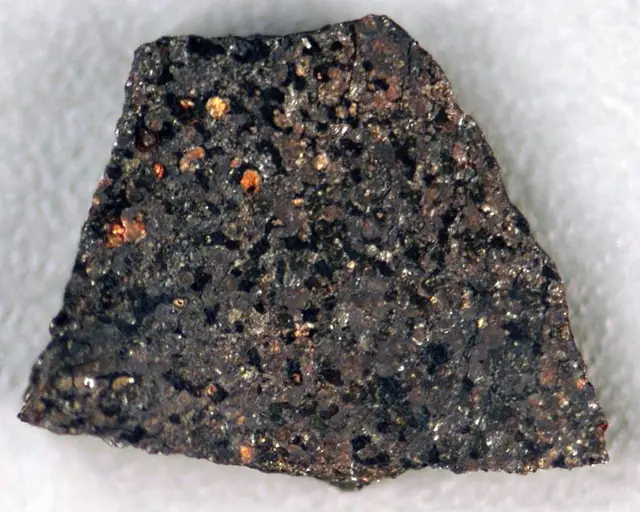
Acapulcoite
Stony meteorites that began to melt but never fully did: metal-veined primitive achondrites, named after a stone that fell near Acapulco in 1976.
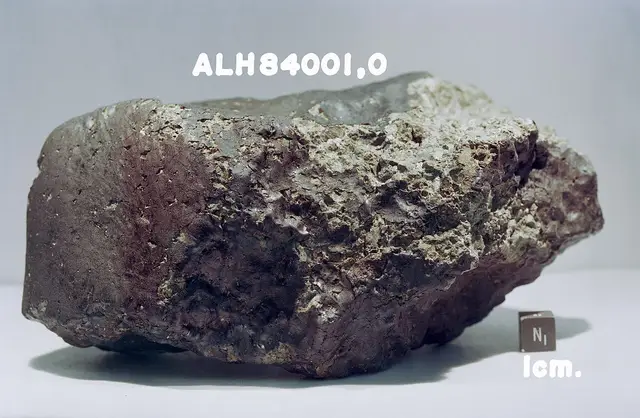
Allan Hills 84001
The stone that sparked the Mars-life debate: a 4-billion-year-old Martian meteorite from Antarctica whose tiny structures were likened to fossil bacteria in 1996.
Angrite
The oldest known igneous rocks: rare basaltic meteorites that crystallised about 4.56 billion years ago, in the very earliest days of the Solar System.