Meteorite
Acapulcoite
Akapulkoit
Stony meteorites that began to melt but never fully did: metal-veined primitive achondrites, named after a stone that fell near Acapulco in 1976.
- Popularly: Meteorite

In short
Acapulcoites are a group of the primitive achondrite class of stony meteorites. They are named after the meteorite that fell near Acapulco, Mexico, on 11 August 1976, the group's only witnessed fall. They consist mainly of olivine, orthopyroxene, plagioclase, nickel–iron metal and troilite. Although they were partly melted and recrystallised, their chemistry is still close to that of chondrites, and some even show relict chondrules. More than 90 meteorites have since been classified as acapulcoites.
Photos

How does it form?
Acapulcoites formed when a parent body of chondritic composition heated up and partly melted. The silicates are cut by veins of nickel–iron metal and sulphide, from micrometres to centimetres thick. Phosphate minerals are associated with these veins and even form separate veins, as in the Monument Draw and Acapulco specimens.
The rocks then recrystallised and gained an equigranular texture. The texture of the metal points to rapid cooling between 600 and 400 °C, at roughly 1,000 to 100,000 °C per million years. Rare relict chondrules are preserved in some specimens, such as Monument Draw and Yamato 74063.
Acapulcoites come from the same parent body as their close relatives, the lodranites; this body is thought to have resembled an S-type asteroid. Lodranites are coarser-grained and point to higher temperatures, so they are thought to come from deeper within the parent body.
What is it used for?
- How planets first heated up: Acapulcoites show how a chondritic body began to melt, the intermediate stage between a chondrite and a fully melted achondrite.
- The timeline of the early Solar System: The cooling history of their parent body can be traced with radiometric dating; the hafnium–tungsten method shows that it cooled below about 1,000 °C between 4,563.1 and 4,562.6 million years ago.
- Links to asteroids: They are compared with the spectra of S-type asteroids.
The Acapulco meteorite
Acapulco fell at about 11 in the morning on 11 August 1976 in El Quemado Colony, just outside Acapulco in the state of Guerrero, Mexico. The fireball travelled from west to east. Witnesses heard a buzz like that of a small aeroplane and an impact like that of a cannon ball. The 1,914-gram stone was collected 15 minutes later from a small crater about 30 cm deep; the bush around it had been splashed radially away, and the stone was cool to the touch. Acapulco is the group’s only witnessed fall.
What determines its value?
Acapulcoites are rare meteorites: a little over 90 have been classified so far, and only one of them, Acapulco, is a witnessed fall. A specimen's value depends on its mass, its freshness and how well the metal veins and texture show on a cut face.
This information is educational, not buying, selling or investment advice. Value varies enormously with quality and treatment.
How to recognise it
- 1
The fusion crust is usually dark brown or dull black and gives no hint as to the true nature of the meteorite.
- 2
At first glance it resembles a metal-rich, highly recrystallised chondrite, but it is coarser-grained and has no chondrules, or only a few.
- 3
Veins of nickel–iron metal from micrometres to centimetres thick are common on a cut face.
Myths and misconceptions
MythYou can tell what kind of meteorite a stone is by looking at its outside.
FactThe dark brown or dull black fusion crust of an acapulcoite gives no hint of the meteorite's true nature. Identifying the type requires cutting the stone, examining the inside and analysing it in a laboratory.
Did you know?
Witnesses of the Acapulco fall described a buzz like that of a small aeroplane and an impact like that of a cannon ball.
The stone was collected 15 minutes after the fall from a small crater 30 cm deep; the bush around it had been splashed radially away, and the stone was cool.
The acapulcoite parent body is calculated to have accreted about 1.5 to 2 million years after the first solids of the Solar System formed.
Where is it found?
Loading map…
- El Quemado, near Acapulco, Guerrero, Mexico · Type localityThe 1,914-gram stone that fell on the morning of 11 August 1976 and gave the group its name; it was picked up cool from a small crater 30 cm deep 15 minutes later. It is the group's only witnessed fall.
Locations are approximate to protect sites. Red dots mark places in Türkiye. Open in the big map →
Frequently asked questions
What is acapulcoite?
Acapulcoites are a group of the primitive achondrite class of stony meteorites. They are named after the meteorite that fell near Acapulco, Mexico, on 11 August 1976, the group's only witnessed fall. They consist mainly of olivine, orthopyroxene, plagioclase, nickel–iron metal and troilite. Although they were partly melted and recrystallised, their chemistry is still close to that of chondrites, and some even show relict chondrules. More than 90 meteorites have since been classified as acapulcoites.
Why are acapulcoites called “primitive” achondrites?
Because they began to melt but kept much of their chondritic character. Their chemistry is close to that of chondrites and some contain relict chondrules. Unlike ordinary achondrites, which crystallised from magma, they formed through partial melting and recrystallisation.
What is acapulcoite used for?
How planets first heated up: Acapulcoites show how a chondritic body began to melt, the intermediate stage between a chondrite and a fully melted achondrite. The timeline of the early Solar System: The cooling history of their parent body can be traced with radiometric dating; the hafnium–tungsten method shows that it cooled below about 1,000 °C between 4,563.1 and 4,562.6 million years ago. Links to asteroids: They are compared with the spectra of S-type asteroids.
How hard is acapulcoite?
It has a hardness of 5–7 on the Mohs scale. It can scratch glass; a steel knife scratches it only with difficulty. Its specific gravity is 3.15–3.85 g/cm³.
Where is acapulcoite found?
Its best-known localities: El Quemado, near Acapulco, Guerrero, Mexico.
How can you tell if acapulcoite is real?
The fusion crust is usually dark brown or dull black and gives no hint as to the true nature of the meteorite. At first glance it resembles a metal-rich, highly recrystallised chondrite, but it is coarser-grained and has no chondrules, or only a few. Veins of nickel–iron metal from micrometres to centimetres thick are common on a cut face.
Is acapulcoite valuable?
On the “street to diamond” value ladder it sits on step 7 of nine: Precious stone. Acapulcoites are rare meteorites: a little over 90 have been classified so far, and only one of them, Acapulco, is a witnessed fall. A specimen's value depends on its mass, its freshness and how well the metal veins and texture show on a cut face.
Sources
- Acapulcoite · Wikipedia
- Akapulkoit · Vikipedi
- Acapulco · Center for Meteorite Studies, Arizona State University
- Acapulcoites – composition · Meteorites.tv (Thomas Grau)
- Primitive achondrite · Wikipedia
- Lodranite · Wikipedia
- Spectral properties and mineral compositions of acapulcoite–lodranite clan meteorites: Establishing S-type asteroid–meteorite connections (Lucas et al.), Meteoritics & Planetary Science · Wiley, 2019
- Physical properties of the stone meteorites: Implications for the properties of their parent bodies (G. J. Flynn, G. J. Consolmagno, P. Brown, R. J. Macke), Chemie der Erde – Geochemistry 78 · NASA Technical Reports Server, 2018
- Handbook of Mineralogy: Enstatite · Mineralogical Society of America
- Handbook of Mineralogy: Forsterite · Mineralogical Society of America
External links
Draft: awaiting expert reviewReport an error
On the same step
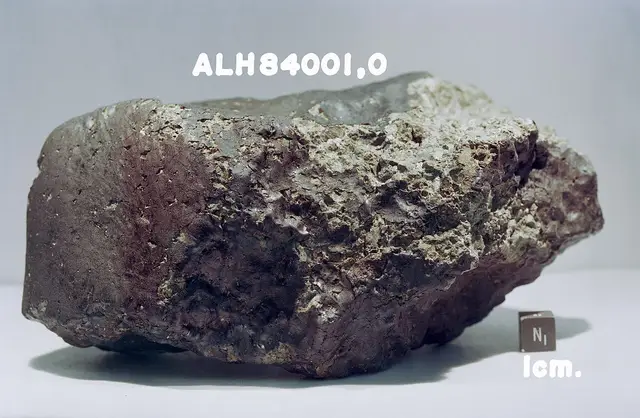
Allan Hills 84001
The stone that sparked the Mars-life debate: a 4-billion-year-old Martian meteorite from Antarctica whose tiny structures were likened to fossil bacteria in 1996.
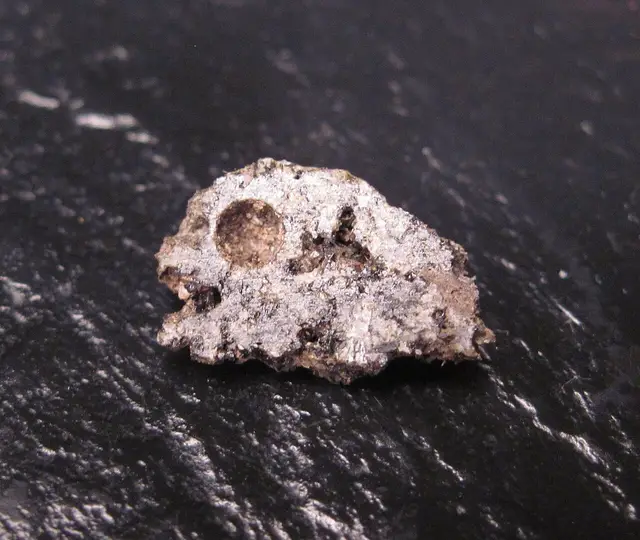
Angrite
The oldest known igneous rocks: rare basaltic meteorites that crystallised about 4.56 billion years ago, in the very earliest days of the Solar System.

Benitoite
A sapphire-like blue stone whose gem crystals come from a single mine in the world: the official state gem of California.