VarietyA variety of Plagioclase
Sunstone
NaAlSi₃O₈ – CaAl₂Si₂O₈Güneş taşı
A feldspar that glitters like the sun with tiny metal flakes inside: the state gem of Oregon, and quite different from the Vikings' “sunstone”.
Also known as: Aventurine feldspar · Oregon sunstone (the copper-bearing labradorite of Oregon)
- Popularly: Semi-precious stone
- Gemstone
- Ornamental
In short
Sunstone is a feldspar that contains very small, flat metallic platelets (copper, hematite or goethite) that reflect light as glitter. As the stone is turned, these platelets flash in gold, orange and red; the effect is called aventurescence. Most sunstone is plagioclase: the Norwegian and Indian stones are oligoclase, while the Oregon stones, from the US state of Oregon, are copper-bearing labradorite. Rarely, potassium feldspars (orthoclase or microcline) show the same effect.
Photos
How does it form?
Oregon sunstone occurs in basalt flows, rich in large feldspar crystals (porphyritic), that formed during widespread basalt eruptions some 15–17 million years ago (in the Miocene). According to GIA’s field report the stone is about 70% anorthite and 30% albite, which puts it in the labradorite part of the plagioclase series. As the lava cooled, copper separated out inside the feldspar as flat platelets of metallic copper; these platelets, and the colours copper gives, produce the stone’s glitter and its red and green tones. In Norway sunstone occurs in masses embedded in a quartz vein that cuts through gneiss.
What is it used for?
- Jewellery: It is used in cabochons, beads and carvings; faceted stones are also cut from Oregon’s large, coloured crystals. Because it has distinct cleavage, it needs protection from knocks.
- Collecting: Oregon stones showing red and green together, with glittering copper platelets, are sought by collectors.
- Local symbol: Oregon sunstone has been the state’s official gemstone since 1987 and is promoted as an untreated stone mined in Oregon.
How does the glitter arise?
The glitter of sunstone is called aventurescence. Very thin, flat metallic platelets (copper, hematite or goethite), lined up parallel inside the stone, reflect the light. According to GIA, smaller platelets give a reddish or golden sheen and larger ones a glittering sparkle. This differs from the play of colour in labradorite: in labradorite the colours come from light interference in thin layers (see the labradorite page), while in sunstone individual platelets reflect the light.
The name “sunstone” and the Vikings
The stone is named for its glittering, sun-like look. The “sunstone” (sólarsteinn) in Icelandic sources of the 13th and 14th centuries is something else: a stone said to help find the Sun in overcast weather, which by one hypothesis could have been Iceland spar or cordierite, minerals that polarise light. A link between the two has not been proven.
What determines its value?
Value depends mostly on colour and glitter: in Oregon stones vivid red or green, bicolour stones with red and green together, and a rich display of glittering copper platelets (schiller) are sought. Because the red and green colours and the schiller are mostly confined to the core of the crystal, large, clean, coloured stones are rare. Cut quality, size and clarity also matter. Because of the copper-diffused “andesine” episode, it is important that a stone is stated to be natural and untreated.
This information is educational, not buying, selling or investment advice. Value varies enormously with quality and treatment.
How to recognise it
- 1
Turn the stone in the light and the small, flat platelets inside flash gold, orange or red; the effect is visible from certain angles.
- 2
The body colour is usually yellow, orange or reddish brown; Oregon stones can be red and green, sometimes both colours in one stone.
- 3
Its hardness is 6–6.5; with distinct cleavage in two directions (one perfect, one good) it is sensitive to knocks.
- 4
It can be confused with aventurine quartz and aventurine glass; refractive index and a gem-laboratory examination are needed for a firm answer.
Fakes and imitations
What shops usually don’t tell you:
- Copper-diffused “andesine”: in the early 2000s most of the red and green stones sold as “andesine”, said to come from Congo or Tibet, had been coloured by diffusing copper into pale feldspar. They shook trust in Oregon sunstone.
- Aventurine glass (goldstone): made by adding metal flakes such as copper to glass, it imitates the glitter of sunstone.
- The name “sunstone” is sometimes used for other glittering stones; remember that the name alone does not guarantee that a stone is a feldspar.
Myths and misconceptions
MythThe Vikings navigated at sea with sunstone, and this is the glittering sunstone feldspar.
FactThe “sunstone” (sólarsteinn) mentioned in 13th- and 14th-century Icelandic sources is described as a stone used to find the Sun in overcast weather. One hypothesis is that it was Iceland spar (calcite) or cordierite, which polarise light; the texts do not say which mineral it was. That the stone was used for navigation in the Viking Age is a hypothesis, not a proven fact.
MythThe red and green stones sold as “andesine” are natural sunstone.
FactIn the early 2000s most stones sold under this name had been coloured by diffusing copper into pale feldspar. A genuine Tibetan source of untreated red andesine was later verified, but whether a stone on the market is natural can only be decided by a laboratory.
MythSunstone is a mineral in its own right.
FactSunstone is not a mineral but the name of a light effect (aventurescence). Most of it is plagioclase (oligoclase, labradorite); more rarely orthoclase or microcline show the same glitter.
What is it believed to be good for?
This section reports beliefs; it is not health information. There is no scientific evidence for these claims and no stone replaces medical treatment.
The meanings people give this stone, and who holds them:
- Kunz writes that Eastern peoples believed stones with remarkable light effects (cat's-eye, star sapphire and the like) brought good fortune; when he assigns such stones to the days of the week, Sunday goes to sunstone.
- Today crystal-therapy sources claim that sunstone gives joy, vitality and optimism and strengthens self-confidence and leadership.
- The same circles say that sunstone brings luck and abundance.
- Some sources claim that sunstone helps with seasonal affective disorder, depression and despair, and absorbs anxiety, fear and anger.
What science says
There is no scientific evidence that sunstone brings joy, luck, vitality or courage. Seasonal affective disorder and depression are medical problems; see a doctor rather than relying on a stone. The “sun” comparison comes from the metallic platelets in the stone reflecting light; no light or energy comes out of the stone itself.
Did you know?
On 4 August 1987 the Oregon State Legislature designated Oregon sunstone as the state gemstone.
At the Sunstone Butte mine in Oregon, crystals often reach 100 carats and sometimes up to 500 carats.
Where is it found?
Loading map…
- Plush area (Dust Devil and Sunstone Butte mines), Lake County, Oregon, USA · Major depositWorking mining areas of Oregon sunstone, the copper-bearing labradorite; shown at region level
- Ponderosa mine area, near Burns, Harney County, Oregon, USA · Major depositOne of Oregon's three sunstone mines; shown at region level because it is a working mine
- Tvedestrand, Agder, Norway · Historic sourceFor a long time the best-known locality of oligoclase sunstone, in masses embedded in a quartz vein cutting gneiss
- Tamil Nadu, India · Known localityAccording to GIA it yields aventurine feldspar with a red-brown body colour and bright glitter; shown at state level
- Lake Baikal area, Siberia, Russia · Known localityOne of the places in Siberia where sunstone occurs; shown at region level
- Middletown Township, Delaware County, Pennsylvania, USA · Known locality
- Statesville, North Carolina, USA · Known locality
Locations are approximate to protect sites. Red dots mark places in Türkiye. Open in the big map →
Frequently asked questions
What is sunstone?
Sunstone is a feldspar that contains very small, flat metallic platelets (copper, hematite or goethite) that reflect light as glitter. As the stone is turned, these platelets flash in gold, orange and red; the effect is called aventurescence. Most sunstone is plagioclase: the Norwegian and Indian stones are oligoclase, while the Oregon stones, from the US state of Oregon, are copper-bearing labradorite. Rarely, potassium feldspars (orthoclase or microcline) show the same effect.
What is sunstone used for?
Jewellery: It is used in cabochons, beads and carvings; faceted stones are also cut from Oregon's large, coloured crystals. Because it has distinct cleavage, it needs protection from knocks. Collecting: Oregon stones showing red and green together, with glittering copper platelets, are sought by collectors. Local symbol: Oregon sunstone has been the state's official gemstone since 1987 and is promoted as an untreated stone mined in Oregon.
How hard is sunstone?
It has a hardness of 6–6.5 on the Mohs scale. It can scratch glass; a steel knife scratches it only with difficulty. Its specific gravity is 2.62–2.76 g/cm³.
Where is sunstone found?
Its best-known localities: Plush area (Dust Devil and Sunstone Butte mines), Lake County, Oregon, USA; Ponderosa mine area, near Burns, Harney County, Oregon, USA; Tvedestrand, Agder, Norway; Tamil Nadu, India; Lake Baikal area, Siberia, Russia.
How can you tell if sunstone is real?
Turn the stone in the light and the small, flat platelets inside flash gold, orange or red; the effect is visible from certain angles. The body colour is usually yellow, orange or reddish brown; Oregon stones can be red and green, sometimes both colours in one stone. Its hardness is 6–6.5; with distinct cleavage in two directions (one perfect, one good) it is sensitive to knocks. Copper-diffused “andesine”: in the early 2000s most of the red and green stones sold as “andesine”, said to come from Congo or Tibet, had been coloured by diffusing copper into pale feldspar. They shook trust in Oregon sunstone.
Is sunstone valuable?
On the “street to diamond” value ladder it sits on step 5 of nine: Ornamental stone. Value depends mostly on colour and glitter: in Oregon stones vivid red or green, bicolour stones with red and green together, and a rich display of glittering copper platelets (schiller) are sought. Because the red and green colours and the schiller are mostly confined to the core of the crystal, large, clean, coloured stones are rare. Cut quality, size and clarity also matter. Because of the copper-diffused “andesine” episode, it is important that a stone is stated to be natural and untreated.
What is sunstone good for?
Kunz writes that Eastern peoples believed stones with remarkable light effects (cat's-eye, star sapphire and the like) brought good fortune; when he assigns such stones to the days of the week, Sunday goes to sunstone. Today crystal-therapy sources claim that sunstone gives joy, vitality and optimism and strengthens self-confidence and leadership. The same circles say that sunstone brings luck and abundance. Some sources claim that sunstone helps with seasonal affective disorder, depression and despair, and absorbs anxiety, fear and anger. There is no scientific evidence that sunstone brings joy, luck, vitality or courage. Seasonal affective disorder and depression are medical problems; see a doctor rather than relying on a stone. The “sun” comparison comes from the metallic platelets in the stone reflecting light; no light or energy comes out of the stone itself. This section reports beliefs; it is not health information. There is no scientific evidence for these claims and no stone replaces medical treatment.
Family

_1.jpg)
Sources
- Sunstone Description (Gem Encyclopedia) · GIA
- Three Occurrences of Oregon Sunstone (D. Pay, R. Weldon, S. McClure, K. Schumacher), Gems & Gemology 49(3) · GIA, 2013
- Sunstone · Wikipedia
- Güneş taşı · Vikipedi
- Sunstone (medieval) · Wikipedia
- The Curious Lore of Precious Stones (G. F. Kunz) · J. B. Lippincott Company; Project Gutenberg, 1913
- Tvedestrand · Wikipedia
External links
Draft: awaiting expert reviewReport an error ↗
On the same step
Agate
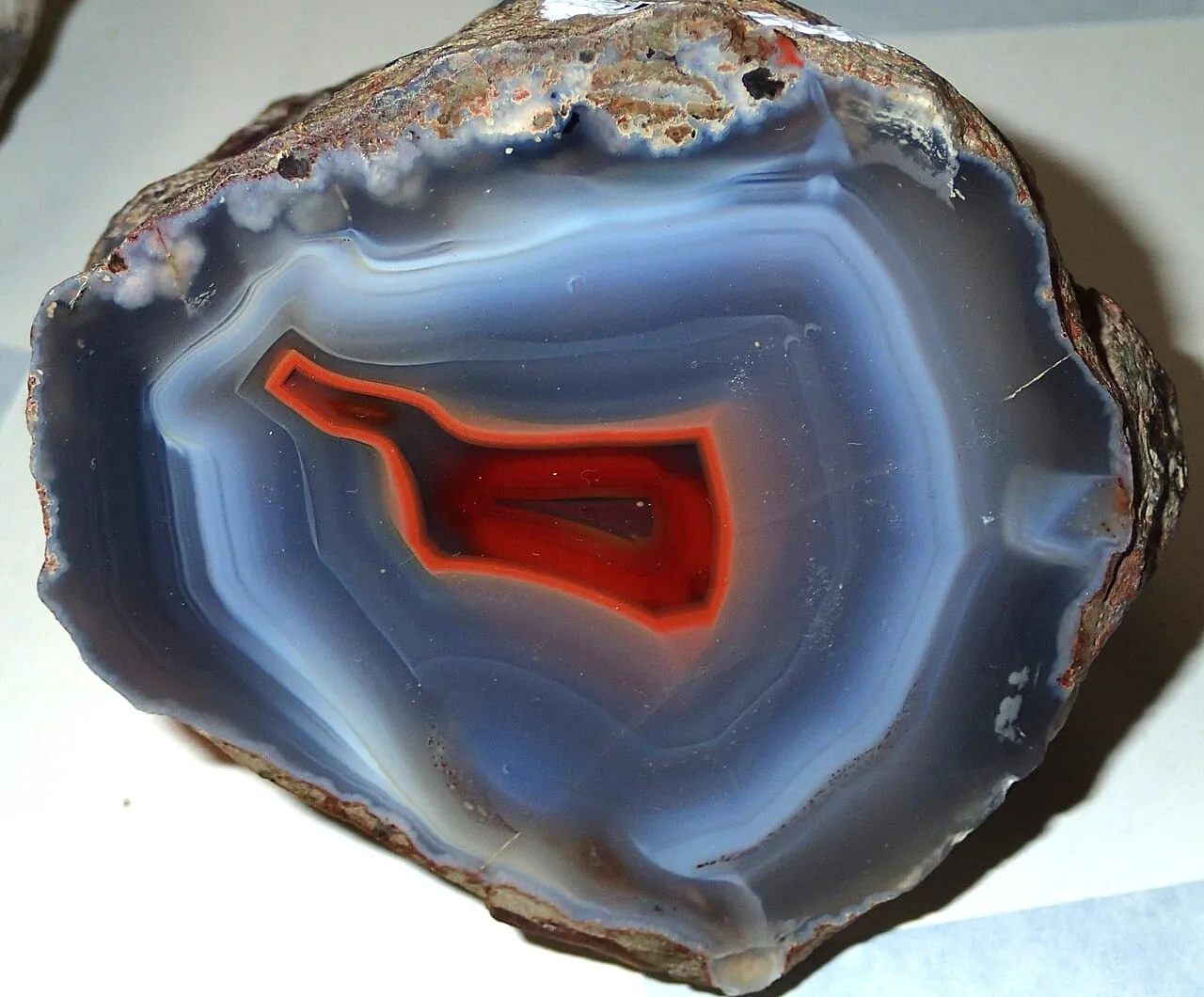
The banded variety of chalcedony: it grows layer by layer in hollows in volcanic rock and shows a new pattern every time it is cut.
Almandine
The commonest garnet: a deep red, iron-rich stone named after the ancient city of Alabanda in Anatolia, used in jewellery and in sandpaper alike.
Amazonite
A turquoise-like green-blue feldspar: a variety of microcline worn as jewellery for more than three thousand years, but it can release lead.