VarietyA variety of Topaz
Imperial topaz
Al₂SiO₄(F,OH)₂İmparator topazı
Topaz in its most sought-after colours, from orange and reddish orange to pink and sherry red, coming mostly from Ouro Preto in Brazil.
- Popularly: Semi-precious stone
In short
Imperial topaz is the trade name for natural topaz in orange, reddish orange, pink and red. According to GIA, its only known commercial source is the Ouro Preto area in the Brazilian state of Minas Gerais, where topaz has been mined for more than 200 years. Pinks, reds and purplish tones come from traces of chromium in the crystal; yellows and oranges come from defects in the crystal structure called colour centres. The name has no fixed standard; in GIA's words, it is the colour, not the term “imperial”, that gives topaz its value.
Photos
How does it form?
Imperial topaz formed within Precambrian metamorphosed sedimentary rocks around Ouro Preto. Hot, fluorine-rich fluids moving through fractures deposited the topaz in veins containing quartz, hematite, dolomite and euclase. According to one study the topaz crystallised at about 360 °C; the fluorine and beryllium it needed came from fluids released during the Brasiliano mountain-building event about 600 million years ago.
Later, very deep tropical weathering turned the rocks into clayey soil to a depth of at least 50 metres. Today the topaz crystals are found in white kaolinite veins and lens-shaped masses within this brown, clayey rock, together with quartz, mica and shiny hematite. Miners treat a white kaolinite vein as a sign that topaz is near.
What is it used for?
- Jewellery: hard and brilliant, it is used as a precious stone in rings, necklaces and earrings. Commercial sizes are mostly 2–8 carats; stones of 20–30 carats are rare.
- Museums and collecting: large, well-coloured stones are displayed in museums. In 2018 the Smithsonian Institution added the vivid red, 48.86-carat “Whitney Flame” topaz to its collection.
- History: stones from Ouro Preto were set in church and court jewellery in Portugal by the mid-18th century, and in the 19th century imperial topaz became a recognised product on the European gem market.
Colours and heat treatment
Ouro Preto topaz covers a wide range of colours, from light yellow through orange, peach and pink to reddish orange and sherry red; in the trade all of them are sold as “imperial”. The commonest are yellow to orange. Pink, red and purple tones come from traces of chromium; yellows and oranges come from colour centres that heating can remove.
This is why some brownish-yellow or orange stones turn pink when heated. However, stones containing fluid inclusions can crack when heated, so most topaz is not suitable for this treatment.
Where is it found?
Today the Ouro Preto area is the only known commercial source of imperial topaz. The deposits are spread over some 120 square kilometres, mostly west of the town; the largest mines are Capão, near the village of Rodrigo Silva, and Vermelhão, near Ouro Preto. The Ural Mountains of Russia were important in the past, but are of very limited commercial significance today. Pink topaz from Katlang in the Mardan district of Pakistan shows similar properties, and small amounts of warm-coloured topaz also come from Nigeria and Sri Lanka. For topaz as a whole, see the topaz page.
What determines its value?
Colour matters most for imperial topaz: saturated reddish orange, sherry red and natural pink are the most sought after, while pale yellow and brownish stones are cheaper. Value per carat rises markedly above 2, 5 and 10 carats; large, clean red stones are very rare. Stones heated to pink are worth less than naturally pink ones and must be disclosed. Because “imperial” has no official definition, what counts is that the seller documents the stone's actual colour and any treatment rather than the name.
This information is educational, not buying, selling or investment advice. Value varies enormously with quality and treatment.
How to recognise it
- 1
As a topaz it is very hard (8) and scratches quartz. But it has perfect cleavage parallel to its base, so a hard knock can split it along a smooth plane.
- 2
Its colour can change with the viewing direction (pleochroism): yellow, yellowish orange and reddish pink may all show in one stone, so the cutter orients the stone to give the best colour.
- 3
Its specific gravity is about 3.5, so it feels clearly heavier than a citrine of the same size (about 2.65).
- 4
Hessonite and mandarin garnet, spessartine, fire opal and citrine can look similar; telling them apart with certainty needs a gemmological laboratory that checks refractive index, specific gravity and optical character.
Fakes and imitations
What shops usually don’t tell you:
- Heat-treated pink topaz: some brownish-yellow or orange topaz turns peach or pink when heated to about 565 °C. This is a common and accepted treatment, but such stones sell for less than naturally pink ones and must be disclosed.
- Citrine (yellow quartz) and coloured glass: their yellow-orange colours lead to them being sold as topaz; both are lighter and softer than topaz.
Myths and misconceptions
MythImperial topaz is named after the emperor of Brazil.
FactThe origin of the name is uncertain. According to GIA it arose in 19th-century Russia, from pink topaz of the Urals whose ownership was restricted to the tsar's family; in Brazil a separate story links the name to Dom Pedro. Neither account has been proven.
MythThe colour of pink imperial topaz is always natural.
FactNaturally pink stones exist but are rare. Some brownish-yellow or orange topaz is heated to turn it pink; such stones are worth less than natural pinks, and the treatment must be disclosed.
MythAny orange or pink topaz is imperial topaz.
FactThe name has no official standard: some dealers use it for every warm colour from orange to pink, red and purple, others only for certain saturated shades. According to GIA, it is the colour, not the name, that gives topaz its value.
What is it believed to be good for?
This section reports beliefs; it is not health information. There is no scientific evidence for these claims and no stone replaces medical treatment.
The meanings people give this stone, and who holds them:
- Today crystal-therapy websites claim that imperial topaz is linked to the sacral and solar plexus chakras, gives confidence, determination and creativity, and attracts abundance.
- The same websites say the stone relieves stress and anxiety and evens out emotional ups and downs.
What science says
There is no scientific evidence that imperial topaz brings confidence, creativity or abundance, or that it relieves stress; persistent anxiety or mood problems call for a doctor. The stone's warm colour comes from traces of chromium and from small defects in its crystal structure.
Did you know?
The discovery of topaz at Ouro Preto was first announced publicly in 1768.
Only 1–2 percent of the material recovered at the Capão mine is of faceting quality, and the most sought-after sherry-red stones make up less than half a percent of the cuttable material.
The rarest colour is pinkish purple to purple: about 200 grams of purple crystals found in 1996 were expected to yield no more than about 15 carats of cut stones.
According to one study, the imperial topaz of Ouro Preto crystallised at about 360 °C and at a pressure of some 3,500 times that at the Earth's surface.
Where is it found?
Loading map…
- Capão mine, Rodrigo Silva, Ouro Preto, Minas Gerais, Brazil · Major depositOne of the oldest and most productive mechanised imperial topaz mines of the district; the topaz lies in kaolinite veins in weathered rock
- Vermelhão (Saramenha) mine, Ouro Preto, Minas Gerais, Brazil · Major depositOne of the two largest topaz deposits around Ouro Preto; noted especially for its large crystals
- Ural Mountains, Russia · Historic sourceAccording to GIA, the name “imperial” arose in the 19th century from pink topaz mined in the Urals; today of very limited commercial significance
- Ghundao Hill, Katlang, Mardan, Pakistan · Known localityPink topaz with similar gemmological traits; told apart from Ouro Preto stones by trace-element analysis
- Nigeria · Known localitySmall quantities of golden to pinkish-orange topaz; no exact site is given
- Sri Lanka · Known localitySmall quantities of golden to pinkish-orange topaz; no exact site is given
Locations are approximate to protect sites. Red dots mark places in Türkiye. Open in the big map →
Frequently asked questions
What is imperial topaz?
Imperial topaz is the trade name for natural topaz in orange, reddish orange, pink and red. According to GIA, its only known commercial source is the Ouro Preto area in the Brazilian state of Minas Gerais, where topaz has been mined for more than 200 years. Pinks, reds and purplish tones come from traces of chromium in the crystal; yellows and oranges come from defects in the crystal structure called colour centres. The name has no fixed standard; in GIA's words, it is the colour, not the term “imperial”, that gives topaz its value.
What is imperial topaz used for?
Jewellery: hard and brilliant, it is used as a precious stone in rings, necklaces and earrings. Commercial sizes are mostly 2–8 carats; stones of 20–30 carats are rare. Museums and collecting: large, well-coloured stones are displayed in museums. In 2018 the Smithsonian Institution added the vivid red, 48.86-carat “Whitney Flame” topaz to its collection. History: stones from Ouro Preto were set in church and court jewellery in Portugal by the mid-18th century, and in the 19th century imperial topaz became a recognised product on the European gem market.
How hard is imperial topaz?
It has a hardness of 8 on the Mohs scale. It scratches glass and steel; a steel knife cannot scratch it. Its specific gravity is 3.49–3.57 g/cm³.
Where is imperial topaz found?
Its best-known localities: Capão mine, Rodrigo Silva, Ouro Preto, Minas Gerais, Brazil; Vermelhão (Saramenha) mine, Ouro Preto, Minas Gerais, Brazil; Ural Mountains, Russia; Ghundao Hill, Katlang, Mardan, Pakistan; Nigeria.
How can you tell if imperial topaz is real?
As a topaz it is very hard (8) and scratches quartz. But it has perfect cleavage parallel to its base, so a hard knock can split it along a smooth plane. Its colour can change with the viewing direction (pleochroism): yellow, yellowish orange and reddish pink may all show in one stone, so the cutter orients the stone to give the best colour. Its specific gravity is about 3.5, so it feels clearly heavier than a citrine of the same size (about 2.65). Heat-treated pink topaz: some brownish-yellow or orange topaz turns peach or pink when heated to about 565 °C. This is a common and accepted treatment, but such stones sell for less than naturally pink ones and must be disclosed.
Is imperial topaz valuable?
On the “street to diamond” value ladder it sits on step 7 of nine: Precious stone. Colour matters most for imperial topaz: saturated reddish orange, sherry red and natural pink are the most sought after, while pale yellow and brownish stones are cheaper. Value per carat rises markedly above 2, 5 and 10 carats; large, clean red stones are very rare. Stones heated to pink are worth less than naturally pink ones and must be disclosed. Because “imperial” has no official definition, what counts is that the seller documents the stone's actual colour and any treatment rather than the name.
What is imperial topaz good for?
Today crystal-therapy websites claim that imperial topaz is linked to the sacral and solar plexus chakras, gives confidence, determination and creativity, and attracts abundance. The same websites say the stone relieves stress and anxiety and evens out emotional ups and downs. There is no scientific evidence that imperial topaz brings confidence, creativity or abundance, or that it relieves stress; persistent anxiety or mood problems call for a doctor. The stone's warm colour comes from traces of chromium and from small defects in its crystal structure. This section reports beliefs; it is not health information. There is no scientific evidence for these claims and no stone replaces medical treatment.
Family


Sources
- Imperial topaz · Wikipedia
- An Update on Imperial Topaz from the Capão Mine, Minas Gerais, Brazil (D. A. Sauer, A. S. Keller, S. F. McClure), Gems & Gemology 32(4) · GIA, 1996
- The Capão Topaz Deposit, Ouro Preto, Minas Gerais, Brazil (P. C. Keller), Gems & Gemology 19(1) · GIA, 1983
- P,T,X conditions of crystallization of Imperial Topaz from Ouro Preto (Minas Gerais, Brazil) (G. Morteani, R. M. S. Bello, A. L. Gandini, C. Preinfalk), Schweizerische Mineralogische und Petrographische Mitteilungen · Technical University of Munich (publication record), 2002
- Topaz Description · GIA
- Topaz History and Lore · GIA
- What is Imperial topaz? (GIA FAQ) · GIA
- Handbook of Mineralogy: Topaz · Mineralogical Society of America
- Rodrigo Silva (Ouro Preto) · Wikipédia (Portuguese)
External links
Draft: awaiting expert reviewReport an error
On the same step

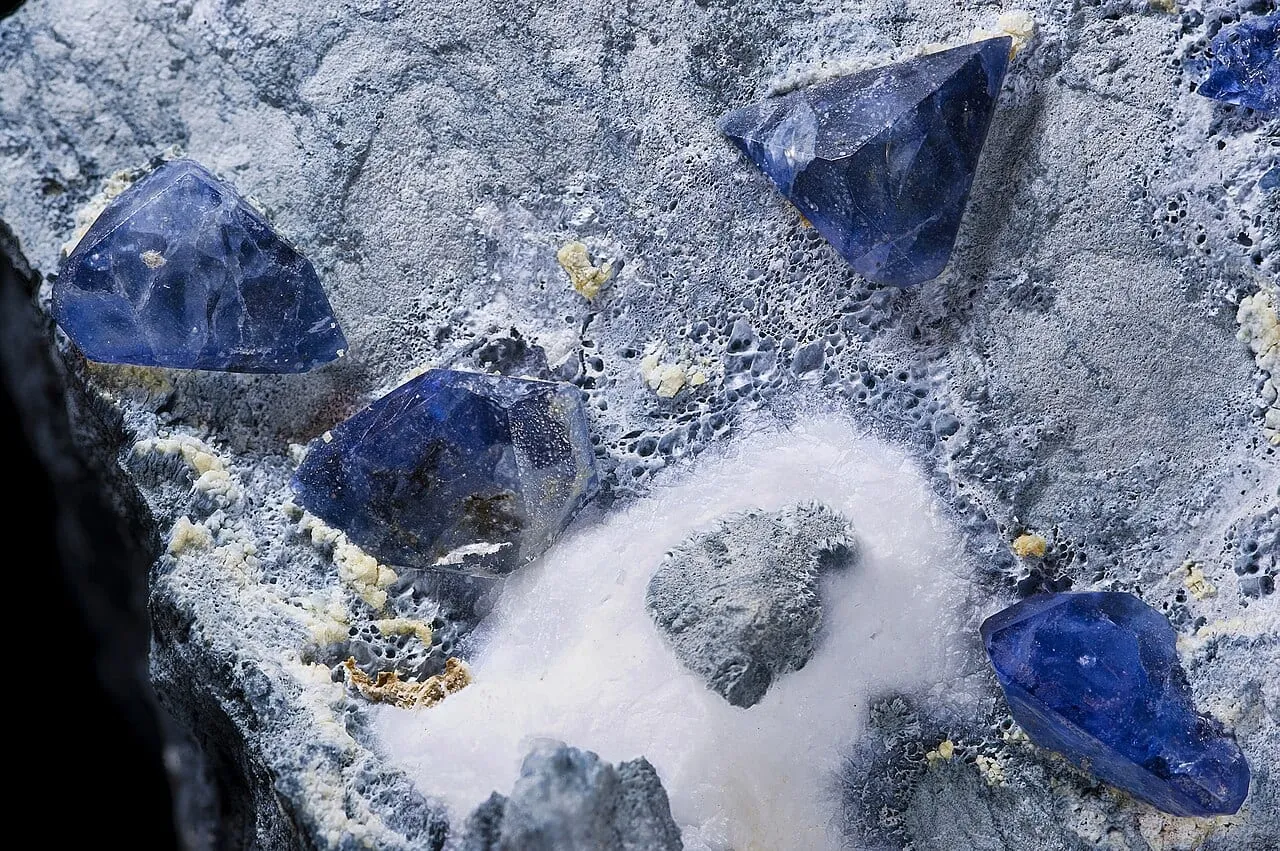
Benitoite
A sapphire-like blue stone whose gem crystals come from a single mine in the world: the official state gem of California.
Black opal
Play-of-colour glowing against a dark grey or black body: the rarest and usually most valuable kind of opal, mostly from Lightning Ridge in Australia.
Cat's-eye chrysoberyl
Chrysoberyl that shows a sharp band of light gliding across its domed surface: the gem meant when people simply say “cat's eye”.