Meteorite
Lodranite
Lodranit
Leftovers of chondrites that partly melted and lost some of their melt: coarse-grained, metal-rich primitive achondrites.
- Popularly: Meteorite

In short
Lodranites are a small group of primitive achondrites made of nickel–iron metal and silicate minerals, mostly olivine and pyroxene. The group is named after the town of Lodhran in Pakistan, where a meteorite fell on 1 October 1868. Like all primitive achondrites, they share similarities with both chondrites and achondrites. They are thought to come from the same parent body as their close relatives, the acapulcoites.
How does it form?
Lodranites can be described as chondrites that were heated to the point where nickel–iron metal and iron sulphide begin to melt together (the eutectic point). At this temperature partial melting began, and some of the metal and silicate melt was removed. The coarse-grained solid residue left behind formed the lodranites. Their composition relates them to the chondrites, and especially to the H chondrites.
Lodranites and acapulcoites come from the same parent body, which was probably similar to an S-type asteroid. Lodranites are coarser-grained and point to higher temperatures, so they are thought to come from deeper within the body. Trace elements show that the parent body had a complex geological history of partial melting, melt migration and metasomatism.
What is it used for?
- How planets first heated up: Lodranites show how a chondritic body partly melted and lost its melt, the stage between a chondrite and a fully melted achondrite.
- The timeline of the early Solar System: The hafnium–tungsten system in high-calcium pyroxenes shows that the parent body cooled below about 1,000 °C between 4,563.1 and 4,562.6 million years ago. This means it accreted about 1.5 to 2 million years after the first solids of the Solar System formed.
The Lodran meteorite
Lodran fell at 2 pm on 1 October 1868 near the town of Lodhran, in today’s Pakistan. The loud bang heard by eyewitnesses and the dust cloud rising to the east of the town led to the meteorite’s discovery and retrieval. Gustav Tschermak first described it in 1870. In Lodran, metal, olivine and pyroxene make up most of the volume in roughly equal amounts, together with sulphide, chromite, phosphide and chrome diopside.
What determines its value?
Lodranites are a very small group and rarely found. A specimen's value depends on its mass, its freshness, how well the metal and silicate grains show on a cut face, and whether it belongs to an observed fall such as Lodran.
This information is educational, not buying, selling or investment advice. Value varies enormously with quality and treatment.
How to recognise it
- 1
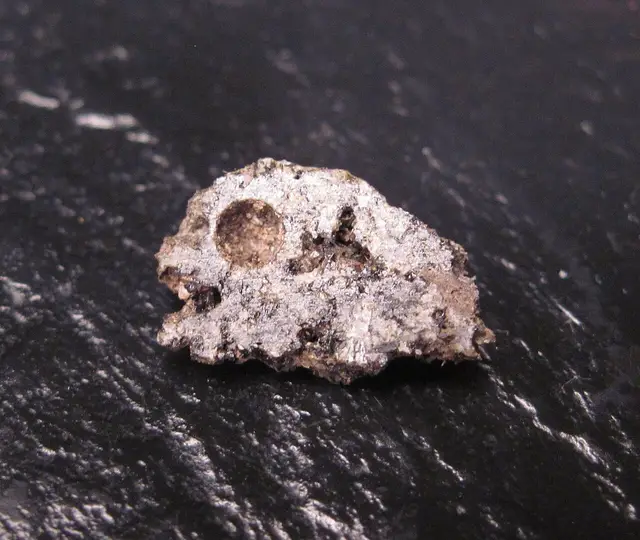
The fusion crust is brownish black; the interior of the Antarctic specimen QUE 93148 is a rich dark amber colour.
- 2
It has a coarse-grained crystalline texture, coarser than that of acapulcoites.
- 3
A cut face shows grains of nickel–iron metal among olivine and pyroxene grains. Only laboratory analysis can confirm the type.
Myths and misconceptions
MythAny stony meteorite containing metal is an iron meteorite.
FactStony meteorites such as lodranites can contain plenty of nickel–iron metal; in the Lodran meteorite, metal, olivine and pyroxene make up most of the volume in roughly equal amounts. Iron meteorites, by contrast, consist almost entirely of metal.
Did you know?
Witnesses of the Lodran fall reported a loud bang and a rising dust cloud to the east of the town, which led to the meteorite being found and recovered.
In 1870 the mineralogist Gustav Tschermak wrote that the Lodran stone was an olivine–bronzite aggregate never before found in a meteorite, similar only to terrestrial olivine rock.
Lodran long stood alone: George Thurland Prior classified it as the only member of the lodranite group and saw close similarities to the ureilites.
Where is it found?
Loading map…
- Lodhran, Punjab, Pakistan · Type localityThe meteorite that fell on the afternoon of 1 October 1868 and gave the group its name. Eyewitnesses reported a loud bang and a rising dust cloud to the east of the town. The point marks the town of Lodhran.
Locations are approximate to protect sites. Red dots mark places in Türkiye. Open in the big map →
Frequently asked questions
What is lodranite?
Lodranites are a small group of primitive achondrites made of nickel–iron metal and silicate minerals, mostly olivine and pyroxene. The group is named after the town of Lodhran in Pakistan, where a meteorite fell on 1 October 1868. Like all primitive achondrites, they share similarities with both chondrites and achondrites. They are thought to come from the same parent body as their close relatives, the acapulcoites.
What is the difference between lodranites and acapulcoites?
Both come from the same parent body. Lodranites are coarser-grained and give higher temperatures with isotopic methods, so they are thought to come from greater depths within the parent body. Lodranites are seen as residues left behind by partial melting.
What is lodranite used for?
How planets first heated up: Lodranites show how a chondritic body partly melted and lost its melt, the stage between a chondrite and a fully melted achondrite. The timeline of the early Solar System: The hafnium–tungsten system in high-calcium pyroxenes shows that the parent body cooled below about 1,000 °C between 4,563.1 and 4,562.6 million years ago. This means it accreted about 1.5 to 2 million years after the first solids of the Solar System formed.
How hard is lodranite?
It has a hardness of 5–7 on the Mohs scale. It can scratch glass; a steel knife scratches it only with difficulty. Its specific gravity is 3.15–3.85 g/cm³.
Where is lodranite found?
Its best-known localities: Lodhran, Punjab, Pakistan.
How can you tell if lodranite is real?
The fusion crust is brownish black; the interior of the Antarctic specimen QUE 93148 is a rich dark amber colour. It has a coarse-grained crystalline texture, coarser than that of acapulcoites. A cut face shows grains of nickel–iron metal among olivine and pyroxene grains. Only laboratory analysis can confirm the type.
Is lodranite valuable?
On the “street to diamond” value ladder it sits on step 7 of nine: Precious stone. Lodranites are a very small group and rarely found. A specimen's value depends on its mass, its freshness, how well the metal and silicate grains show on a cut face, and whether it belongs to an observed fall such as Lodran.
Sources
- Lodranite · Wikipedia
- Lodhran · Wikipedia
- Gustav Tschermak · Wikipedia
- Primitive achondrite · Wikipedia
- Antarctic Meteorite Newsletter, February 1995: petrographic descriptions (QUE 93148) · NASA Johnson Space Center, 1995
- Acapulcoites – composition · Meteorites.tv (Thomas Grau)
- Physical properties of the stone meteorites: Implications for the properties of their parent bodies (G. J. Flynn, G. J. Consolmagno, P. Brown, R. J. Macke), Chemie der Erde – Geochemistry 78 · NASA Technical Reports Server, 2018
- Handbook of Mineralogy: Enstatite · Mineralogical Society of America
- Handbook of Mineralogy: Forsterite · Mineralogical Society of America
External links
Draft: awaiting expert reviewReport an error
On the same step
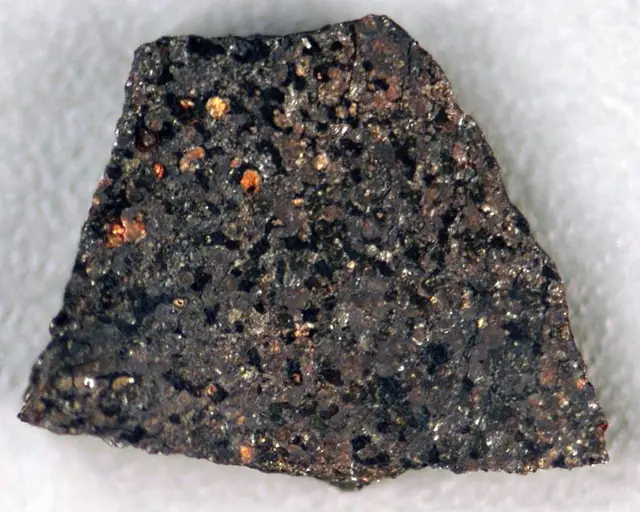
Acapulcoite
Stony meteorites that began to melt but never fully did: metal-veined primitive achondrites, named after a stone that fell near Acapulco in 1976.
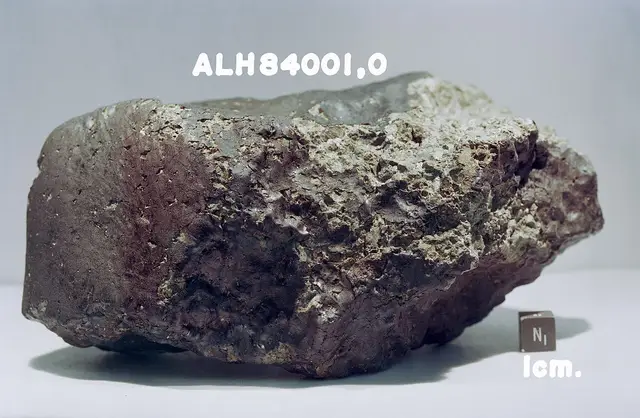
Allan Hills 84001
The stone that sparked the Mars-life debate: a 4-billion-year-old Martian meteorite from Antarctica whose tiny structures were likened to fossil bacteria in 1996.
Angrite
The oldest known igneous rocks: rare basaltic meteorites that crystallised about 4.56 billion years ago, in the very earliest days of the Solar System.