VarietyA variety of Diopside
Chrome diopside
CaMgSi₂O₆Krom diyopsit
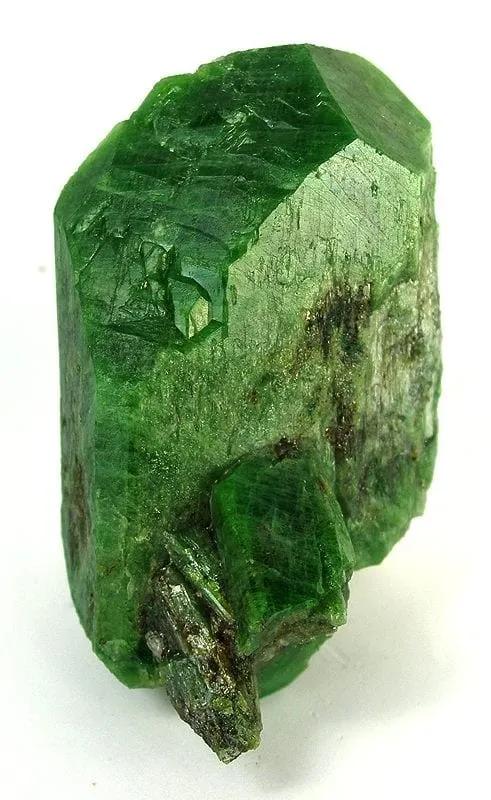
The vivid green, chromium-coloured form of diopside: a stone that resembles emerald but is far softer and far more affordable.
Also known as: Chromian diopside · Siberian emerald (misleading trade name) · Yakutian emerald (misleading nickname)
- Popularly: Semi-precious stone
In short
Chrome diopside is the green form of the pyroxene mineral diopside in which a little chromium has entered the crystal structure. Chromium, the same element that makes emerald green, gives it a vivid, saturated green. Most gem material comes from the Inagli deposit in the Yakutia region of Russia. According to ICA it is the most affordable gemstone in a pure, rich green, but it is soft and has cleavage, so it needs careful use.
Photos
How does it form?
Chrome diopside is mostly tied to ultrabasic rocks, meaning rocks poor in silica and rich in magnesium. In the diopside crystal structure, chromium takes the place of part of the magnesium: Inagli stones contain between 0.13 and 0.75 per cent chromium oxide, and according to the Russian Wikipedia the figure can reach 2 per cent. The world’s main deposit is the Inagli ring massif in Yakutia, a body of alkaline and ultrabasic rocks emplaced in the Mesozoic; the feldspar–chrome diopside–mica veins in its dunite core formed about 133 million years ago. Researchers link these veins to hot fluids altering the rock inside the massif and to recrystallisation; tiny melt inclusions in the stone point to formation at about 770–850 °C.
Chrome diopside is also a common component of fragments of peridotite brought up from the Earth’s mantle. When kimberlite volcanoes carry these fragments to the surface, chrome diopside grains end up scattered in and around the kimberlite.
What is it used for?
- Jewellery: It is faceted and used mostly in earrings and pendants; because it is soft, it is less often chosen for rings and bracelets.
- An alternative to emerald and tsavorite: Its colour can rival far pricier green gems such as tsavorite and chrome-green tourmaline.
- Diamond prospecting: Because it is found near kimberlites, it gives geologists searching for diamond deposits a clue.
- Science: According to GIA, a chrome diopside inclusion in a diamond shows that the diamond grew in the Earth’s mantle in a rock called peridotite.
Where else is it found?
Although most gem chrome diopside comes from Inagli, the mineral occurs elsewhere too. Chromium-bearing diopside is found in the kimberlites of the Kimberley diamond mines in South Africa; the Handbook of Mineralogy gives a chemical analysis of a sample from the Dutoitspan mine. In the Outokumpu mining district of Finland, chrome diopside crystals occur with uvarovite, the green chromium garnet, and pyrrhotite. In the United States, much of the chrome diopside from the State Line kimberlites on the Colorado–Wyoming border and from the Green River Basin in Wyoming is of gem quality. Gemmological sources also list Pakistan, Afghanistan and Myanmar among its sources.
Reaching the market
According to ICA, chrome diopside is mostly mined in Yakutia and Siberia. The liberalisation of the economy of the former Soviet Union made it far easier to find on the international market than it used to be. Inagli stones are described as highly transparent and intensely green. For the mineral family and its other forms, see the diopside page.
What determines its value?
Colour matters most for chrome diopside: a vivid, saturated and evenly distributed green is the most sought after. Because the colour turns too dark as stones get bigger, value does not climb steadily with size as it does for many gems; bright, clean small stones are the most sought after. Transparency, cut quality and undamaged facet edges also count. Because of pleochroism, cutters have to choose the direction that shows the best green.
This information is educational, not buying, selling or investment advice. Value varies enormously with quality and treatment.
How to recognise it
- 1
Its colour ranges from vivid to deep green; in large stones the colour becomes so dark that the stone can look almost black. That is why most cut stones are small.
- 2
It shows marked pleochroism: viewed from different directions the stone can show pure green, yellowish green and green with a yellow-brown shade.
- 3
Its hardness is about 5.5–6.5, so quartz scratches it. It has cleavage in two directions; facet edges can wear over time and a hard knock can split the stone.
- 4
It may contain fine fibrous inclusions and rarely shows a cat's-eye effect. A gem laboratory is needed for a sure identification.
Myths and misconceptions
MythChrome diopside sold as “Siberian emerald” is a kind of emerald.
FactChrome diopside is a pyroxene, while emerald is a variety of the mineral beryl. The element that colours both green is the same (chromium), but the minerals are entirely different; “Siberian emerald” is a misleading trade name.
MythChrome diopside can be worn without worry in a ring worn every day.
FactIts hardness is only about 5.5 and it has cleavage in two directions. ICA therefore notes that earrings or a pendant suit it better than a ring that will see a lot of wear.
What is it believed to be good for?
This section reports beliefs; it is not health information. There is no scientific evidence for these claims and no stone replaces medical treatment.
The meanings people give this stone, and who holds them:
- Crystal-therapy websites claim that chrome diopside stimulates the “heart chakra” and supports feelings of love, compassion and forgiveness.
- The same sources claim that the stone helps with headaches, regulates blood pressure and speeds recovery after illness.
What science says
There is no scientific evidence that chrome diopside affects the emotions, relieves headaches, regulates blood pressure or speeds recovery. The stone is an ordinary calcium magnesium silicate with a little chromium in it. Headaches, high blood pressure and recovery from illness are matters for a doctor.
Did you know?
Chrome diopside grains are scattered around kimberlite pipes and are used as a clue in diamond prospecting; the mineral also turns up as inclusions inside diamonds.
The Inagli massif is known not only for chrome diopside but also for platinum and vermiculite deposits.
Even Russian scientific papers call Inagli chrome diopside “Yakutian emerald”, in quotation marks; this name is misleading too, as the stone has nothing to do with emerald.
Where is it found?
Loading map…
- Inagli massif, about 29 km west-south-west of Aldan, Sakha (Yakutia), Russia · Major depositThe main source of gem chrome diopside; the stone occurs in feldspar–chrome diopside–mica veins in the dunite core of the massif
- Kimberley diamond mines (Dutoitspan), Northern Cape, South Africa · Known localityChromium-bearing diopside from kimberlite pipes; the Handbook of Mineralogy gives an analysis from the Dutoitspan mine
- Outokumpu, North Karelia, Finland · Known localityChrome diopside crystals found with uvarovite and pyrrhotite
- State Line kimberlite district (Kelsey Lake area), Larimer County, Colorado, USA · Known localityMuch of the chrome diopside from the kimberlites on the Colorado–Wyoming border is of gem quality
Locations are approximate to protect sites. Red dots mark places in Türkiye. Open in the big map →
Frequently asked questions
What is chrome diopside?
Chrome diopside is the green form of the pyroxene mineral diopside in which a little chromium has entered the crystal structure. Chromium, the same element that makes emerald green, gives it a vivid, saturated green. Most gem material comes from the Inagli deposit in the Yakutia region of Russia. According to ICA it is the most affordable gemstone in a pure, rich green, but it is soft and has cleavage, so it needs careful use.
What is chrome diopside used for?
Jewellery: It is faceted and used mostly in earrings and pendants; because it is soft, it is less often chosen for rings and bracelets. An alternative to emerald and tsavorite: Its colour can rival far pricier green gems such as tsavorite and chrome-green tourmaline. Diamond prospecting: Because it is found near kimberlites, it gives geologists searching for diamond deposits a clue. Science: According to GIA, a chrome diopside inclusion in a diamond shows that the diamond grew in the Earth's mantle in a rock called peridotite.
How hard is chrome diopside?
It has a hardness of 5.5–6.5 on the Mohs scale. It can scratch glass; a steel knife scratches it only with difficulty. Its specific gravity is 3.22–3.38 g/cm³.
Where is chrome diopside found?
Its best-known localities: Inagli massif, about 29 km west-south-west of Aldan, Sakha (Yakutia), Russia; Kimberley diamond mines (Dutoitspan), Northern Cape, South Africa; Outokumpu, North Karelia, Finland; State Line kimberlite district (Kelsey Lake area), Larimer County, Colorado, USA.
How can you tell if chrome diopside is real?
Its colour ranges from vivid to deep green; in large stones the colour becomes so dark that the stone can look almost black. That is why most cut stones are small. It shows marked pleochroism: viewed from different directions the stone can show pure green, yellowish green and green with a yellow-brown shade. Its hardness is about 5.5–6.5, so quartz scratches it. It has cleavage in two directions; facet edges can wear over time and a hard knock can split the stone.
Is chrome diopside valuable?
On the “street to diamond” value ladder it sits on step 5 of nine: Ornamental stone. Colour matters most for chrome diopside: a vivid, saturated and evenly distributed green is the most sought after. Because the colour turns too dark as stones get bigger, value does not climb steadily with size as it does for many gems; bright, clean small stones are the most sought after. Transparency, cut quality and undamaged facet edges also count. Because of pleochroism, cutters have to choose the direction that shows the best green.
What is chrome diopside good for?
Crystal-therapy websites claim that chrome diopside stimulates the “heart chakra” and supports feelings of love, compassion and forgiveness. The same sources claim that the stone helps with headaches, regulates blood pressure and speeds recovery after illness. There is no scientific evidence that chrome diopside affects the emotions, relieves headaches, regulates blood pressure or speeds recovery. The stone is an ordinary calcium magnesium silicate with a little chromium in it. Headaches, high blood pressure and recovery from illness are matters for a doctor. This section reports beliefs; it is not health information. There is no scientific evidence for these claims and no stone replaces medical treatment.
Family

_1.jpg)

Sources
- Chrome Diopside · International Colored Gemstone Association (ICA)
- Diopside · Wikipedia
- Хромдиопсид (Chrome diopside) · Vikipedi (Rusça)
- Handbook of Mineralogy: Diopside · Mineralogical Society of America
- Chrome Diopside (Gemology, 16.9.1) · Geosciences LibreTexts
- 40Ar/39Ar geochronology of alkaline rocks of the Inagli massif (Aldan Shield, southern Yakutia) (Ponomarchuk et al.), Russian Geology and Geophysics 60(1) · Elsevier / SB RAS, 2019
- Inclusions of silicate and sulfate melts in chrome diopside from the Inagli deposit, Yakutia, Russia (Naumov et al.), Geochemistry International · Pleiades Publishing, 2008
- Polychroism of jewel chrome-diopside from the Inagli deposit (Yakutia) and the techniques of its sorting and faceting (M. A. Ivanov), Zapiski RMO 144(6) · Russian Mineralogical Society, 2015
- Pegmatitic chrome-diopsidite, Inagli Deposit, Russia (photo description by James St. John) · Wikimedia Commons
- Kelsey Lake Diamond Mine · Wikipedia
- Chromdiopsid, Uwarowit, Magnetkies; Outokumpu, Finland (Hannes Grobe) · Wikimedia Commons
- Diopside Gemstone Information · Minerals.net
- Quarterly Crystal: Cr-diopside in diamond (Micro-World), Gems & Gemology 54(1) · GIA, 2018

Draft: awaiting expert reviewReport an error
On the same step
Agate
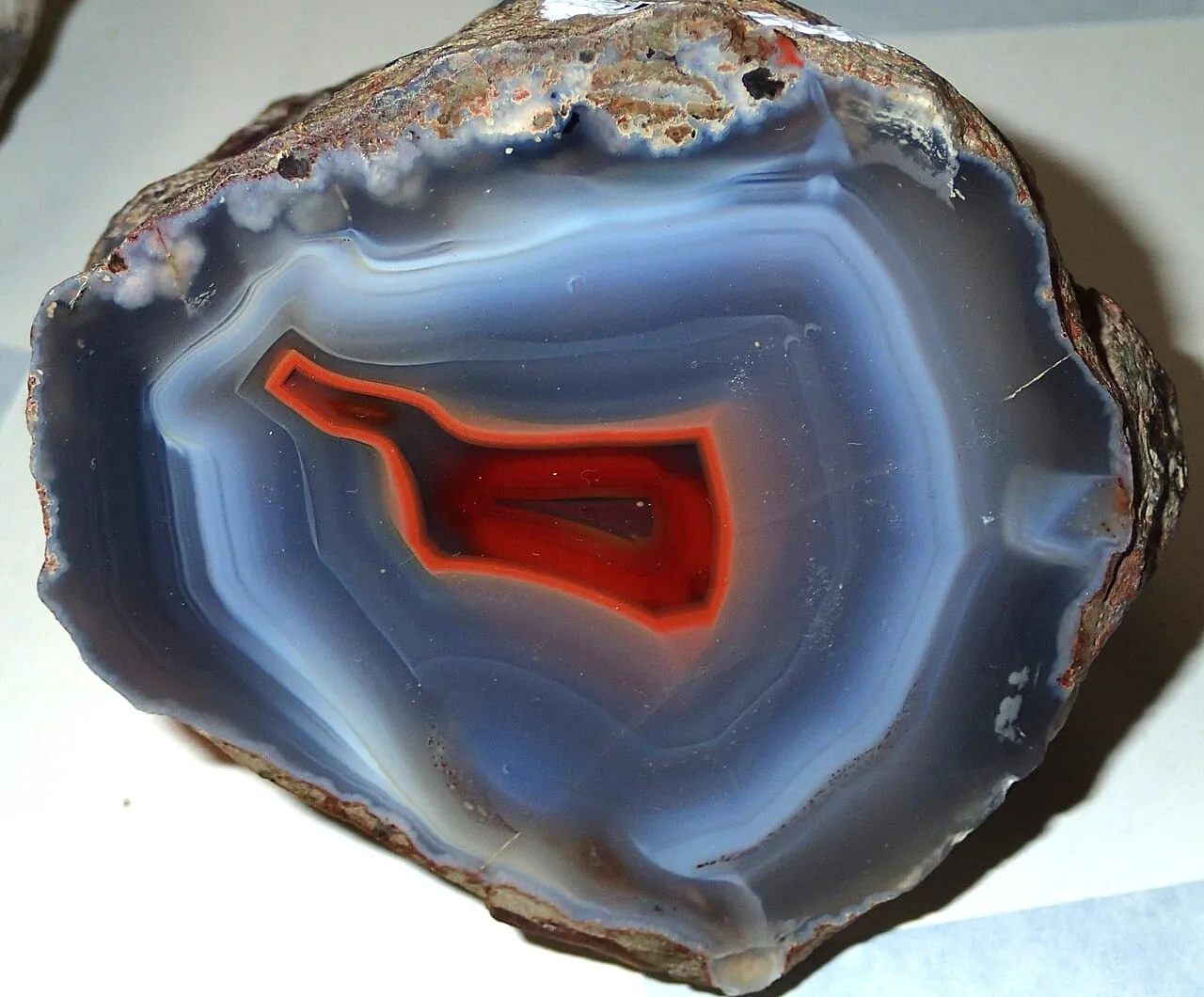
The banded variety of chalcedony: it grows layer by layer in hollows in volcanic rock and shows a new pattern every time it is cut.

Almandine
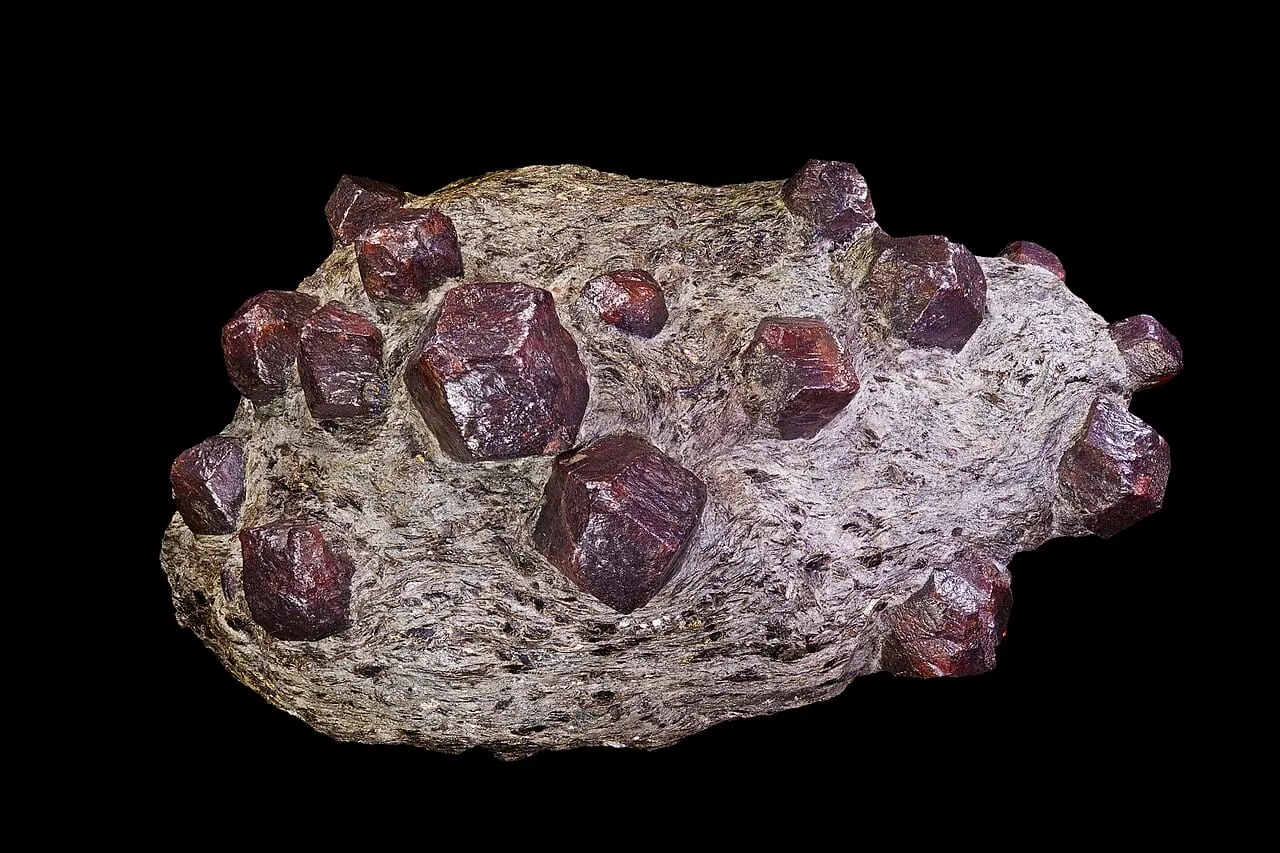
The commonest garnet: a deep red, iron-rich stone named after the ancient city of Alabanda in Anatolia, used in jewellery and in sandpaper alike.
Amazonite
A turquoise-like green-blue feldspar: a variety of microcline worn as jewellery for more than three thousand years, but it can release lead.