Mineral
Andalusite
Al₂SiO₅Andaluzit
A pleochroic stone that looks green from one side and reddish from another; in its chiastolite variety a natural cross appears in cross-section.
Also known as: Chiastolite (cross-patterned variety) · Macle (old name for chiastolite)
- Popularly: Semi-precious stone
- Gemstone
- Industrial
- Important in Türkiye

In short
Andalusite is an aluminium silicate (Al₂SiO₅) mineral; it is one of three siblings with the same chemical formula but stable under different conditions, and the one that forms at low pressure. Thanks to its strong pleochroism, the same crystal looks reddish pink, green and yellow when viewed from different directions. The variety in which carbon or clay remains line up in the shape of a cross is called chiastolite. Its name points to the Andalusia region of Spain.
Photos

How does it form?
Andalusite forms when clay-rich sedimentary rocks are heated and transformed at low pressure: in the contact zones where a magma heats the surrounding rocks, or in schists that have undergone regional metamorphism. It is rare in granites and pegmatites, but the largest crystals come from there. In some sandstones it also occurs as grains. In the chiastolite variety, carbon and clay remains line up along the axes of the crystal as it grows; the cross that appears in cross-section comes from this.
What is it used for?
- Ornamental stone: Clear andalusite, thanks to its strong pleochroism, shows a play of red, green and yellow when cut. Clean crystals from Brazil and Sri Lanka are cut into jewellery.
- Chiastolite: Cross-patterned crystals, sliced and polished, have been carried for centuries as keepsakes and charms.
- Industry: Andalusite is used as a refractory (heat-resistant) material in furnaces, kilns and other high-temperature processes. According to Wikipedia, about a quarter of world production comes from the Glomel mine in France, while South Africa holds the largest share of known deposits.
- Science: As one of the three aluminium silicate minerals, it helps in understanding the metamorphic conditions of a rock.
In Türkiye
Around Sivrihisar in Eskişehir, andalusite, kyanite and sillimanite formed one after another as metamorphism progressed and remained together in the rock; the area has been the subject of a scientific study of the successive formation of the three aluminium silicate minerals under conditions near the triple point.
What determines its value?
As an ornamental stone, the value of andalusite depends on colour and pleochroism (the play of red, green and yellow), on clarity and on the quality of the cut; clean, vividly coloured, large stones are rare, and those from well-known sources such as Brazil and Sri Lanka are more sought after. In chiastolite the sharpness of the pattern and the symmetry of the cross matter. In industry its value depends on the size of the deposit, grain size and purity: it is used in heat-resistant materials.
This information is educational, not buying, selling or investment advice. Value varies enormously with quality and treatment.
How to recognise it
- 1
Prismatic crystals with a nearly square cross-section; in the chiastolite variety, when the crystal is cut, dark carbon or clay inclusions form a cross or “X” pattern.
- 2
Its hardness is 6.5–7.5: a steel knife cannot scratch it. It is strongly pleochroic; as you turn the stone its colour shifts between reddish pink and greenish yellow.
- 3
It is found in schists formed by contact or regional metamorphism of clay-rich rocks, together with kyanite, sillimanite, cordierite, garnet and mica; it is rare in granites and pegmatites, but they yield the largest crystals.
- 4
It is told from kyanite (blue, bladed crystals) and sillimanite (fine needles or fibres) by crystal form; a microscope may be needed to separate these three minerals with the same formula with certainty.
Myths and misconceptions
MythAndalusite, kyanite and sillimanite are the same stone, just under different names.
FactAll three have the formula Al₂SiO₅, but their atoms are arranged differently, so they are three separate minerals. Andalusite is stable at low pressure and moderate temperature, kyanite at high pressure and sillimanite at high temperature; so which one is present tells you under what conditions the rock was transformed.
What is it believed to be good for?
This section reports beliefs; it is not health information. There is no scientific evidence for these claims and no stone replaces medical treatment.
The meanings people give this stone, and who holds them:
- According to George F. Kunz (1913), chiastolite worn so as to touch the skin was believed to stop the flow of blood from any part of the body and to increase the secretion of milk, and worn hanging from the neck to cure all kinds of fever.
- According to the same source, because the cross on the stone was seen as a sacred symbol, chiastolite was believed to drive evil spirits away from its wearer, and the stone was regarded as an object of mystical and religious significance.
What science says
There is no evidence that chiastolite stops bleeding, increases milk or lowers fever; for bleeding or high fever, medical help is needed, not a stone. The cross pattern is a wholly natural phenomenon, formed when carbon and clay remains line up in an orderly way as the crystal grows.
Did you know?
Its name points to the Andalusia region of Spain, but that is a locality error: the specimens named in 1798 actually came from El Cardoso de la Sierra in Guadalajara province.
Chiastolite has been known since the 16th century; pilgrims returning from Santiago de Compostela took it as a souvenir to many European countries.
Kyanite, andalusite and sillimanite are three different minerals with the same formula; by seeing which one occurs in a rock, geologists estimate the pressure and temperature the rock went through. Andalusite is the one that is stable at low pressure and moderate temperature.
Where is it found?
Loading map…
- El Cardoso de la Sierra, Guadalajara, Spain · Type localityWhere the specimens that gave the mineral its name actually came from; the name points to Andalusia because of a locality error
- Glomel, Côtes-d'Armor, France · Major depositThe world's densest andalusite deposit; about a quarter of global production
- Santa Teresa, Espírito Santo, Brazil · Known localityGem-quality andalusite crystals
- Nawalapitiya, Central Province, Sri Lanka · Known locality
- Lancaster, Massachusetts, USA · Historic sourceA known locality of the Massachusetts chiastolite that Kunz also mentions
- Bodenmais, Bavaria, Germany · Known locality
- Sivrihisar, Eskişehir, Türkiye · Known localityWhere andalusite, kyanite and sillimanite formed in succession during metamorphism; the point marks the Sivrihisar area
Locations are approximate to protect sites. Red dots mark places in Türkiye. Open in the big map →
Frequently asked questions
What is andalusite?
Andalusite is an aluminium silicate (Al₂SiO₅) mineral; it is one of three siblings with the same chemical formula but stable under different conditions, and the one that forms at low pressure. Thanks to its strong pleochroism, the same crystal looks reddish pink, green and yellow when viewed from different directions. The variety in which carbon or clay remains line up in the shape of a cross is called chiastolite. Its name points to the Andalusia region of Spain.
What is andalusite used for?
Ornamental stone: Clear andalusite, thanks to its strong pleochroism, shows a play of red, green and yellow when cut. Clean crystals from Brazil and Sri Lanka are cut into jewellery. Chiastolite: Cross-patterned crystals, sliced and polished, have been carried for centuries as keepsakes and charms. Industry: Andalusite is used as a refractory (heat-resistant) material in furnaces, kilns and other high-temperature processes. According to Wikipedia, about a quarter of world production comes from the Glomel mine in France, while South Africa holds the largest share of known deposits.
How hard is andalusite?
It has a hardness of 6.5–7.5 on the Mohs scale. It scratches glass and steel; a steel knife cannot scratch it. Its specific gravity is 3.13–3.17 g/cm³.
Where is andalusite found?
Its best-known localities: El Cardoso de la Sierra, Guadalajara, Spain; Glomel, Côtes-d'Armor, France; Lancaster, Massachusetts, USA; Santa Teresa, Espírito Santo, Brazil; Nawalapitiya, Central Province, Sri Lanka.
Where is andalusite found in Türkiye?
Known localities in Türkiye: Sivrihisar, Eskişehir, Türkiye.
How can you tell if andalusite is real?
Prismatic crystals with a nearly square cross-section; in the chiastolite variety, when the crystal is cut, dark carbon or clay inclusions form a cross or “X” pattern. Its hardness is 6.5–7.5: a steel knife cannot scratch it. It is strongly pleochroic; as you turn the stone its colour shifts between reddish pink and greenish yellow. It is found in schists formed by contact or regional metamorphism of clay-rich rocks, together with kyanite, sillimanite, cordierite, garnet and mica; it is rare in granites and pegmatites, but they yield the largest crystals.
Is andalusite valuable?
On the “street to diamond” value ladder it sits on step 5 of nine: Ornamental stone. As an ornamental stone, the value of andalusite depends on colour and pleochroism (the play of red, green and yellow), on clarity and on the quality of the cut; clean, vividly coloured, large stones are rare, and those from well-known sources such as Brazil and Sri Lanka are more sought after. In chiastolite the sharpness of the pattern and the symmetry of the cross matter. In industry its value depends on the size of the deposit, grain size and purity: it is used in heat-resistant materials.
What is andalusite good for?
According to George F. Kunz (1913), chiastolite worn so as to touch the skin was believed to stop the flow of blood from any part of the body and to increase the secretion of milk, and worn hanging from the neck to cure all kinds of fever. According to the same source, because the cross on the stone was seen as a sacred symbol, chiastolite was believed to drive evil spirits away from its wearer, and the stone was regarded as an object of mystical and religious significance. There is no evidence that chiastolite stops bleeding, increases milk or lowers fever; for bleeding or high fever, medical help is needed, not a stone. The cross pattern is a wholly natural phenomenon, formed when carbon and clay remains line up in an orderly way as the crystal grows. This section reports beliefs; it is not health information. There is no scientific evidence for these claims and no stone replaces medical treatment.
Sources
- Handbook of Mineralogy: Andalusite · Mineralogical Society of America
- Andalusite · Webmineral
- Andalusite · Wikipedia
- The Curious Lore of Precious Stones (G. F. Kunz) · J. B. Lippincott Company; Project Gutenberg, 1913
- Coexisting andalusite, kyanite, and sillimanite: Sequential formation of three Al₂SiO₅ polymorphs during progressive metamorphism near the triple point, Sivrihisar, Turkey (Whitney), American Mineralogist 87: 405–416 · Mineralogical Society of America, 2002
External links
Draft: awaiting expert reviewReport an error ↗
On the same step
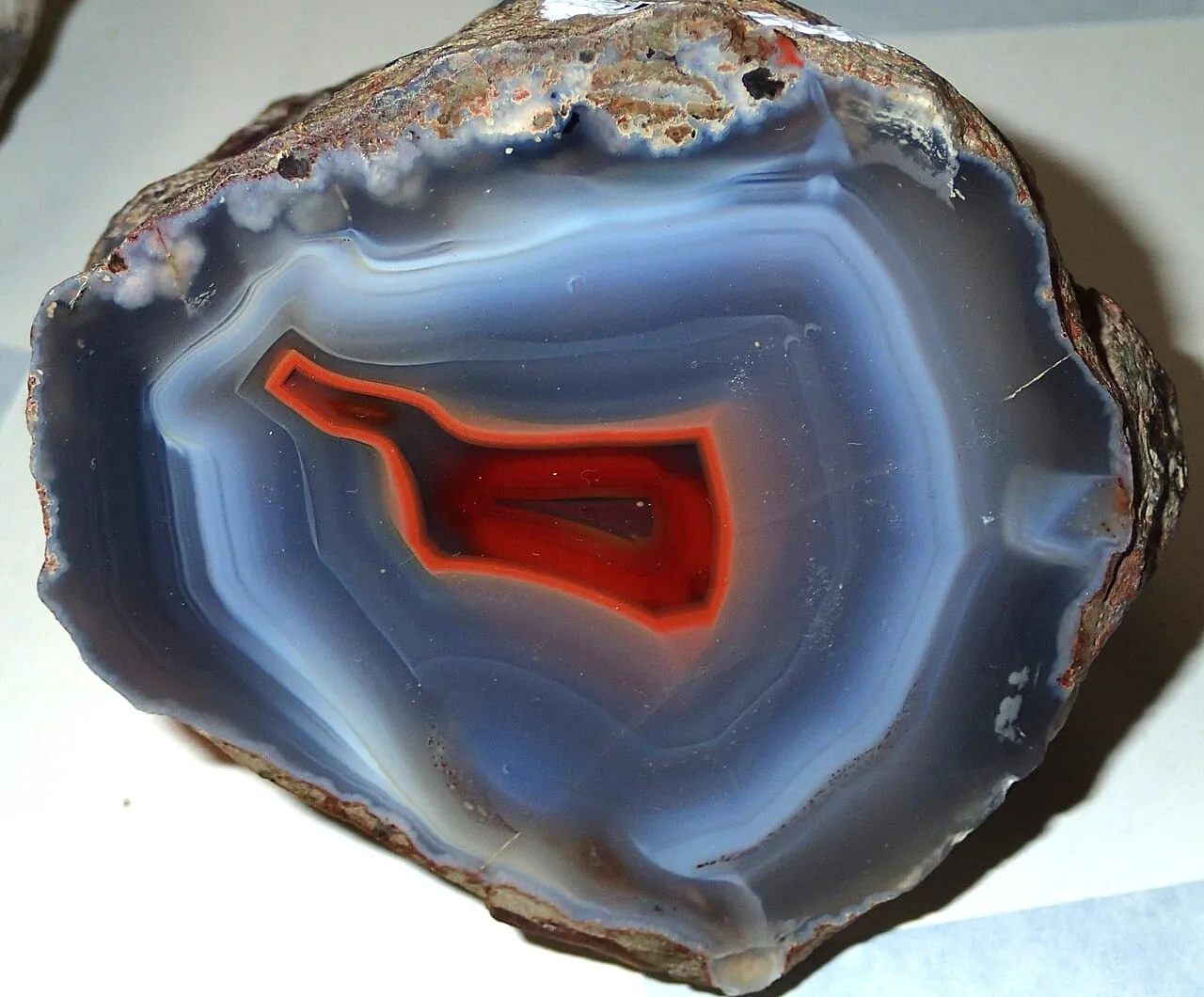
Agate
The banded variety of chalcedony: it grows layer by layer in hollows in volcanic rock and shows a new pattern every time it is cut.
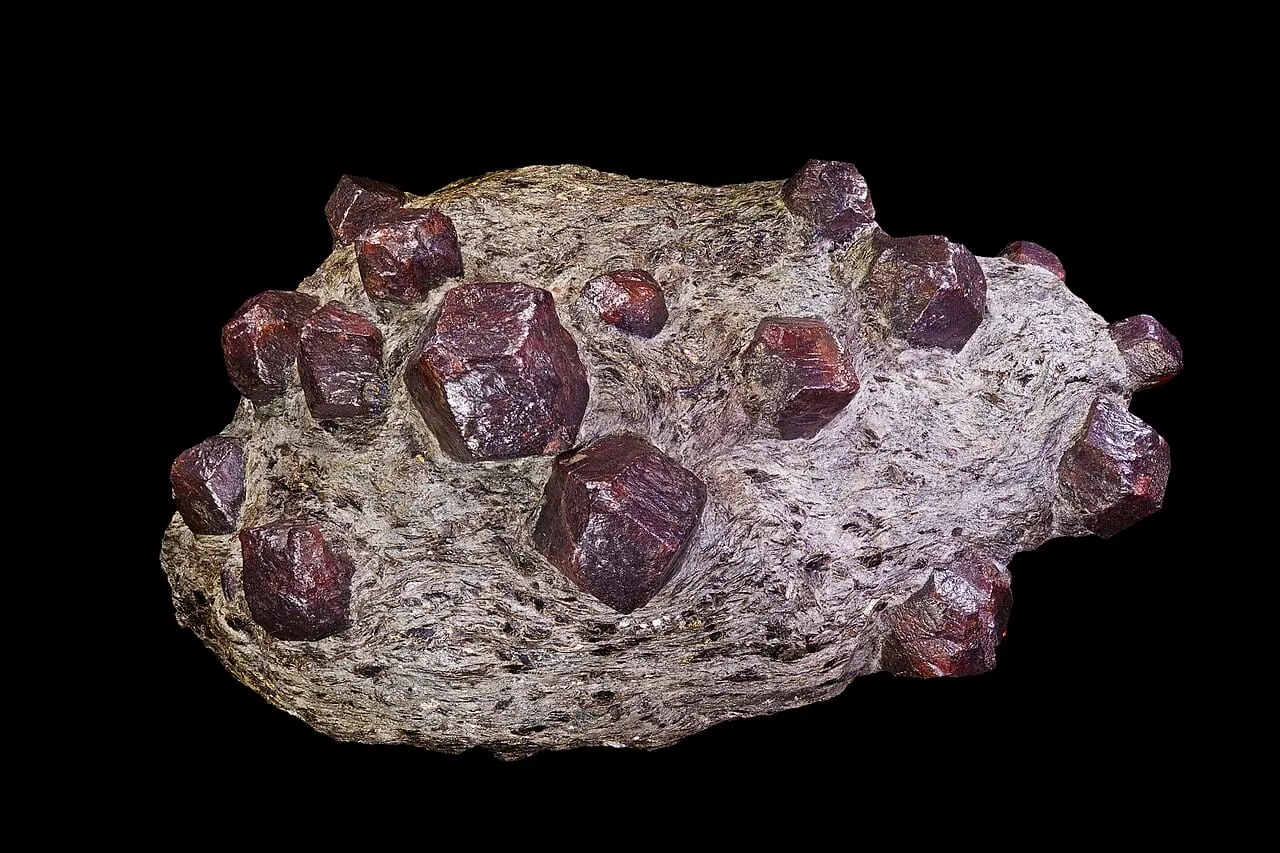
Almandine
The commonest garnet: a deep red, iron-rich stone named after the ancient city of Alabanda in Anatolia, used in jewellery and in sandpaper alike.
Amazonite
A turquoise-like green-blue feldspar: a variety of microcline worn as jewellery for more than three thousand years, but it can release lead.