VarietyA variety of Tourmaline
Watermelon tourmaline
XY₃Z₆(T₆O₁₈)(BO₃)₃V₃WKarpuz turmalin
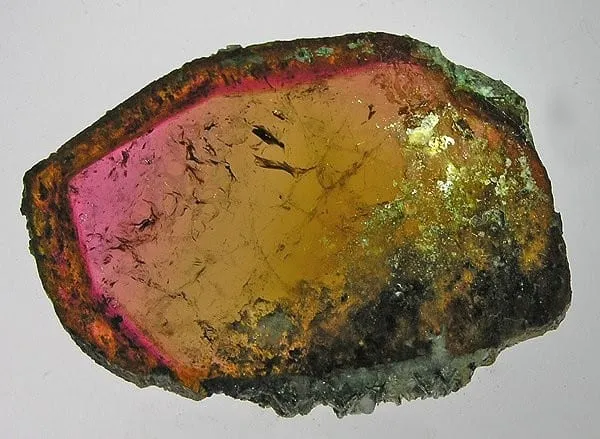
Tourmaline that is pink inside and green outside: cut across, it looks like a slice of watermelon, and it is often sold as thin slices.
Also known as: Watermelon elbaite
- Popularly: Semi-precious stone
In short
Watermelon tourmaline is the name for tourmaline crystals with a pink or red centre and a green outside; sometimes a colourless ring lies between the two colours. Most of these stones are elbaite, a lithium-bearing kind of tourmaline. Dealers gave it the name because its colours resemble the rind and flesh of a watermelon. The colours arise when the trace elements around the crystal change while it grows. Its main sources are the Brazilian state of Minas Gerais and the US states of Maine and California.
Photos
How does it form?
Watermelon tourmaline, like the other gem tourmalines, forms in lithium-rich granite pegmatites: a pegmatite is a coarse-grained rock that crystallises slowly from the last, water-rich part of a magma. A tourmaline crystal grows outwards layer by layer. According to GIA, watermelon, bicolour and multicoloured zoning appears when the concentration or kind of trace elements changes while the crystal grows. In tourmaline, manganese produces pinks and reds, and iron (and possibly titanium) produces greens. In watermelon tourmaline the pink core forms first; as the crystal keeps growing, its surroundings change and a green rim develops on the outside.
What is it used for?
- Jewellery: To show off the colour pattern, designers often set thin slices of the crystal in pendants and earrings instead of faceting it. Clean stones are also faceted.
- Collecting: Crystals with sound terminations and distinct colour zones, and well-polished slices, are sought by collectors.
- Science: The colour zones are like a record of how the fluid around the crystal changed as it grew, and they are studied in mineralogy.
The name
The name comes from the trade: according to GIA, dealers call these tourmalines “watermelon” because their colours resemble the rind and flesh of that fruit. According to the International Gem Society, some stones also have a colourless ring between the two colours.
Famous localities
According to Gemdat, the main watermelon tourmaline localities are in the Brazilian state of Minas Gerais (Coronel Murta, Barra do Salinas district), at the Himalaya mine in San Diego County, California, and at the Dunton quarry and Mount Mica in Maine. GIA has also published watermelon tourmaline slices from the famous Cruzeiro mine in Minas Gerais that show rainbow colours (an iris effect) thanks to fine internal fractures.
What determines its value?
The value of watermelon tourmaline depends most on lively colours and a sharp contrast between them: stones in which a vivid pink core and a distinct green rim form balanced, even rings are the most sought after. Compared with single-coloured tourmalines it is relatively affordable, but clean, vividly coloured stones and large stones over 10 carats are worth markedly more. In slices the quality of the cut and the absence of cracks that spoil the pattern matter; in crystal specimens, size and undamaged terminations count.
This information is educational, not buying, selling or investment advice. Value varies enormously with quality and treatment.
How to recognise it
- 1
Seen in cross-section, the crystal shows a pink or red core surrounded by a green rim; there may be a colourless ring between them.
- 2
Its hardness is 7–7.5; it has no cleavage and is brittle. Its refractive index is about 1.614–1.666 and its specific gravity 2.90–3.40.
- 3
Under short-wave ultraviolet light the pink core may glow a chalky blue or creamy white.
- 4
It is often sold as thin slices polished on both faces, or as crystal specimens; slices are preferred to faceted cuts because they show the colour pattern.
Fakes and imitations
What shops usually don’t tell you:
- Acid cleaning: in some stones dark inclusions are bleached with acid; this should be disclosed.
- Irradiation: colour changes can be produced by irradiation; a laboratory report can identify the treatment.
Myths and misconceptions
MythWatermelon tourmaline is a separate kind of stone.
FactWatermelon tourmaline is not a separate mineral but a trade name for colour-zoned tourmaline, most of it elbaite. The colour zones form when the amount or kind of trace elements around the growing crystal changes.
MythAny tourmaline that is pink and green is watermelon tourmaline.
FactThe name refers to a concentric arrangement, a pink core surrounded by a green rim. Crystals that are pink at one end and green at the other are called bicolour tourmaline in the trade; GIA counts these two colour patterns separately.
What is it believed to be good for?
This section reports beliefs; it is not health information. There is no scientific evidence for these claims and no stone replaces medical treatment.
The meanings people give this stone, and who holds them:
- Today crystal-therapy websites and stone sellers claim that watermelon tourmaline opens and balances the heart chakra, increases love, joy and emotional balance, and eases stress.
What science says
There is no scientific evidence that watermelon tourmaline increases love, joy or emotional balance. The two colours carry no meaning; they are a physical trace left by the trace elements (manganese for pink, iron for green) that changed while the crystal grew.
Did you know?
In 1972 large pockets opened at the Dunton mine in Maine yielded hundreds of pounds of red and green tourmaline crystals; one of them, the “Jolly Green Giant”, is now in the Smithsonian's National Museum of Natural History in Washington.
Tourmaline is the official state mineral of Maine; the state's first major tourmaline discovery was made in 1820 at Mount Mica in the town of Paris.
The colour order is not always the same: at Utö in Sweden the tourmaline crystals are the other way round, blue in the centre and pink outside.
Where is it found?
Loading map…
- Cruzeiro mine, São José da Safira, Minas Gerais, Brazil · Major depositSource of the watermelon tourmaline slices with an iris effect published by GIA in 2024
- Coronel Murta (Barra do Salinas district), Minas Gerais, Brazil · Known localityOne of the main watermelon tourmaline localities listed by Gemdat
- Dunton Gem Quarry, Plumbago Mountain, Newry, Oxford County, Maine, USA · Major depositMany of the finest New England watermelon tourmalines came from here; in 1972 large pockets yielded hundreds of pounds of red and green crystals
- Mount Mica, Paris, Oxford County, Maine, USA · Historic sourceMaine's first major tourmaline discovery was made here in 1820
- Himalaya mine, Gem Hill, Mesa Grande, San Diego County, California, USA · Known localityA pegmatite mine known for bicoloured and watermelon-zoned tourmaline
Locations are approximate to protect sites. Red dots mark places in Türkiye. Open in the big map →
Frequently asked questions
What is watermelon tourmaline?
Watermelon tourmaline is the name for tourmaline crystals with a pink or red centre and a green outside; sometimes a colourless ring lies between the two colours. Most of these stones are elbaite, a lithium-bearing kind of tourmaline. Dealers gave it the name because its colours resemble the rind and flesh of a watermelon. The colours arise when the trace elements around the crystal change while it grows. Its main sources are the Brazilian state of Minas Gerais and the US states of Maine and California.
What is watermelon tourmaline used for?
Jewellery: To show off the colour pattern, designers often set thin slices of the crystal in pendants and earrings instead of faceting it. Clean stones are also faceted. Collecting: Crystals with sound terminations and distinct colour zones, and well-polished slices, are sought by collectors. Science: The colour zones are like a record of how the fluid around the crystal changed as it grew, and they are studied in mineralogy.
How hard is watermelon tourmaline?
It has a hardness of 7–7.5 on the Mohs scale. It scratches glass and steel; a steel knife cannot scratch it. Its specific gravity is 2.9–3.4 g/cm³.
Where is watermelon tourmaline found?
Its best-known localities: Cruzeiro mine, São José da Safira, Minas Gerais, Brazil; Dunton Gem Quarry, Plumbago Mountain, Newry, Oxford County, Maine, USA; Mount Mica, Paris, Oxford County, Maine, USA; Coronel Murta (Barra do Salinas district), Minas Gerais, Brazil; Himalaya mine, Gem Hill, Mesa Grande, San Diego County, California, USA.
How can you tell if watermelon tourmaline is real?
Seen in cross-section, the crystal shows a pink or red core surrounded by a green rim; there may be a colourless ring between them. Its hardness is 7–7.5; it has no cleavage and is brittle. Its refractive index is about 1.614–1.666 and its specific gravity 2.90–3.40. Under short-wave ultraviolet light the pink core may glow a chalky blue or creamy white. Acid cleaning: in some stones dark inclusions are bleached with acid; this should be disclosed.
Is watermelon tourmaline valuable?
On the “street to diamond” value ladder it sits on step 5 of nine: Ornamental stone. The value of watermelon tourmaline depends most on lively colours and a sharp contrast between them: stones in which a vivid pink core and a distinct green rim form balanced, even rings are the most sought after. Compared with single-coloured tourmalines it is relatively affordable, but clean, vividly coloured stones and large stones over 10 carats are worth markedly more. In slices the quality of the cut and the absence of cracks that spoil the pattern matter; in crystal specimens, size and undamaged terminations count.
What is watermelon tourmaline good for?
Today crystal-therapy websites and stone sellers claim that watermelon tourmaline opens and balances the heart chakra, increases love, joy and emotional balance, and eases stress. There is no scientific evidence that watermelon tourmaline increases love, joy or emotional balance. The two colours carry no meaning; they are a physical trace left by the trace elements (manganese for pink, iron for green) that changed while the crystal grew. This section reports beliefs; it is not health information. There is no scientific evidence for these claims and no stone replaces medical treatment.
Family


Sources
- Watermelon Tourmaline · Gemdat.org
- Tourmaline Description · GIA
- Tourmaline Quality Factors · GIA
- Tourmaline History and Lore · GIA
- Brazilian Watermelon Tourmaline with Iris Effect (R. Behnke), Gems & Gemology 60(1) · GIA, 2024
- Tourmaline Value, Price, and Jewelry Information · International Gem Society
- Maine State Mineral: Tourmaline · Maine Geological Survey
- Watermelon Tourmaline Slice, Dunton Quarry, Newry, Maine (image caption) · Minerals.net
- Paragenesis of the Newry pegmatite, Maine, American Mineralogist 15 · Mineralogical Society of America, 1930
- Elbaite · Wikipedia
- The chemical composition of tourmaline from Utö (Hj. Sjögren) · Geologische Bundesanstalt library (digitised reprint), 1916
- Himalaya Mine (mine record) · Western Mining History
- Coronel Murta · Wikipedia
- Newry, Maine · Wikipedia
- Paris, Maine · Wikipedia
Draft: awaiting expert reviewReport an error
On the same step
Agate
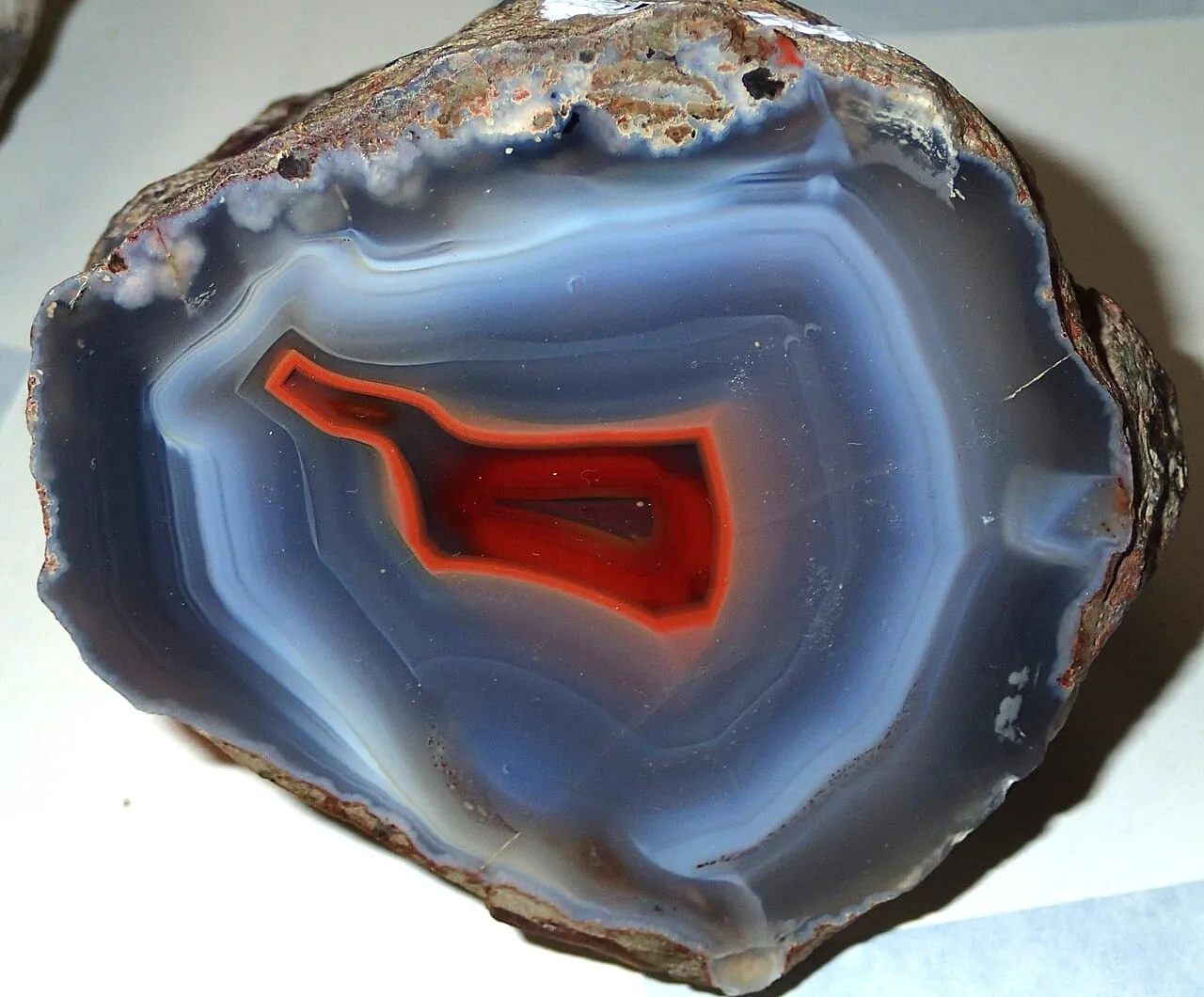
The banded variety of chalcedony: it grows layer by layer in hollows in volcanic rock and shows a new pattern every time it is cut.
Almandine
The commonest garnet: a deep red, iron-rich stone named after the ancient city of Alabanda in Anatolia, used in jewellery and in sandpaper alike.
Amazonite
A turquoise-like green-blue feldspar: a variety of microcline worn as jewellery for more than three thousand years, but it can release lead.