Meteorite
Octahedrite
Oktahedrit
Iron meteorites that show criss-crossing bands when etched: the Widmanstätten pattern of metal that cooled over millions of years.
- Popularly: Meteorite

In short
Octahedrites are the most common structural class of iron meteorites. When meteoric iron with a certain nickel content cools, nickel-poor kamacite separates out of nickel-rich taenite. On a cut, polished and acid-etched surface the bands of these two alloys appear as intersecting lines called the Widmanstätten pattern. The name comes from the kamacite plates lying parallel to the faces of an octahedron.
Photos

How does it form?
Below their melting point, iron and nickel form a single homogeneous alloy, taenite. Below about 900 to 600 °C, depending on the nickel content, two alloys become stable: nickel-poor kamacite (5–15 per cent nickel) and nickel-rich taenite (up to 50 per cent nickel). Octahedrites have a nickel content between the two, so during very slow cooling kamacite separates out and grows as plates along particular crystal planes of the taenite.
This happens inside asteroids as nickel diffuses through the solid metal between 450 and 700 °C, and is only possible during very slow cooling, about 100 to 10,000 °C per million years, with total cooling times of 10 million years or less. When the meteorite is cut, polished and etched with acid, the pattern becomes visible because taenite is more resistant to the acid.
What is it used for?
- How asteroid cores cooled: Because the pattern can only form through very slow cooling lasting millions of years, octahedrites are used to study how the metal cores of asteroids cooled.
- Recognising meteorites: A genuine Widmanstätten pattern is one of the important signs that a piece of iron is a meteorite.
- Museums and education: Etched octahedrite slices, such as the Casas Grandes specimen at the Field Museum, are displayed in museums to show the inner structure of the metal.
Famous octahedrites
Gibeon (Namibia) is a fine, Canyon Diablo (USA) a coarse, Cape York (Greenland) a medium and Sikhote-Alin (Russia) a coarsest octahedrite. For the general properties of iron meteorites, see the iron meteorite page.
What determines its value?
Octahedrites are the iron meteorites most often found. A piece's value depends on its mass, its state of preservation, the beauty of the pattern on an etched face, and whether it belongs to a well-known meteorite such as Gibeon, Canyon Diablo or Sikhote-Alin. For undocumented pieces, verifying the source matters.
This information is educational, not buying, selling or investment advice. Value varies enormously with quality and treatment.
How to recognise it
- 1
Very heavy; the outside weathers to a rusty brown, and a cut surface is steel grey.
- 2
When a cut, polished surface is etched with nitric acid, bands crossing at fixed angles (the Widmanstätten pattern) appear, with areas of fine-grained plessite between them.
- 3
Some contain rounded dark nodules of troilite and graphite up to several centimetres across.
Myths and misconceptions
MythThe Widmanstätten pattern can easily be faked in a laboratory.
FactThe pattern forms as nickel diffuses through solid metal between 450 and 700 °C during extremely slow cooling, about 100 to 10,000 °C per million years. That is why it cannot be reproduced in the laboratory, and a genuine pattern is one of the important signs of an iron meteorite.
Did you know?
The first to see the pattern was the English mineralogist William Thomson, who treated a Krasnojarsk meteorite with nitric acid in Naples in 1804 to remove its rust. Alois von Beckh Widmanstätten, director of the Imperial Porcelain works in Vienna, saw the same pattern in 1808, and it was named after him.
An octahedron has eight faces, but because opposite faces are parallel, octahedrites have only four sets of kamacite plates.
According to H. H. Nininger, the Casas Grandes iron meteorite from Mexico was found in ruins wrapped in “mummy cloth”.
Where is it found?
Loading map…
- Around Gibeon, Hardap Region, Namibia · Known localityThe Gibeon meteorite: a fine octahedrite of group IVA and a classic example of the Widmanstätten pattern.
- Meteor Crater, Arizona, USA · Known localityThe Canyon Diablo meteorite: a coarse octahedrite of group IAB, the remains of the asteroid that made the crater.
- Cape York, Melville Bay, Greenland · Known localityThe Cape York meteorite: a medium octahedrite of group IIIAB; its largest mass is the 31-tonne Ahnighito.
- Sikhote-Alin Mountains, Primorsky Krai, Russia · Known localityThe Sikhote-Alin meteorite, seen to fall on 12 February 1947: a coarsest octahedrite of group IIAB.
Locations are approximate to protect sites. Red dots mark places in Türkiye. Open in the big map →
Frequently asked questions
What is octahedrite?
Octahedrites are the most common structural class of iron meteorites. When meteoric iron with a certain nickel content cools, nickel-poor kamacite separates out of nickel-rich taenite. On a cut, polished and acid-etched surface the bands of these two alloys appear as intersecting lines called the Widmanstätten pattern. The name comes from the kamacite plates lying parallel to the faces of an octahedron.
How are octahedrites subdivided?
By the width of the kamacite bands in the Widmanstätten pattern: coarsest (wider than 3.3 mm, 5–9 per cent nickel), coarse (1.3–3.3 mm), medium (0.5–1.3 mm), fine (0.2–0.5 mm) and finest (narrower than 0.2 mm, 17–18 per cent nickel) octahedrites. Plessitic octahedrites, with spindles of kamacite, are a transitional structure between octahedrites and ataxites. The more nickel, the finer the bands.
What is octahedrite used for?
How asteroid cores cooled: Because the pattern can only form through very slow cooling lasting millions of years, octahedrites are used to study how the metal cores of asteroids cooled. Recognising meteorites: A genuine Widmanstätten pattern is one of the important signs that a piece of iron is a meteorite. Museums and education: Etched octahedrite slices, such as the Casas Grandes specimen at the Field Museum, are displayed in museums to show the inner structure of the metal.
How hard is octahedrite?
It has a hardness of 4–5.5 on the Mohs scale. A fingernail cannot scratch it, but a steel knife can. Its specific gravity is 7–8 g/cm³.
Where is octahedrite found?
Its best-known localities: Around Gibeon, Hardap Region, Namibia; Meteor Crater, Arizona, USA; Cape York, Melville Bay, Greenland; Sikhote-Alin Mountains, Primorsky Krai, Russia.
How can you tell if octahedrite is real?
Very heavy; the outside weathers to a rusty brown, and a cut surface is steel grey. When a cut, polished surface is etched with nitric acid, bands crossing at fixed angles (the Widmanstätten pattern) appear, with areas of fine-grained plessite between them. Some contain rounded dark nodules of troilite and graphite up to several centimetres across.
Is octahedrite valuable?
On the “street to diamond” value ladder it sits on step 5 of nine: Ornamental stone. Octahedrites are the iron meteorites most often found. A piece's value depends on its mass, its state of preservation, the beauty of the pattern on an etched face, and whether it belongs to a well-known meteorite such as Gibeon, Canyon Diablo or Sikhote-Alin. For undocumented pieces, verifying the source matters.
Sources
- Octahedrite · Wikipedia
- Oktahedrit · Vikipedi
- Widmanstätten pattern · Wikipedia
- Meteorite collecting among ancient Americans (H. H. Nininger), American Antiquity 4 (1) · Society for American Archaeology, 1938
- Gibeon (meteorite) · Wikipedia
- Canyon Diablo (meteorite) · Wikipedia
- Cape York meteorite · Wikipedia
- Sikhote-Alin meteorite · Wikipedia
- Kamacite Mineral Data · Webmineral.com
- Taenite Mineral Data · Webmineral.com
- Density and specific gravity (R. L. Korotev) · Washington University in St. Louis, Some Meteorite Information
External links
Draft: awaiting expert reviewReport an error
On the same step
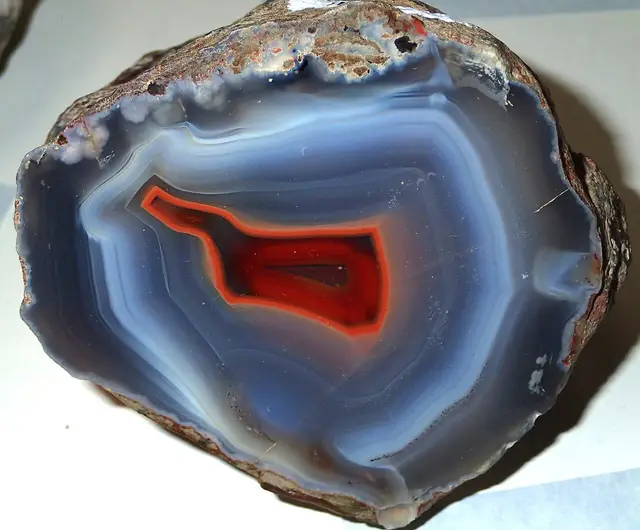
Agate
The banded variety of chalcedony: it grows layer by layer in hollows in volcanic rock and shows a new pattern every time it is cut.
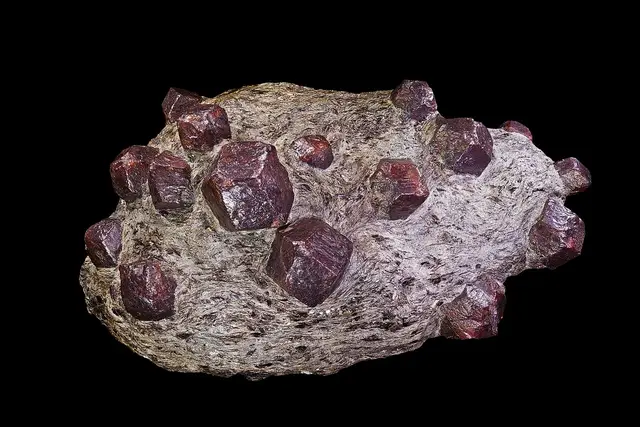
Almandine
The commonest garnet: a deep red, iron-rich stone named after the ancient city of Alabanda in Anatolia, used in jewellery and in sandpaper alike.
Amazonite
A turquoise-like green-blue feldspar: a variety of microcline worn as jewellery for more than three thousand years, but it can release lead.