Meteorite
Gibeon meteorite
Gibeon meteoriti
Namibia's prehistoric iron rain: a meteorite scattered over 390 km whose cut and etched pieces show one of the finest Widmanstätten patterns.
Also known as: Gibeon · Bethany
- Popularly: Meteorite

In short
Gibeon is an iron meteorite that fell in Namibia in prehistoric times, named after the nearest town, Gibeon. Its fragments are spread over a huge area of 390 × 120 kilometres; 100–150 pieces have been collected so far, totalling about 26 tonnes. It is a fine octahedrite of group IVA, and when cut and etched with acid it shows a classic example of the Widmanstätten pattern of criss-crossing metal bands. In the capital, Windhoek, 29 of its pieces are displayed on a fountain.
Photos

How does it form?
Iron meteorites like Gibeon come from the metal cores of small planets (asteroids) that melted early in the Solar System. As the metal core cooled very slowly, between 450 and 700 °C nickel atoms slowly moved through the solid alloy and nickel-poor kamacite separated from nickel-rich taenite. The resulting thin bands are what we see today as the Widmanstätten pattern, and Gibeon, of group IVA, is a classic example.
After the parent body was broken up by collisions, a piece reached Earth and fell on Namibia in prehistoric times. Because it broke apart in the atmosphere, its fragments were scattered over a huge area 390 kilometres long and 120 kilometres wide.
What is it used for?
- Science: The width of the Widmanstätten bands and the meteorite’s chemistry help work out how slowly the parent body’s metal core cooled.
- Museums: Gibeon pieces are displayed in many museums around the world; those on the fountain in Windhoek were declared a national monument in 1950.
- History: The Nama people made tools and weapons from this meteoritic iron.
Where is it found?
Gibeon fragments are found in southern Namibia, over a large strewn field centred near the village of Gibeon in the Hardap Region. It is the second-largest known strewn field in the world, after that of the Aletai meteorite in northwestern China. Over time 100–150 different pieces have been collected, and new ones are still found now and then.
What determines its value?
Gibeon's value is raised by the fine, regular Widmanstätten pattern that appears when it is cut and etched. A piece's value depends on its mass, the beauty of the pattern in section, its resistance to rusting, and its documented, legal origin. Since 1950 all meteorites found in Namibia have been national monuments and should not be removed from where they lie.
This information is educational, not buying, selling or investment advice. Value varies enormously with quality and treatment.
How to recognise it
- 1
A heavy metal mass with a rusty brown or blackish outer surface; being almost entirely iron–nickel, it strongly attracts a magnet.
- 2
Cut, polished and etched with acid, it reveals the Widmanstätten pattern of thin silvery bands crossing each other at angles.
- 3
Because meteorites found in Namibia are protected, a piece's origin and legal history should be shown by documents.
Myths and misconceptions
MythThe pattern on Gibeon slices is engraved later or is a decoration that can be made artificially.
FactThe Widmanstätten pattern forms only when metal cools very slowly over millions of years, which is why it cannot be reproduced in the laboratory. Etching with acid only makes the existing pattern visible.
MythA meteorite found in Namibia can be taken and sold.
FactUnder a 1950 decision, all meteorites found in Namibia are automatically national monuments; they should not be removed from where they are found or damaged.
Did you know?
The first people to find Gibeon pieces were the Nama, who made iron tools and weapons from them, including heads for their assegai spears.
In 1836 the English captain J. E. Alexander collected samples near the Fish River and sent them to London, where John Herschel analysed them and confirmed for the first time that the material came from outside Earth.
33 pieces, weighing 195 to 506 kilograms, were collected in 1911–1913 and brought to Windhoek; two were stolen from storage and two more from the fountain, which now displays 29.
Where is it found?
Loading map…
- Around Gibeon, Hardap Region (Great Namaqualand), Namibia · Type localityThe fragments are scattered over an elliptical area 390 km long and 120 km wide, the second-largest known strewn field in the world, centred near the village of Gibeon. All meteorites found in Namibia are protected as national monuments.
Locations are approximate to protect sites. Red dots mark places in Türkiye. Open in the big map →
Frequently asked questions
What is gibeon meteorite?
Gibeon is an iron meteorite that fell in Namibia in prehistoric times, named after the nearest town, Gibeon. Its fragments are spread over a huge area of 390 × 120 kilometres; 100–150 pieces have been collected so far, totalling about 26 tonnes. It is a fine octahedrite of group IVA, and when cut and etched with acid it shows a classic example of the Widmanstätten pattern of criss-crossing metal bands. In the capital, Windhoek, 29 of its pieces are displayed on a fountain.
Why does Gibeon show this pattern?
The Widmanstätten pattern formed as the metal core of the parent body cooled extremely slowly over millions of years, at about 100 to 10,000 °C per million years. During this time nickel-poor kamacite and nickel-rich taenite separated into thin bands within each other. Acid attacks the two minerals at different rates, which makes the pattern visible.
What is gibeon meteorite used for?
Science: The width of the Widmanstätten bands and the meteorite's chemistry help work out how slowly the parent body's metal core cooled. Museums: Gibeon pieces are displayed in many museums around the world; those on the fountain in Windhoek were declared a national monument in 1950. History: The Nama people made tools and weapons from this meteoritic iron.
How hard is gibeon meteorite?
It has a hardness of 4–5.5 on the Mohs scale. A fingernail cannot scratch it, but a steel knife can. Its specific gravity is 7–8 g/cm³.
Where is gibeon meteorite found?
Its best-known localities: Around Gibeon, Hardap Region (Great Namaqualand), Namibia.
How can you tell if gibeon meteorite is real?
A heavy metal mass with a rusty brown or blackish outer surface; being almost entirely iron–nickel, it strongly attracts a magnet. Cut, polished and etched with acid, it reveals the Widmanstätten pattern of thin silvery bands crossing each other at angles. Because meteorites found in Namibia are protected, a piece's origin and legal history should be shown by documents.
Is gibeon meteorite valuable?
On the “street to diamond” value ladder it sits on step 5 of nine: Ornamental stone. Gibeon's value is raised by the fine, regular Widmanstätten pattern that appears when it is cut and etched. A piece's value depends on its mass, the beauty of the pattern in section, its resistance to rusting, and its documented, legal origin. Since 1950 all meteorites found in Namibia have been national monuments and should not be removed from where they lie.
Sources
- Gibeon (meteorite) · Wikipedia
- Widmanstätten pattern · Wikipedia
- Kamacite Mineral Data · Webmineral.com
- Taenite Mineral Data · Webmineral.com
- Density and specific gravity (R. L. Korotev) · Washington University in St. Louis, Some Meteorite Information
External links
Draft: awaiting expert reviewReport an error
On the same step
Agate
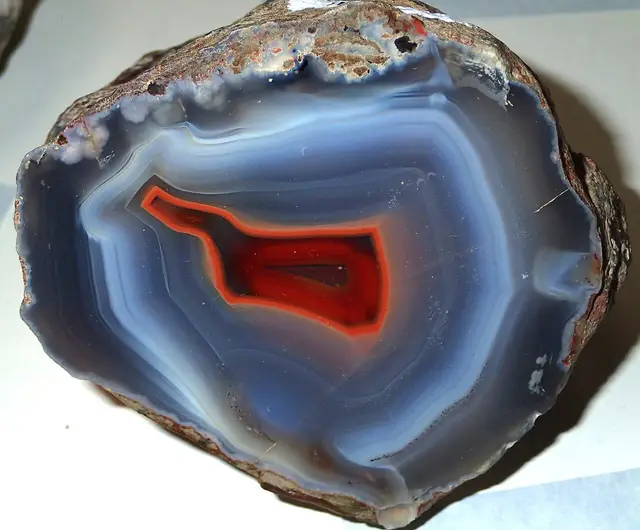
The banded variety of chalcedony: it grows layer by layer in hollows in volcanic rock and shows a new pattern every time it is cut.

Almandine
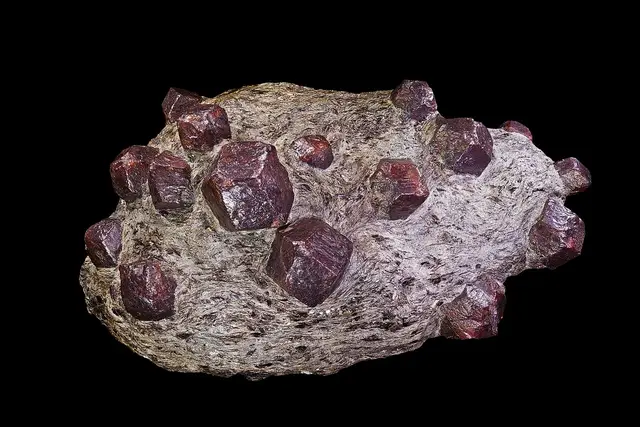
The commonest garnet: a deep red, iron-rich stone named after the ancient city of Alabanda in Anatolia, used in jewellery and in sandpaper alike.
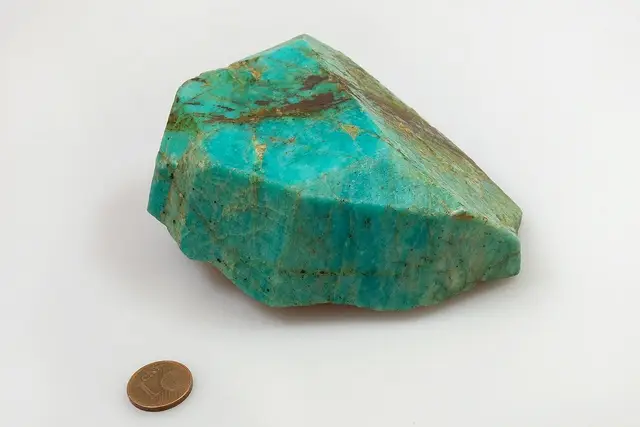
Amazonite
A turquoise-like green-blue feldspar: a variety of microcline worn as jewellery for more than three thousand years, but it can release lead.