Meteorite
Canyon Diablo meteorite
Canyon Diablo meteoriti
Pieces of the asteroid that blasted Arizona's Meteor Crater; the age of the Earth, 4.55 billion years, was measured with this meteorite.
Also known as: Canyon Diablo · Barringer meteorite · Holsinger Meteorite (largest fragment)
- Popularly: Meteorite

In short
Canyon Diablo is the name given to the fragments of the roughly 50-metre asteroid that made Meteor Crater (Barringer Crater) in Arizona, USA, about 50,000 years ago. The pieces are found around the crater rim, and some 30 tonnes have been collected; the largest weighs 639 kilograms. It is a coarse octahedrite iron meteorite that even contains small diamonds. In 1953 Clair Patterson measured lead isotopes in this meteorite and worked out the age of the Earth as 4.55 billion years.
Photos

How does it form?
Canyon Diablo is an iron meteorite of the IAB group. A metal body about 50 metres across struck what is now Arizona about 50,000 years ago and blasted out Meteor Crater. The impact broke the body apart and scattered its pieces around the crater. Today meteorites are found on the crater rim and in the strewn field around it; the canyon that gave the name lies at the western edge of this field, about 4 kilometres west of the crater.
The small diamonds and lonsdaleite in the meteorite are minerals formed when carbon is transformed under high pressure.
What is it used for?
- Age of the Earth: In 1953 Clair Patterson used its lead isotopes to set the age of the Earth at 4.55 billion years.
- Isotope standard: Its troilite serves as the standard reference for sulfur isotope ratios.
- Crater science: Meteor Crater and its meteorites played a key role in showing that such craters are not volcanic.
- History: Prehistoric Native Americans knew and used these meteorite pieces.
History
The pieces were named in 1891 after the nearest post office, Canyon Diablo, and have been collected and studied by scientists since the 19th century. The largest piece, the 639-kilogram Holsinger Meteorite, is displayed at the Meteor Crater Visitor Center on the crater rim. The 22-kilogram “Basket Meteorite”, known for its basket-like shape, is also at the Meteor Crater museum.
What determines its value?
Because so much of it was collected, Canyon Diablo is one of the iron meteorites most often seen in collections. A piece's value depends on its mass, shape, the condition of its surface (rust), the pattern in section and its documented origin. Its scientific value is very high: it was used to measure the age of the Earth and as an isotope standard.
This information is educational, not buying, selling or investment advice. Value varies enormously with quality and treatment.
How to recognise it
- 1
Heavy metal pieces with a rusty brown to blackish surface; some show shallow thumbprint-like hollows (regmaglypts).
- 2
Being almost entirely iron–nickel, they are much heavier than a stone of the same size and strongly attract a magnet.
- 3
Cut and etched with acid, they show a coarse Widmanstätten pattern and sometimes black graphite–troilite nodules.
Myths and misconceptions
MythMeteor Crater is a volcanic crater.
FactFrom the late 19th to the early 20th century the crater's origin was long debated. Thanks to the work of Daniel M. Barringer, F. R. Moulton and Harvey H. Nininger, it was largely accepted by the early 1930s that the crater was made by a meteorite impact.
Did you know?
The meteorite's troilite (iron sulfide) is used worldwide as the standard reference for sulfur isotope ratios.
Moissanite (silicon carbide), the second-hardest natural mineral, as well as diamond and lonsdaleite have been found in it.
Its pieces are in many museums worldwide: the largest outside the US (485 kg) is at the Canterbury Museum in Christchurch, New Zealand, and a 360 kg piece is at the National Museum of Natural History in Paris.
Where is it found?
Loading map…
- Meteor Crater (Barringer Crater), Coconino County, Arizona, USA · Type localityThe crater made about 50,000 years ago by an asteroid roughly 50 metres across. Meteorites are found around the rim; the largest, the 639 kg Holsinger Meteorite, is displayed at the visitor centre on the rim. The name comes from the nearest post office, Canyon Diablo.
Locations are approximate to protect sites. Red dots mark places in Türkiye. Open in the big map →
Frequently asked questions
What is canyon Diablo meteorite?
Canyon Diablo is the name given to the fragments of the roughly 50-metre asteroid that made Meteor Crater (Barringer Crater) in Arizona, USA, about 50,000 years ago. The pieces are found around the crater rim, and some 30 tonnes have been collected; the largest weighs 639 kilograms. It is a coarse octahedrite iron meteorite that even contains small diamonds. In 1953 Clair Patterson measured lead isotopes in this meteorite and worked out the age of the Earth as 4.55 billion years.
How was the age of the Earth measured with a meteorite?
Meteorites formed at the same time as the Earth, at the start of the Solar System. In 1953 Clair Cameron Patterson measured lead isotope ratios in samples of the Canyon Diablo meteorite and, using uranium–lead dating, worked out the Earth's age as 4.550 billion years (plus or minus 70 million years). This is very close to the estimate accepted today.
What is canyon Diablo meteorite used for?
Age of the Earth: In 1953 Clair Patterson used its lead isotopes to set the age of the Earth at 4.55 billion years. Isotope standard: Its troilite serves as the standard reference for sulfur isotope ratios. Crater science: Meteor Crater and its meteorites played a key role in showing that such craters are not volcanic. History: Prehistoric Native Americans knew and used these meteorite pieces.
How hard is canyon Diablo meteorite?
It has a hardness of 4–5.5 on the Mohs scale. A fingernail cannot scratch it, but a steel knife can. Its specific gravity is 7–8 g/cm³.
Where is canyon Diablo meteorite found?
Its best-known localities: Meteor Crater (Barringer Crater), Coconino County, Arizona, USA.
How can you tell if canyon Diablo meteorite is real?
Heavy metal pieces with a rusty brown to blackish surface; some show shallow thumbprint-like hollows (regmaglypts). Being almost entirely iron–nickel, they are much heavier than a stone of the same size and strongly attract a magnet. Cut and etched with acid, they show a coarse Widmanstätten pattern and sometimes black graphite–troilite nodules.
Is canyon Diablo meteorite valuable?
On the “street to diamond” value ladder it sits on step 5 of nine: Ornamental stone. Because so much of it was collected, Canyon Diablo is one of the iron meteorites most often seen in collections. A piece's value depends on its mass, shape, the condition of its surface (rust), the pattern in section and its documented origin. Its scientific value is very high: it was used to measure the age of the Earth and as an isotope standard.
Sources
- Canyon Diablo (meteorite) · Wikipedia
- Meteor Crater · Wikipedia
- Kamacite Mineral Data · Webmineral.com
- Taenite Mineral Data · Webmineral.com
- Density and specific gravity (R. L. Korotev) · Washington University in St. Louis, Some Meteorite Information
External links
Draft: awaiting expert reviewReport an error
On the same step
Agate
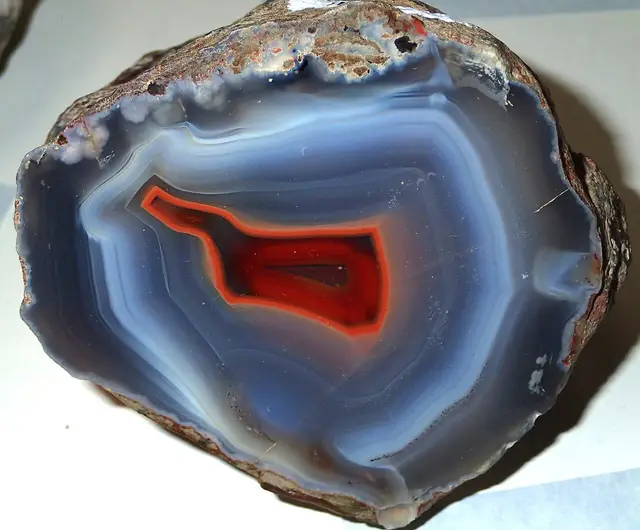
The banded variety of chalcedony: it grows layer by layer in hollows in volcanic rock and shows a new pattern every time it is cut.

Almandine
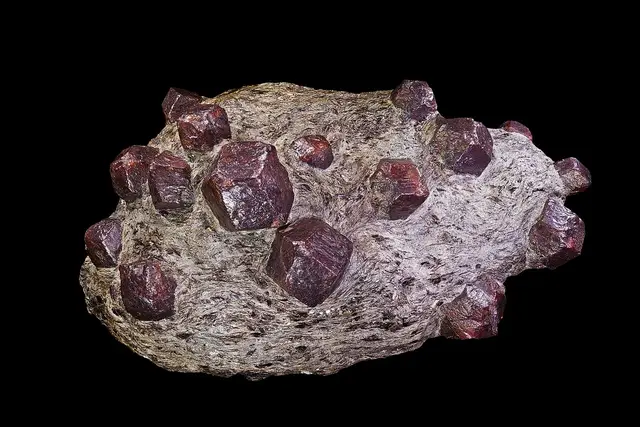
The commonest garnet: a deep red, iron-rich stone named after the ancient city of Alabanda in Anatolia, used in jewellery and in sandpaper alike.
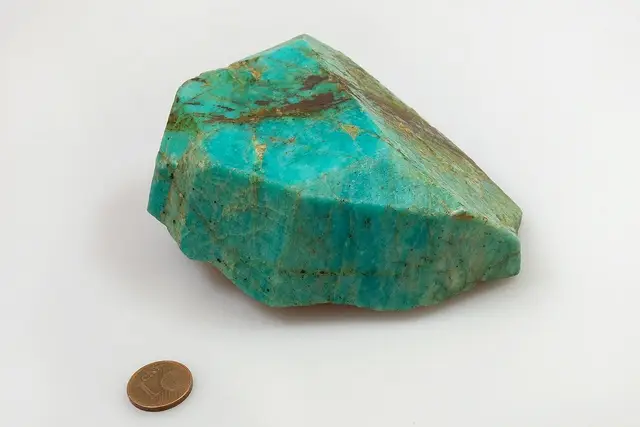
Amazonite
A turquoise-like green-blue feldspar: a variety of microcline worn as jewellery for more than three thousand years, but it can release lead.