Meteorite
Nakhla meteorite
Nakhla meteoriti
A piece of Mars that fell on Egypt in 1911: the first meteorite to show signs of water on Mars, and star of the legend of a dog it supposedly killed.
Also known as: Nakhla
- Popularly: Meteorite

In short
Nakhla is a Martian meteorite that fell near Abu Hummus in Egypt's Beheira Governorate on 28 June 1911. It came down as about forty pieces with a total weight of about 10 kilograms. It was the first meteorite reported from Egypt, the first Martian meteorite to show signs of water-driven processes on Mars, and the type specimen that named the “nakhlite” Martian meteorites. It formed about 1.3 billion years ago at a volcano on Mars.
Photos

How does it form?
Nakhla is an augite-rich igneous rock that formed from basaltic magma at a volcano on Mars about 1.3 billion years ago. Its crystallisation age, compared with crater counts on the Martian surface, suggests that nakhlites formed on one of the large volcanic regions such as Tharsis, Elysium or Syrtis Major. After it formed, the rock met water and secondary minerals built up in its pores.
A large impact on Mars blasted the rock into space. After travelling through the Solar System for an unknown time, it entered Earth’s atmosphere and fell on Egypt in 1911.
What is it used for?
- Water on Mars: It is the first meteorite to show water-driven processes on Mars.
- Martian volcanism: It is studied to understand Mars’s volcanic history and interior.
- Life research: Amino acids (aspartic acid, glutamic acid, glycine, alanine) were found in it, but it is unclear whether they come from the meteorite itself or from Earth contamination.
History
The meteorite fell at about 09:00 on 28 June 1911 around the village of El Nakhla El Bahariya. The pieces weighed from 20 grams to 1,813 grams and were collected near several small hamlets. A NASA team that received a piece from the British Museum in 1998 began examining it with an electron microscope in 1999.
What determines its value?
Nakhla's value is scientific: it is the first meteorite carrying signs of water on Mars and the type specimen of the nakhlites. Its pieces are kept in museums such as those in London and Paris. Martian meteorites in general are so rare that they are among the most sought-after meteorites; a piece's value depends on its mass and documented origin.
This information is educational, not buying, selling or investment advice. Value varies enormously with quality and treatment.
How to recognise it
- 1
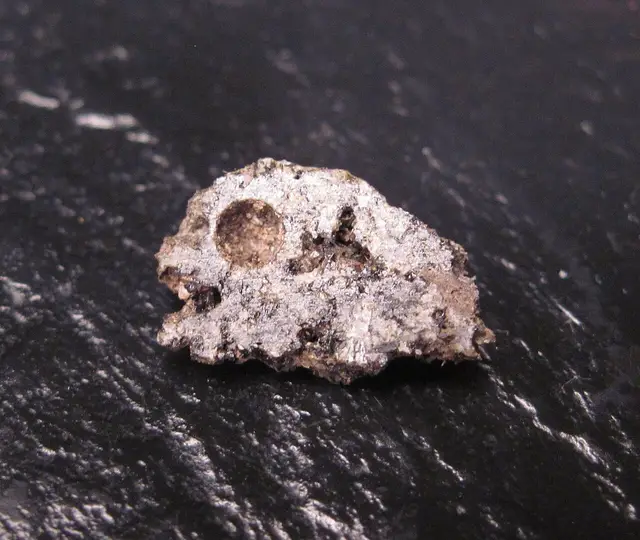
Its outside is covered by a thin, black and sometimes glossy fusion crust; inside it is grey.
- 2
Augite and olivine crystals can be seen in it; there are no round grains (chondrules).
- 3
Its Martian origin is shown in the lab by features such as the isotopic make-up of its carbonates.
Myths and misconceptions
MythThe Nakhla meteorite killed a dog when it fell.
FactA farmer from the village of Denshal said a piece landed on a dog and vaporised it instantly. But no remains of the dog were found and there was no other witness, so the story remains unconfirmed, though it has become a legend among astronomers.
MythTraces of Martian bacteria were found in Nakhla.
FactNASA researchers found carbon-rich material in the rock's pores resembling the work of bacteria, but at a 2006 scientific conference most participants found it insufficient as proof. A 2014 study also judged a non-biological origin to be the most reasonable explanation for the shapes.
Did you know?
Many people saw it fall: it came from the northwest, leaving a column of white smoke, and several explosions were heard before it landed.
The Egyptian government presented two pieces found near Ezbet Abdel Malek to the British Museum.
In 2006 London's Natural History Museum let NASA researchers break open an intact piece for the first time, giving fresh samples relatively free of Earth contamination.
Where is it found?
Loading map…
- El Nakhla El Bahariya, Abu Hummus, Beheira, Egypt · Type localityOn the morning of 28 June 1911 about forty pieces fell over an area 4.5 km across, burying themselves up to a metre deep. It was the first meteorite reported from Egypt.
Locations are approximate to protect sites. Red dots mark places in Türkiye. Open in the big map →
Frequently asked questions
What is nakhla meteorite?
Nakhla is a Martian meteorite that fell near Abu Hummus in Egypt's Beheira Governorate on 28 June 1911. It came down as about forty pieces with a total weight of about 10 kilograms. It was the first meteorite reported from Egypt, the first Martian meteorite to show signs of water-driven processes on Mars, and the type specimen that named the “nakhlite” Martian meteorites. It formed about 1.3 billion years ago at a volcano on Mars.
How does Nakhla show there was water on Mars?
The rock contains carbonates and water-bearing minerals formed by chemical reactions in water. It also met water after it formed, leaving secondary minerals inside it. Because its carbonates hold more carbon-13 than Earth rocks, they must have formed on Mars.
What is nakhla meteorite used for?
Water on Mars: It is the first meteorite to show water-driven processes on Mars. Martian volcanism: It is studied to understand Mars's volcanic history and interior. Life research: Amino acids (aspartic acid, glutamic acid, glycine, alanine) were found in it, but it is unclear whether they come from the meteorite itself or from Earth contamination.
How hard is nakhla meteorite?
It has a hardness of 5.5–7 on the Mohs scale. It can scratch glass; a steel knife scratches it only with difficulty. Its specific gravity is 3.08–3.22 g/cm³.
Where is nakhla meteorite found?
Its best-known localities: El Nakhla El Bahariya, Abu Hummus, Beheira, Egypt.
How can you tell if nakhla meteorite is real?
Its outside is covered by a thin, black and sometimes glossy fusion crust; inside it is grey. Augite and olivine crystals can be seen in it; there are no round grains (chondrules). Its Martian origin is shown in the lab by features such as the isotopic make-up of its carbonates.
Is nakhla meteorite valuable?
On the “street to diamond” value ladder it sits on step 7 of nine: Precious stone. Nakhla's value is scientific: it is the first meteorite carrying signs of water on Mars and the type specimen of the nakhlites. Its pieces are kept in museums such as those in London and Paris. Martian meteorites in general are so rare that they are among the most sought-after meteorites; a piece's value depends on its mass and documented origin.
Sources
- Nakhla meteorite · Wikipedia
- Nakhla meteoriti · Vikipedi
- Nakhlite · Wikipedia
- Stony meteorite porosities and densities: A review of the data through 2001 (D. T. Britt & G. J. Consolmagno), Meteoritics & Planetary Science 38 · University of Arizona Repository, 2003
- Handbook of Mineralogy: Forsterite · Mineralogical Society of America
External links
Draft: awaiting expert reviewReport an error
On the same step
Acapulcoite
Stony meteorites that began to melt but never fully did: metal-veined primitive achondrites, named after a stone that fell near Acapulco in 1976.
Allan Hills 84001
The stone that sparked the Mars-life debate: a 4-billion-year-old Martian meteorite from Antarctica whose tiny structures were likened to fossil bacteria in 1996.
Angrite
The oldest known igneous rocks: rare basaltic meteorites that crystallised about 4.56 billion years ago, in the very earliest days of the Solar System.