VarietyA variety of Opal
Boulder opal
SiO₂·nH₂OBoulder opal
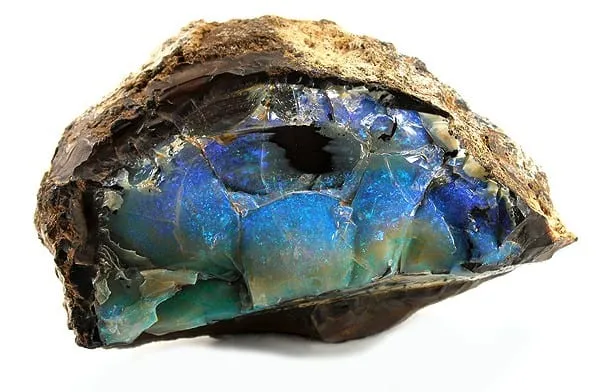
Precious opal glowing in thin veins and patches inside brown ironstone: an opal cut together with its host rock, found only in Queensland.
Also known as: Queensland boulder opal · Yowah nut (small round concretion type from Yowah) · Ironstone opal
- Popularly: Semi-precious stone
In short
Boulder opal is precious opal that forms inside and in the cracks of siliceous ironstone concretions in western Queensland, Australia. The opal layers are usually so thin that they cannot be separated from the rock, so the stone is cut with its brown ironstone backing and looks like a doublet made by nature itself. The dark ironstone background makes the opal's blue, green and red play-of-colour look vivid. The name “boulder” also comes from the opal staying attached to its host rock in the finished stone. The fields around Quilpie, Yowah, Koroit and Winton are the main opal areas.
Photos
How does it form?
Much of Queensland is covered by an opal-bearing sandstone unit of Upper Cretaceous age. Its lower part consists of opal-bearing sandstone and clay layers, capped by a hard, reddish, siliceous crust 5 to 16 metres thick. The opal is found in siliceous ironstone concretions in the lower layers. Silica-rich groundwater seeps into the cracks and pores of these concretions; as the water withdraws, silica builds up, and where tiny spheres settle in regular arrays, precious opal with play-of-colour forms.
The opal lies sometimes in thin veins between the layers of the concretion and sometimes as a core at its centre. The opal layers are often so thin that they break if anyone tries to separate them from the ironstone. The opal is therefore cut with its host rock left behind it; the ironstone both strengthens the stone and gives a dark background that sets off the colours.
What is it used for?
- Jewellery: it is usually cut into free-form cabochons for pendants, rings and earrings. Because the ironstone backing strengthens thin opal, even thin opal layers can be used.
- Carvings and art: some craftsmen carve boulder opal into sculptures and art pieces while keeping the stone’s natural form.
- Collecting: Yowah nuts and large, bright pieces of boulder opal are sought by collectors.
Mining
Open-cut mining is the rule at most Queensland opal fields. Instead of washing the dirt to separate the opal, as at Lightning Ridge, miners split the ironstone concretions they dig up one by one by hand; only a small share of them contain opal. Flat concretions are called “lily pads”, small round ones “nuts”.
Where is it found?
Boulder opal is found only in Queensland. It occurs sporadically in a broad belt across western Queensland, from Kynuna in the north to Yowah and Koroit in the south. The largest quantities have come from around Quilpie and Jundah; Quilpie has one of the world’s largest boulder opal deposits. Yowah is known for its nuts, and Opalton near Winton is one of Queensland’s largest opal fields. For opal as a whole, see the opal page; for the other dark-background opal, see black opal.
What determines its value?
The value of boulder opal depends mostly on the brightness of its play-of-colour, the range of colours and the beauty of the pattern; the dark ironstone background makes the colours look more vivid. The size and continuity of the opal surface, its share relative to the ironstone, the soundness of the stone and how well the cut suits it also count. Natural stones are worth far more than glued doublets and triplets and treated matrix opals, so the seller should state that the stone is natural boulder opal.
This information is educational, not buying, selling or investment advice. Value varies enormously with quality and treatment.
How to recognise it
- 1
One face or the inside of the stone shows opal with bright play-of-colour, while the rest is dull, dark brown ironstone; the boundary between opal and rock is natural and irregular, not straight.
- 2
The opal usually forms thin veins, patches or a core in the middle of the concretion, so stones are often cut in free forms and their surfaces are not always flat.
- 3
Unlike a glued doublet, it has no straight glue line between the opal and the backing; the back is natural ironstone.
- 4
Andamooka matrix opal darkened with sugar and acid shows black carbon dots under a loupe; in boulder opal the dark colour comes from the rock itself. A certain identification needs a gemmological laboratory.
Fakes and imitations
What shops usually don’t tell you:
- Glued doublets and triplets: made by gluing a thin slice of opal onto a dark backing such as ironstone, dark common opal, onyx or obsidian; they can be mistaken for natural boulder opal and must be disclosed at sale.
- Sugar-acid treated matrix opal: porous Andamooka matrix opal is darkened with carbon; it can look like natural boulder opal or black opal.
Myths and misconceptions
MythBoulder opal is a doublet with a stone glued to its back.
FactNo. In boulder opal the opal layer formed naturally inside the ironstone and cannot be separated from it; the back is not glued on but is the stone's own host rock. This is why the Australian Museum describes it as a “natural doublet”.
MythEvery stone sold as “matrix opal” is boulder opal.
FactBoulder opal is Queensland's natural opal in ironstone. The South Australian stones sold in the trade as “Andamooka matrix opal”, by contrast, are often darkened with sugar and acid; the two are different materials and the treatment must be disclosed.
Did you know?
Opal was discovered in Queensland in the 1870s. The state has about a dozen opal fields.
The opal comes from inside ironstone concretions, and miners have to split each concretion by hand to look inside; only a few contain opal.
Miners call the flat concretions “lily pads” and the small round ones from Yowah “nuts”; the “Yowah nut” is a sought-after collector's piece.
The altar and baptismal font of St Finbarr's Church in Quilpie are decorated with local opals.
Where is it found?
Loading map…
- Quilpie and the Toompine opal field, Queensland, Australia · Major depositOne of the largest boulder opal deposits in the world
- Yowah, Paroo, Queensland, Australia · Major depositFamous for “Yowah nuts”, small, round ironstone concretions with precious opal inside
- Jundah, Barcoo, Queensland, Australia · Historic sourceWith Quilpie, the area with the most boulder opal; mining in the early 20th century stopped after about twenty years because of water shortages
- Opalton Opal Field, Winton, Queensland, Australia · Known localityOne of the largest and most extensively worked opal deposits in Queensland
- Kynuna, Queensland, Australia · Known localityThe northern end of the boulder opal belt, which runs south to Yowah and Koroit
Locations are approximate to protect sites. Red dots mark places in Türkiye. Open in the big map →
Frequently asked questions
What is boulder opal?
Boulder opal is precious opal that forms inside and in the cracks of siliceous ironstone concretions in western Queensland, Australia. The opal layers are usually so thin that they cannot be separated from the rock, so the stone is cut with its brown ironstone backing and looks like a doublet made by nature itself. The dark ironstone background makes the opal's blue, green and red play-of-colour look vivid. The name “boulder” also comes from the opal staying attached to its host rock in the finished stone. The fields around Quilpie, Yowah, Koroit and Winton are the main opal areas.
What is boulder opal used for?
Jewellery: it is usually cut into free-form cabochons for pendants, rings and earrings. Because the ironstone backing strengthens thin opal, even thin opal layers can be used. Carvings and art: some craftsmen carve boulder opal into sculptures and art pieces while keeping the stone's natural form. Collecting: Yowah nuts and large, bright pieces of boulder opal are sought by collectors.
How hard is boulder opal?
It has a hardness of 5.5–6.5 on the Mohs scale. It can scratch glass; a steel knife scratches it only with difficulty. Its specific gravity is 1.9–2.3 g/cm³.
Where is boulder opal found?
Its best-known localities: Quilpie and the Toompine opal field, Queensland, Australia; Yowah, Paroo, Queensland, Australia; Jundah, Barcoo, Queensland, Australia; Opalton Opal Field, Winton, Queensland, Australia; Kynuna, Queensland, Australia.
How can you tell if boulder opal is real?
One face or the inside of the stone shows opal with bright play-of-colour, while the rest is dull, dark brown ironstone; the boundary between opal and rock is natural and irregular, not straight. The opal usually forms thin veins, patches or a core in the middle of the concretion, so stones are often cut in free forms and their surfaces are not always flat. Unlike a glued doublet, it has no straight glue line between the opal and the backing; the back is natural ironstone. Glued doublets and triplets: made by gluing a thin slice of opal onto a dark backing such as ironstone, dark common opal, onyx or obsidian; they can be mistaken for natural boulder opal and must be disclosed at sale.
Is boulder opal valuable?
On the “street to diamond” value ladder it sits on step 6 of nine: Fine ornamental and collector stone. The value of boulder opal depends mostly on the brightness of its play-of-colour, the range of colours and the beauty of the pattern; the dark ironstone background makes the colours look more vivid. The size and continuity of the opal surface, its share relative to the ironstone, the soundness of the stone and how well the cut suits it also count. Natural stones are worth far more than glued doublets and triplets and treated matrix opals, so the seller should state that the stone is natural boulder opal.
Family


Sources
- Opal · Australian Museum
- Splendor in the Outback: A Visit to Australia's Opal Fields (T. Hsu, A. Lucas, V. Pardieu), Gems & Gemology 51(4) · GIA, 2015
- Opal Description (Gem Encyclopedia) · GIA
- Opal Quality Factors · GIA
- Sugar/Heat-Treated Opal (T. Hsu, L. Kennedy), Gem News International, Gems & Gemology 58(1) · GIA, 2022
- Opal · Wikipedia
- Quilpie · Wikipedia
- Yowah · Wikipedia
- Jundah · Wikipedia
- Opalton, Queensland · Wikipedia
- Kynuna · Wikipedia
Draft: awaiting expert reviewReport an error
On the same step
Achondrite
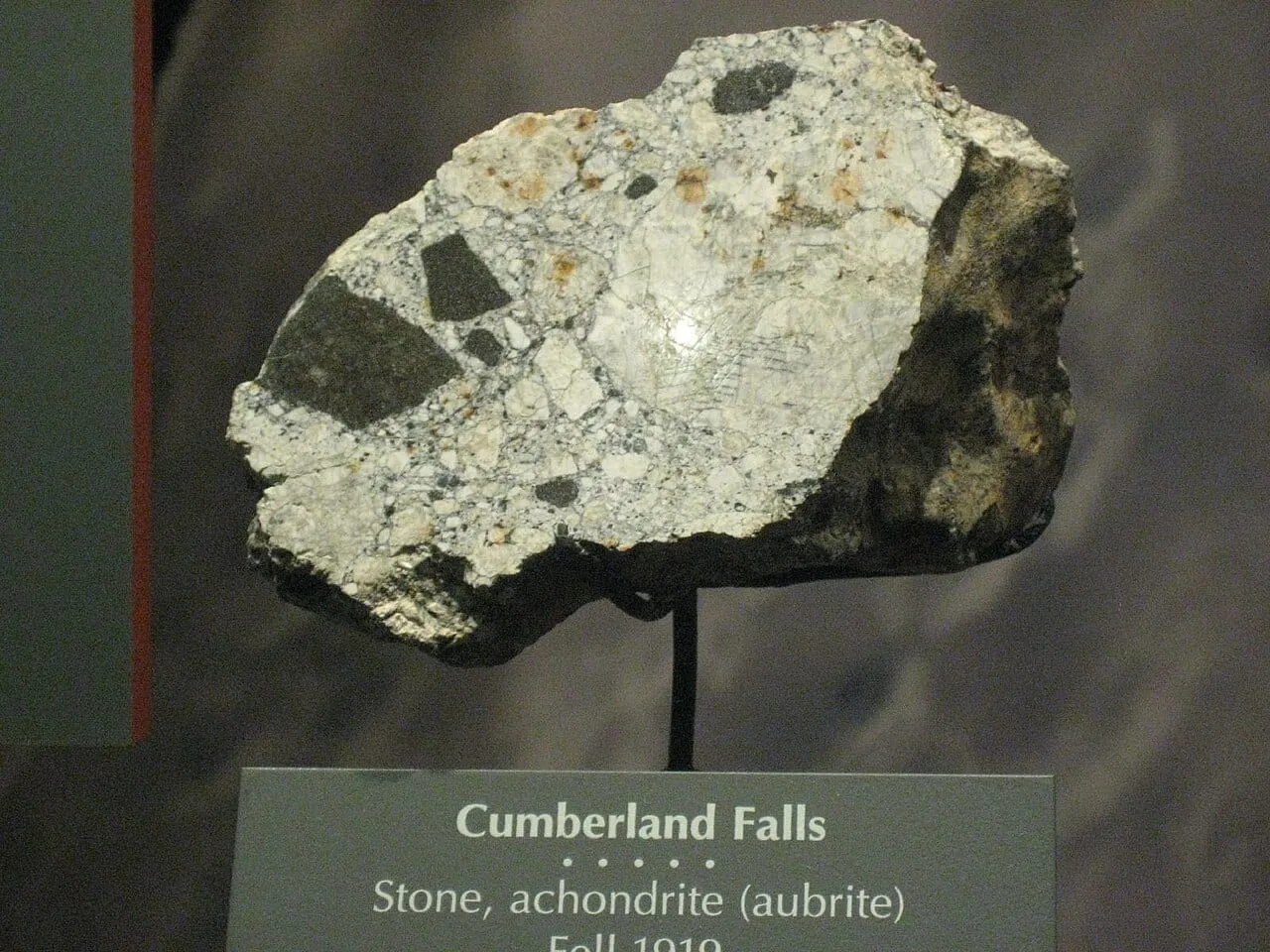
Stony meteorites with no chondrules: rock from melted asteroids, the Moon and Mars, and hard to recognise because they look like Earth rocks.
Amber
Tree resin fossilised over millions of years: a light, warm organic gem that sometimes holds prehistoric insects.
Ammolite
The rainbow-bright layer of fossil ammonite shell; of gem quality it comes only from the Canadian province of Alberta.