VarietyA variety of Topaz
Blue topaz
Al₂SiO₄(F,OH)₂Mavi topaz
The topaz most often seen in jewellery shops: an inexpensive, durable blue gem whose colour is nearly always produced by irradiating and heating colourless topaz.
Also known as: London Blue topaz (dark blue, treated) · Swiss Blue topaz (medium blue, treated) · Sky Blue topaz (light blue, treated) · Texas topaz (natural blue topaz from Mason County)
- Popularly: Semi-precious stone
In short
Blue topaz is topaz that is blue. Naturally blue topaz exists, but it is mostly very pale; according to GIA, the blue of topaz on the market is hardly ever natural. Colourless topaz is plentiful: it is first irradiated, which turns it brown, and then heated to a stable blue. The trade calls the light shades “Sky Blue”, the medium shades “Swiss Blue” and the dark shades “London Blue”. Once the treatment spread in the late 1970s, blue topaz became both the favourite colour of topaz and one of the least expensive gems.
Photos
How does it form?
Topaz forms in cavities and veins in granites and pegmatites through which hot, fluorine-rich fluids circulate. Natural blue colour comes from small defects in the crystal structure: according to GIA, such atomic-level imperfections can give topaz a yellow, brown or blue colour. The naturally blue topaz of Texas crystallised in pegmatites linked to granites about 1 to 1.3 billion years old; today most stones are gathered from the alluvium of creeks and river beds.
The blue topaz seen in jewellery shops, however, gets its colour in the laboratory. Colourless topaz is first irradiated with gamma rays, fast electrons or neutrons, which gives it a colour in the yellow to brown range; in most cases it is then heated, which removes that colour and leaves a stable blue. Colourless topaz was first irradiated to a blue colour in 1957; irradiated and heated blue topaz entered the market in the late 1970s and eventually became the most commonly irradiated gemstone.
What is it used for?
- Jewellery: hard, brilliant and inexpensive, it is widely used in rings, earrings, necklaces and bracelets. It is often cut to standard sizes and set in multi-stone and mass-market jewellery.
- An alternative to aquamarine: light blue topaz looks like aquamarine and costs much less, so it is chosen in its place; but which stone it is must be stated clearly at sale.
- Large stones and carvings: because it is easy to find in large sizes, it suits big cut stones and carvings.
- Collecting: naturally blue topaz crystals from places such as Ukraine, Zimbabwe and the Urals are sought by collectors.
Irradiation and colour names
The shade of blue topaz depends on how it was irradiated. Dark “London Blue” is produced with neutrons, that is, in a nuclear reactor. Light “Sky Blue” shades are often produced by electron irradiation, and medium “Swiss Blue” by a combination of the two methods. The resulting blue is stable to light.
In neutron-irradiated stones, trace elements temporarily become radioactive. The stones are therefore stored for months, sometimes years, until their radioactivity has fallen to a safe level. In a 2011 study of 15 stones, most were already safe 95 days after irradiation, but some with higher concentrations of trace elements would need to be stored for several years.
Where is it found?
The best-known source of naturally blue topaz is Mason County in the US state of Texas. Most of the Texas topaz that GIA studied in 2023 was colourless or very light blue; stones with a saturated blue colour were a small minority. The Volyn deposit in Ukraine’s Zhytomyr region yields large topaz crystals, among them rare but untreated blue shades. Large, vivid blue crystals came from the St. Ann’s mine in Zimbabwe in the late 1980s. Russia’s Ural Mountains, the Pikes Peak area of Colorado, Jos in Nigeria, Klein Spitzkoppe in Namibia and the gem gravels of Sri Lanka also yield blue topaz. For topaz as a whole, see the topaz page; for the stone it is most often confused with, see aquamarine.
What determines its value?
Blue topaz is a plentiful, inexpensive gem; its value depends mostly on the shade and saturation of the colour, the size of the stone and the quality of the cut. Small stones are cheap; according to GIA, value rises for stones larger than 10 × 8 millimetres. Because blue topaz is usually clean, eye-visible inclusions lower its value. Stones coloured by coating are worth less, while naturally blue topaz with documented origin from Mason County, Texas, is valued much more highly in its home region.
This information is educational, not buying, selling or investment advice. Value varies enormously with quality and treatment.
How to recognise it
- 1
As a topaz it is hard (8) and scratches glass and quartz. But it has perfect cleavage, so a hard knock can split it along a smooth plane.
- 2
It is most often confused with aquamarine. Blue topaz has a clearly higher refractive index (about 1.61–1.62) and specific gravity (about 3.56) than aquamarine (about 1.58 and 2.7), so a gem lab tells them apart easily.
- 3
A large, clean, dark or vivid blue topaz is almost certainly treated; natural blue topaz is mostly very light blue. Routine gemmological tests usually cannot tell natural blue from treated blue with certainty.
- 4
On topaz coloured by a surface coating, the coating can scratch and wear; it becomes visible when the stone is examined immersed in a liquid.
Fakes and imitations
What shops usually don’t tell you:
- Treated stones sold as “natural blue”: irradiation and heating mimic what happens in nature so closely that routine tests usually cannot reveal the treatment. A claim of natural colour should rest on documents showing where the stone came from.
- Coated topaz: a thin coloured film is applied to the surface of colourless topaz. The coating scratches and wears easily, and this treatment too must be disclosed when the stone is sold.
Safety
Blue topaz that has been irradiated, stored and measured at licensed facilities carries radioactivity below the legal limits by the time it is sold. In neutron-irradiated stones, trace elements temporarily become radioactive, so these stones must be stored for months and sometimes years. In the United States such stones are tested by a licensed body before sale; stones from unregulated channels carry no such assurance. Stones treated with cobalt-60 gamma rays do not become radioactive.
Myths and misconceptions
MythThe colour of blue topaz is natural.
FactNaturally blue topaz exists but is rare and usually very pale. Nearly all blue topaz on the market is made by irradiating and heating colourless topaz; according to GIA, any blue topaz on the market today is assumed to have been irradiated.
MythIrradiated blue topaz is radioactive and dangerous to wear.
FactStones treated at licensed facilities are stored until their radioactivity falls below the legal limit (about 37–100 becquerels per gram, depending on the country) and are sold only after being measured. Stones treated with gamma rays never become radioactive. The risk lies with stones that have not been checked.
MythBlue topaz and aquamarine are the same stone.
FactThey are different minerals: aquamarine is blue beryl, blue topaz is topaz. Light blue topaz is often used to imitate aquamarine, but according to GIA aquamarine, rarer in nature, especially in fine colour, and with a long history as a gem, is worth more.
What is it believed to be good for?
This section reports beliefs; it is not health information. There is no scientific evidence for these claims and no stone replaces medical treatment.
The meanings people give this stone, and who holds them:
- Today crystal-therapy websites link blue topaz with the throat chakra and claim that it makes communication, speaking openly and self-expression easier.
- In Türkiye, stone sellers and crystal-therapy websites claim that blue topaz relieves stress and brings calm and peace of mind.
What science says
There is no scientific evidence that blue topaz makes communication easier or relieves stress; persistent anxiety or stress calls for a doctor. The colour of blue topaz on the market does not come from nature but from irradiation in a nuclear reactor or an accelerator, followed by heating.
Did you know?
Blue topaz has been the official state gem of Texas since 1969. In 1977 Texas also chose an official cut, the “Lone Star” cut, whose pavilion facets show a large five-pointed star through the top of the stone, like the star on the Texas flag.
By one estimate about 30 million carats (some 6 tonnes) of topaz are irradiated worldwide every year; in 1988, 40 percent of this was done in the United States.
The colour of Texas's naturally blue topaz can sometimes fade in sunlight.
On the jewellery trade's wedding anniversary lists, blue topaz is the gem of the fourth year of marriage.
Where is it found?
Loading map…
- Mason County, Llano Uplift, Texas, USA · Major depositNaturally blue “Texas topaz”, mostly gathered from creek and river alluvium; Texas’s state gem since 1969
- Volyn deposit, Khoroshiv (formerly Volodarsk-Volynskyi), Zhytomyr Oblast, Ukraine · Major depositLarge topaz crystals in pegmatites; blue shades are rare and usually untreated
- St. Ann's mine, Miami (Mwami) district, Mashonaland West, Zimbabwe · Known localityLarge, vivid blue natural topaz crystals; the point marks the Karoi area, the mine site is approximate
- Central Urals pegmatites (Murzinka area), Sverdlovsk Oblast, Russia · Historic sourceThe Urals are known for fine blue topaz crystals, many of them cuttable
- Pikes Peak area, Colorado, USA · Known localityFine blue topaz crystals in granitic rocks
- Jos, Plateau State, Nigeria · Known localityBlue and white topaz crystals, many of them cuttable
- Klein Spitzkoppe, Erongo, Namibia · Known localityColourless and blue topaz in cavity-rich pegmatites in granite; topaz was first reported here in 1889
- Sri Lanka · Known localityColourless, yellow and blue topaz pieces in the gem gravels; no exact site is given
Locations are approximate to protect sites. Red dots mark places in Türkiye. Open in the big map →
Frequently asked questions
What is blue topaz?
Blue topaz is topaz that is blue. Naturally blue topaz exists, but it is mostly very pale; according to GIA, the blue of topaz on the market is hardly ever natural. Colourless topaz is plentiful: it is first irradiated, which turns it brown, and then heated to a stable blue. The trade calls the light shades “Sky Blue”, the medium shades “Swiss Blue” and the dark shades “London Blue”. Once the treatment spread in the late 1970s, blue topaz became both the favourite colour of topaz and one of the least expensive gems.
Is blue topaz the birthstone for December?
Not on the official lists. The current US list used by jewellers gives turquoise, zircon and tanzanite for December, while topaz is the birthstone for November. Some jewellery websites nevertheless include blue topaz among the December stones.
What is blue topaz used for?
Jewellery: hard, brilliant and inexpensive, it is widely used in rings, earrings, necklaces and bracelets. It is often cut to standard sizes and set in multi-stone and mass-market jewellery. An alternative to aquamarine: light blue topaz looks like aquamarine and costs much less, so it is chosen in its place; but which stone it is must be stated clearly at sale. Large stones and carvings: because it is easy to find in large sizes, it suits big cut stones and carvings. Collecting: naturally blue topaz crystals from places such as Ukraine, Zimbabwe and the Urals are sought by collectors.
How hard is blue topaz?
It has a hardness of 8 on the Mohs scale. It scratches glass and steel; a steel knife cannot scratch it. Its specific gravity is 3.56–3.57 g/cm³.
Where is blue topaz found?
Its best-known localities: Mason County, Llano Uplift, Texas, USA; Volyn deposit, Khoroshiv (formerly Volodarsk-Volynskyi), Zhytomyr Oblast, Ukraine; Central Urals pegmatites (Murzinka area), Sverdlovsk Oblast, Russia; St. Ann's mine, Miami (Mwami) district, Mashonaland West, Zimbabwe; Pikes Peak area, Colorado, USA.
How can you tell if blue topaz is real?
As a topaz it is hard (8) and scratches glass and quartz. But it has perfect cleavage, so a hard knock can split it along a smooth plane. It is most often confused with aquamarine. Blue topaz has a clearly higher refractive index (about 1.61–1.62) and specific gravity (about 3.56) than aquamarine (about 1.58 and 2.7), so a gem lab tells them apart easily. A large, clean, dark or vivid blue topaz is almost certainly treated; natural blue topaz is mostly very light blue. Routine gemmological tests usually cannot tell natural blue from treated blue with certainty. Treated stones sold as “natural blue”: irradiation and heating mimic what happens in nature so closely that routine tests usually cannot reveal the treatment. A claim of natural colour should rest on documents showing where the stone came from.
Is blue topaz valuable?
On the “street to diamond” value ladder it sits on step 5 of nine: Ornamental stone. Blue topaz is a plentiful, inexpensive gem; its value depends mostly on the shade and saturation of the colour, the size of the stone and the quality of the cut. Small stones are cheap; according to GIA, value rises for stones larger than 10 × 8 millimetres. Because blue topaz is usually clean, eye-visible inclusions lower its value. Stones coloured by coating are worth less, while naturally blue topaz with documented origin from Mason County, Texas, is valued much more highly in its home region.
What is blue topaz good for?
Today crystal-therapy websites link blue topaz with the throat chakra and claim that it makes communication, speaking openly and self-expression easier. In Türkiye, stone sellers and crystal-therapy websites claim that blue topaz relieves stress and brings calm and peace of mind. There is no scientific evidence that blue topaz makes communication easier or relieves stress; persistent anxiety or stress calls for a doctor. The colour of blue topaz on the market does not come from nature but from irradiation in a nuclear reactor or an accelerator, followed by heating. This section reports beliefs; it is not health information. There is no scientific evidence for these claims and no stone replaces medical treatment.
Is blue topaz dangerous?
Blue topaz that has been irradiated, stored and measured at licensed facilities carries radioactivity below the legal limits by the time it is sold. In neutron-irradiated stones, trace elements temporarily become radioactive, so these stones must be stored for months and sometimes years. In the United States such stones are tested by a licensed body before sale; stones from unregulated channels carry no such assurance. Stones treated with cobalt-60 gamma rays do not become radioactive.
Family


Sources
- Topaz Description · GIA
- Topaz Quality Factors · GIA
- Why does aquamarine cost so much more than blue topaz that's almost the same color? (GIA FAQ) · GIA
- Altering the Color of Topaz (K. Nassau), Gems & Gemology 21(1) · GIA, 1985
- Radioactive Decay Pattern of Blue Topaz Treated by Neutron Irradiation (J. Zhang, T. Lu, H. Chen), Gems & Gemology 47(4) · GIA, 2011
- Topaz from Mason County, Texas (R. Bassoo, D. Eames, M. F. Hardman, K. Befus, Z. Sun), Gems & Gemology 59(4) · GIA, 2023
- Ukrainian Pegmatitic Heliodor and Topaz, Gem News International, Gems & Gemology 60(1) · GIA, 2024
- Topaz Gem, Price, and Jewelry Information · International Gem Society
- Distinguishing Aquamarine Imitations · International Gem Society
- Anniversary Gifts by Year · International Gem Society
- December Birthstones: Blue Topaz, Blue Zircon, Tanzanite and Turquoise · International Gem Society
- Gemstone irradiation · Wikipedia
- Topaz · Wikipedia
- Birthstone · Wikipedia
- Volyn Deposit · Wikipedia
- Khoroshiv · Wikipedia
- Karoi · Wikipedia
- Spitzkoppe · Wikipedia
- Handbook of Mineralogy: Topaz · Mineralogical Society of America
Draft: awaiting expert reviewReport an error
On the same step
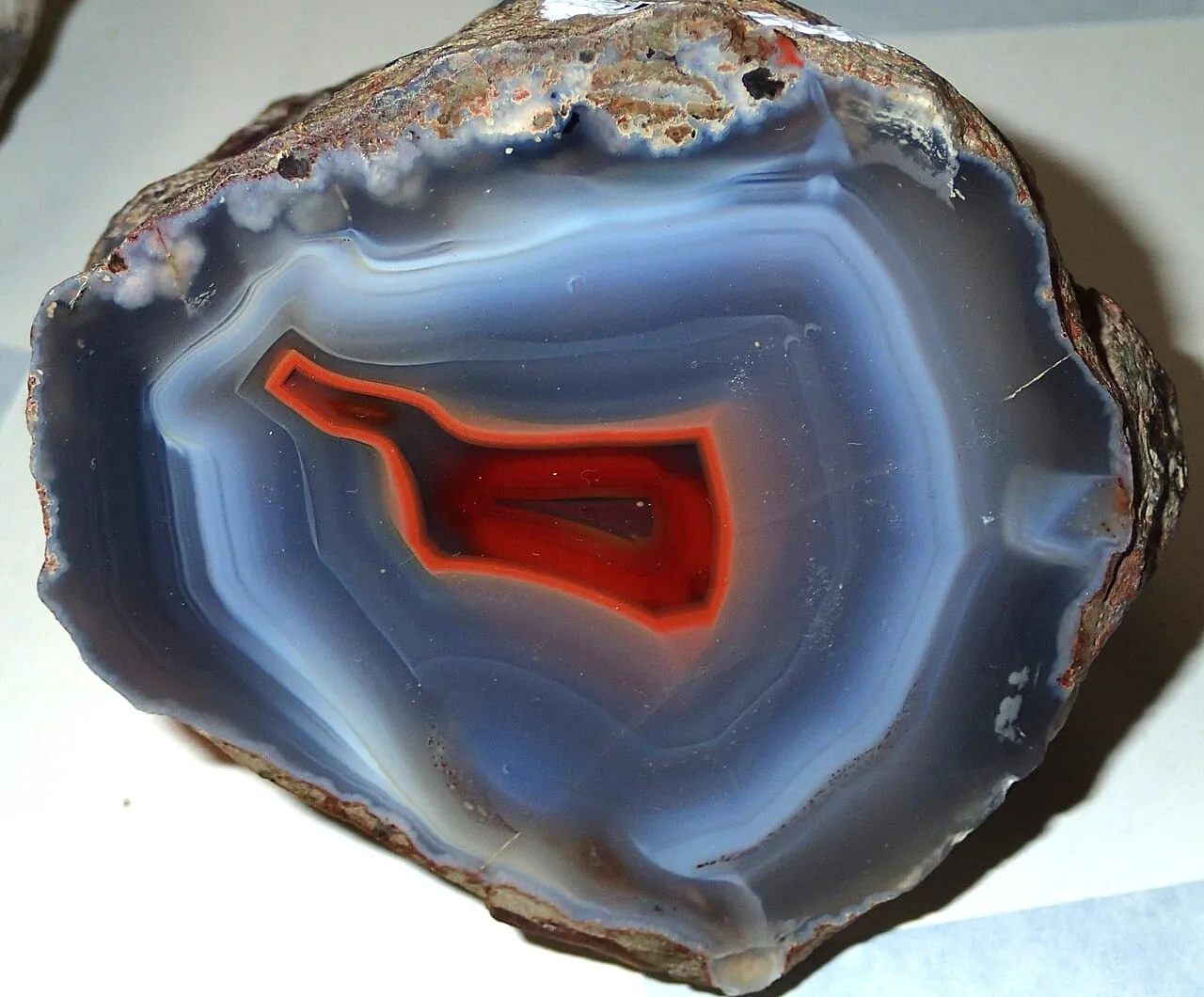
Agate
The banded variety of chalcedony: it grows layer by layer in hollows in volcanic rock and shows a new pattern every time it is cut.
Almandine
The commonest garnet: a deep red, iron-rich stone named after the ancient city of Alabanda in Anatolia, used in jewellery and in sandpaper alike.
Amazonite
A turquoise-like green-blue feldspar: a variety of microcline worn as jewellery for more than three thousand years, but it can release lead.