VarietyA variety of Pearl
Tahitian pearl
Tahiti incisi
A large cultured pearl grown in the black-lipped oyster in the lagoons of French Polynesia, with green, purple and pink overtones on a grey-black body.
Also known as: Black pearl · Tahitian black pearl
- Popularly: Semi-precious stone
In short
A Tahitian pearl is a cultured pearl grown in the black-lipped pearl oyster (Pinctada margaritifera). Although named after Tahiti, most of the farms lie in the lagoons of the Tuamotu and Gambier archipelagos of French Polynesia. It is popularly called a “black pearl”, yet most are not jet black but charcoal grey, silver or dark green, with purple, pink and blue overtones. Usually 8–18 mm across, they are much larger than Akoya pearls. First cultured in the 1960s, they soon became French Polynesia’s most important export.
Photos
How does it form?
A Tahitian pearl is a cultured pearl: people start the process and the oyster makes the pearl. The black-lipped pearl oyster is a large species that can live up to 30 years, weigh up to 5 kilograms and grow 30 centimetres across. Young oysters collected in the lagoon are strung on lines and raised; an oyster must be at least two years old and 11–12 cm across before it can be grafted. Into its reproductive organ the technician places a 5–9 mm bead, traditionally carved from the shell of freshwater mussels from the Mississippi basin in the United States, together with a small piece of mantle from another black-lipped oyster. The mantle piece also determines the colour of the pearl.
The grafted oysters are tended in the lagoon for at least a year and a half to two years, during which they coat the bead with nacre, layer after layer. Not everything goes to plan: according to 2006 figures, out of every 100 grafted oysters about 20 reject the bead and 25 to 30 die. The colour comes from organic pigments called porphyrins in the shell and from organic matter within the nacre.
What is it used for?
- Jewellery: used in necklaces, earrings and rings; its large size and naturally dark colour set it apart from other cultured pearls. In most harvests more than 40 percent of the pearls come out baroque or semi-baroque (irregular in shape), and these are used in jewellery too.
- Mother-of-pearl: for centuries the oyster was fished for its shell; in the 19th century European sailors traded for the shells, which were used for buttons, inlay and jewellery.
- Economy: in 2004 pearls made up 71 percent of French Polynesia’s local exports by value and supported about 5,000 people.
A short history
Polynesians treasured the shell of the black-lipped oyster long before Europeans arrived. When the oysters were overfished for mother-of-pearl in the 19th century, the French authorities introduced diving seasons; in 1885 Bouchon-Brandely, one of the biologists they hired, also proposed collecting young oysters and raising them in protected areas, still the main way of obtaining oysters today. In the early 1960s the veterinarian Jean-Marie Domard tried culturing pearls in this oyster with Japanese specialists, and within a few years the first fine cultured pearls were harvested. The first commercial farm opened on Manihi Atoll in 1966. When leasing sea areas became easier in the early 1990s, the number of farms and the output grew fast; as quality fell, the government brought in a minimum nacre thickness, “top gem” and A to D quality grades and export inspections in the early 2000s, and banned the sale of reject pearls. According to a 2006 report, French Polynesia supplied about 90 percent of world production of these pearls, the rest coming from places such as the Cook Islands, the Marshall Islands and Okinawa in Japan.
What determines its value?
Colour, lustre, shape, size and surface quality matter most. The greenish-black “peacock” colour and aubergine (purple) overtones are the most sought after; silver and golden tones are worth less because other South Sea oysters produce them too. Perfectly round pearls are scarce: in a first harvest only about 5 percent are round. In 2002 French Polynesia set a minimum nacre thickness of 0.8 mm for exported pearls; treatments such as dyeing should be disclosed.
This information is educational, not buying, selling or investment advice. Value varies enormously with quality and treatment.
How to recognise it
- 1
Size is a clue: Tahitian pearls are usually 8–18 mm across, mostly 9–12 mm, and few are smaller than 9 mm. Very black, round pearls of 8 mm or less are generally dyed or irradiated Akoya pearls.
- 2
The colour is not flat: as the pearl is turned, green, blue, purple and pink overtones play over a grey, black or brown body. The most characteristic colour is a greenish black known as “peacock”.
- 3
A strand in which every pearl is exactly the same colour, or dye concentrated around the drill hole under a loupe, points to dyeing.
- 4
Parallel grooves running all the way round the pearl (“ringed” or “circled” pearls) are common in Tahitian pearls.
Fakes and imitations
What shops usually don’t tell you:
- Dyed pearls: since the early 1900s small, light-coloured Akoya pearls have been dyed black with silver nitrate solutions, and light-coloured Tahitian and South Sea pearls have also been found darkened. Under long-wave ultraviolet light natural-colour Tahitian pearls glow a dull reddish brown, while dyed pearls usually show no glow or a dull green one; a laboratory makes the final call.
- Irradiated pearls: in Akoya pearls darkened with gamma rays, the nucleus made of freshwater mussel shell turns dark, and a dark core can be seen through the drill hole.
- Glass and plastic imitations: beads with a black coating; they feel smooth when rubbed against the teeth or against each other.
Myths and misconceptions
MythTahitian pearls are jet black.
FactThough called “black pearls”, most Tahitian pearls are actually charcoal grey, silver or dark green; they span a wide range from white to black, with green, pink, blue and purple overtones.
MythTahitian pearls are grown around the island of Tahiti.
Fact“Tahitian” is a trade name. Most farms lie in the lagoons of the Tuamotu and Gambier archipelagos, hundreds of kilometres from Tahiti, and pearls from the same oyster are also grown on other Pacific islands such as the Cook Islands.
What is it believed to be good for?
This section reports beliefs; it is not health information. There is no scientific evidence for these claims and no stone replaces medical treatment.
The meanings people give this stone, and who holds them:
- According to Tahitian legends, black pearls were emanations from the gods; the important god Oro was believed to have come down to earth on his rainbow, which was thought to be the source of the iridescence of the pearl and its shell.
What science says
The colours and iridescence of a Tahitian pearl come not from a rainbow but from light being refracted and reflected by the very thin layers of aragonite and conchiolin that make up nacre, and from organic pigments called porphyrins in the oyster’s shell.
Did you know?
According to George F. Kunz and Charles H. Stevenson’s book on pearls, published in 1908, Queen Pomare of Tahiti played marbles with black pearls in the early 1800s.
The nacre of a Tahitian pearl can reach 2–2.5 mm in two years; an Akoya pearl lays down about 1 mm in the same time.
In 1989 the largest round cultured black pearl on record measured 20.8 mm across.
In French Polynesia, pearls for export are inspected by the government pearl service and shipped in sealed bags; an X-ray machine was installed at Tahiti-Faa’a airport to stop smuggled exports.
Where is it found?
Loading map…
- Manihi Atoll, Tuamotu, French Polynesia · Historic sourceFrench Polynesia’s first black pearl farm was founded here in 1966 by Hubert and Jacques Rosenthal and was in full operation by 1968; the atoll is still home to many pearl farms.
- Ahe Atoll, Tuamotu, French Polynesia · Known localitySeveral pearl farms lie in its 138 km² lagoon.
- Arutua Atoll, Tuamotu, French Polynesia · Known localityOne of the atolls where the government began restricting pearl-farming permits after 1997, as lagoons became overcrowded.
- Gambier Islands (Mangareva), French Polynesia · Major depositIts relatively cool waters favour quality pearls; the islands have 129 pearl farms run by fourteen companies.
- Manihiki Atoll, Cook Islands · Major depositThe atoll’s economy is dominated by black pearl farming, with pearl farms dotted around the lagoon.
- Okinawa, Japan · Known localityOne of the small producers outside French Polynesia; the black-lipped pearl oyster also lives in Okinawan waters.
Locations are approximate to protect sites. Red dots mark places in Türkiye. Open in the big map →
Frequently asked questions
What is tahitian pearl?
A Tahitian pearl is a cultured pearl grown in the black-lipped pearl oyster (Pinctada margaritifera). Although named after Tahiti, most of the farms lie in the lagoons of the Tuamotu and Gambier archipelagos of French Polynesia. It is popularly called a “black pearl”, yet most are not jet black but charcoal grey, silver or dark green, with purple, pink and blue overtones. Usually 8–18 mm across, they are much larger than Akoya pearls. First cultured in the 1960s, they soon became French Polynesia’s most important export.
What is tahitian pearl used for?
Jewellery: used in necklaces, earrings and rings; its large size and naturally dark colour set it apart from other cultured pearls. In most harvests more than 40 percent of the pearls come out baroque or semi-baroque (irregular in shape), and these are used in jewellery too. Mother-of-pearl: for centuries the oyster was fished for its shell; in the 19th century European sailors traded for the shells, which were used for buttons, inlay and jewellery. Economy: in 2004 pearls made up 71 percent of French Polynesia’s local exports by value and supported about 5,000 people.
How hard is tahitian pearl?
It has a hardness of 2.5–3 on the Mohs scale. A fingernail cannot scratch it, but a steel knife can. Its specific gravity is 2.72–2.78 g/cm³.
Where is tahitian pearl found?
Its best-known localities: Gambier Islands (Mangareva), French Polynesia; Manihiki Atoll, Cook Islands; Manihi Atoll, Tuamotu, French Polynesia; Ahe Atoll, Tuamotu, French Polynesia; Arutua Atoll, Tuamotu, French Polynesia.
How can you tell if tahitian pearl is real?
Size is a clue: Tahitian pearls are usually 8–18 mm across, mostly 9–12 mm, and few are smaller than 9 mm. Very black, round pearls of 8 mm or less are generally dyed or irradiated Akoya pearls. The colour is not flat: as the pearl is turned, green, blue, purple and pink overtones play over a grey, black or brown body. The most characteristic colour is a greenish black known as “peacock”. A strand in which every pearl is exactly the same colour, or dye concentrated around the drill hole under a loupe, points to dyeing. Dyed pearls: since the early 1900s small, light-coloured Akoya pearls have been dyed black with silver nitrate solutions, and light-coloured Tahitian and South Sea pearls have also been found darkened. Under long-wave ultraviolet light natural-colour Tahitian pearls glow a dull reddish brown, while dyed pearls usually show no glow or a dull green one; a laboratory makes the final call.
Is tahitian pearl valuable?
On the “street to diamond” value ladder it sits on step 7 of nine: Precious stone. Colour, lustre, shape, size and surface quality matter most. The greenish-black “peacock” colour and aubergine (purple) overtones are the most sought after; silver and golden tones are worth less because other South Sea oysters produce them too. Perfectly round pearls are scarce: in a first harvest only about 5 percent are round. In 2002 French Polynesia set a minimum nacre thickness of 0.8 mm for exported pearls; treatments such as dyeing should be disclosed.
What is tahitian pearl good for?
According to Tahitian legends, black pearls were emanations from the gods; the important god Oro was believed to have come down to earth on his rainbow, which was thought to be the source of the iridescence of the pearl and its shell. The colours and iridescence of a Tahitian pearl come not from a rainbow but from light being refracted and reflected by the very thin layers of aragonite and conchiolin that make up nacre, and from organic pigments called porphyrins in the oyster’s shell. This section reports beliefs; it is not health information. There is no scientific evidence for these claims and no stone replaces medical treatment.
Family
.jpg)

Sources
- Polynesian Black Pearls (M. Goebel & D. M. Dirlam), Gems & Gemology 25(3) · GIA, 1989
- La perle de Tahiti (note de l'Institut d'émission) · Institut d'émission d'outre-mer (IEOM), 2006
- Pearl Description (Gem Encyclopedia) · Gemological Institute of America (GIA)
- Pearl Quality Factors · Gemological Institute of America (GIA)
- Tahitian pearl · Wikipedia
- Pearl · Wikipedia
- Baroque pearl · Wikipedia
- Manihi · Wikipedia
- Ahe · Wikipedia
- Arutua · Wikipedia
- Gambier Islands · Wikipedia
- Manihiki · Wikipedia
External links
Draft: awaiting expert reviewReport an error
On the same step

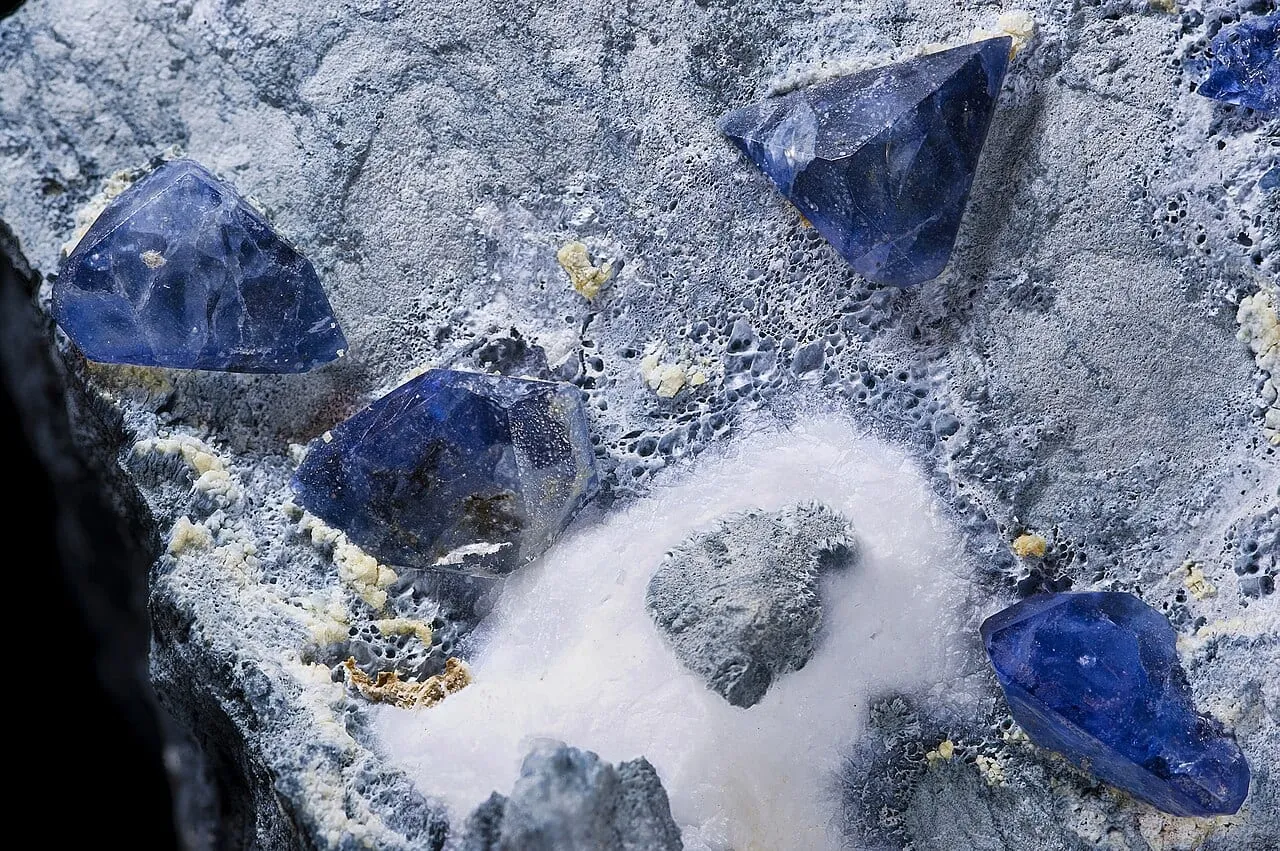
Benitoite
A sapphire-like blue stone whose gem crystals come from a single mine in the world: the official state gem of California.
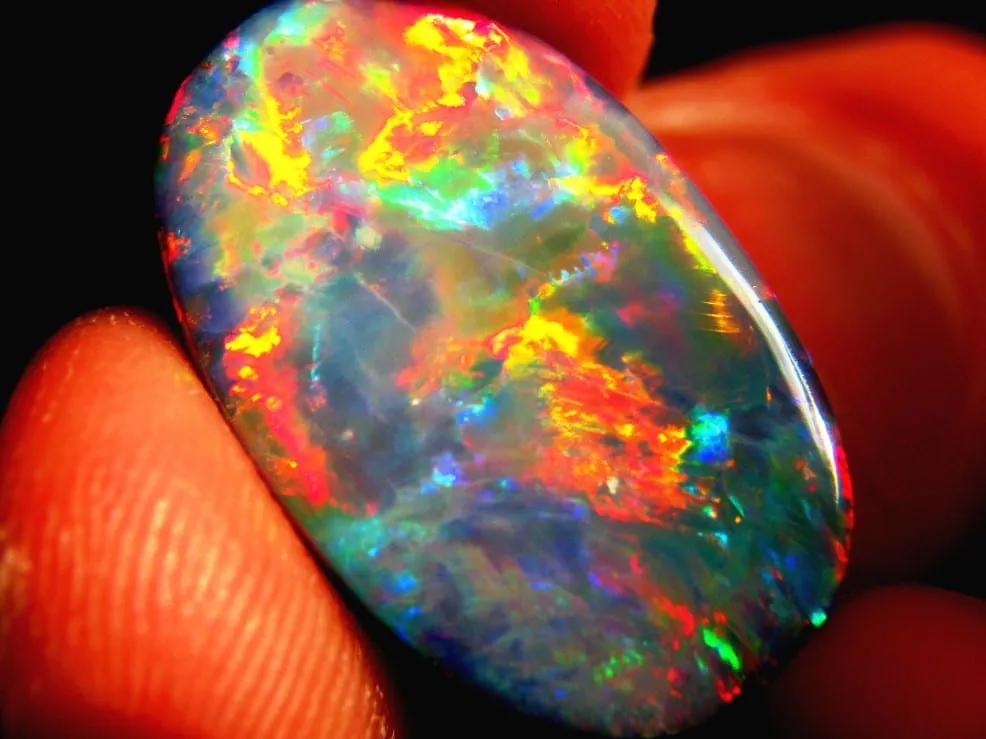
Black opal
Play-of-colour glowing against a dark grey or black body: the rarest and usually most valuable kind of opal, mostly from Lightning Ridge in Australia.
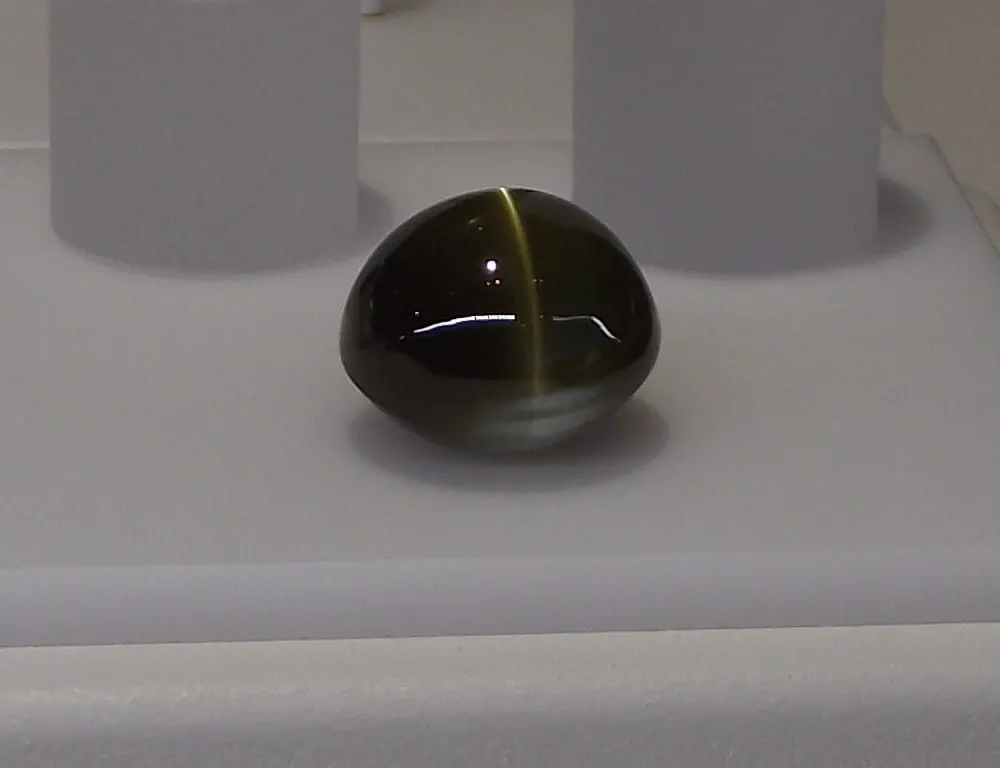
Cat's-eye chrysoberyl
Chrysoberyl that shows a sharp band of light gliding across its domed surface: the gem meant when people simply say “cat's eye”.