Mineral
Pyromorphite
Pb₅(PO₄)₃ClPiromorfit
A very heavy, toxic lead phosphate that forms green, yellow and orange crystals in lead deposits; its name means “fire form”.
- Popularly: Ore and raw material
- Ore
- Handle with care
- Important in Türkiye

In short
Pyromorphite is a mineral made of lead, phosphate and chlorine (Pb₅(PO₄)₃Cl). It most often forms vivid green, yellow or orange crystals shaped like six-sided prisms, and it is very heavy. It appears in the upper parts of lead deposits where they meet air and water, as lead minerals such as galena break down. It matters little as an ore; its main audience is mineral collectors. Because it contains lead, it is toxic.
Photos

How does it form?
Pyromorphite is a secondary mineral: it forms near the surface, in the part of a lead deposit that meets air and groundwater (the oxidised zone), as primary lead minerals such as galena break down; the phosphate comes from the surrounding waters. That is why it occurs with cerussite, anglesite, smithsonite and galena. The Handbook of Mineralogy adds that it is very rarely seen as a volcanic sublimate.
What is it used for?
- Lead ore: Its lead content is around 75–79% (government planning report); where it is abundant it is occasionally mined as an ore.
- Collecting: Its bundles and spheres of green, yellow and orange crystals are favourites of mineral collectors.
- Environmental science: Adding phosphate to lead-polluted mine waste and soils, so that the lead turns into pyromorphite-like minerals that barely dissolve in water, is a method being researched to reduce the transfer of lead to the environment and living things. A study published in 2021 confirmed that pyromorphite or pyromorphite-like minerals formed after a phosphate treatment, but showed that only part of the lead had changed into this form.
Three minerals, one structure
Pyromorphite, mimetite (Pb₅(AsO₄)₃Cl) and vanadinite (Pb₅(VO₄)₃Cl) are sister minerals: the crystal structure is the same, but they carry arsenate or vanadate in place of phosphate. Pyromorphite and mimetite can grade into each other as arsenic replaces phosphorus. According to the Turkish planning report, pyromorphite is isomorphous with apatite, meaning it shares the same structure; the material of our teeth and bones resembles apatite too.
In Türkiye
Pyromorphite is mentioned as a secondary mineral in Türkiye’s lead–zinc deposits. According to the 2001 report of the lead–zinc working group for the Eighth Five-Year Development Plan, issued by the State Planning Organisation, typical crystals of the mineral occur in the Keban deposits in Elazığ. The lead–zinc mineralisation at Keban developed along the contacts of intrusive rocks with schist and marble; Türkiye’s first ore concentration plant went into operation there in 1952.
What determines its value?
As an ore, pyromorphite is worked only where it is abundant, according to its lead content (about three quarters of its weight) and the size of the deposit; in most deposits galena is the main source of lead. Collectors look for vivid, even green, yellow or orange colour, sharp, lustrous and undamaged crystals, a neat arrangement on the host rock, size, and origin from well-known places such as Daoping in China or Les Farges in France. Because it is soft and brittle, and because it contains lead, it is not suited to jewellery.
This information is educational, not buying, selling or investment advice. Value varies enormously with quality and treatment.
How to recognise it
- 1
The colour is usually vivid green, yellow, orange or brown. Crystals are short or long prisms with a six-sided cross-section, sometimes slender needle-like bundles, sometimes spheres or kidney-shaped masses.
- 2
It has a resinous lustre and is very heavy (specific gravity about 7): about two and a half times as heavy as a piece of quartz of the same size.
- 3
Its hardness is 3.5–4: a steel knife scratches it, it is brittle, and its streak is white.
- 4
It occurs with minerals such as galena, cerussite, anglesite and smithsonite in the upper parts of lead deposits. Some specimens may glow yellow to orange under ultraviolet light.
Fakes and imitations
What shops usually don’t tell you:
- Mimetite (arsenic-bearing) and vanadinite (vanadium-bearing) look very much like pyromorphite: all three share the same crystal structure, and pyromorphite and mimetite can grade into each other. Colour is not a reliable way to tell them apart; a laboratory analysis is needed for certain identification.
Safety
Pyromorphite contains lead (about three quarters of its weight), a toxic metal that builds up in the body and can permanently damage the brain and nervous system, especially in children. According to the World Health Organization, there is no level of lead exposure that is known to be without harmful effects; exposure happens mainly by swallowing lead-contaminated dust, soil, water or food, and by breathing in particles released when lead-containing materials burn. Always wash your hands after touching pyromorphite and keep specimens out of children’s reach. Never put pyromorphite in your mouth, grind it, sand it or heat it, and do not breathe its dust. Never put it in drinking water.
Myths and misconceptions
MythA green, heavy lead mineral is always pyromorphite.
FactPyromorphite shares its crystal structure with arsenic-bearing mimetite and vanadium-bearing vanadinite; their colours look alike and they can grade into one another. Only a chemical analysis can say reliably which one a specimen is.
MythBeautiful crystals are harmless; lead is only a worry for miners and painters.
FactAccording to the World Health Organization, one of the main routes of lead exposure is swallowing lead-contaminated dust, soil, water or food, and children are especially exposed to hand-to-mouth contamination. That is why anyone who handles a pyromorphite specimen should wash their hands, and specimens should be kept away from children.
What is it believed to be good for?
This section reports beliefs; it is not health information. There is no scientific evidence for these claims and no stone replaces medical treatment.
The meanings people give this stone, and who holds them:
- Crystal-therapy websites claim that pyromorphite helps with headaches, high blood pressure, gum disease and eye strain.
- The same sites say yellow and green pyromorphite balances the “solar plexus” and “heart chakras”, gives determination and courage, and that the green kind brings abundance.
What science says
No study supports these claims. Pyromorphite is a lead mineral; lead is toxic and, according to the World Health Organization, there is no level of lead exposure that is known to be without harmful effects. It should therefore never be rubbed on the body, soaked in drinking water (“gem water”), put in the mouth, ground, or have its dust inhaled. Someone with high blood pressure or gum disease should not leave treatment to a stone but see a doctor.
Did you know?
Its name comes from the Greek for “fire” (pyr) and “form” (morphe): droplets of melted pyromorphite take on a crystal shape again as they cool.
Pyromorphite, mimetite and vanadinite share one crystal structure; they carry arsenate or vanadate where pyromorphite has phosphate. Pyromorphite belongs to the apatite group, and the material of our teeth and bones resembles apatite too.
A fungus found in lead-polluted soil (*Paecilomyces javanicus*) can form biominerals of pyromorphite.
Pyromorphite was first distinguished chemically by M. H. Klaproth in 1784, and J. F. L. Hausmann gave it its name in 1813.
Where is it found?
Loading map…
- Santa Eufemia, Córdoba, Spain · Known localityThe lead image of the Wikipedia article is a specimen from the “Minas Viejas” mine here
- Daoping mine, Gongcheng County, Guangxi, China · Known localityA Chinese mine known for fine pyromorphite crystals
- Les Farges mine, Ussel, Corrèze, France · Known localityListed by the Handbook of Mineralogy for fine crystal groups
- Bad Ems area (Friedrichssegen mine), Rhineland-Palatinate, Germany · Historic sourceThe Handbook of Mineralogy names Friedrichssegen and other mines nearby
- Příbram, Central Bohemia, Czechia · Historic sourceSilver-bearing lead deposits mined for centuries
- Leadhills, Lanarkshire, Scotland · Historic sourceMicrocrystals with cerussite and caledonite from the old Leadhills mines
- Phoenixville, Pennsylvania, USA · Historic sourceThe Wheatley mines
- Kellogg, Coeur d’Alene district, Idaho, USA · Known localityLarge crystal groups from the Bunker Hill and neighbouring mines
- Broken Hill, New South Wales, Australia · Known localityThe oxidised zone of a great lead–zinc–silver deposit
- Keban, Elazığ, Türkiye · Known localityLead–zinc deposits; according to a government report, typical crystals of the mineral occur here
Locations are approximate to protect sites. Red dots mark places in Türkiye. Open in the big map →
Frequently asked questions
What is pyromorphite?
Pyromorphite is a mineral made of lead, phosphate and chlorine (Pb₅(PO₄)₃Cl). It most often forms vivid green, yellow or orange crystals shaped like six-sided prisms, and it is very heavy. It appears in the upper parts of lead deposits where they meet air and water, as lead minerals such as galena break down. It matters little as an ore; its main audience is mineral collectors. Because it contains lead, it is toxic.
What is pyromorphite used for?
Lead ore: Its lead content is around 75–79% (government planning report); where it is abundant it is occasionally mined as an ore. Collecting: Its bundles and spheres of green, yellow and orange crystals are favourites of mineral collectors. Environmental science: Adding phosphate to lead-polluted mine waste and soils, so that the lead turns into pyromorphite-like minerals that barely dissolve in water, is a method being researched to reduce the transfer of lead to the environment and living things.
How hard is pyromorphite?
It has a hardness of 3.5–4 on the Mohs scale. A fingernail cannot scratch it, but a steel knife can. Its specific gravity is 6.5–7.14 g/cm³.
Where is pyromorphite found?
Its best-known localities: Bad Ems area (Friedrichssegen mine), Rhineland-Palatinate, Germany; Příbram, Central Bohemia, Czechia; Leadhills, Lanarkshire, Scotland; Phoenixville, Pennsylvania, USA; Santa Eufemia, Córdoba, Spain.
Where is pyromorphite found in Türkiye?
Known localities in Türkiye: Keban, Elazığ, Türkiye.
How can you tell if pyromorphite is real?
The colour is usually vivid green, yellow, orange or brown. Crystals are short or long prisms with a six-sided cross-section, sometimes slender needle-like bundles, sometimes spheres or kidney-shaped masses. It has a resinous lustre and is very heavy (specific gravity about 7): about two and a half times as heavy as a piece of quartz of the same size. Its hardness is 3.5–4: a steel knife scratches it, it is brittle, and its streak is white. Mimetite (arsenic-bearing) and vanadinite (vanadium-bearing) look very much like pyromorphite: all three share the same crystal structure, and pyromorphite and mimetite can grade into each other. Colour is not a reliable way to tell them apart; a laboratory analysis is needed for certain identification.
Is pyromorphite valuable?
On the “street to diamond” value ladder it sits on step 4 of nine: Fine dimension stone and ore. As an ore, pyromorphite is worked only where it is abundant, according to its lead content (about three quarters of its weight) and the size of the deposit; in most deposits galena is the main source of lead. Collectors look for vivid, even green, yellow or orange colour, sharp, lustrous and undamaged crystals, a neat arrangement on the host rock, size, and origin from well-known places such as Daoping in China or Les Farges in France. Because it is soft and brittle, and because it contains lead, it is not suited to jewellery.
What is pyromorphite good for?
Crystal-therapy websites claim that pyromorphite helps with headaches, high blood pressure, gum disease and eye strain. The same sites say yellow and green pyromorphite balances the “solar plexus” and “heart chakras”, gives determination and courage, and that the green kind brings abundance. No study supports these claims. Pyromorphite is a lead mineral; lead is toxic and, according to the World Health Organization, there is no level of lead exposure that is known to be without harmful effects. It should therefore never be rubbed on the body, soaked in drinking water (“gem water”), put in the mouth, ground, or have its dust inhaled. Someone with high blood pressure or gum disease should not leave treatment to a stone but see a doctor. This section reports beliefs; it is not health information. There is no scientific evidence for these claims and no stone replaces medical treatment.
Is pyromorphite dangerous?
Pyromorphite contains lead (about three quarters of its weight), a toxic metal that builds up in the body and can permanently damage the brain and nervous system, especially in children. According to the World Health Organization, there is no level of lead exposure that is known to be without harmful effects; exposure happens mainly by swallowing lead-contaminated dust, soil, water or food, and by breathing in particles released when lead-containing materials burn. Always wash your hands after touching pyromorphite and keep specimens out of children’s reach. Never put pyromorphite in your mouth, grind it, sand it or heat it, and do not breathe its dust. Never put it in drinking water.
Sources
- Pyromorphite · Wikipedia
- Handbook of Mineralogy: Pyromorphite · Mineralogical Society of America
- Pyromorphite · Webmineral
- Piromorfit · MTA Genel Müdürlüğü, Bilgi Merkezi
- Sekizinci Beş Yıllık Kalkınma Planı, Madencilik Özel İhtisas Komisyonu Raporu: Kurşun-Çinko-Kadmiyum Çalışma Grubu Raporu (DPT 2628 - ÖİK 639) · Devlet Planlama Teşkilatı, 2001
- Lead poisoning (fact sheet) · World Health Organization
- Restoration and risk reduction of lead mining waste by phosphate-enriched biosolid amendments (N. Li, X. Tang, J. Yang, Z. Sun), Scientific Reports · Springer Nature, 2021
- Keban · Wikipedia
- Gongcheng Yao Autonomous County · Wikipedia
- Santa Eufemia, Córdoba · Wikipedia
- Ussel, Corrèze · Wikipedia
- Bad Ems · Wikipedia
- Kellogg, Idaho · Wikipedia
- Broken Hill · Wikipedia
- Phoenixville, Pennsylvania · Wikipedia
- Leadhills · Wikipedia
- Příbram · Wikipedia
External links
Draft: awaiting expert reviewReport an error ↗
On the same step
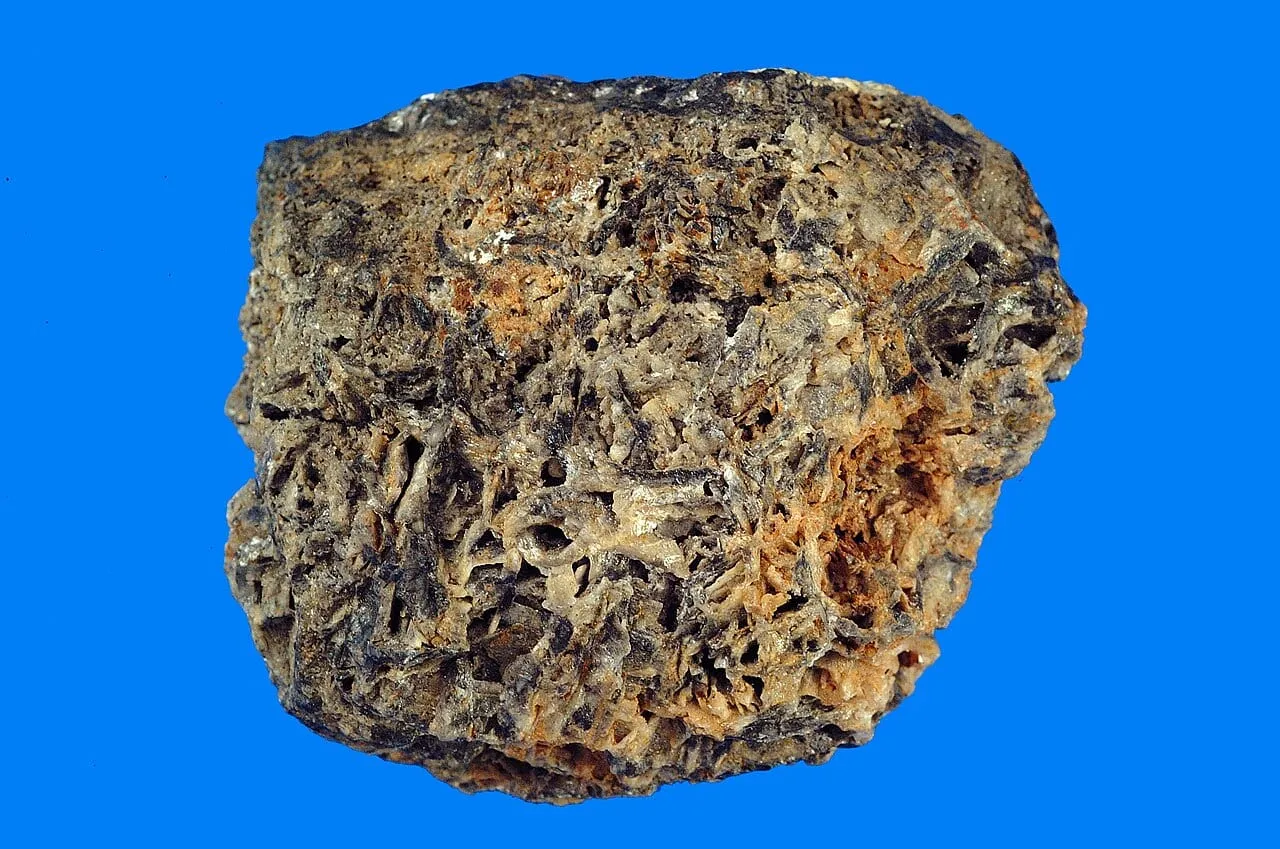
Anglesite
A heavy lead sulfate mineral with a diamond-like shine that grows as a crust around galena; it is named after the island of Anglesey in Wales.
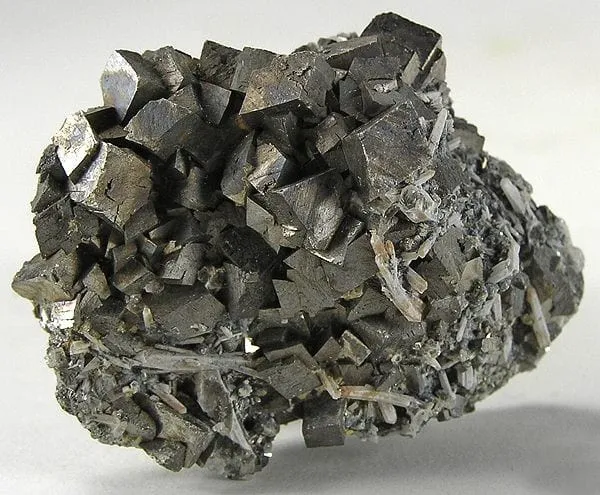
Arsenopyrite
A widespread silvery-grey sulfide containing arsenic: it smells of garlic when struck and is poisonous.
Banded iron formation
An ancient rock of alternating iron-oxide and chert bands: the record of oxygen beginning to build up on Earth, and the main source of iron ore.