Mineral
Pyrolusite
MnO₂Pirolüzit
Black, finger-staining manganese dioxide: an ore for steel and batteries. The fern-like black patterns on rock are not fossils, and most are not even pyrolusite.
Also known as: Manganese dioxide (β-MnO₂, its chemical name)
- Popularly: Ore and raw material
- Ore
- Industrial
- Important in Türkiye

In short
Pyrolusite is manganese dioxide (MnO₂), one of the commonest manganese oxide minerals. It forms earthy masses between steel-grey and black that stain the fingers, or rarely needle-like crystals. Its name comes from the Greek words for “fire” and “to wash”, because it was used to remove the colour from glass. Its main use is as manganese ore: 85–90 percent of manganese demand goes into steelmaking. In Türkiye pyrolusite occurs in many places, but most of the deposits are small and low in grade.
Photos

How does it form?
Pyrolusite forms under strongly oxidising conditions. The Handbook of Mineralogy describes it as forming in manganese-bearing hydrothermal (hot-water) deposits and rocks, in bogs and lakes and under shallow marine conditions; it is often an alteration product of another manganese mineral, manganite. It occurs with manganite, hollandite, hausmannite, braunite, goethite and hematite.
In some Turkish deposits pyrolusite is a secondary mineral. In the ore of the Tavas area of Denizli, according to Yüce and colleagues, pyrolusite and psilomelane make up only about 7 percent by weight and formed mostly in the cracks and fractures of braunite as it altered; braunite in turn often arose from the alteration of rhodochrosite. Pyrolusite also forms radiating, needle-shaped crystal clusters in cavities.
What is it used for?
- Steel: 85–90 percent of manganese demand goes into iron and steel (Wikipedia). Manganese is an oxygen remover and an alloying element in steel; for this the ore is turned into alloys such as ferromanganese. About 3 tons of ore are needed for 1 ton of ferromanganese (Yüce et al.).
- Batteries: Manganese dioxide is used in alkaline batteries; more than 230,000 tons were used for this in 2002 (Wikipedia). Natural pyrolusite has been used, but high-quality batteries need a synthetic product.
- Glass: It removes iron tints from glass, and glassmakers used it for centuries for this.
- Pigment and chemicals: In prehistory it served as paint in cave art. According to the USGS, manganese ore is also consumed as brick colorant, in animal feed and in fertilisers; pyrolusite is also used as an oxidising agent in making chlorine (Wikipedia).
The “plants” on rock surfaces
The black, branching patterns often seen in the cracks of limestone and other rocks are mineral growths called “dendrites” (Greek for “tree”). As water rich in manganese and iron seeps through cracks between layers, manganese oxides are deposited in branching forms; the result looks like a fern, a moss or a tiny forest and is often taken for a fossil. In fact these are “pseudofossils”: there are no remains of living things in them. Dendrites can also form in cracks in quartz; the patterns in stones called “moss agate” (dendritic agate) are of this kind. Dendrites were once often called pyrolusite, but careful analyses have shown that they are mostly other manganese oxides.
In Türkiye
Türkiye is not a leading manganese producer. In the USGS’s 2026 summary, South Africa, Gabon, Ghana and Australia lead manganese ore production, and Türkiye does not have a line of its own. Pyrolusite occurs in many places in the country, but according to Ateşok’s survey the deposits are small ones scattered across almost every region; at the time it was written (the 1970s) about 90 percent of these low-grade deposits were not being worked. The figures below come from that old survey and from studies of the 1990s; they do not show the present situation.
- Thrace (Çatalca–Kırklareli): According to Ateşok, Türkiye’s largest and most economic manganese deposits, of sedimentary type, lie in the belt from Çatalca to Kırklareli, chiefly around Çatalca, Binkılıç and Çakıllı. The ore minerals are mainly pyrolusite, psilomelane and, in places, manganite; the average Mn content is 20–38 percent. According to the survey, this belt supplied between 21 and 87 percent of national output in 1962–1967 and about 75 percent on average in 1970–1977; it is suited to open-pit mining because of its closeness to a port and to the surface, and its one drawback is its low Mn content.
- Black Sea region: Most deposits are small and the manganese mineral is mainly pyrolusite, with psilomelane, manganite, hausmannite and cryptomelane alongside. Among the deposits Ateşok names are Tütüncüler in Artvin (about 25 percent Mn on average), Topkirazlar and Gökçepınar in Zonguldak, and Çayırlı (about 52 percent Mn) and İliç (43–45 percent Mn, psilomelane and pyrolusite) in Erzincan.
- Central Anatolia and the Taurus belt: The main ore minerals are pyrolusite and rhodochrosite. Kızılcaviran and Yakayı in Eskişehir (40–50 percent Mn, pyrolusite), Çayırlıköy (35–47 percent Mn, pyrolusite and hausmannite) and Haymana (about 47 percent Mn, about 215,000 tons of visible and probable reserves) in Ankara are mentioned.
- Western Anatolia: Most deposits are small and low in grade; in many places Mn falls below 30 percent. Tavas (Ulukent) in Denizli was, according to Yüce and colleagues, Türkiye’s most important working mine, with a reserve of about 4 million tons and ore averaging 34 percent Mn; the product was supplied to the Ereğli iron and steel works. In the Kınık village area of Sındırgı in Balıkesir the ore is mainly pyrolusite, psilomelane and manganite, and a ferromanganese-grade concentrate of 46 percent Mn has been shown to be obtainable by physical methods.
According to Yüce and colleagues, in the 1990s Türkiye had no plant to make ferromanganese, and a ferromanganese consumption of more than 100,000 tons a year was met by imports. Whether that still holds today cannot be told from the sources used here. The great majority of Türkiye’s manganese ores are of the earthy oxide type, and because they break down into very fine grains they are hard to concentrate (Ateşok).
What determines its value?
Pyrolusite is an ore sold by the ton, and its value depends on its manganese (Mn) content, how few harmful impurities such as silica, iron and phosphorus it carries, and whether it comes as lumps or as dust. For ferromanganese the ore should hold at least 44–45 percent Mn, no more than 11 percent silica (15 percent with alumina), and come as dust-free lumps of 20–60 mm (Yüce et al.). Türkiye's earthy oxide ores crumble into very fine grains and slime and so are hard to concentrate (Ateşok). The size of the deposit, how well it suits open-pit mining and the distance to a port matter too; the ore needed for batteries is more selective still. Among collectors, well-formed, large pyrolusite crystals are rare and sought after.
This information is educational, not buying, selling or investment advice. Value varies enormously with quality and treatment.
How to recognise it
- 1
Steel-grey, iron-grey or black; the crystals are metallic, while the earthy mass is dull and shades into bluish black. The streak is black or bluish black, and it stains fingers and paper.
- 2
Hardness varies: crystals are 6–6.5 on the Mohs scale, but earthy masses are as soft as 2 and crumble in the hand. The density is about 4.4–5 g/cm³, so it feels heavy.
- 3
Crystals are rare and form needle-like, fibrous bundles; it is more often found as botryoidal, kidney-shaped or powdery masses. The cleavage is perfect on {110}.
- 4
Other manganese oxides (such as psilomelane, manganite, braunite and hausmannite) look very much like it; telling them apart for sure takes X-ray diffraction (XRD) or a microscope. The black branching patterns on rock surfaces are often called “pyrolusite”, but that is mostly wrong.
Fakes and imitations
What shops usually don’t tell you:
- Black hematite and magnetite can look like pyrolusite. Hematite leaves a reddish-brown streak and magnetite is attracted by a magnet, while pyrolusite leaves a black streak.
- Other black manganese oxides such as psilomelane and romanèchite are often confused with pyrolusite. The “pyrolusite dendrites” on rock surfaces have been found not to be pyrolusite, and most are made of other manganese oxides.
Safety
Pyrolusite is harmless to handle, but its earthy mass stains fingers and clothes; washing your hands afterwards is enough. The fine dust and fumes of manganese ores should not be breathed for long: in 1837 the British academic James Couper noted a link between miners' heavy exposure to manganese and an illness resembling Parkinson's disease. Wear a dust mask for dusty work.
Myths and misconceptions
MythThe black fern-like or moss-like patterns on rock surfaces are fossil plants.
FactThey are not fossils but mineral patterns called dendrites. As water rich in manganese and iron moves along cracks and bedding planes in the rock, black manganese oxides grow in branching shapes; there is no trace of a living thing in them. That is why they are called “pseudofossils”.
MythThese black tree-like patterns are pyrolusite.
FactAlthough many sources say so, careful analyses of numerous examples of these dendrites have found that none of them are pyrolusite (Wikipedia). They are usually other manganese oxides and hydroxides such as birnessite, romanèchite, todorokite, cryptomelane, hollandite and coronadite.
MythThe manganese dioxide in batteries is pyrolusite taken straight from the mine.
FactNatural pyrolusite has been used in batteries, but high-quality batteries need synthetic manganese dioxide (Wikipedia).
Did you know?
The name pyrolusite comes from the Greek words for “fire” and “to wash”: glassmakers used it because, mixed into molten glass, it removes the green and brown tints of iron.
According to Wikipedia, blocks of pyrolusite are often found at Neanderthal sites; it may have been kept as a pigment, or powdered and mixed with tinder fungus to light fires. The 30,000–24,000-year-old paintings in the Gargas cave also used manganese dioxide pigments.
In 1774 the Swedish chemist Johan Gottlieb Gahn first made impure manganese metal by reducing manganese dioxide with carbon.
Where is it found?
Loading map…
- Horní Blatná (Platten), Karlovy Vary Region, Czechia · Known localityThe Handbook of Mineralogy cites good pyrolusite crystals from Horní Blatná; its chemical analysis (98.7 percent MnO₂) is of a sample from here. The point is the approximate position of the town.
- Ilmenau area (Elgersburg, Öhrenstock), Thuringia, Germany · Historic sourceThe Handbook of Mineralogy lists Elgersburg, Friedrichroda and Öhrenstock near Ilmenau in Thuringia among the well-studied pyrolusite localities. The point is the position of the town of Ilmenau.
- Eibenstock, Saxony, Germany · Historic sourceOne of the German localities the Handbook of Mineralogy gives for pyrolusite. The point is the position of the town of Eibenstock.
- Ironwood, Gogebic County, Michigan, USA · Major depositThe Handbook of Mineralogy lists Ironwood (Michigan) among the large pyrolusite deposits of the USA. The point is the position of the city of Ironwood.
- Leadville, Lake County, Colorado, USA · Known localityOne of the US localities the Handbook of Mineralogy gives for pyrolusite. The point is the position of the city of Leadville.
- Thrace manganese belt (Çatalca–Kırklareli: Çatalca, Binkılıç, Çakıllı), Türkiye · Major depositAccording to Ateşok, Türkiye's largest and most economic manganese deposits, of sedimentary type, lie in this belt running from Çatalca to Kırklareli; the ore minerals are mainly pyrolusite and psilomelane, with manganite in places. The point is roughly the middle of the belt. The data are old (1970s).
- Tavas (Ulukent), Denizli, Türkiye · Major depositAccording to Yüce and colleagues (1990s), the Denizli–Tavas deposit, with a reserve of about 4 million tons, was the biggest working mine in Türkiye, producing 25,000 tons of ore a year; the ore holds about 30 percent braunite and 24 percent rhodochrosite by weight, while pyrolusite and psilomelane make up only about 7 percent and formed mostly as fracture fillings from the alteration of braunite. The point is the position of the town of Tavas.
- Kınık village area, Sındırgı, Balıkesir, Türkiye · Known localityYüce and colleagues report that the ore of the manganese occurrence here consists mainly of pyrolusite, psilomelane and manganite (about 30 percent Mn); a 46 percent Mn concentrate was made by physical methods. The point is the position of the town of Sındırgı.
- İliç, Erzincan, Türkiye · Known localityAccording to Ateşok, in the İliç deposit, of hydrothermal origin, the ore minerals are mainly psilomelane and pyrolusite; the average Mn content is 43–45 percent and about 100,000 tons of visible reserves were found. The data are old. The point is the position of the town of İliç.
- Haymana, Ankara, Türkiye · Known localityAccording to Ateşok, in the three pits at Haymana the ore minerals are generally pyrolusite and hausmannite; the Mn grade is about 47 percent and the visible and probable reserve about 215,000 tons. The data are old. The point is the position of the town of Haymana.
Locations are approximate to protect sites. Red dots mark places in Türkiye. Open in the big map →
Frequently asked questions
What is pyrolusite?
Pyrolusite is manganese dioxide (MnO₂), one of the commonest manganese oxide minerals. It forms earthy masses between steel-grey and black that stain the fingers, or rarely needle-like crystals. Its name comes from the Greek words for “fire” and “to wash”, because it was used to remove the colour from glass. Its main use is as manganese ore: 85–90 percent of manganese demand goes into steelmaking. In Türkiye pyrolusite occurs in many places, but most of the deposits are small and low in grade.
What is pyrolusite used for?
Steel: 85–90 percent of manganese demand goes into iron and steel (Wikipedia). Manganese is an oxygen remover and an alloying element in steel; for this the ore is turned into alloys such as ferromanganese. About 3 tons of ore are needed for 1 ton of ferromanganese (Yüce et al.). Batteries: Manganese dioxide is used in alkaline batteries; more than 230,000 tons were used for this in 2002 (Wikipedia). Natural pyrolusite has been used, but high-quality batteries need a synthetic product. Glass: It removes iron tints from glass, and glassmakers used it for centuries for this.
How hard is pyrolusite?
It has a hardness of 2–6.5 on the Mohs scale. It can scratch glass; a steel knife scratches it only with difficulty. Its specific gravity is 4.4–5.06 g/cm³.
Where is pyrolusite found?
Its best-known localities: Ironwood, Gogebic County, Michigan, USA; Thrace manganese belt (Çatalca–Kırklareli: Çatalca, Binkılıç, Çakıllı), Türkiye; Tavas (Ulukent), Denizli, Türkiye; Ilmenau area (Elgersburg, Öhrenstock), Thuringia, Germany; Eibenstock, Saxony, Germany.
Where is pyrolusite found in Türkiye?
Known localities in Türkiye: Thrace manganese belt (Çatalca–Kırklareli: Çatalca, Binkılıç, Çakıllı), Türkiye; Tavas (Ulukent), Denizli, Türkiye; Kınık village area, Sındırgı, Balıkesir, Türkiye; İliç, Erzincan, Türkiye; Haymana, Ankara, Türkiye.
How can you tell if pyrolusite is real?
Steel-grey, iron-grey or black; the crystals are metallic, while the earthy mass is dull and shades into bluish black. The streak is black or bluish black, and it stains fingers and paper. Hardness varies: crystals are 6–6.5 on the Mohs scale, but earthy masses are as soft as 2 and crumble in the hand. The density is about 4.4–5 g/cm³, so it feels heavy. Crystals are rare and form needle-like, fibrous bundles; it is more often found as botryoidal, kidney-shaped or powdery masses. The cleavage is perfect on {110}. Black hematite and magnetite can look like pyrolusite. Hematite leaves a reddish-brown streak and magnetite is attracted by a magnet, while pyrolusite leaves a black streak.
Is pyrolusite valuable?
On the “street to diamond” value ladder it sits on step 4 of nine: Fine dimension stone and ore. Pyrolusite is an ore sold by the ton, and its value depends on its manganese (Mn) content, how few harmful impurities such as silica, iron and phosphorus it carries, and whether it comes as lumps or as dust. For ferromanganese the ore should hold at least 44–45 percent Mn, no more than 11 percent silica (15 percent with alumina), and come as dust-free lumps of 20–60 mm (Yüce et al.). Türkiye's earthy oxide ores crumble into very fine grains and slime and so are hard to concentrate (Ateşok). The size of the deposit, how well it suits open-pit mining and the distance to a port matter too; the ore needed for batteries is more selective still. Among collectors, well-formed, large pyrolusite crystals are rare and sought after.
Is pyrolusite dangerous?
Pyrolusite is harmless to handle, but its earthy mass stains fingers and clothes; washing your hands afterwards is enough. The fine dust and fumes of manganese ores should not be breathed for long: in 1837 the British academic James Couper noted a link between miners' heavy exposure to manganese and an illness resembling Parkinson's disease. Wear a dust mask for dusty work.
Sources
- Türkiye Manganez Yataklarının Değerlendirilmesi ve Konunun Ülkemiz Açısından Önemi (G. Ateşok), tebliğ · TMMOB Maden Mühendisleri Odası (İTÜ Maden Fakültesi)
- Denizli-Tavas Manganez Cevherinin Fiziksel, Kimyasal ve Mineralojik Özellikleri ve Kalsinasyonu (A. E. Yüce, V. Gürkan, F. Arslan, G. Ateşok, R. Güllüoğlu), Türkiye 15. Madencilik Kongresi · TMMOB Maden Mühendisleri Odası, 1997
- Balıkesir-Sındırgı Bölgesi Manganez Cevherlerinden Metalurjik Kullanıma Uygun Konsantrelerin Üretimi (A. E. Yüce, V. Gürkan, F. Boylu, M. Çakan), Türkiye 16. Madencilik Kongresi · TMMOB Maden Mühendisleri Odası, 1999
- Handbook of Mineralogy: Pyrolusite · Mineralogical Society of America
- Mineral Commodity Summaries 2026: Manganese · U.S. Geological Survey, 2026
- Pyrolusite · Wikipedia
- Piroluzit · Vikipedi
- Dendrite (crystal) · Wikipedia
- Manganese · Wikipedia
External links
Draft: awaiting expert reviewReport an error ↗
On the same step
Anglesite
A heavy lead sulfate mineral with a diamond-like shine that grows as a crust around galena; it is named after the island of Anglesey in Wales.
Arsenopyrite
A widespread silvery-grey sulfide containing arsenic: it smells of garlic when struck and is poisonous.
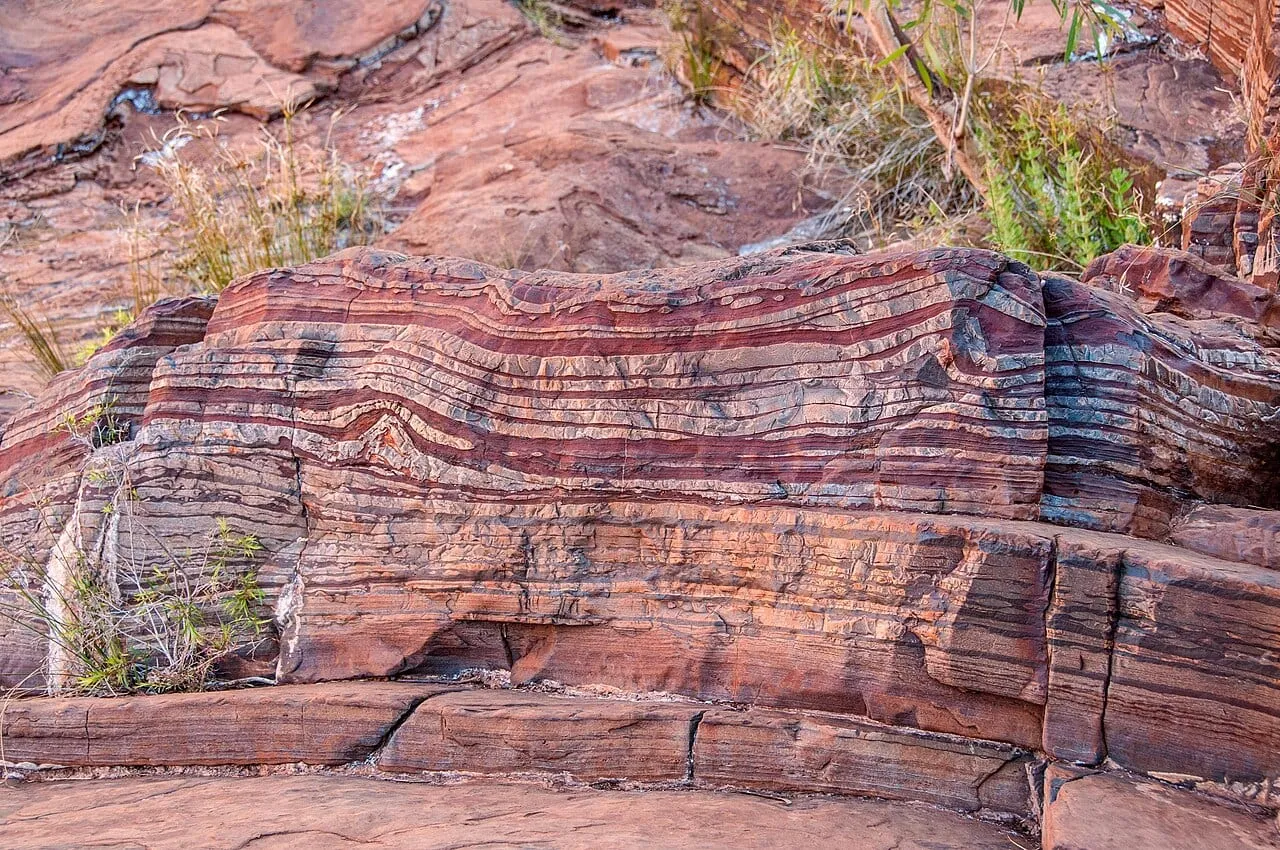
Banded iron formation
An ancient rock of alternating iron-oxide and chert bands: the record of oxygen beginning to build up on Earth, and the main source of iron ore.