Meteorite
Nakhlite
Nakhlit
Stones from a volcano on Mars: augite-rich Martian meteorites that formed from lava about 1.3 billion years ago and were later soaked by liquid water.
- Popularly: Meteorite

In short
Nakhlites are a group of Martian meteorites named after the first of them, the Nakhla meteorite. They are augite-rich igneous rocks that formed from basaltic magma about 1.3 billion years ago and contain crystals of augite and olivine. They were suffused with liquid water around 620 million years ago and were ejected from Mars by an asteroid impact around 10.75 million years ago.
Photos

How does it form?
Nakhlites formed on Mars about 1.3 billion years ago from the basaltic magma of a volcano. Augite crystals accumulated in the magma to form an augite-rich rock. A 2017 study dated them to at least four different eruptions between 1,416 ± 7 and 1,322 ± 10 million years ago.
Around 620 million years ago these rocks were suffused with liquid water. In 2003 scientists from Japan’s National Institute of Polar Research reported iddingsite in Yamato 000593, a mineral that forms when basalt weathers in the presence of liquid water. Around 10.75 million years ago an asteroid impact ejected the nakhlites from the Martian surface into space, and pieces eventually fell to Earth.
Based on the dimensions of the 6.5 km crater in Elysium proposed as a possible source, the source volcano was growing by only 0.4–0.7 m per million years at that time. This is far slower than would be expected for a volcano on Earth and implies that Martian volcanism had slowed greatly by then.
What is it used for?
- The history of water on Mars: Secondary minerals in nakhlites show that liquid water existed on Mars hundreds of millions of years ago.
- Martian volcanism: Their ages and the estimated source crater help us understand when, and how fast, volcanoes on Mars grew.
- The search for life: Carbon-rich features in stones such as Yamato 000593 fuel debate on how signs of life on Mars should be sought, and how they can be misread.
Known nakhlites
Nakhla (Egypt, 1911) comprises about 40 pieces with an estimated total of 10 kg. Lafayette (800 g) was recognised in Purdue University’s collection in 1931. Yamato 000593 (13.7 kg) was found on the Yamato Glacier in Antarctica in December 2000; it is the second-largest meteorite from Mars found on Earth. Others include Governador Valadares, NWA 817 and NWA 998 from Morocco, Yamato 000749 and 000802, and MIL 03346, MIL 090030, MIL 090032 and MIL 090136 from the Miller Range in Antarctica. Nakhlites are one of the groups of Martian meteorites.
What determines its value?
Nakhlites are a small group within the already very rare Martian meteorites. A specimen's value depends on its mass, its freshness and whether it belongs to a well-known stone such as Nakhla, Lafayette or Yamato 000593. Most of these stones are kept in museum and research collections.
This information is educational, not buying, selling or investment advice. Value varies enormously with quality and treatment.
How to recognise it
- 1
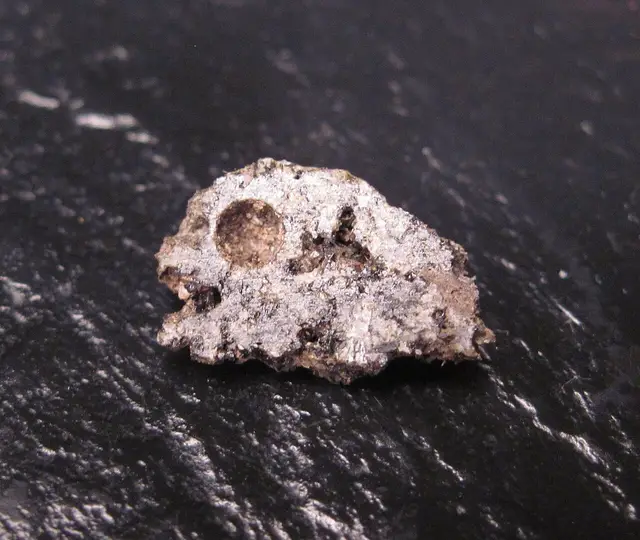
The outside is covered by a black fusion crust; the interior of Nakhla is light to dark grey.
- 2
On a cut face elongated augite crystals dominate; olivine is less abundant.
- 3
Only laboratory analyses, such as oxygen isotope measurements, can confirm that a stone comes from Mars.
Myths and misconceptions
MythYamato 000593 proved that there was life on Mars.
FactIn 2014 NASA researchers reported carbon-rich spheres and microtunnels in Yamato 000593 resembling traces left by living things. The scientific consensus, however, is that shape alone cannot be used to detect primitive life, so these features are not evidence of life.
Did you know?
The Lafayette meteorite was recognised in Purdue University's geological collection in 1931. According to a story reported by the meteorite collector Harvey Nininger in 1935, a Black student at Purdue had found it after seeing it land in a pond where he was fishing.
In 2022 researchers from the University of Glasgow found deoxynivalenol, a “vomitoxin” produced by a fungus that contaminates grain crops, in Lafayette. From records of fungal outbreaks and fireball sightings they concluded that it fell in either 1919 or 1927.
A 2017 study showed that the nakhlites formed in at least four different eruptions between 1,416 and 1,322 million years ago.
Where is it found?
Loading map…
- El Nakhla El Bahariya, Abu Hummus, Beheira, Egypt · Type localityThe Nakhla meteorite, which fell on 28 June 1911 and gave the group its name: about 40 pieces, an estimated 10 kg in all.
- Purdue University, West Lafayette, Indiana, USA · Known localityThe 800-gram Lafayette meteorite was recognised as a meteorite in Purdue University's geological collection in 1931; exactly where it fell is not known.
- Yamato Glacier, Queen Fabiola Mountains, Antarctica · Known localityYamato 000593, 13.7 kg, found by the 41st Japanese Antarctic Research Expedition in December 2000; the second-largest meteorite from Mars found on Earth.
Locations are approximate to protect sites. Red dots mark places in Türkiye. Open in the big map →
Frequently asked questions
What is nakhlite?
Nakhlites are a group of Martian meteorites named after the first of them, the Nakhla meteorite. They are augite-rich igneous rocks that formed from basaltic magma about 1.3 billion years ago and contain crystals of augite and olivine. They were suffused with liquid water around 620 million years ago and were ejected from Mars by an asteroid impact around 10.75 million years ago.
Where on Mars do nakhlites come from?
Their crystallisation ages, compared with crater-count chronologies of different regions of Mars, suggest that they formed on a large volcanic construct such as Tharsis, Elysium or Syrtis Major Planum. A 6.5 km crater in the volcanic plains north-west of Elysium Mons has been identified as a possible source.
What is nakhlite used for?
The history of water on Mars: Secondary minerals in nakhlites show that liquid water existed on Mars hundreds of millions of years ago. Martian volcanism: Their ages and the estimated source crater help us understand when, and how fast, volcanoes on Mars grew. The search for life: Carbon-rich features in stones such as Yamato 000593 fuel debate on how signs of life on Mars should be sought, and how they can be misread.
How hard is nakhlite?
It has a hardness of 5.5–7 on the Mohs scale. It can scratch glass; a steel knife scratches it only with difficulty. Its specific gravity is 3.08–3.22 g/cm³.
Where is nakhlite found?
Its best-known localities: El Nakhla El Bahariya, Abu Hummus, Beheira, Egypt; Purdue University, West Lafayette, Indiana, USA; Yamato Glacier, Queen Fabiola Mountains, Antarctica.
How can you tell if nakhlite is real?
The outside is covered by a black fusion crust; the interior of Nakhla is light to dark grey. On a cut face elongated augite crystals dominate; olivine is less abundant. Only laboratory analyses, such as oxygen isotope measurements, can confirm that a stone comes from Mars.
Is nakhlite valuable?
On the “street to diamond” value ladder it sits on step 7 of nine: Precious stone. Nakhlites are a small group within the already very rare Martian meteorites. A specimen's value depends on its mass, its freshness and whether it belongs to a well-known stone such as Nakhla, Lafayette or Yamato 000593. Most of these stones are kept in museum and research collections.
Sources
- Nakhlite · Wikipedia
- Nakhla meteorite · Wikipedia
- Yamato 000593 · Wikipedia
- Science sleuths solve century-old mystery of Martian meteorite's discovery · University of Glasgow, 2022
- Nakhlites (Martian meteorites) · Meteorites.tv (Thomas Grau)
- Stony meteorite porosities and densities: A review of the data through 2001 (D. T. Britt & G. J. Consolmagno), Meteoritics & Planetary Science 38 · University of Arizona Repository, 2003
- Handbook of Mineralogy: Augite · Mineralogical Society of America
- Handbook of Mineralogy: Forsterite · Mineralogical Society of America
External links
Draft: awaiting expert reviewReport an error
On the same step
Acapulcoite
Stony meteorites that began to melt but never fully did: metal-veined primitive achondrites, named after a stone that fell near Acapulco in 1976.
Allan Hills 84001
The stone that sparked the Mars-life debate: a 4-billion-year-old Martian meteorite from Antarctica whose tiny structures were likened to fossil bacteria in 1996.
Angrite
The oldest known igneous rocks: rare basaltic meteorites that crystallised about 4.56 billion years ago, in the very earliest days of the Solar System.