Meteorite
Northwest Africa 7034
NWA 7034 (Black Beauty)
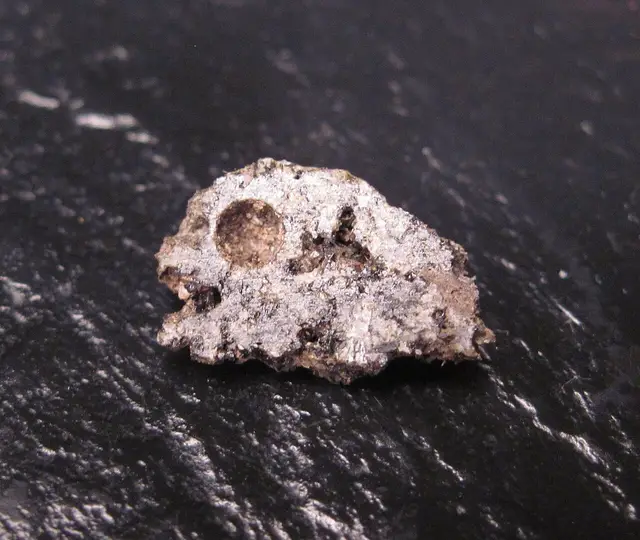
“Black Beauty”: a black stone of hundreds of fragments found in the Sahara, holding 4.4-billion-year-old pieces and more water than any other Martian meteorite.
Also known as: NWA 7034 · Black Beauty
- Popularly: Meteorite

In short
NWA 7034, nicknamed “Black Beauty”, is a 320-gram Martian meteorite found by nomads in Western Sahara in 2011. It is a breccia of hundreds of rock fragments stuck together, with pieces about 4.4 billion years old. It contains more water than any other Martian meteorite found on Earth. Because it fits none of the known groups of Martian meteorites, a new group was defined for it.
How does it form?
NWA 7034 is a breccia formed when pieces of Mars’s very old crust were broken up by impacts and welded together again. It contains components about 4.42 billion years old, making it the second-oldest known Martian meteorite. It was heated during Mars’s Amazonian period. Its high water content may come from bodies of water that once existed on Mars.
According to a 2022 study, the meteorite was blasted into space by the impact that made Karratha crater, 5–10 million years ago, in the Terra Cimmeria–Terra Sirenum region of Mars’s southern highlands. Before that it was part of the material thrown out by the nearby Khujirt crater, which formed about 1.5 billion years ago.
What is it used for?
NWA 7034 is studied to understand Mars’s early crust and the history of water on Mars. Being the most water-rich Martian meteorite known, it gives important clues to the presence of water in early Mars. Its oxygen isotope ratios, which differ from other Martian meteorites, also help study how the Martian crust was altered by water or mixed by impacts.
History
The meteorite was found by nomads at Rabt Sbayta in Western Sahara in 2011, bought from a meteorite dealer in Morocco and sold to a collector in the United States. At first it was classed as an ungrouped planetary achondrite; the Meteoritical Society approved the name “Martian (basaltic breccia)” in January 2013, changed to “Martian (polymict breccia)” in 2018.
What determines its value?
NWA 7034's value is scientific: it is the only kind of sample carrying very old pieces of the Martian crust together with abundant water. Its American owner donated a slice to the University of New Mexico. Martian meteorites in general are so rare that they are among the most sought-after; a piece's value depends on its mass and documentation of which pairing it belongs to.
This information is educational, not buying, selling or investment advice. Value varies enormously with quality and treatment.
How to recognise it
- 1
A deep black stone; cut, it shows light and dark fragments stuck together.
- 2
It contains plagioclase and pyroxene crystals up to 5 millimetres across.
- 3
Its Martian origin is shown in the lab by chemical features such as its iron/manganese ratio.
Myths and misconceptions
MythThe number in the meteorite's name gives its location or weight.
FactMeteorites found in large numbers in northwest Africa and sold in markets get the region's name (Northwest Africa) and a number given in sequence. 7034 only shows its place in that sequence.
Did you know?
The “Northwest Africa 7034” in its name is one of the numbers given in sequence to meteorites found in northwest Africa and sold on the market.
According to a 2022 study, it was blasted off Mars by the impact that made Karratha crater in the southern highlands about 5–10 million years ago.
Japanese researchers concluded from this meteorite that water appeared on Mars about 4.4 billion years ago.
Where is it found?
Loading map…
- Rabt Sbayta, Ghredad Sabti region, Western Sahara · Type localityFound by nomads in 2011, it was bought from a dealer in Morocco and sold to a collector in the US. The coordinates are based on the dealer's information.
Locations are approximate to protect sites. Red dots mark places in Türkiye. Open in the big map →
Frequently asked questions
What is northwest Africa 7034?
NWA 7034, nicknamed “Black Beauty”, is a 320-gram Martian meteorite found by nomads in Western Sahara in 2011. It is a breccia of hundreds of rock fragments stuck together, with pieces about 4.4 billion years old. It contains more water than any other Martian meteorite found on Earth. Because it fits none of the known groups of Martian meteorites, a new group was defined for it.
Why was NWA 7034 put in a new group?
Martian meteorites used to be divided into shergottites, nakhlites, chassignites and ALH 84001. NWA 7034 is a breccia that fits none of these. The Meteoritical Society approved the name “Martian (basaltic breccia)” for it in 2013; because it contains many kinds of fragments, including impact melts and sedimentary rocks, the name was changed to “Martian (polymict breccia)” in 2018.
What is northwest Africa 7034 used for?
NWA 7034 is studied to understand Mars's early crust and the history of water on Mars. Being the most water-rich Martian meteorite known, it gives important clues to the presence of water in early Mars. Its oxygen isotope ratios, which differ from other Martian meteorites, also help study how the Martian crust was altered by water or mixed by impacts.
How hard is northwest Africa 7034?
It has a hardness of 5.5–6.5 on the Mohs scale. It can scratch glass; a steel knife scratches it only with difficulty. Its specific gravity is 2.66–3.56 g/cm³.
Where is northwest Africa 7034 found?
Its best-known localities: Rabt Sbayta, Ghredad Sabti region, Western Sahara.
How can you tell if northwest Africa 7034 is real?
A deep black stone; cut, it shows light and dark fragments stuck together. It contains plagioclase and pyroxene crystals up to 5 millimetres across. Its Martian origin is shown in the lab by chemical features such as its iron/manganese ratio.
Is northwest Africa 7034 valuable?
On the “street to diamond” value ladder it sits on step 7 of nine: Precious stone. NWA 7034's value is scientific: it is the only kind of sample carrying very old pieces of the Martian crust together with abundant water. Its American owner donated a slice to the University of New Mexico. Martian meteorites in general are so rare that they are among the most sought-after; a piece's value depends on its mass and documentation of which pairing it belongs to.
Sources
- Northwest Africa 7034 · Wikipedia
- Handbook of Mineralogy: Augite · Mineralogical Society of America
- Handbook of Mineralogy: Pigeonite · Mineralogical Society of America
- Handbook of Mineralogy: Andesine · Mineralogical Society of America
External links
Draft: awaiting expert reviewReport an error
On the same step
Acapulcoite
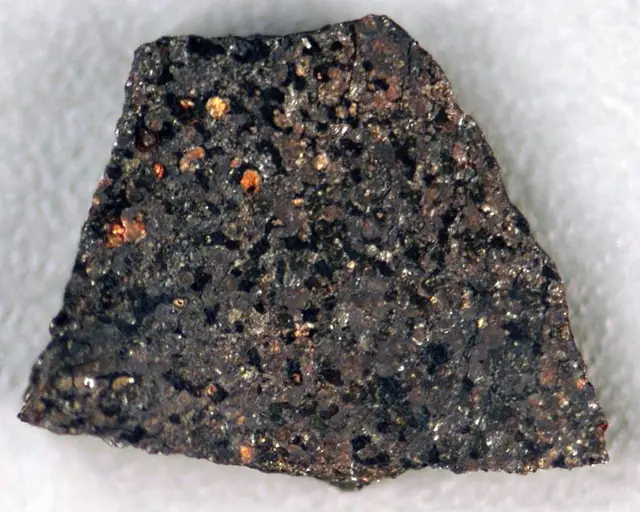
Stony meteorites that began to melt but never fully did: metal-veined primitive achondrites, named after a stone that fell near Acapulco in 1976.
Allan Hills 84001
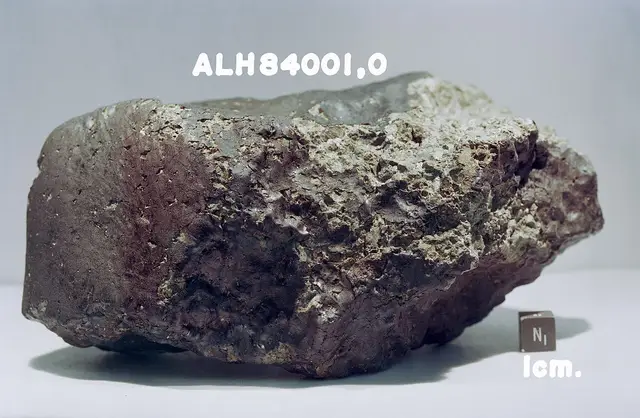
The stone that sparked the Mars-life debate: a 4-billion-year-old Martian meteorite from Antarctica whose tiny structures were likened to fossil bacteria in 1996.
Angrite
The oldest known igneous rocks: rare basaltic meteorites that crystallised about 4.56 billion years ago, in the very earliest days of the Solar System.