Mineral
Monazite
(Ce,La,Nd,Th)PO₄Monazit
An ore of the rare earths (cerium, lanthanum, neodymium) and thorium: a reddish-brown, heavy phosphate that can be radioactive.
Also known as: Monazite-(Ce) (the cerium-dominant species)
- Popularly: Ore and raw material
- Ore
- Industrial
- Handle with care
- Important in Türkiye
-164025.jpg)
In short
Monazite is a phosphate of rare earth elements such as cerium, lanthanum and neodymium, and most specimens contain some thorium. It is a heavy, reddish-brown mineral with a resinous lustre. It occurs as small crystals in rocks such as granite, and because it is heavy and durable it collects in beach and river sands. Because of its thorium it can be radioactive, so it is not a stone to carry or wear.
Photos

How does it form?
Monazite is a common accessory mineral in granites and syenites and their pegmatites, in carbonatites, in volcaniclastic rocks, in fissure veins and in high-grade metamorphic rocks. Because it is heavy and durable, it collects in river and beach sands when the source rock wears away. According to the Handbook of Mineralogy, the principal source of cerium, rare earths and thorium is heavy mineral sands in the Carolinas and Florida in the United States, and in Australia, Sri Lanka, India and Brazil.
In thorium-rich crystals, radioactive decay can gradually destroy the crystal structure (the metamict state).
What is it used for?
- Rare earth elements: Monazite is an ore of rare earths such as cerium, lanthanum and neodymium. According to the USGS, the largest use of rare earths worldwide is in magnets (neodymium magnets); in the United States the largest use is in catalysts.
- Thorium: Thorium, once used in gas lamp mantles, was obtained from monazite.
- Geological dating: The zones in its crystals make it possible to date events in the history of rocks.
- Radioactive waste research: According to Wikipedia, in Oak Ridge National Laboratory studies synthetic monazite proved more effective than borosilicate glass at containing radioactive waste, thanks to its low leaching and slow corrosion rates.
Radioactivity
Thorium-rich monazite is radioactive. According to Wikipedia, commercial monazite sands typically contain 6–12% thorium oxide, and in some deposits as much as 20–30%; monazite from carbonatites or from Bolivia’s tin veins is almost thorium-free. As thorium and uranium decay, radium forms, so waste from processing monazite has to be managed with care. This is why thorium-poor rare earth minerals such as bastnäsite later came to the fore as ore.
In Türkiye
In Türkiye monazite has been recorded as a minor mineral in the Kızılcaören fluorite-baryte-rare earth deposit in Beylikova, Eskişehir. Gültekin and colleagues (2003) list the deposit’s mineral assemblage as fluorite, baryte, quartz, calcite, bastnäsite, phlogopite, pyrolusite and hematite, and its minor minerals as plagioclase, feldspar, pyrite, psilomelane, braunite, monazite, fluocerite, brockite, goethite and rutile. The main rare earth mineral of the deposit is bastnäsite; for the deposit see the bastnäsite page.
What determines its value?
Monazite is an ore, and its value depends on the proportion of rare earth oxides in it and which elements it holds (magnet elements such as neodymium and praseodymium are the most sought after), the cost and legal rules for managing radioactive components such as thorium and uranium, the size and type of the deposit (a by-product of beach sands, or a carbonatite) and demand from the magnet industry. Monazite is often recovered as a by-product of mining ilmenite, rutile and zircon, while thorium-poor bastnäsite deposits have to some extent pushed it into the background by easing radioactive waste concerns. For collectors, large, well-formed crystals count, but keeping and carrying radioactive specimens is subject to legal rules.
This information is educational, not buying, selling or investment advice. Value varies enormously with quality and treatment.
How to recognise it
- 1
It is reddish brown, brown, yellowish or pinkish, with a lustre ranging from resinous and waxy to glassy or diamond-like. The streak (powder colour) is greyish white.
- 2
Its hardness is 5–5.5 and its specific gravity about 5, so it feels heavy. Crystals are mostly flat tablets, sometimes wedge-shaped or prismatic, with a distinct cleavage in one direction.
- 3
Thorium-rich specimens are radioactive and register on a radiation meter such as a Geiger counter. A sure identification needs laboratory analysis.
- 4
It occurs in granites, syenites and pegmatites, in carbonatites and Alpine clefts with zircon, xenotime and titanite; in river and beach sands as dark reddish-brown grains.
Fakes and imitations
What shops usually don’t tell you:
- Monazite has no widely known imitation. It can be confused with other heavy mineral grains in beach sands (such as zircon and xenotime); because they are hard to tell apart by eye, analysis is needed for a sure identification.
- Bastnäsite: like monazite, an ore of cerium and the other light rare earths, but a different mineral; it is a carbonate-fluoride and usually contains less thorium.
Safety
Monazite can be radioactive because of the thorium (and a little uranium) it contains. Keep specimens in a closed, labelled container in a well-ventilated place, away from bedrooms, kitchens and living areas and out of reach of children; do not carry one with you and do not hold it longer than necessary. Never break, grind or sand it: if the dust is breathed or swallowed, it irradiates the body from the inside. Do not wear monazite as jewellery, put it in water or put it in your mouth. Keeping, carrying and posting radioactive materials is subject to legal regulation in many countries; in Türkiye the competent authority is the Nuclear Regulatory Authority (NDK). Wash your hands after handling.
Myths and misconceptions
MythRare earth elements are called “rare” because there is very little of them in the Earth’s crust.
FactAccording to the USGS, rare earths are relatively abundant in the Earth’s crust; what is scarce is deposits of minable concentration. Ore minerals such as monazite provide those concentrations.
MythMonazite and bastnäsite are the same ore.
FactBoth are main ores of cerium and the other light rare earths, but they are different minerals: monazite is a phosphate and contains thorium, while bastnäsite is a carbonate-fluoride and contains less. According to Wikipedia, bastnäsite later displaced monazite because of lower thorium concerns.
What is it believed to be good for?
This section reports beliefs; it is not health information. There is no scientific evidence for these claims and no stone replaces medical treatment.
The meanings people give this stone, and who holds them:
- Some “negative ion” bracelets, necklaces and sleep masks deliberately contain naturally radioactive minerals such as monazite and zircon; these products are sold with claims that they improve circulation, stamina and energy, “detoxify” the body and prevent cancer.
What science says
Hassan and colleagues (2021) examined 15 bracelets and 5 necklaces bought online; they found the products rich in monazite and zircon, some of them exceeding the public dose limit of 1 mSv a year when worn continuously (the highest sample reached about 1.22 mSv a year when worn 16 hours a day), and recommended banning the import and sale of such products. All 10 “negative ion” products examined by the Dutch RIVM in 2021 contained more radioactivity than the law allows. No health benefit has been shown for these products; monazite or other radioactive stones should not be worn on the body or put in water.
Did you know?
The name comes from the Greek monazein, “to be solitary”: the mineral was given this name because it seemed very rare when first found.
In the 1880s Carl Auer von Welsbach, looking for thorium for incandescent gas mantles, came across monazite sand that had arrived from Brazil as ship ballast; this is how monazite first drew industrial interest.
Monazite crystals often contain several zones, each formed in a separate geological event. This is why monazite is used to date the events that rocks have been through.
Where is it found?
Loading map…
- Bayan Obo, Inner Mongolia, China · Major depositAn iron-niobium-rare earth deposit; according to Wikipedia it holds most of the world's known rare earth reserves. The ore contains bastnäsite and monazite
- Mount Weld, Western Australia · Major depositAccording to the Handbook a carbonatite where monazite occurs; rare earth oxides are held in secondary phosphates, and Lynas has operated here since 2011
- Steenkampskraal, Western Cape, South Africa · Known localityAccording to Wikipedia the highest-grade monazite ore in the world (about 50% total rare earth oxides); worked by Anglo American from 1952 to 1963
- Eneabba, Western Australia · Known localityMonazite and xenotime are obtained as by-products of processing mineral sands
- Chavara, Kerala, India · Major depositWikipedia calls India especially rich in monazite and names the Kerala beach sands; Indian Rare Earths operates here
- Ilmen Mountains (Miass), Chelyabinsk, Russia · Historic sourceAccording to the Handbook of Mineralogy, monazite occurs in the Ilmen Mountains of the Southern Urals, at Miass; the area is the type locality of many minerals
- Jaguaraçu (José Pinto pegmatite), Minas Gerais, Brazil · Known localityAccording to the Handbook, large monazite crystals occur in the José Pinto pegmatite (location given as Jaguaraçu town)
- Mars Hill, North Carolina, USA · Known localityAccording to the Handbook, Mars Hill in Madison County is known for large monazite crystals; monazite was once mined in North Carolina
- Kızılcaören, Beylikova, Eskişehir, Türkiye · Known localityRecorded as a minor mineral in the fluorite-baryte-rare earth deposit; the main rare earth mineral is bastnäsite
Locations are approximate to protect sites. Red dots mark places in Türkiye. Open in the big map →
Frequently asked questions
What is monazite?
Monazite is a phosphate of rare earth elements such as cerium, lanthanum and neodymium, and most specimens contain some thorium. It is a heavy, reddish-brown mineral with a resinous lustre. It occurs as small crystals in rocks such as granite, and because it is heavy and durable it collects in beach and river sands. Because of its thorium it can be radioactive, so it is not a stone to carry or wear.
What is monazite used for?
Rare earth elements: Monazite is an ore of rare earths such as cerium, lanthanum and neodymium. According to the USGS, the largest use of rare earths worldwide is in magnets (neodymium magnets); in the United States the largest use is in catalysts. Thorium: Thorium, once used in gas lamp mantles, was obtained from monazite. Geological dating: The zones in its crystals make it possible to date events in the history of rocks.
How hard is monazite?
It has a hardness of 5–5.5 on the Mohs scale. A fingernail cannot scratch it, but a steel knife can. Its specific gravity is 4.98–5.43 g/cm³.
Where is monazite found?
Its best-known localities: Bayan Obo, Inner Mongolia, China; Mount Weld, Western Australia; Chavara, Kerala, India; Ilmen Mountains (Miass), Chelyabinsk, Russia; Steenkampskraal, Western Cape, South Africa.
Where is monazite found in Türkiye?
Known localities in Türkiye: Kızılcaören, Beylikova, Eskişehir, Türkiye.
How can you tell if monazite is real?
It is reddish brown, brown, yellowish or pinkish, with a lustre ranging from resinous and waxy to glassy or diamond-like. The streak (powder colour) is greyish white. Its hardness is 5–5.5 and its specific gravity about 5, so it feels heavy. Crystals are mostly flat tablets, sometimes wedge-shaped or prismatic, with a distinct cleavage in one direction. Thorium-rich specimens are radioactive and register on a radiation meter such as a Geiger counter. A sure identification needs laboratory analysis. Monazite has no widely known imitation. It can be confused with other heavy mineral grains in beach sands (such as zircon and xenotime); because they are hard to tell apart by eye, analysis is needed for a sure identification.
Is monazite valuable?
On the “street to diamond” value ladder it sits on step 4 of nine: Fine dimension stone and ore. Monazite is an ore, and its value depends on the proportion of rare earth oxides in it and which elements it holds (magnet elements such as neodymium and praseodymium are the most sought after), the cost and legal rules for managing radioactive components such as thorium and uranium, the size and type of the deposit (a by-product of beach sands, or a carbonatite) and demand from the magnet industry. Monazite is often recovered as a by-product of mining ilmenite, rutile and zircon, while thorium-poor bastnäsite deposits have to some extent pushed it into the background by easing radioactive waste concerns. For collectors, large, well-formed crystals count, but keeping and carrying radioactive specimens is subject to legal rules.
What is monazite good for?
Some “negative ion” bracelets, necklaces and sleep masks deliberately contain naturally radioactive minerals such as monazite and zircon; these products are sold with claims that they improve circulation, stamina and energy, “detoxify” the body and prevent cancer. Hassan and colleagues (2021) examined 15 bracelets and 5 necklaces bought online; they found the products rich in monazite and zircon, some of them exceeding the public dose limit of 1 mSv a year when worn continuously (the highest sample reached about 1.22 mSv a year when worn 16 hours a day), and recommended banning the import and sale of such products. All 10 “negative ion” products examined by the Dutch RIVM in 2021 contained more radioactivity than the law allows. No health benefit has been shown for these products; monazite or other radioactive stones should not be worn on the body or put in water. This section reports beliefs; it is not health information. There is no scientific evidence for these claims and no stone replaces medical treatment.
Is monazite dangerous?
Monazite can be radioactive because of the thorium (and a little uranium) it contains. Keep specimens in a closed, labelled container in a well-ventilated place, away from bedrooms, kitchens and living areas and out of reach of children; do not carry one with you and do not hold it longer than necessary. Never break, grind or sand it: if the dust is breathed or swallowed, it irradiates the body from the inside. Do not wear monazite as jewellery, put it in water or put it in your mouth. Keeping, carrying and posting radioactive materials is subject to legal regulation in many countries; in Türkiye the competent authority is the Nuclear Regulatory Authority (NDK). Wash your hands after handling.
Sources
- Handbook of Mineralogy: Monazite-(Ce) · Mineralogical Society of America
- Monazite · Wikipedia
- Monazite-(Ce) (Webmineral) · Webmineral
- Mineral Commodity Summaries 2026: Rare Earths · U.S. Geological Survey, 2026
- Mineral Commodity Summaries 2026: Titanium Mineral Concentrates · U.S. Geological Survey, 2026
- Naturally Occurring Radioactive Materials in Bracelets and Necklaces: Radiological Risk Evaluation (Hassan et al.), International Journal of Environmental Research and Public Health 18 · MDPI, 2021
- Radioactivity measurement in ‘negative ion’ consumer products (RIVM report 2021-0239) · RIVM, 2021
- Seçili makale özleri: Kızılcaören fluorite-barite-REE deposit (Gültekin, Örgün & Suner, Journal of Asian Earth Sciences 21: 365–376) · İstanbul Teknik Üniversitesi
- Bayan Obo Mining District · Wikipedia
- Mount Weld · Wikipedia
- Steenkampskraal · Wikipedia
- Eneabba · Wikipedia
- Chavara · Wikipedia
- Ilmensky Nature Reserve · Wikipedia
- Jaguaraçu · Wikipedia
- Mars Hill, North Carolina · Wikipedia
External links
Draft: awaiting expert reviewReport an error ↗
On the same step
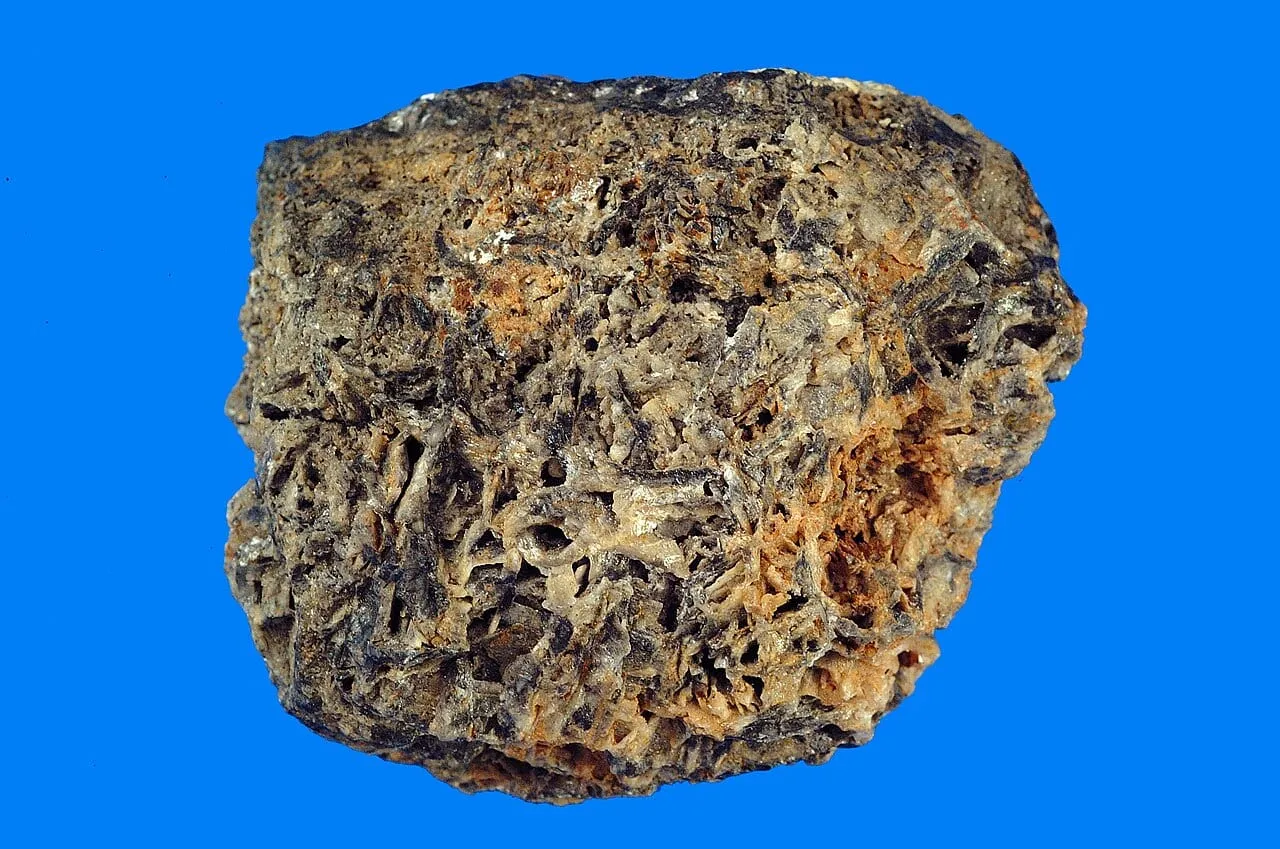
Anglesite
A heavy lead sulfate mineral with a diamond-like shine that grows as a crust around galena; it is named after the island of Anglesey in Wales.
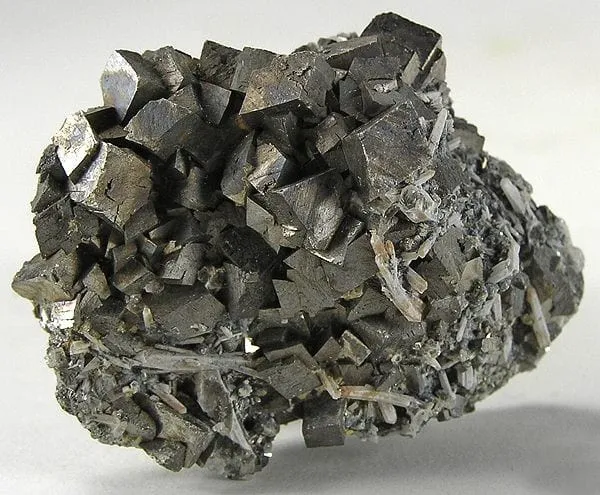
Arsenopyrite
A widespread silvery-grey sulfide containing arsenic: it smells of garlic when struck and is poisonous.
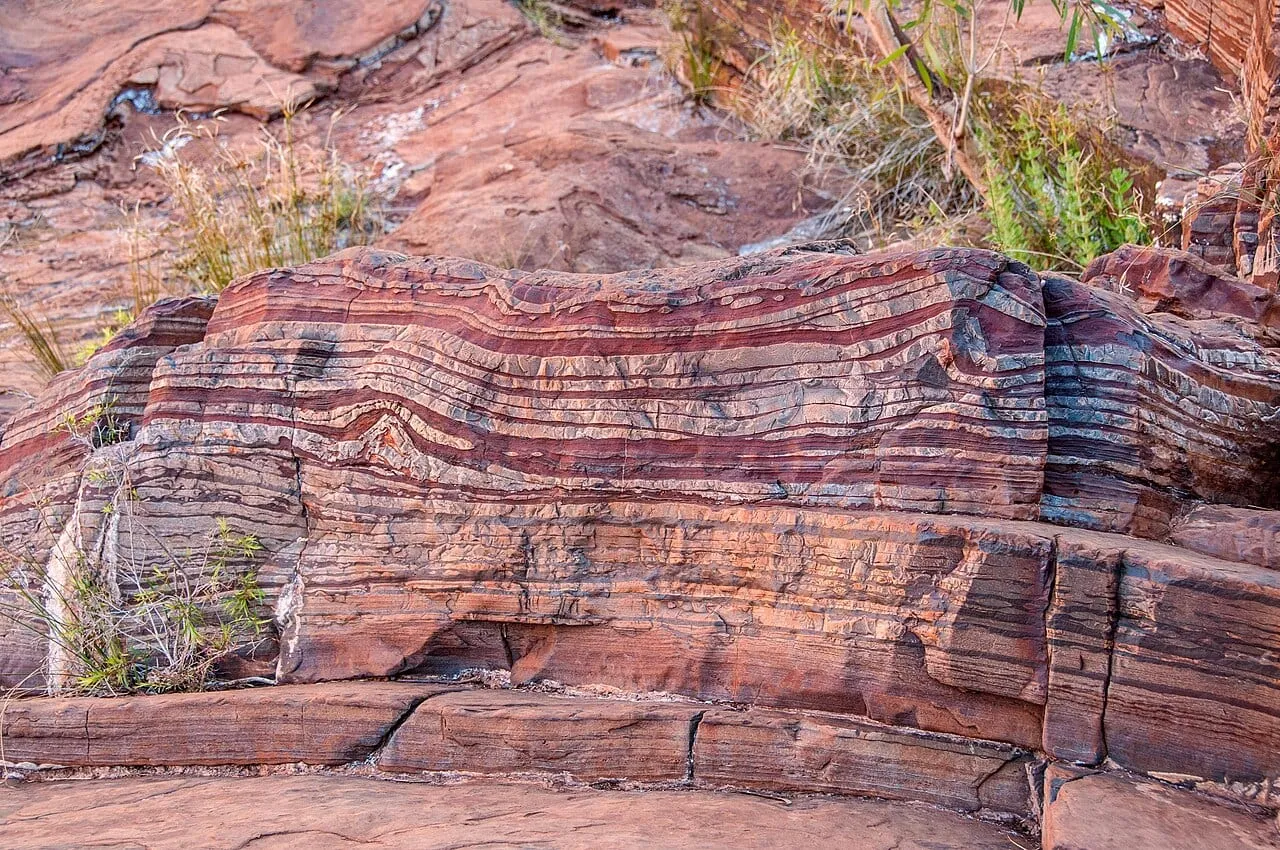
Banded iron formation
An ancient rock of alternating iron-oxide and chert bands: the record of oxygen beginning to build up on Earth, and the main source of iron ore.