Mineral
Molybdenite
MoS₂Molibdenit
The main ore of molybdenum: a soft, greasy, lead-grey mineral that looks like graphite but is more than twice as heavy.
Also known as: Molybdenum disulfide (chemical name)
- Popularly: Ore and raw material
- Ore
- Industrial
- Important in Türkiye

In short
Molybdenite is a lead-grey, metallic-looking, very soft mineral made of molybdenum and sulfur (MoS₂). It splits into thin, flexible flakes and leaves a grey mark on the fingers, which is why it is most often mistaken for graphite. It is the most important ore of molybdenum, a metal used mostly in steel and alloys.
Photos

How does it form?
Molybdenite forms in high-temperature hydrothermal veins, in fine veins and disseminations inside rocks such as granite (porphyry-type deposits), in skarns where magma meets limestone, and in pegmatites and aplites; it even occurs rarely in meteorites. In porphyry deposits it usually comes with copper minerals, especially chalcopyrite, so a large part of the world’s molybdenum is a by-product of copper mining.
Why is it slippery?
In molybdenite, layers of molybdenum atoms are sandwiched between sheets of sulfur atoms. The bonds within each layer are strong, but the bonds between layers are weak; the layers slide over each other easily, so the mineral is soft, feels greasy and can be used as a solid lubricant, like graphite. The same structure is why the mineral splits into thin flakes. For the look-alike, see the graphite page.
What is it used for?
- Steel and alloys: According to Wikipedia, about 86% of molybdenum goes into metallurgy: structural steel, stainless steel, tool steels, cast iron and superalloys. It gives steel strength and resistance to heat and wear. According to the USGS, molybdenum concentrate is roasted to molybdenum oxide, from which ferromolybdenum and metal powder are made.
- Lubricant and catalyst: Molybdenum disulfide is a solid lubricant and a catalyst for removing sulfur in oil refineries (hydrodesulfurisation).
- Rhenium: Molybdenite ores are the main source of rhenium.
- Electronics: It featured in early semiconductor detectors and is studied today for transistors and optoelectronics.
- Life: Molybdenum is an essential trace element for living things; it is found in more than 50 enzymes, including those that fix nitrogen (nitrogenase).
Where does it come from?
According to the USGS, world molybdenum mining in 2025 was about 260 thousand tonnes (molybdenum content). China (97 thousand tonnes), Chile (42 thousand), the United States (40 thousand), Peru (39 thousand) and Mexico (17 thousand) supplied about 90% of it. Only China and the United States produce molybdenum both from primary molybdenum mines and as a by-product of copper mines; the other countries rely on by-product.
In Türkiye
In Türkiye molybdenite is known from mineralisations linked to granite. The best-studied example is the Başnayayla molybdenum-copper mineralisation about 15 km southwest of Yozgat (Kuşçu and Genç, 1999). Linked to granitoids of Paleocene (?) age, it takes the form of quartz-molybdenite veinlets, coatings in cracks and disseminations; the main ore minerals are molybdenite, chalcopyrite, pyrite and magnetite, with small amounts of ilmenite, bornite and bismuthinite. In the study’s words it is a low-grade porphyry and/or stockwork-type mineralisation.
MTA investigated it by drilling in 1993 (690 m in total at five locations); because the grade and reserve were not economic (a molybdenum grade of about 0.02%), work stopped in 1995. It is nevertheless the only molybdenum mineralisation in the granite-related ore belt of Central Anatolia where detailed drilling was carried out.
What determines its value?
Molybdenite is an ore, and its value depends on the grade (the proportion of molybdenum in the ore), the size of the deposit, whether molybdenum is the main product or a by-product of copper mining, the cost of processing and demand from the steel industry. According to the USGS, every producer except China and the United States gains molybdenum as a by-product of copper mines, and as demand grows copper producers are upgrading their plants to recover molybdenite. About 90% of supply comes from five countries (China, Chile, the United States, Peru and Mexico), so trade restrictions matter too: China introduced export controls on molybdenum powders in 2025. For collectors, well-formed hexagonal crystals, size and freedom from damage count.
This information is educational, not buying, selling or investment advice. Value varies enormously with quality and treatment.
How to recognise it
- 1
It is very soft (hardness 1–1.5): a fingernail scratches it, it leaves a grey mark on paper and fingers, and it feels greasy and slippery.
- 2
It is lead-grey with a metallic lustre and splits into thin, flexible flakes. The flakes bend but do not spring back.
- 3
What sets it apart from graphite is weight: its specific gravity is about 4.7, more than twice that of graphite (about 2.1–2.2). The streak is bluish grey (greenish grey in some sources), while graphite’s is black to steel-grey.
- 4
It mostly occurs in quartz veins or inside rocks such as granite, as leafy flakes, clusters or scattered grains, and is often accompanied by copper minerals such as chalcopyrite.
Fakes and imitations
What shops usually don’t tell you:
- Graphite: the mineral it is most often confused with. Graphite is much lighter and has a black streak; molybdenite feels distinctly heavy in the hand.
- Galena: molybdenite used to be confused with the lead ore galena too; both are grey with a metallic lustre. Galena has a specific gravity of about 7.6 and breaks into cubes, while molybdenite splits into thin sheets in one direction.
Safety
Molybdenite is harmless to handle; its flakes rub off on fingers and paper, so wash your hands afterwards. Do not crush or grind raw specimens and do not breathe the dust.
Myths and misconceptions
MythMolybdenite is just another name for graphite.
FactThey are separate minerals: graphite is made of carbon, molybdenite of molybdenum and sulfur. Both are soft, slippery grey minerals that mark paper, but molybdenite is more than twice as heavy. Because of this resemblance they were long confused, and not until Scheele’s work in 1778 was it understood that molybdenite is the ore of a separate element.
MythMolybdenite is a lead ore.
FactIt contains no lead; it is molybdenum disulfide (MoS₂). Its name comes from the Greek word for “lead” because it was long mistaken for lead ores.
Did you know?
The name comes from the Greek molybdos, “lead”: grey, soft substances that were mixed up with lead ores used to be called “molybdena”. In 1778 the Swedish chemist Carl Wilhelm Scheele correctly proposed that molybdena was the ore of a distinct new element; the metal was isolated in 1781 by Peter Jacob Hjelm.
Molybdenite ores are the main source of rhenium, a rare metal: a few parts per million, and sometimes 1–2%, of the molybdenum in the mineral is replaced by rhenium.
Molybdenite was once used as a semiconductor in the “cat’s whisker” detectors of crystal radios, and it is still studied today for transistors and optoelectronics.
Where is it found?
Loading map…
- Climax, Colorado, USA · Major depositAccording to Wikipedia, the Climax mine was the largest molybdenum mine in the world and for many years supplied three-fourths of the world's molybdenum
- Henderson mine, Clear Creek County, Colorado, USA · Major depositNorth America's largest primary (molybdenum-first) mine; in production since 1976
- Questa, New Mexico, USA · Known localityA molybdenum mine opened in 1916, closed permanently in 2014 because of low molybdenum prices and high operating costs
- Bingham Canyon mine, Utah, USA · Known localityA copper mine that yields molybdenum as a by-product (in 2005 the molybdenum it produced was worth more than its copper)
- Chuquicamata, Antofagasta, Chile · Major depositA huge copper mine; molybdenite occurs in quartz veins and molybdenum is a significant by-product. According to the USGS, Chile is the world's second-largest molybdenum producer
- Knaben, Agder, Norway · Historic sourceMolybdenite was mined here from 1885 to 1973; mining picked up after 1897, when adding molybdenum to steel proved useful for weapon making
- Luanchuan, Henan, China · Major depositAccording to Wikipedia the county has significant molybdenum and tungsten deposits; according to the USGS, China is the world's largest molybdenum producer (about 97 thousand tonnes in 2025)
- Başnayayla, Yozgat, Türkiye · Known localityAbout 15 km southwest of Yozgat, a low-grade molybdenum-copper mineralisation linked to granite; MTA investigated it by drilling and found it uneconomic (location approximate)
Locations are approximate to protect sites. Red dots mark places in Türkiye. Open in the big map →
Frequently asked questions
What is molybdenite?
Molybdenite is a lead-grey, metallic-looking, very soft mineral made of molybdenum and sulfur (MoS₂). It splits into thin, flexible flakes and leaves a grey mark on the fingers, which is why it is most often mistaken for graphite. It is the most important ore of molybdenum, a metal used mostly in steel and alloys.
What is molybdenite used for?
Steel and alloys: According to Wikipedia, about 86% of molybdenum goes into metallurgy: structural steel, stainless steel, tool steels, cast iron and superalloys. It gives steel strength and resistance to heat and wear. According to the USGS, molybdenum concentrate is roasted to molybdenum oxide, from which ferromolybdenum and metal powder are made. Lubricant and catalyst: Molybdenum disulfide is a solid lubricant and a catalyst for removing sulfur in oil refineries (hydrodesulfurisation). Rhenium: Molybdenite ores are the main source of rhenium.
How hard is molybdenite?
It has a hardness of 1–1.5 on the Mohs scale. It is soft enough to scratch with a fingernail. Its specific gravity is 4.62–4.73 g/cm³.
Where is molybdenite found?
Its best-known localities: Climax, Colorado, USA; Henderson mine, Clear Creek County, Colorado, USA; Chuquicamata, Antofagasta, Chile; Luanchuan, Henan, China; Knaben, Agder, Norway.
Where is molybdenite found in Türkiye?
Known localities in Türkiye: Başnayayla, Yozgat, Türkiye.
How can you tell if molybdenite is real?
It is very soft (hardness 1–1.5): a fingernail scratches it, it leaves a grey mark on paper and fingers, and it feels greasy and slippery. It is lead-grey with a metallic lustre and splits into thin, flexible flakes. The flakes bend but do not spring back. What sets it apart from graphite is weight: its specific gravity is about 4.7, more than twice that of graphite (about 2.1–2.2). The streak is bluish grey (greenish grey in some sources), while graphite’s is black to steel-grey. Graphite: the mineral it is most often confused with. Graphite is much lighter and has a black streak; molybdenite feels distinctly heavy in the hand.
Is molybdenite valuable?
On the “street to diamond” value ladder it sits on step 4 of nine: Fine dimension stone and ore. Molybdenite is an ore, and its value depends on the grade (the proportion of molybdenum in the ore), the size of the deposit, whether molybdenum is the main product or a by-product of copper mining, the cost of processing and demand from the steel industry. According to the USGS, every producer except China and the United States gains molybdenum as a by-product of copper mines, and as demand grows copper producers are upgrading their plants to recover molybdenite. About 90% of supply comes from five countries (China, Chile, the United States, Peru and Mexico), so trade restrictions matter too: China introduced export controls on molybdenum powders in 2025. For collectors, well-formed hexagonal crystals, size and freedom from damage count.
Is molybdenite dangerous?
Molybdenite is harmless to handle; its flakes rub off on fingers and paper, so wash your hands afterwards. Do not crush or grind raw specimens and do not breathe the dust.
Sources
- Handbook of Mineralogy: Molybdenite · Mineralogical Society of America
- Molybdenite · Wikipedia
- Molybdenum · Wikipedia
- Molybdenite (Webmineral) · Webmineral
- Mineral Commodity Summaries 2026: Molybdenum · U.S. Geological Survey, 2026
- Başnayayla (Yozgat) Molibden-Bakır Cevherleşmesi (Kuşçu & Genç), Türkiye Jeoloji Bülteni 42(2) · Türkiye Jeoloji Kurumu, 1999
- Climax, Colorado · Wikipedia
- Henderson Mine · Wikipedia
- Questa, New Mexico · Wikipedia
- Bingham Canyon Mine · Wikipedia
- Chuquicamata · Wikipedia
- Knaben · Wikipedia
- Luanchuan County · Wikipedia
External links
Draft: awaiting expert reviewReport an error ↗
On the same step
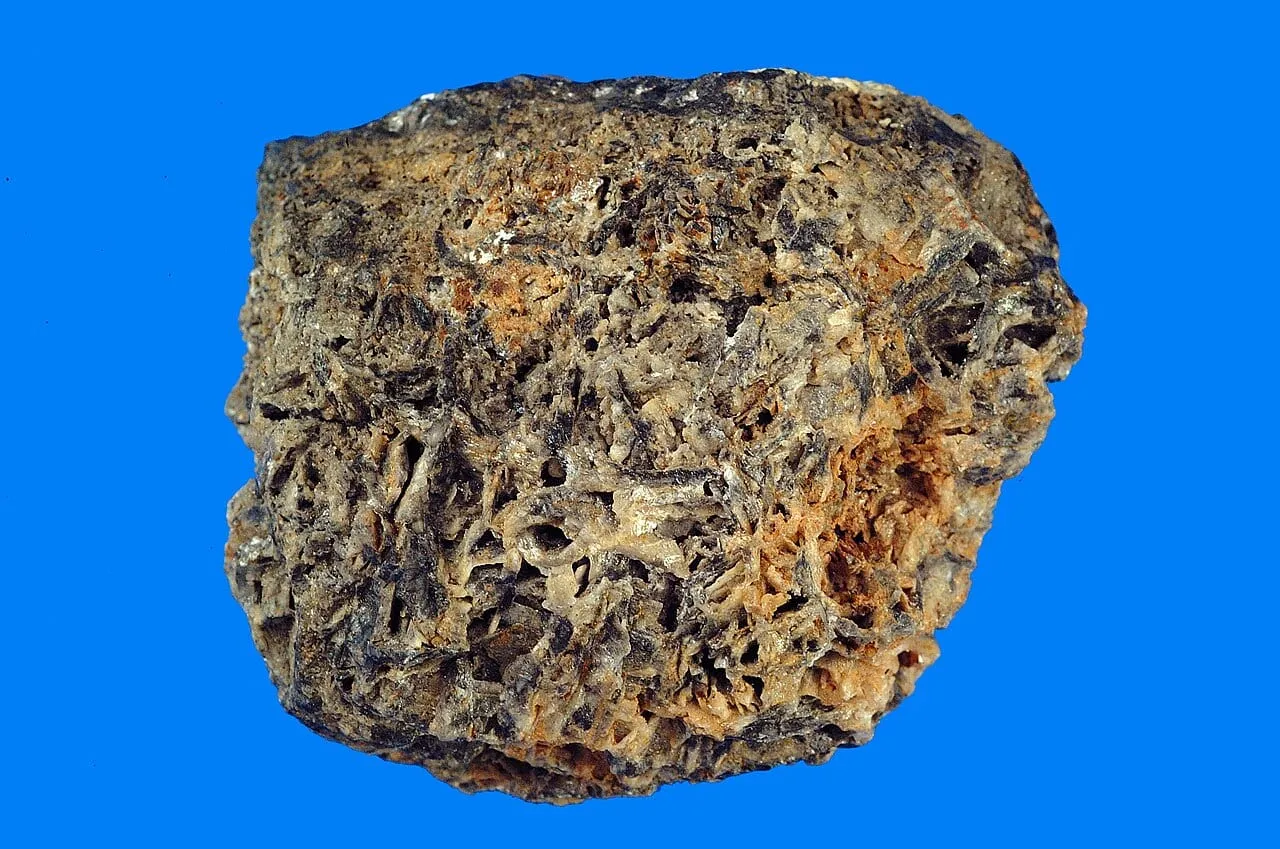
Anglesite
A heavy lead sulfate mineral with a diamond-like shine that grows as a crust around galena; it is named after the island of Anglesey in Wales.
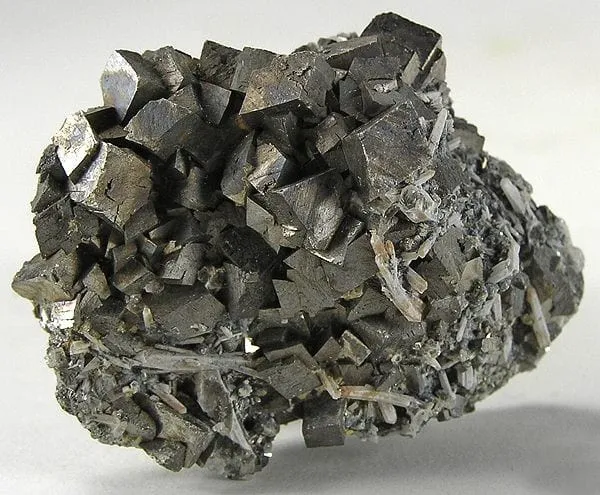
Arsenopyrite
A widespread silvery-grey sulfide containing arsenic: it smells of garlic when struck and is poisonous.
Banded iron formation
An ancient rock of alternating iron-oxide and chert bands: the record of oxygen beginning to build up on Earth, and the main source of iron ore.