Meteorite
Carbonaceous chondrite
Karbonlu kondrit
Dark chondrites that carry water and organic compounds, among the most primitive rocks in the Solar System, famous for falls such as Murchison and Allende.
Also known as: C chondrite · Carbonaceous meteorite
- Popularly: Meteorite
_(14601493358).jpg)
In short
Carbonaceous chondrites are dark, mostly fragile stony meteorites that contain water-bearing clay-like minerals and organic compounds such as amino acids. They kept the Solar System’s first material almost without heating, which makes them some of the most primitive meteorites. They make up about 4.6% of meteorites seen to fall; the best known are Murchison and Allende, which fell in 1969.
Photos
_(4.560-4.568_Ga)_6_(16763228023).jpg)
How does it form?
Carbonaceous chondrites are stones that gathered into asteroids from the Solar System’s first material. Their spectra closely resemble those of carbon-rich “C-type” asteroids, and they very probably come from such asteroids. Most never heated above 200 °C, and CIs never above 50 °C, so they kept both their organic compounds and their water-bearing minerals. Examples such as Murchison were widely altered by water while still on their parent asteroids: liquid water turned silicate minerals into clay-like ones.
What is it used for?
Carbonaceous chondrites have no everyday use; their value is scientific:
- The age of the Solar System: The calcium–aluminium-rich inclusions (CAIs) in CV chondrites such as Allende are the oldest dated solids in the Solar System (4.567 billion years).
- The building blocks of life: Amino acids and nucleobases have been found in Murchison, and a 2010 study identified about 14,000 different molecular compositions. Because such compounds can form without life, they are studied to understand how the building blocks of life may have reached the young Earth.
- Earth’s water: The CI and CM groups contain 3–22% water by weight; these stones are used in studies of where Earth’s water came from.
- Comparison with spacecraft samples: About 5.4 g brought from Ryugu by Hayabusa2 in December 2020, and 121.6 g brought from Bennu by OSIRIS-REx on 24 September 2023, have a composition resembling CI chondrites. 20 amino acids and uracil were reported in the Ryugu samples, and in January 2025 five nucleobases and 14 of the 20 amino acids used in proteins were reported in the Bennu samples.
- Museums and collections: Cut and polished slices show off chondrules and CAIs, so they are displayed in museums and collections.
Main groups
Carbonaceous chondrites are divided into at least eight groups, each named after its first-known specimen:
- CI (Ivuna): The group whose chemical composition is closest to the Sun’s, yet also the one most altered by water: it contains 18–20% water by weight and shows no chondrules. Only five firm specimens are known: Alais (1806), Orgueil (1864), Tonk (1911), Ivuna (1938) and Revelstoke (1965).
- CM (Mighei): The most abundant group of carbonaceous chondrites; it contains 3–14% water by weight. Murchison, Sutter’s Mill and Winchcombe belong here.
- CV (Vigarano): Allende’s group; rich in CAIs.
- CO (Ornans), CK (Karoonda) and CR (Renazzo): The other groups, named after type specimens that fell in France, Australia and Italy.
- CH and CB: Groups rich in iron–nickel metal: up to 40% in CH, and more than 50% in CB (type specimen Bencubbin).
- Ungrouped specimens: Stones such as Tagish Lake that fit no group neatly.
For ordinary chondrites and chondrule-bearing stones in general, see the chondrite page.
Why does it matter to collect them quickly?
Carbonaceous chondrites are fragile and can change when they come into contact with water; CIs do not last long on the ground. Specimens protected soon after a fall are therefore very valuable. The Winchcombe meteorite, which fell in England in 2021, was protected within 12 hours without having been rained on, and fragments of Tagish Lake were carried to laboratories frozen. They offer records almost as clean as samples brought back by spacecraft.
Why are they hard to recognise?
Carbonaceous chondrites are dark and can be mistaken for slag, rocks coated in desert varnish or iron ores. To work out whether a stone is a meteorite at all, see the Is my stone valuable? guide; only a laboratory can say which group it belongs to.
What determines its value?
Carbonaceous chondrites make up about 4.6% of meteorites seen to fall; they are much rarer than ordinary chondrites and, being fragile, do not last long on the ground. What determines their value is the group (only five CI specimens are firmly known), whether the fall was witnessed and the stone gathered quickly and kept from rain and damp, whether it belongs to a famous fall such as Murchison, Allende, Orgueil or Tagish Lake, and whether its name is registered in the Meteoritical Society’s database. Pieces are mostly traded as small slices or crumbs, so the name and paperwork of the stone they came from matter more than anything else.
This information is educational, not buying, selling or investment advice. Value varies enormously with quality and treatment.
How to recognise it
- 1
Dark grey to black; a freshly fallen one has a thin, matt black fusion crust. The Tagish Lake meteorite has been likened to a charcoal briquette, apart from its fusion crust.
- 2
Many are light and fragile: in the CI and CM groups, water-bearing clay-like minerals make them markedly less dense than ordinary chondrites (about 2.1 g/cm³, against 3.0–3.7 g/cm³ for ordinary chondrites). CIs are so fragile that they do not survive long on the ground after falling.
- 3
A cut surface of a CV or CO chondrite (such as Allende) may show round chondrules and whitish CAIs in the dark matrix; in CIs, chondrules can hardly be seen.
- 4
Only a meteorite laboratory can say that a stone is a carbonaceous chondrite and which group it belongs to; the names and classes of new meteorites are published in the database of the Meteoritical Society.
Fakes and imitations
What shops usually don’t tell you:
- Slag: waste from mining and metal smelting. It is dark, but it is full of gas bubble holes and looks glassy.
- Rocks coated in desert varnish: according to the Buseck Center for Meteorite Studies at Arizona State University, over 90% of people who write in believing they have found a meteorite have found slag, iron ores or Earth rocks coated in dark desert varnish.
- Magnetite and hematite: these heavy, dark iron-oxide minerals resemble meteorites, but hematite leaves a reddish-brown streak and magnetite a blackish-grey one. Details are in this site’s “Is my stone valuable?” guide.
- Undocumented “carbonaceous chondrite” pieces: a genuine carbonaceous chondrite has a registered name and class; be wary of sales without documents.
Myths and misconceptions
MythFinding amino acids in Murchison proves there is life in space.
FactAmino acids can form without life. Some of those found in Murchison are types not used in the proteins of Earth’s living things, and according to Britannica the molecular structures of these compounds rule out an origin in life on Earth. The finding shows that the building blocks of life can form in space by themselves, not life itself.
MythA carbonaceous chondrite is a stone full of carbon, like coal, that can burn.
Fact“Carbonaceous” means the rock contains carbon compounds. Carbon is only a few per cent by weight (3–5% in CIs) and most of it is in organic compounds; the bulk of the stone is silicates, water-bearing clay-like minerals and magnetite.
Did you know?
Allende fell on 8 February 1969, only months before the Apollo missions brought back the first Moon rocks. About 2 tonnes were collected, and because it is rich in CAIs it gave laboratories the oldest dated solids (4.567 billion years).
Some stardust grains (silicon carbide) in Murchison formed around other stars before the Solar System existed. A study published in 2020 reported that some of them are about 7 billion years old, the oldest solid material measured on Earth.
In the 1960s, a piece of the Orgueil meteorite that had been kept in a sealed jar in Montauban since 1864 was found to hide the seed capsule of a rush plant. The capsule had been camouflaged with coal dust and glued in; it is thought to be a hoax meant to influence the debate on spontaneous generation of the time.
Where is it found?
Loading map…
- Murchison, Victoria, Australia · Major depositA CM2 meteorite that fell on the morning of 28 September 1969; more than 100 kg of fragments were collected, the largest weighing 7 kg. A 2010 study found about 14,000 different molecular compositions in it, including more than 70 amino acids.
- Pueblito de Allende, Chihuahua, Mexico · Major depositA CV3 meteorite that fell on 8 February 1969; about 2 tonnes were collected, the largest piece weighing 110 kg. The fragments were scattered over an area of about 50 × 8 km. Its CAIs, at 4.567 billion years, are among the oldest dated solids.
- Orgueil, Tarn-et-Garonne, France · Historic sourceA CI1 meteorite that fell on the evening of 14 May 1864; about 20 stones and about 14 kg of material in all are known. The largest collection (8.72 kg) is in the Muséum national d'histoire naturelle in Paris.
- Tagish Lake, British Columbia, Canada · Known localityA C2-ungrouped meteorite that fell on 18 January 2000; the fragments, carried frozen to research laboratories, contain abundant organic material, amino acids and nanodiamonds. Its density is markedly lower than that of other chondrites.
- Coloma (Sutter's Mill), California, USA · Known localityA CM meteorite that fell on the morning of 22 April 2012; the falling stones showed up on weather radar and fragments began to be found near Coloma on 24 April. About 953 g in all are known. It is named after the mill where the 1848 gold rush began.
- Winchcombe, Gloucestershire, England · Known localityA CM2 meteorite that fell on the evening of 28 February 2021; 602 g in all were collected. Because it was protected before it rained, it offers a record almost as pristine as a sample brought back by a spacecraft. It is the first meteorite found in Britain since 1991.
Locations are approximate to protect sites. Red dots mark places in Türkiye. Open in the big map →
Frequently asked questions
What is carbonaceous chondrite?
Carbonaceous chondrites are dark, mostly fragile stony meteorites that contain water-bearing clay-like minerals and organic compounds such as amino acids. They kept the Solar System’s first material almost without heating, which makes them some of the most primitive meteorites. They make up about 4.6% of meteorites seen to fall; the best known are Murchison and Allende, which fell in 1969.
What is carbonaceous chondrite used for?
Carbonaceous chondrites have no everyday use; their value is scientific: The age of the Solar System: The calcium–aluminium-rich inclusions (CAIs) in CV chondrites such as Allende are the oldest dated solids in the Solar System (4.567 billion years). The building blocks of life: Amino acids and nucleobases have been found in Murchison, and a 2010 study identified about 14,000 different molecular compositions. Because such compounds can form without life, they are studied to understand how the building blocks of life may have reached the young Earth.
How hard is carbonaceous chondrite?
It has a hardness of 2.5–7 on the Mohs scale. It can scratch glass; a steel knife scratches it only with difficulty. Its specific gravity is 2.11–3.1 g/cm³.
Where is carbonaceous chondrite found?
Its best-known localities: Murchison, Victoria, Australia; Pueblito de Allende, Chihuahua, Mexico; Orgueil, Tarn-et-Garonne, France; Tagish Lake, British Columbia, Canada; Coloma (Sutter's Mill), California, USA.
How can you tell if carbonaceous chondrite is real?
Dark grey to black; a freshly fallen one has a thin, matt black fusion crust. The Tagish Lake meteorite has been likened to a charcoal briquette, apart from its fusion crust. Many are light and fragile: in the CI and CM groups, water-bearing clay-like minerals make them markedly less dense than ordinary chondrites (about 2.1 g/cm³, against 3.0–3.7 g/cm³ for ordinary chondrites). CIs are so fragile that they do not survive long on the ground after falling. A cut surface of a CV or CO chondrite (such as Allende) may show round chondrules and whitish CAIs in the dark matrix; in CIs, chondrules can hardly be seen. Slag: waste from mining and metal smelting. It is dark, but it is full of gas bubble holes and looks glassy.
Is carbonaceous chondrite valuable?
On the “street to diamond” value ladder it sits on step 6 of nine: Fine ornamental and collector stone. Carbonaceous chondrites make up about 4.6% of meteorites seen to fall; they are much rarer than ordinary chondrites and, being fragile, do not last long on the ground. What determines their value is the group (only five CI specimens are firmly known), whether the fall was witnessed and the stone gathered quickly and kept from rain and damp, whether it belongs to a famous fall such as Murchison, Allende, Orgueil or Tagish Lake, and whether its name is registered in the Meteoritical Society’s database. Pieces are mostly traded as small slices or crumbs, so the name and paperwork of the stone they came from matter more than anything else.
Sources
- Carbonaceous chondrite · Wikipedia
- C-tipi asteroit · Vikipedi
- CI chondrite · Wikipedia
- CM chondrite · Wikipedia
- Murchison meteorite · Wikipedia
- Murchison meteorite · Encyclopaedia Britannica
- High molecular diversity of extraterrestrial organic matter in Murchison meteorite revealed 40 years after its fall (Schmitt-Kopplin et al.), Proceedings of the National Academy of Sciences 107(7): 2763–2768 · PNAS, 2010
- Lifetimes of interstellar dust from cosmic ray exposure ages of presolar silicon carbide (Heck et al.), Proceedings of the National Academy of Sciences 117(4) · PNAS, 2020
- Allende meteorite · Wikipedia
- Orgueil meteorite · Wikipedia
- Tagish Lake (meteorite) · Wikipedia
- Sutter's Mill meteorite · Wikipedia
- Coloma, California · Wikipedia
- Winchcombe meteorite · Wikipedia
- 162173 Ryugu · Wikipedia
- 101955 Bennu · Wikipedia
- Meteorite porosities and densities: a review of trends in the data (D. T. Britt & G. J. Consolmagno), Lunar and Planetary Science XXXV, abstract 2108 · Lunar and Planetary Institute, 2004
- Handbook of Mineralogy: Clinochrysotile · Mineralogical Society of America
- Handbook of Mineralogy: Forsterite · Mineralogical Society of America
External links
Draft: awaiting expert reviewReport an error ↗
On the same step
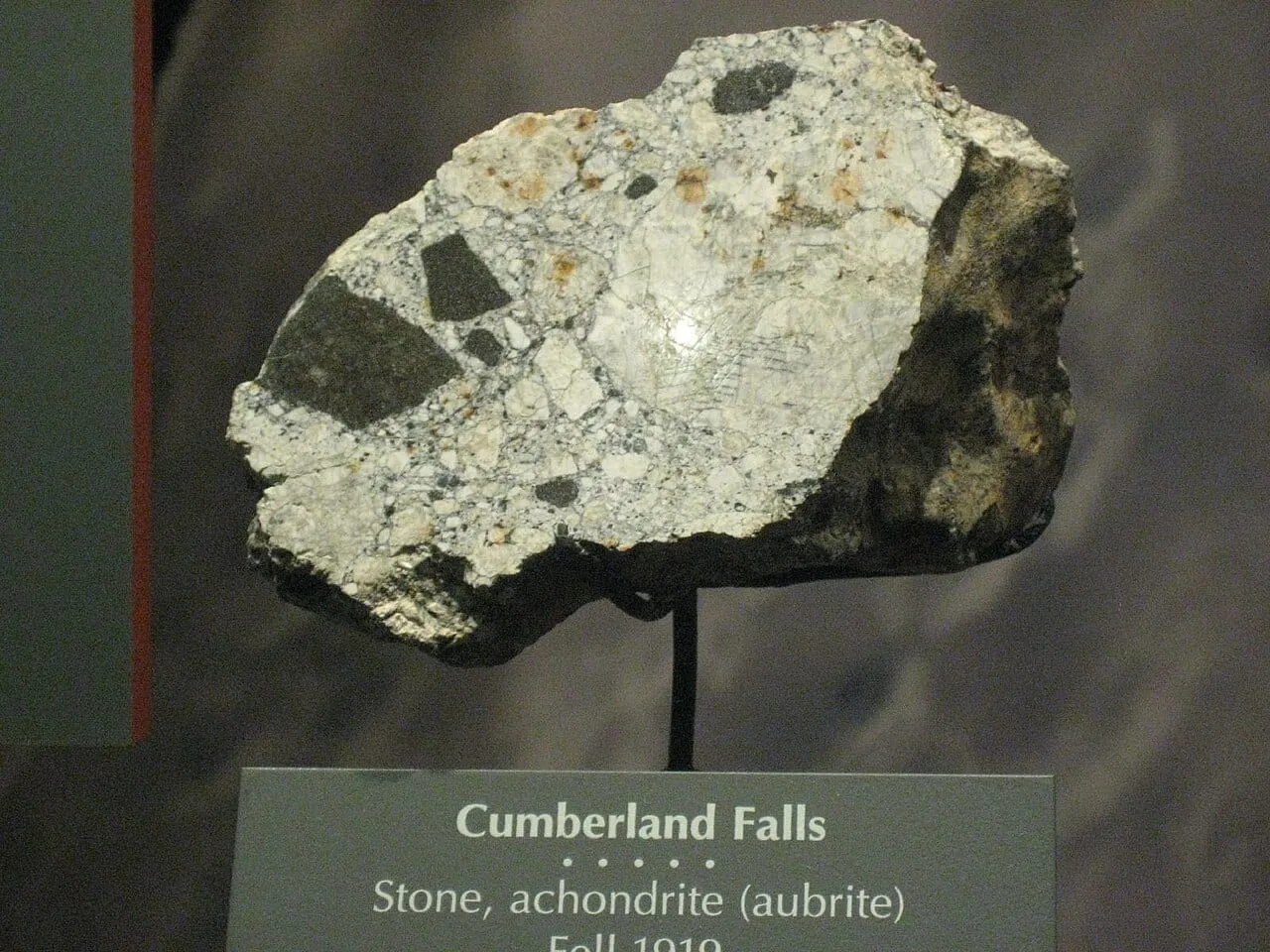
Achondrite
Stony meteorites with no chondrules: rock from melted asteroids, the Moon and Mars, and hard to recognise because they look like Earth rocks.
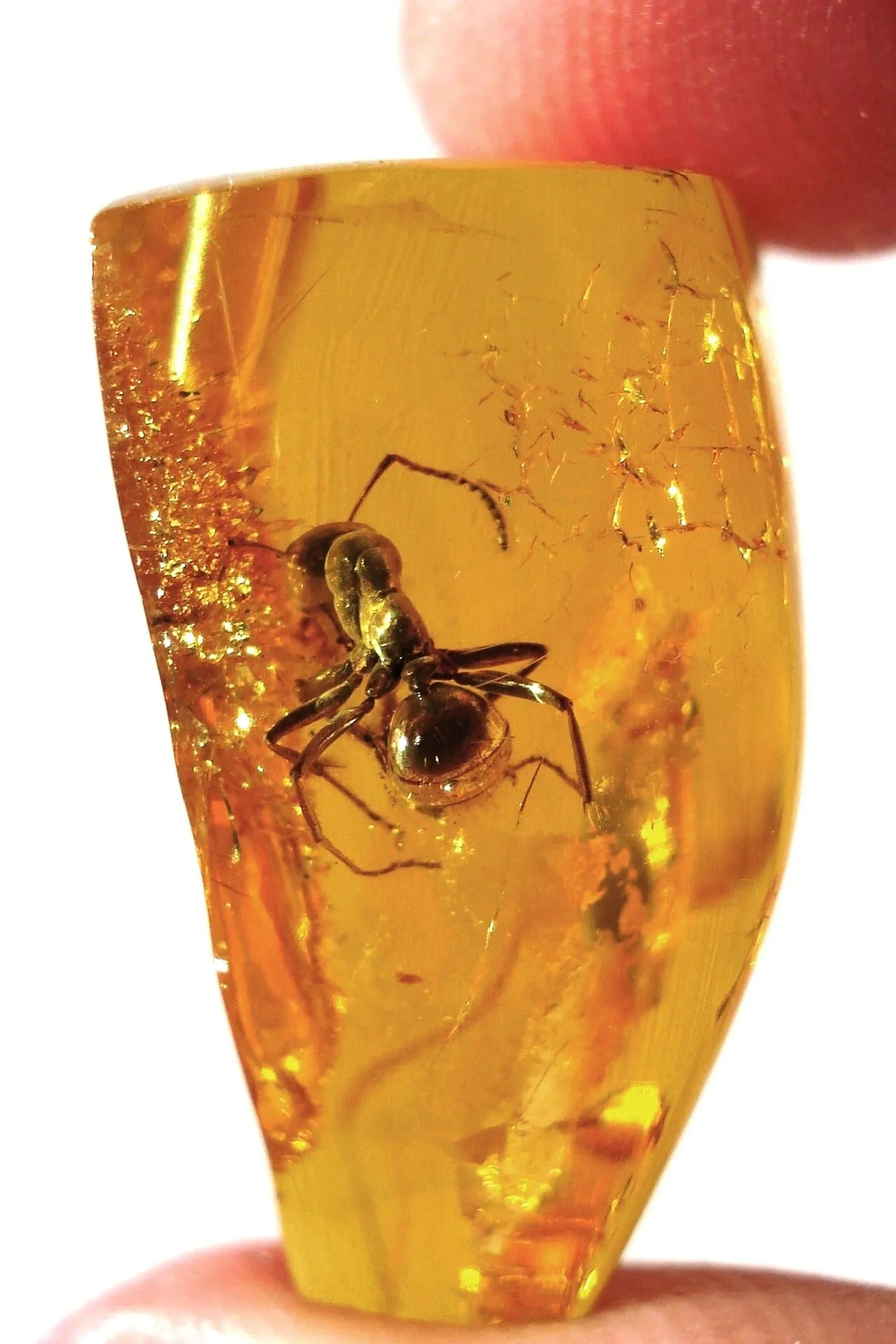
Amber
Tree resin fossilised over millions of years: a light, warm organic gem that sometimes holds prehistoric insects.
Ammolite
The rainbow-bright layer of fossil ammonite shell; of gem quality it comes only from the Canadian province of Alberta.