Mineral
Benitoite
BaTiSi₃O₉Benitoit
A sapphire-like blue stone whose gem crystals come from a single mine in the world: the official state gem of California.
- Popularly: Semi-precious stone
- Gemstone

In short
Benitoite is a very rare mineral containing barium, titanium and silicon. It is known for its tones from sapphire blue to colourless and for a dispersion of light that in some directions exceeds that of diamond. Its gem-quality crystals have been produced in commercial quantities only from a single mine in the US state of California, so faceted stones are few and most are smaller than one carat. California made benitoite its official state gem in 1985.
Photos

How does it form?
Benitoite forms under unusual conditions: in low-temperature, high-pressure settings typical of subduction zones, inside hydrothermally altered serpentinite bodies. In California, benitoite is found in bodies of blueschist within serpentinite. As the blueschist is altered by hot fluids derived from the regional metamorphism of the serpentinite, benitoite crystals grow in fractures in the rock; the fractures are later filled with white natrolite. Rare minerals such as neptunite and joaquinite are found with the crystals.
What is it used for?
- Jewellery: Benitoite is cut as a faceted stone and used in rings and pendants. Because it has no distinct cleavage, it is easy to facet. But it is sensitive to sudden temperature changes and to ultrasonic vibration, so it should not be cleaned in an ultrasonic cleaner.
- Collecting: Blue crystals on white natrolite are among the most sought-after specimens for mineral collectors.
- Science: Because it fluoresces strongly under an electron beam, it is used in electron microprobes to adjust and align the beam size; it also serves as a standard in analyses for barium and titanium.
A single mine
Gem-quality benitoite comes in commercial quantities from only one place in the world, the Benitoite Gem mine in the New Idria district of San Benito County, California; the mine used to be called the Dallas mine. When the prospector J. M. Couch found the stone in 1906–1907 he took it for sapphire. George D. Louderback of the University of California realised it was a new mineral and named it after the San Benito River, county and mountains. Benitoite is also found in a few places outside California, such as Arkansas, Japan and Australia; but there it occurs only as an accessory mineral and not of gem quality.
What determines its value?
What matters most in benitoite is the saturation and evenness of the blue, clarity, cut and size; because the pleochroism is strong, cutting the stone in the right direction also matters. Because gem-quality material comes from a single mine, and according to GIA's 1997 study about 5,000 carats of faceted stones were produced over the life of the mine, supply is very limited; about 2% of those stones weigh over 2 carats. Pink and colourless stones are very rare, and the orange colour is produced by heat treatment. Because synthetic benitoite can be made, a laboratory report showing that a stone is natural is important.
This information is educational, not buying, selling or investment advice. Value varies enormously with quality and treatment.
How to recognise it
- 1
Its colour runs from sapphire blue to violetish blue; blue and colourless zones can appear together in one crystal. Pink and colourless stones are very rare.
- 2
Its pleochroism is strong: looked at from one direction the crystal is blue or violetish blue, from another colourless.
- 3
Its crystals are flattened, often triangular or hexagonal in outline, and are found in white natrolite together with rare minerals such as neptunite and joaquinite.
- 4
Under short-wave ultraviolet light it glows a bright sky blue; it is counted among the most beautiful fluorescent minerals.
- 5
Its hardness is 6–6.5, far softer than sapphire (9). It is told from sapphire by its higher birefringence; a gem laboratory is needed for certain identification.
Fakes and imitations
What shops usually don’t tell you:
- Sapphire and tanzanite: it can be confused with them because of its similar blue colour; benitoite shows higher birefringence than sapphire.
- Heat-treated orange benitoite: orange stones have been produced by heating colourless material; this colour has not been seen in untreated benitoite.
- Synthetic benitoite has been grown in the laboratory.
Myths and misconceptions
MythBenitoite is a kind of sapphire.
FactBenitoite is a separate mineral containing barium and titanium, while sapphire is the blue variety of the mineral corundum. When benitoite was first found in the early 1900s, the prospector took it for sapphire; but its hardness is 6–6.5, while that of sapphire is 9.
What is it believed to be good for?
This section reports beliefs; it is not health information. There is no scientific evidence for these claims and no stone replaces medical treatment.
The meanings people give this stone, and who holds them:
- Some stone sellers and crystal-therapy sites claim that benitoite is linked with the throat, third eye and crown chakras, supports spiritual communication and “astral travel”, gives protection, and even eases communication with beings from other worlds.
What science says
There is no scientific evidence that benitoite has any effect on spiritual or extraterrestrial communication, protection or health; these claims come mostly from sellers' and crystal-therapy writing. The stone's real appeal is its rarity, its colour and its dispersion of light.
Did you know?
In 1985 benitoite was made the official state gem of California.
Its dispersion, the power to split light into colours, exceeds that of diamond in some directions.
The faceted stones are small: according to GIA's 1997 study, about 89% of the faceted stones that the mine's current operators have produced since 1967 are under one carat; the largest known cut stone is 15.42 carats.
Where is it found?
Loading map…
- Benitoite Gem mine (New Idria district), San Benito County, California, USA · Type localityThe only place in the world that yields gem-quality benitoite in commercial quantities; in a blueschist body within serpentinite
- Big Creek–Rush Creek area, Fresno County, California, USA · Known localityA non-gem benitoite locality named in the Handbook of Mineralogy
- Trumbull Peak (near Incline), Mariposa County, California, USA · Known localityA non-gem benitoite locality named in the Handbook of Mineralogy
- Magnet Cove (Diamond Jo quarry), Arkansas, USA · Known localityBenitoite occurs here only as an accessory mineral
- Ōmi, Itoigawa, Niigata Prefecture, Japan · Known localityBenitoite in a dike cutting a serpentinite body; found only as an accessory mineral
- Broken Hill, New South Wales, Australia · Known localityA non-gem benitoite locality named in the Handbook of Mineralogy
Locations are approximate to protect sites. Red dots mark places in Türkiye. Open in the big map →
Frequently asked questions
What is benitoite?
Benitoite is a very rare mineral containing barium, titanium and silicon. It is known for its tones from sapphire blue to colourless and for a dispersion of light that in some directions exceeds that of diamond. Its gem-quality crystals have been produced in commercial quantities only from a single mine in the US state of California, so faceted stones are few and most are smaller than one carat. California made benitoite its official state gem in 1985.
What is benitoite used for?
Jewellery: Benitoite is cut as a faceted stone and used in rings and pendants. Because it has no distinct cleavage, it is easy to facet. But it is sensitive to sudden temperature changes and to ultrasonic vibration, so it should not be cleaned in an ultrasonic cleaner. Collecting: Blue crystals on white natrolite are among the most sought-after specimens for mineral collectors. Science: Because it fluoresces strongly under an electron beam, it is used in electron microprobes to adjust and align the beam size; it also serves as a standard in analyses for barium and titanium.
How hard is benitoite?
It has a hardness of 6–6.5 on the Mohs scale. It can scratch glass; a steel knife scratches it only with difficulty. Its specific gravity is 3.64–3.69 g/cm³.
Where is benitoite found?
Its best-known localities: Benitoite Gem mine (New Idria district), San Benito County, California, USA; Big Creek–Rush Creek area, Fresno County, California, USA; Trumbull Peak (near Incline), Mariposa County, California, USA; Magnet Cove (Diamond Jo quarry), Arkansas, USA; Ōmi, Itoigawa, Niigata Prefecture, Japan.
How can you tell if benitoite is real?
Its colour runs from sapphire blue to violetish blue; blue and colourless zones can appear together in one crystal. Pink and colourless stones are very rare. Its pleochroism is strong: looked at from one direction the crystal is blue or violetish blue, from another colourless. Its crystals are flattened, often triangular or hexagonal in outline, and are found in white natrolite together with rare minerals such as neptunite and joaquinite. Sapphire and tanzanite: it can be confused with them because of its similar blue colour; benitoite shows higher birefringence than sapphire.
Is benitoite valuable?
On the “street to diamond” value ladder it sits on step 7 of nine: Precious stone. What matters most in benitoite is the saturation and evenness of the blue, clarity, cut and size; because the pleochroism is strong, cutting the stone in the right direction also matters. Because gem-quality material comes from a single mine, and according to GIA's 1997 study about 5,000 carats of faceted stones were produced over the life of the mine, supply is very limited; about 2% of those stones weigh over 2 carats. Pink and colourless stones are very rare, and the orange colour is produced by heat treatment. Because synthetic benitoite can be made, a laboratory report showing that a stone is natural is important.
What is benitoite good for?
Some stone sellers and crystal-therapy sites claim that benitoite is linked with the throat, third eye and crown chakras, supports spiritual communication and “astral travel”, gives protection, and even eases communication with beings from other worlds. There is no scientific evidence that benitoite has any effect on spiritual or extraterrestrial communication, protection or health; these claims come mostly from sellers' and crystal-therapy writing. The stone's real appeal is its rarity, its colour and its dispersion of light. This section reports beliefs; it is not health information. There is no scientific evidence for these claims and no stone replaces medical treatment.
Sources
- Benitoite from the New Idria District, San Benito County, California (Laurs, Rohtert, Gray), Gems & Gemology 33(3) · GIA, 1997
- Benitoite, California State Gem (CGS Note 11) · California Geological Survey, 2002
- Handbook of Mineralogy: Benitoite · Mineralogical Society of America
- Benitoite · Wikipedia
External links
Draft: awaiting expert reviewReport an error ↗
On the same step
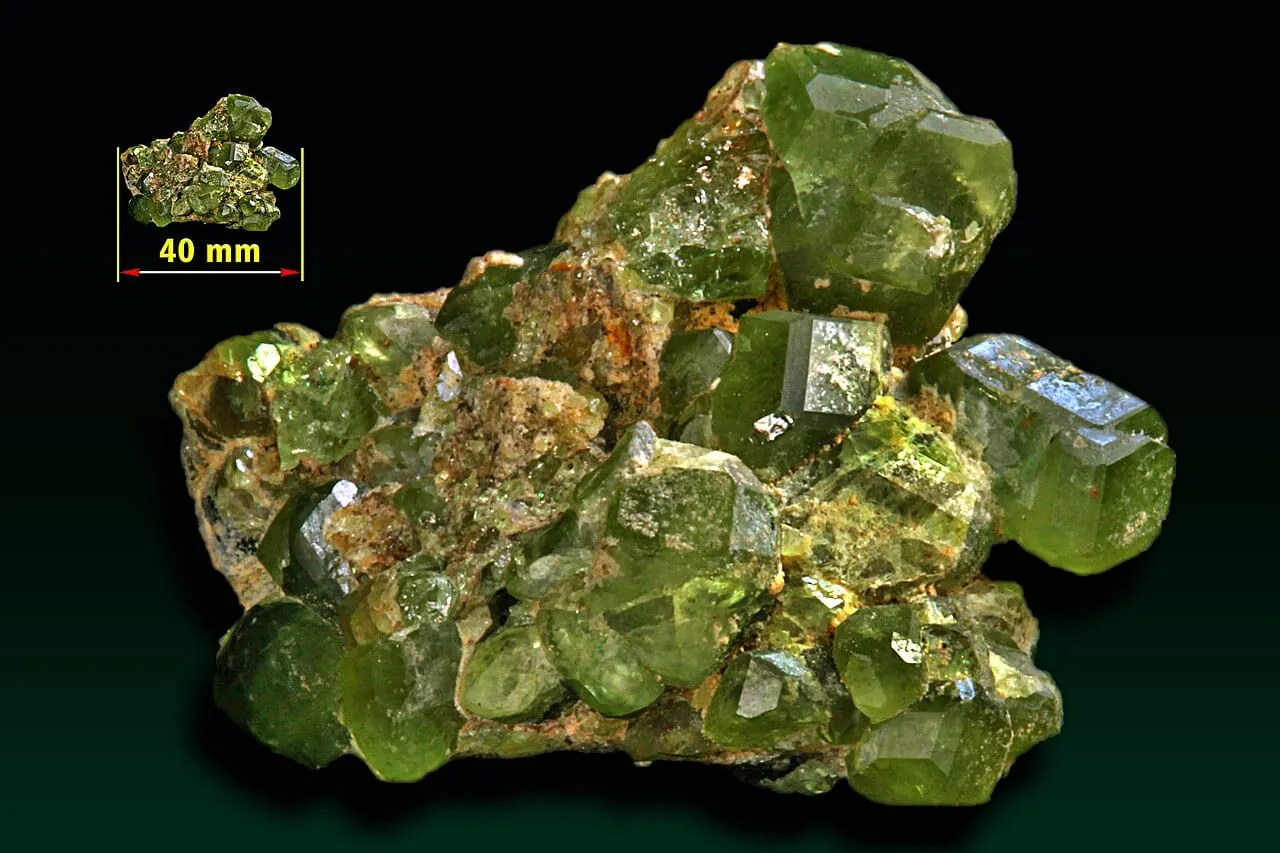
Demantoid
Its name means “diamond-like”: an emerald-green garnet that splits light more than diamond does, known since the 1850s from the Urals; a rare and valuable stone.
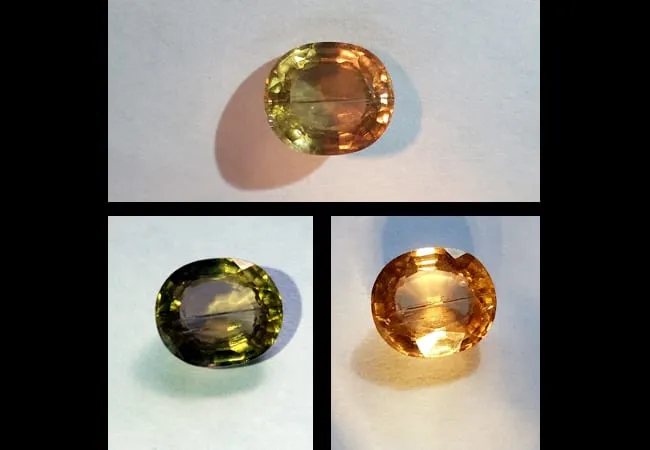
Diaspore
A rare mineral that looks greenish in daylight and pinkish under incandescent light; gem-quality material comes almost only from Muğla.
Gold
A heavy, bright yellow metal that occurs pure in nature, never tarnishes and can be hammered into sheets or drawn into wire.