Mineral
Anorthite
CaAl₂Si₂O₈Anortit
The calcium end of the plagioclase series: rare in pure form on Earth, but the main mineral of the Moon’s pale highlands.
- Popularly: Common stone

In short
Anorthite is a feldspar mineral made of calcium, aluminium, silicon and oxygen (CaAl₂Si₂O₈). It is the calcium-rich end of the plagioclase series, whose other end is sodium-rich albite. It occurs in dark rocks such as basalt and gabbro, but pure anorthite with no sodium is rare on Earth. Because it is the main mineral of the anorthosite that makes up the Moon’s pale highlands, it matters a great deal to space science.
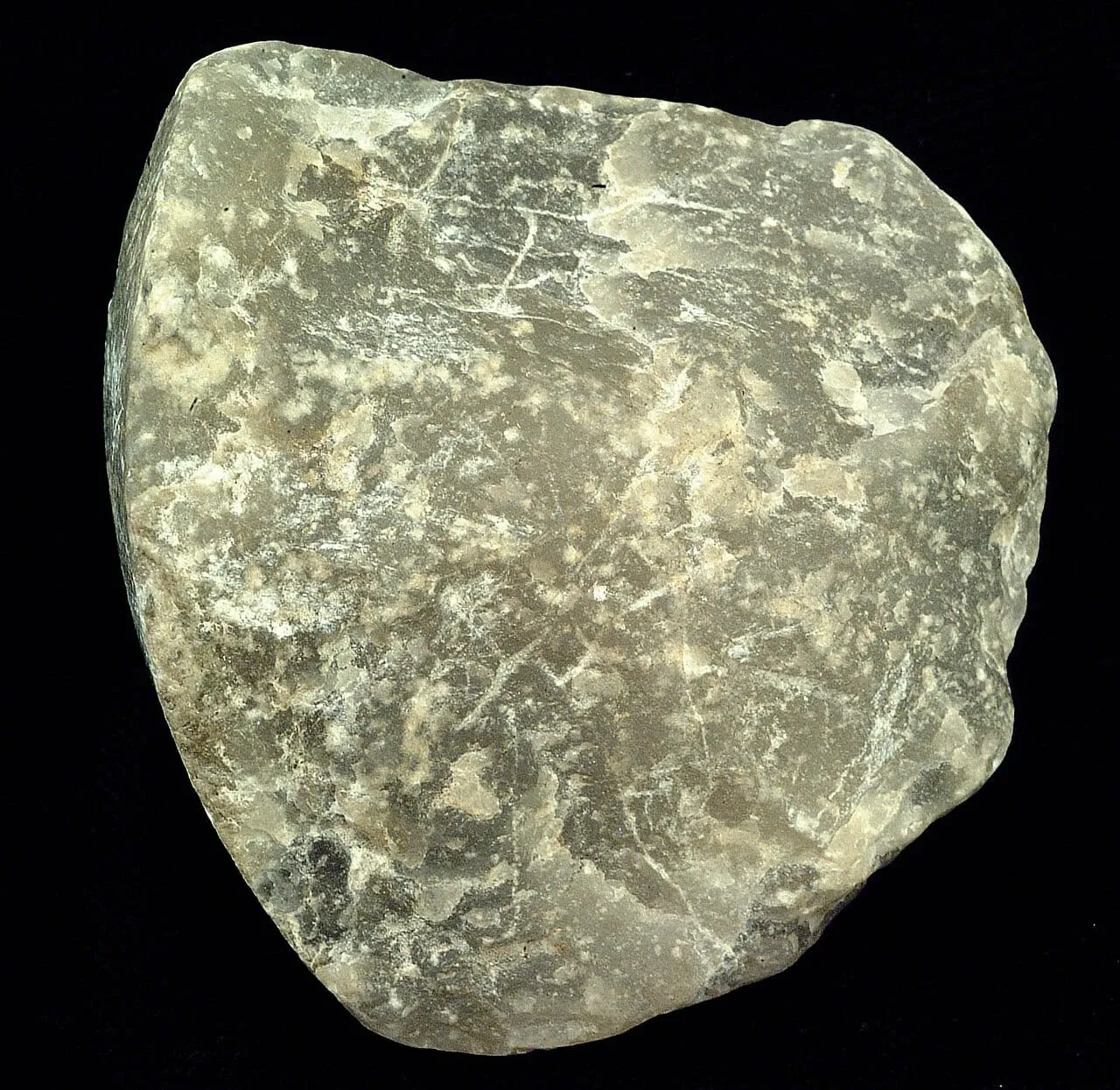
Photos

How does it form?
Anorthite is a scarce constituent of basic (silica-poor) igneous rocks such as basalt and gabbro. It also occurs in some high-grade metamorphic rocks (granulite facies), in metamorphosed carbonate rocks and in corundum deposits. As magma cools, calcium-rich plagioclase crystallises first, which is why anorthite-rich plagioclase turns up in dark rocks. Anorthite is known from meteorites too. Its composition forms a continuous series with sodium-rich albite; for the details of that series, see the plagioclase page.
What is it used for?
Anorthite has no important known industrial use; its value is scientific:
- Understanding the Moon: Anorthosite, the dominant rock of the Moon’s highlands, is made of anorthite-rich plagioclase. These rocks shed light on the early history of the lunar crust; the “Genesis Rock”, sample 15415, is about 4.1 billion years old.
- A rock-forming mineral: It is a main mineral of rocks such as gabbro and basalt; geologists use the anorthite content of plagioclase to classify rocks and to understand the conditions in which they formed.
- Collecting: Sharp crystals from Monte Somma and Miyake Island appeal to collectors.
Name and type locality
Anorthite takes its name from a Greek word meaning “oblique”; its crystal is triclinic and has no right angles. Anorthite is listed among the IMA’s long-recognised (“grandfathered”) minerals under the date 1823. The type localities are Monte Somma (Vesuvius) and the Fassa Valley in Italy.
In Türkiye
Pure anorthite is rare in Türkiye too, but anorthite-rich plagioclase occurs in gabbros. According to a study published in Lithos in 2025, in the Eocene Yıldız Dağı gabbroic intrusion in northern Türkiye the anorthite content of the plagioclase reaches up to 90%. The study describes the intrusion as a small gabbroic body, exposed over about 2 km², emplaced along the İzmir–Ankara–Erzincan suture zone.
What determines its value?
Anorthite is mainly a rock-forming mineral and has no price of its own. Collectors look for sharp, clear, undamaged crystals and specimens from well-known places such as Monte Somma or Miyake Island; cut stones are very rare. Its value in science comes from what it tells us: the anorthite in Moon and meteorite samples records the history of the Solar System and of the lunar crust.
This information is educational, not buying, selling or investment advice. Value varies enormously with quality and treatment.
How to recognise it
- 1
It is usually white, greyish or reddish, with a glassy lustre. Crystals are short prisms, though it is more often seen as coarse grains or in masses.
- 2
It scratches glass (hardness 6–6.5) and, like all plagioclase, shows fine parallel lines (multiple twinning) on its cleavage surfaces.
- 3
It occurs with olivine, pyroxene and corundum, in dark rocks such as gabbro and in cavities of some volcanic rocks.
- 4
It cannot be told from the other members of the plagioclase series by eye; its composition is determined by microscope, X-ray or chemical analysis.
Fakes and imitations
What shops usually don’t tell you:
- Anorthite is most often confused with other feldspars such as labradorite, albite and orthoclase. The differences are very hard to see by eye; a laboratory is needed for a sure identification.
Myths and misconceptions
MythPlagioclase is very common, so pure anorthite is common too.
FactMost plagioclase is a mix of sodium and calcium. Pure sodium-free anorthite is rare on Earth (Wikipedia); it also weathers easily, which makes it scarcer in surface rocks than you might expect.
MythAnorthosite means anorthite.
FactAnorthosite is a rock made of more than 90% plagioclase. The plagioclase in Earth’s anorthosites is mostly labradorite and andesine (An40–60 in Proterozoic anorthosites); anorthite-rich plagioclase is a feature of lunar anorthosite and of some Archean anorthosites (An80–90).
What is it believed to be good for?
This section reports beliefs; it is not health information. There is no scientific evidence for these claims and no stone replaces medical treatment.
The meanings people give this stone, and who holds them:
- Crystal-therapy websites claim that anorthite strengthens bones and the skeleton and helps with calcium balance in the blood, pain and high blood pressure.
- The same sites say anorthite raises mental clarity, focus and confidence and is linked to the “third-eye chakra”.
What science says
No study supports these claims. Anorthite is a silicate that holds its calcium tightly in its crystal structure; touching or carrying a stone does not pass calcium into the body. Someone with a bone, pain or blood-pressure problem should not leave treatment to a stone but see a doctor.
Did you know?
Its name comes from the Greek for “oblique”: its crystal axes do not meet at right angles (it is triclinic).
Anorthite melts at about 1,550 °C (Wikipedia). Two other minerals share its composition, so it belongs to a threefold family with dmisteinbergite and svyatoslavite.
Lunar sample 15415, collected near Spur crater on Apollo 15 in 1971, is called the “Genesis Rock”. It was first thought to be a piece of the Moon’s primordial crust; later it turned out to have formed after the crust had solidified.
Anorthite also occurs in samples of comet Wild 2 brought back by the Stardust spacecraft, and in the calcium–aluminium-rich inclusions of chondritic meteorites (Wikipedia).
Where is it found?
Loading map…
- Monte Somma, Vesuvius, Campania, Italy · Type localityThe type locality; sharp, lustrous crystals in cavities of volcanic rock
- Val di Fassa (Mount Monzoni), Trentino-Alto Adige, Italy · Type localityWikipedia lists Val di Fassa among the type localities; the Handbook of Mineralogy names Mount Monzoni as a classic occurrence
- Miyakejima, Tokyo, Japan · Known localityWell-formed anorthite crystals in volcanic rocks
- Karpinsk (formerly Bogoslovsk) area, Urals, Russia · Known localityA classic Urals locality named by the Handbook of Mineralogy
- Lohja area, Uusimaa, Finland · Known localityThe Finnish locality named by the Handbook of Mineralogy (“Lojo”)
- Great Sitkin Island, Aleutian Islands, Alaska, USA · Known localityA volcanic island; the Handbook of Mineralogy cites anorthite from here
- Grass Valley area, Nevada County, California, USA · Known localityThe Californian locality named by the Handbook of Mineralogy
Locations are approximate to protect sites. Red dots mark places in Türkiye. Open in the big map →
Frequently asked questions
What is anorthite?
Anorthite is a feldspar mineral made of calcium, aluminium, silicon and oxygen (CaAl₂Si₂O₈). It is the calcium-rich end of the plagioclase series, whose other end is sodium-rich albite. It occurs in dark rocks such as basalt and gabbro, but pure anorthite with no sodium is rare on Earth. Because it is the main mineral of the anorthosite that makes up the Moon’s pale highlands, it matters a great deal to space science.
What is anorthite used for?
Anorthite has no important known industrial use; its value is scientific: Understanding the Moon: Anorthosite, the dominant rock of the Moon’s highlands, is made of anorthite-rich plagioclase. These rocks shed light on the early history of the lunar crust; the “Genesis Rock”, sample 15415, is about 4.1 billion years old. A rock-forming mineral: It is a main mineral of rocks such as gabbro and basalt; geologists use the anorthite content of plagioclase to classify rocks and to understand the conditions in which they formed.
How hard is anorthite?
It has a hardness of 6–6.5 on the Mohs scale. It can scratch glass; a steel knife scratches it only with difficulty. Its specific gravity is 2.72–2.76 g/cm³.
Where is anorthite found?
Its best-known localities: Monte Somma, Vesuvius, Campania, Italy; Val di Fassa (Mount Monzoni), Trentino-Alto Adige, Italy; Miyakejima, Tokyo, Japan; Karpinsk (formerly Bogoslovsk) area, Urals, Russia; Lohja area, Uusimaa, Finland.
How can you tell if anorthite is real?
It is usually white, greyish or reddish, with a glassy lustre. Crystals are short prisms, though it is more often seen as coarse grains or in masses. It scratches glass (hardness 6–6.5) and, like all plagioclase, shows fine parallel lines (multiple twinning) on its cleavage surfaces. It occurs with olivine, pyroxene and corundum, in dark rocks such as gabbro and in cavities of some volcanic rocks. Anorthite is most often confused with other feldspars such as labradorite, albite and orthoclase. The differences are very hard to see by eye; a laboratory is needed for a sure identification.
Is anorthite valuable?
On the “street to diamond” value ladder it sits on step 3 of nine: Building and industrial stone. Anorthite is mainly a rock-forming mineral and has no price of its own. Collectors look for sharp, clear, undamaged crystals and specimens from well-known places such as Monte Somma or Miyake Island; cut stones are very rare. Its value in science comes from what it tells us: the anorthite in Moon and meteorite samples records the history of the Solar System and of the lunar crust.
What is anorthite good for?
Crystal-therapy websites claim that anorthite strengthens bones and the skeleton and helps with calcium balance in the blood, pain and high blood pressure. The same sites say anorthite raises mental clarity, focus and confidence and is linked to the “third-eye chakra”. No study supports these claims. Anorthite is a silicate that holds its calcium tightly in its crystal structure; touching or carrying a stone does not pass calcium into the body. Someone with a bone, pain or blood-pressure problem should not leave treatment to a stone but see a doctor. This section reports beliefs; it is not health information. There is no scientific evidence for these claims and no stone replaces medical treatment.
Sources
- Anorthite · Wikipedia
- Handbook of Mineralogy: Anorthite · Mineralogical Society of America
- Anorthite · Webmineral
- Anorthosite · Wikipedia
- Genesis Rock · Wikipedia
- Petrogenesis of a post-collisional, shallow crustal mafic complex: A case study of the Yıldız Dağı gabbroic intrusion (Northern Türkiye), Lithos · Elsevier, 2025
- Mount Vesuvius · Wikipedia
- Fassa Valley · Wikipedia
- Miyake, Tokyo · Wikipedia
- Karpinsk · Wikipedia
- Lohja · Wikipedia
- Great Sitkin Island · Wikipedia
- Grass Valley, California · Wikipedia
External links
Draft: awaiting expert reviewReport an error ↗
On the same step
Albite
The white, sodium end of the feldspars: with its deposits at Çine–Milas, a glass and ceramics raw material that makes Türkiye one of the world’s main feldspar producers.
Alunite
The “alum stone” from which alum was made for centuries. Foça, Şaphane in Kütahya and Şebinkarahisar are Türkiye's old alum homelands.
Anhydrite
Gypsum without its water: a calcium sulfate mineral, whose blue-grey Peruvian form is sold as “angelite”.