Rock
Anorthosite
Anortozit
The rock of the Moon's bright highlands: a plutonic rock made almost entirely of plagioclase, rare on Earth but forming giant bodies.
- Popularly: Natural stone (building and decor)
- Building stone
- Ornamental
_3.jpg)
In short
Anorthosite is a light grey or white, coarse-grained rock formed when magma cools slowly deep in the crust. At least 90% of it by volume is plagioclase feldspar; dark minerals are very scarce. On Earth it is much rarer than basalt or granite, yet where it occurs it forms bodies tens of thousands of square kilometres in extent. The Moon's pale highlands are made of anorthosite too. In some kinds, labradorite crystals flash blue in the light.
Photos
_60.jpg)
How does it form?
Anorthosite forms deep in the crust when a magma rich in plagioclase feldspar cools and crystallises very slowly. These crystals separate from the magma and accumulate or clump together to build anorthosite bodies. Most anorthosites on Earth are Precambrian in age and occur as large masses such as laccoliths, lopoliths or sills (sheet-like or lens-shaped intrusions at depth).
There are three main kinds. Archean anorthosites (about 3.2 to 2.8 billion years old) contain large plagioclase crystals. Proterozoic “massif” anorthosites are the commonest terrestrial type and were emplaced about 1.8 to 1 billion years ago. Anorthosites in layered intrusions alternate with layers of norite and gabbro in complexes such as the Bushveld and Stillwater. Lunar anorthosite is a separate kind.
What is it used for?
- Cladding stone: Labradorescent anorthosites are polished and used as cladding and ornamental stone, usually sold as “granite”.
- Crushed stone: Crushed, it is used as aggregate in construction and road building.
- Ore: The ilmenite found in it is a source of iron and titanium. The layered Bushveld and Stillwater complexes also host platinum and palladium deposits alongside their anorthosite layers.
- Science: The anorthosite of the lunar highlands is studied to understand the Moon’s early history and how its first crust formed.
Where is it found?
The biggest anorthosite bodies on Earth lie in eastern Canada, in the Adirondack Mountains of the USA (the Marcy massif) and in the Bushveld Complex of South Africa. Labradorite from around Nain in Canada has been known since the 18th century. In the roughly 2.97-billion-year-old Fiskenæsset anorthosite complex in Greenland, a mine producing ruby was opened. Anorthosite also makes up the Moon’s pale highlands.
What determines its value?
In most places anorthosite is used as crushed stone and construction raw material; sold that way, by the tonne, it is worth little. As block and cladding stone, its value depends on whether large, crack-free blocks can be quarried, on even colour and pattern, on the strength of the play of blue-green colour in labradorescent kinds and the quality of the polish, and on the distance of the quarry. Ore minerals found with anorthosite, such as ilmenite, add value of their own.
This information is educational, not buying, selling or investment advice. Value varies enormously with quality and treatment.
How to recognise it
- 1
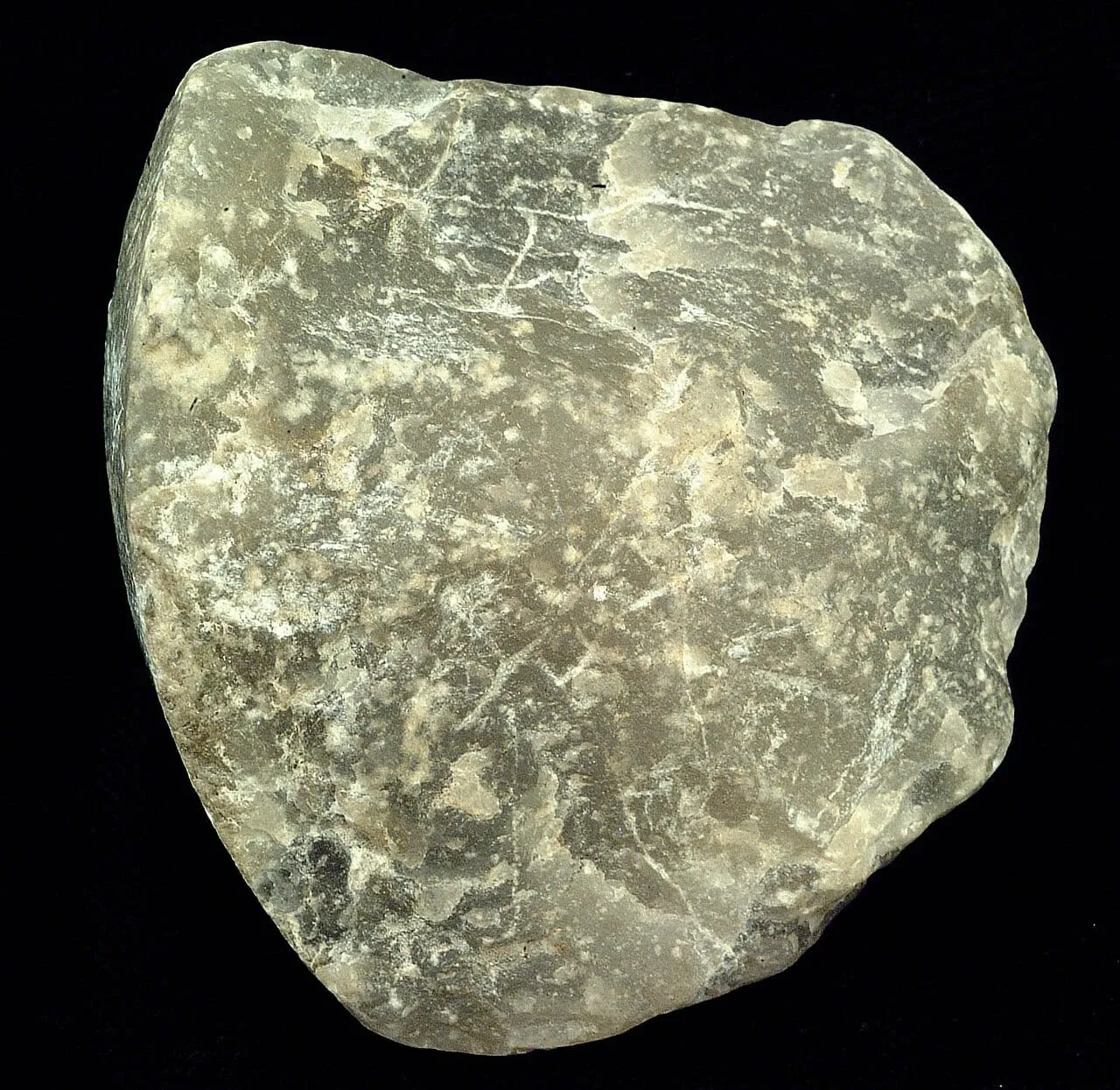
It is made almost entirely of grey-white, coarse, interlocking plagioclase crystals, with a few scattered dark grains.
- 2
Anorthosites on Earth are coarse-grained; in some samples the crystals reach several centimetres.
- 3
In some kinds, turning the rock in the light makes the plagioclase crystals flash with a blue or green sheen (labradorescence).
- 4
It scratches glass, cannot be scratched with a steel knife, and does not fizz in vinegar or dilute acid.
Fakes and imitations
What shops usually don’t tell you:
- In the stone trade most hard silicate rocks that take a polish are sold as “granite”; blue-flashing anorthosites are sold under names such as “Labrador Antique granite” or “Blue Eyes granite”, but they are not granite.
- Some dark slabs sold as “black granite” are also anorthosite; gabbro and diabase are other possible rocks behind such slabs.
Myths and misconceptions
MythAnorthosite and anorthite are the same thing.
FactAnorthosite is a rock, at least 90% of it plagioclase; anorthite is a mineral, the calcium-richest end of the plagioclase series. The plagioclase of Earth's anorthosites is mostly labradorite or bytownite; anorthite is a feature of lunar anorthosite.
MythThe blue-flashing “Labrador granite” or “Blue Eyes granite” is real granite.
FactStones sold under these names are anorthosite: made almost entirely of plagioclase and containing no quartz. Granite is dominated by quartz and alkali feldspar.
Did you know?
The dominant rock of the Moon's pale highlands is anorthosite. According to one model, as the molten Moon cooled, light plagioclase crystals floated to the top and formed an anorthosite crust about 50 km thick.
The lunar anorthosite of sample 15415, picked up near Spur crater on the 1971 Apollo 15 mission, is nicknamed the “Genesis Rock”. It was thought to be a piece of the Moon's primordial crust but turned out to have formed after the crust had solidified; it is more than 4 billion years old.
No volcanic equivalent of anorthosite, that is, one that erupted as lava, is known on Earth, and anorthosite dikes are very rare.
Where is it found?
Loading map…
- Marcy anorthosite massif, Adirondack Mountains, New York, USA · Major depositA giant anorthosite body of andesine-labradorite type, thousands of square kilometres in area and some 1.15 billion years old, that makes up much of the Adirondack Highlands.
- Nain, Labrador, Canada · Major depositAnorthosites of the Nain Plutonic Suite, about 1.3 billion years old; labradorite showing labradorescence has been known from this area since the 18th century. The “Blue Eyes granite” of the Ten Mile Bay quarry is an anorthosite.
- Fiskenæsset (Qeqertarsuatsiaat), southwest Greenland · Known localityThe Fiskenæsset Anorthosite Complex, about 2.97 billion years old; the ruby and pink sapphire deposit at Aappaluttoq lies in rocks associated with this anorthosite.
- Bushveld Complex, northern South Africa · Major depositA layered intrusion about 2.05 billion years old and larger than 66,000 km²; its layers of anorthosite occur together with the platinum and palladium reefs (Merensky and UG2).
- Stillwater Complex, Montana, USA · Known localityA layered intrusion about 2.7 billion years old, known for its “banded series” of alternating norite, gabbro and anorthosite and for the palladium-platinum J-M Reef.
Locations are approximate to protect sites. Red dots mark places in Türkiye. Open in the big map →
Frequently asked questions
What is anorthosite?
Anorthosite is a light grey or white, coarse-grained rock formed when magma cools slowly deep in the crust. At least 90% of it by volume is plagioclase feldspar; dark minerals are very scarce. On Earth it is much rarer than basalt or granite, yet where it occurs it forms bodies tens of thousands of square kilometres in extent. The Moon's pale highlands are made of anorthosite too. In some kinds, labradorite crystals flash blue in the light.
What is anorthosite used for?
Cladding stone: Labradorescent anorthosites are polished and used as cladding and ornamental stone, usually sold as “granite”. Crushed stone: Crushed, it is used as aggregate in construction and road building. Ore: The ilmenite found in it is a source of iron and titanium. The layered Bushveld and Stillwater complexes also host platinum and palladium deposits alongside their anorthosite layers. Science: The anorthosite of the lunar highlands is studied to understand the Moon's early history and how its first crust formed.
How hard is anorthosite?
It has a hardness of 6–6.5 on the Mohs scale. It can scratch glass; a steel knife scratches it only with difficulty. Its specific gravity is 2.6–2.8 g/cm³.
Where is anorthosite found?
Its best-known localities: Marcy anorthosite massif, Adirondack Mountains, New York, USA; Nain, Labrador, Canada; Bushveld Complex, northern South Africa; Fiskenæsset (Qeqertarsuatsiaat), southwest Greenland; Stillwater Complex, Montana, USA.
How can you tell if anorthosite is real?
It is made almost entirely of grey-white, coarse, interlocking plagioclase crystals, with a few scattered dark grains. Anorthosites on Earth are coarse-grained; in some samples the crystals reach several centimetres. In some kinds, turning the rock in the light makes the plagioclase crystals flash with a blue or green sheen (labradorescence). In the stone trade most hard silicate rocks that take a polish are sold as “granite”; blue-flashing anorthosites are sold under names such as “Labrador Antique granite” or “Blue Eyes granite”, but they are not granite.
Is anorthosite valuable?
On the “street to diamond” value ladder it sits on step 3 of nine: Building and industrial stone. In most places anorthosite is used as crushed stone and construction raw material; sold that way, by the tonne, it is worth little. As block and cladding stone, its value depends on whether large, crack-free blocks can be quarried, on even colour and pattern, on the strength of the play of blue-green colour in labradorescent kinds and the quality of the polish, and on the distance of the quarry. Ore minerals found with anorthosite, such as ilmenite, add value of their own.
Sources
- Anorthosite · Wikipedia
- Anorthosite · Encyclopaedia Britannica
- Lunar highlands · Wikipedia
- Genesis Rock · Wikipedia
- Adirondack Mountains · Wikipedia
- Geologic setting and characteristics of Adirondack anorthosite and related mangerite-charnockite-granite (AMCG) suite · New York State Geological Association field trip guide, 2008
- Nain, Newfoundland and Labrador · Wikipedia
- Qeqertarsuatsiaat (Fiskenæsset) · Wikipedia
- The application of trace elements and Sr-Pb isotopes to dating and tracing ruby formation: The Aappaluttoq deposit, SW Greenland · Chemical Geology, 2019
- Bushveld Igneous Complex · Wikipedia
- Stillwater igneous complex · Wikipedia
External links
Draft: awaiting expert reviewReport an error ↗
On the same step
Albite
The white, sodium end of the feldspars: with its deposits at Çine–Milas, a glass and ceramics raw material that makes Türkiye one of the world’s main feldspar producers.
Alunite
The “alum stone” from which alum was made for centuries. Foça, Şaphane in Kütahya and Şebinkarahisar are Türkiye's old alum homelands.
Anhydrite
Gypsum without its water: a calcium sulfate mineral, whose blue-grey Peruvian form is sold as “angelite”.