Mineral
Zeolite (clinoptilolite)
(Na,K,Ca)₂₋₃Al₃(Al,Si)₂Si₁₃O₃₆·12H₂OZeolit (klinoptilolit)
A volcanic stone riddled with atom-sized channels: it cleans water and traps odours and ammonia. Türkiye's best-known deposits are Gördes and Bigadiç.
Also known as: Natural zeolite · Zeolitic tuff (tuff rich in zeolite) · Heulandite-group zeolite (the group clinoptilolite belongs to)
- Popularly: Ore and raw material
- Industrial
- Important in Türkiye
.jpg)
In short
Zeolites are a group of minerals whose framework of silicon, aluminium and oxygen holds tiny channels and cages, filled with water and exchangeable ions such as sodium, potassium and calcium; MTA says natural zeolite includes more than 40 minerals. The commonest is clinoptilolite, found in tuff beds formed when acid volcanic ash altered in lake or sea water. Its ion-exchange and absorbing power make it useful in animal feed, odour control, water purification, agriculture and building materials.
Photos

How does it form?
Most natural zeolites come from the reaction of volcanic ash and glassy tuff with water. Acid volcanic glass dissolves on contact with lake or sea water, and water-bearing aluminosilicate frameworks, that is zeolite crystals, precipitate in its place; this process is called devitrification. Clay can form in the same process: according to İMİB’s bentonite report, zeolite is one of the by-products when volcanic glass turns to bentonite. Clinoptilolite also forms in the cavities of volcanic rocks such as rhyolite and andesite.
Britannica says zeolites occur both as cavity fillings in volcanic rocks and as alteration products of volcanic glass in sedimentary sequences. At Gördes the zeolitic tuffs formed when rhyolitic and rhyodacitic products of the Kobaklar volcanism flowed into Lake Gördes, then a sedimentary basin, and piled up there (Ulusoy and Albayrak, 2009).
What is it used for?
- Animal feed and odour control: According to the USGS, 42 percent of US natural zeolite sales go into animal feed and 15 percent into odour control. The European Commission authorised sedimentary clinoptilolite as a feed additive (binder) in 2013 (Wikipedia).
- Water and wastewater treatment: Its ion-exchange power is used to hold ammonium and heavy-metal ions such as Pb, Cd, Zn, Cu and Ni in water. MTA researchers showed in the laboratory that acid activation of Gördes clinoptilolite increases heavy-metal uptake (for cadmium, for example, from 39 to 61 percent).
- Agriculture and gardening: A soil conditioner and fertiliser carrier that holds moisture and nutrients. Some samples MTA studied have a porosity above 40 percent.
- Building materials: Zeolitic tuff is used as lightweight building stone and lightweight aggregate, and ground zeolite as a pozzolanic additive in cement; MTA researchers have also made aerated concrete.
- Cat litter, paper and ceramics: In MTA’s tests some samples were white enough to be used as paper filler and others could be used in coloured-firing ceramics; as cat litter, their absorbency alone was low.
- Radioactive waste and the chemical industry: It has been used to treat radioactively contaminated wastewater at Chernobyl. According to Britannica, zeolites also help separate hydrocarbons in petroleum refining, dry gases and liquids, and control pollution by selective adsorption.
Natural and synthetic zeolite
Natural zeolite is common on Earth; according to the USGS, world output in 2025 was about 1.3 million tons as far as it is reported. But many countries report natural zeolite production late or not at all, and because most of the tonnage is spent as tuff on building work, figures cannot be compared between countries. Synthetic zeolites made in the laboratory also exist; the USGS states that almost all of the United States’ zeolite trade is in synthetic zeolite.
In Türkiye
An MTA bulletin lists Türkiye’s zeolite deposits as Polatlı, Nallıhan and Beypazarı in Ankara, Şaphane in Kütahya, Gördes in Manisa, Urla in İzmir, Bigadiç in Balıkesir and the Cappadocia region. MTA writes that Türkiye’s zeolites consist mainly of clinoptilolite and heulandite, plus chabazite, erionite and analcime.
- Gördes (Manisa): The volcano-sedimentary formations known as the “Gördes zeolites” formed when rhyolitic and rhyodacitic products of the Kobaklar volcanism flowed into Lake Gördes and settled; metamorphic rocks of the Menderes Massif and Miocene sedimentary units crop out around it. The area holds mostly clinoptilolite, with less heulandite and analcime (Ulusoy and Albayrak, 2009, citing Vural and Albayrak, 2005). Gördes clinoptilolite has been used in several MTA studies; a 2024 MTA study tried heavy-metal uptake on wastewater samples from the Nif Çayı (Gediz Basin) and the Güzelhisar Deresi (Menderes Basin).
- Bigadiç (Balıkesir): The lake-laid tuffite beds of the Bigadiç Formation, probably Late Miocene–Early Pliocene in age (the Akçakertil and Beğendikler tuffite members), contain clinoptilolite; Ataman (1977) identified zeolite in the tuffs here. Bigadiç is also the name of one of Türkiye’s main borate deposits (see colemanite).
- Foça (İzmir): In the MTA study heulandite dominates here, and mordenite has also been found; according to Esenli (2002) the sampled area holds about 120 million tons of visible and probable reserves.
- Cappadocia (Nevşehir): One of the zeolite regions; the fibrous zeolite erionite found in the same region has been linked to mesothelioma in villages such as Tuzköy. It must not be confused with ordinary clinoptilolite.
Türkiye’s production figure varies widely between sources. The USGS’s 2026 table shows about 57,000 tons for Türkiye in 2024; in the same table Slovakia, Georgia, China, South Korea, Russia and Indonesia have higher tonnages, and the USGS also notes that the figures are not comparable between countries. Britannica, on the other hand, names China, South Korea, Japan, Türkiye and Jordan among the leading zeolite producers of the early 21st century. The sources used on this page give no single national reserve figure; MTA studies give figures deposit by deposit (for example about 120 million tons for Foça).
What determines its value?
Natural zeolite is an industrial raw material sold by the ton, and its value depends on the share of zeolite in the product: the USGS says prices vary with the percentage of zeolite, the chemical and physical properties of the zeolite mineral, particle size, surface modification or activation, and end use. Clinoptilolite, heulandite and mordenite differ in ion-exchange strength; colour, whiteness and freedom from fibrous types such as erionite or from heavy-metal contamination also count. The size of the deposit, how well it suits open-pit mining and the distance to the buyer matter too. Low-grade zeolitic tuff used as building stone is worth far less, while high-value jobs such as feed, odour control and water purification call for a high zeolite content.
This information is educational, not buying, selling or investment advice. Value varies enormously with quality and treatment.
How to recognise it
- 1
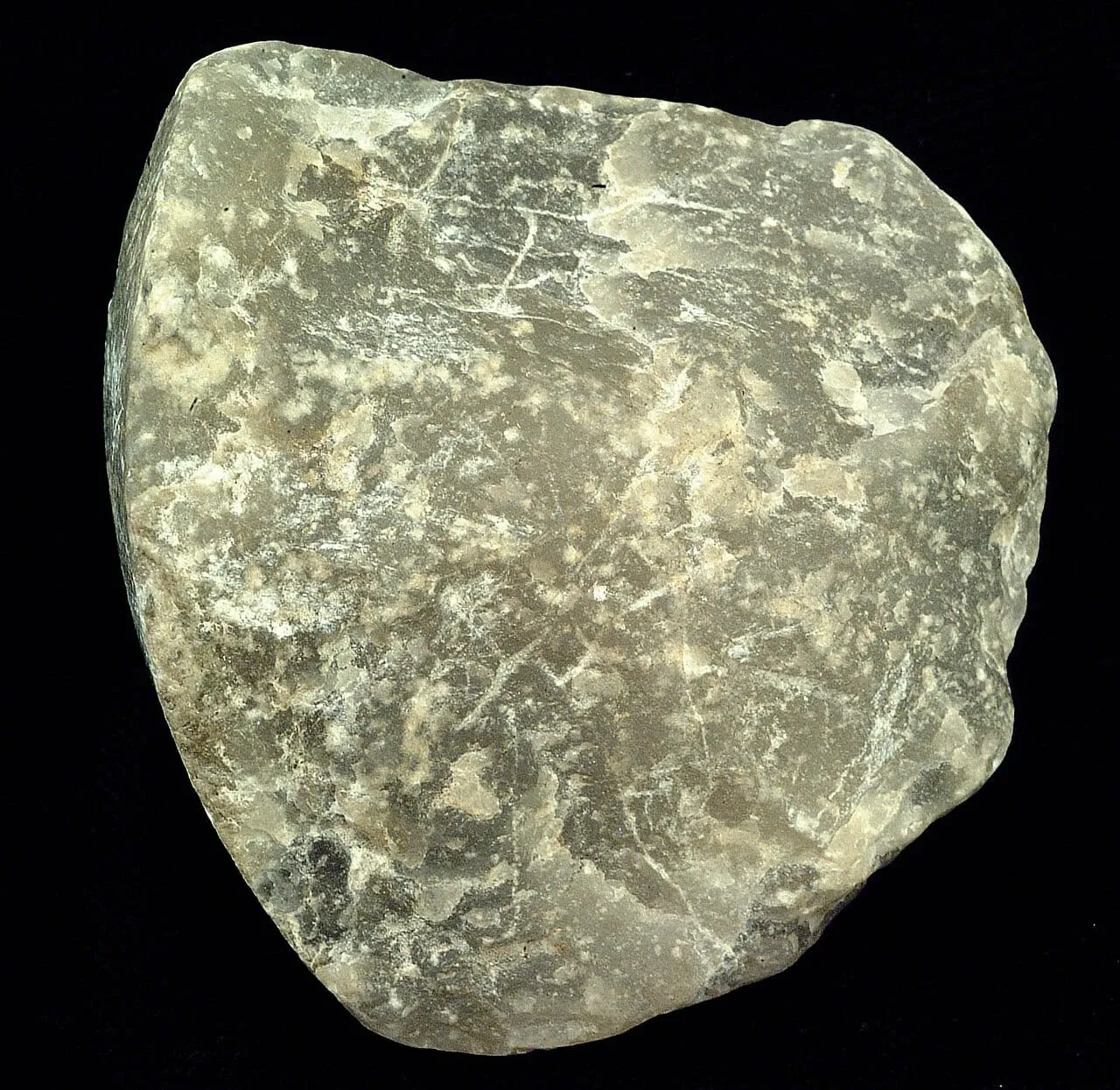
Natural zeolite mostly occurs not as a stone but as zeolite-rich tuff: a light, fine-grained, porous rock that is white, cream, light grey or yellowish. Clinoptilolite crystals are microscopic and cannot be seen with the naked eye.
- 2
Pure clinoptilolite has a Mohs hardness of 3.5–4, a density of 2.1–2.2 g/cm³ and a glassy lustre. In MTA's Foça, Bigadiç and Gördes samples the tuff's density ranges from 1.98 to 2.40 g/cm³.
- 3
Heated, it loses its water, which is why the name means “boiling stone”. In 1756 the Swedish mineralogist Cronstedt saw a mineral give off steam when heated and gave it this name.
- 4
In water it does not swell and turn to mud as bentonite does; the zeolite samples MTA studied did not disperse in water. Clinoptilolite and its relative heulandite look very much alike; MTA identified zeolite types by thin section and X-ray diffraction (XRD) analysis (heulandite dominates its Foça samples, clinoptilolite those from Bigadiç and Gördes).
Fakes and imitations
What shops usually don’t tell you:
- Other absorbent powders and clays such as bentonite and diatomite can look like zeolite. Bentonite swells markedly in water, zeolitic tuff does not; telling them apart for sure needs a laboratory.
- Synthetic zeolites made in the laboratory also exist and should not be confused with the natural rock; the USGS states that almost all of the United States' zeolite trade is in synthetic zeolite.
Safety
Clinoptilolite is not fibrous and is harmless to hold, but its fine dust should not be breathed; wear a dust mask for dusty work. Not every zeolite is harmless: erionite, found in Cappadocia, is a fibrous, asbestos-like zeolite; according to MTA it is a stronger carcinogen than asbestos and its use is banned. When collecting or using zeolitic tuff, make sure it holds no fibrous zeolite; only a laboratory can tell.
Myths and misconceptions
MythZeolite is a natural mineral, so every zeolite is harmless.
FactMost zeolites are harmless, but fibrous kinds such as erionite cause mesothelioma, a cancer of the lung lining, just as asbestos does. The International Agency for Research on Cancer (IARC) ranks erionite as a Group 1 carcinogen, and in villages in Cappadocia where the mineral occurs, deaths from mesothelioma have been found to be very high.
MythZeolite is a single mineral, and “zeolite” means clinoptilolite.
FactZeolite is a group of more than 40 natural minerals. According to MTA, the zeolites of Türkiye consist mainly of clinoptilolite and heulandite, plus chabazite, erionite and analcime; in the Foça area of İzmir, for example, the dominant mineral is heulandite, not clinoptilolite.
What is it believed to be good for?
This section reports beliefs; it is not health information. There is no scientific evidence for these claims and no stone replaces medical treatment.
The meanings people give this stone, and who holds them:
- Companies that sell supplements and “natural living” products claim that drinking clinoptilolite (zeolite) powder or drops binds heavy metals and “toxins” in the body and carries them out; the Turkish Wikipedia also calls zeolite a “toxin binder” in health uses.
- Makers of zeolite supplements have also claimed that their products treat cancer, diarrhoea, autism, the herpes virus and hangovers, and balance the body's pH.
What science says
Clinoptilolite exchanges ions, which is why it really works in wastewater treatment and animal feed; that does not mean zeolite swallowed by a person pulls heavy metals or “toxins” out of the body. According to Memorial Sloan Kettering there are no published human data showing that zeolites treat cancer or any other illness, and the US Food and Drug Administration (FDA) has sent warning letters to several distributors over such claims. Animal studies have reported that clinoptilolite lowers lead levels; a review (Kraljević Pavelić et al., 2018) says these materials can be regarded as safe, but adds that human studies are needed for each product before firm benefits can be claimed. Memorial Sloan Kettering reports one zeolite product with high levels of heavy metals such as arsenic, lead, mercury and cadmium, and zeolite can also bind other substances and neutralise stomach acid, reducing the absorption of medicines. The fibrous zeolite erionite causes cancer when breathed in.
Did you know?
The word zeolite comes from the Greek words for “to boil” and “stone”. In 1756 Cronstedt noticed a mineral giving off steam when heated and gave it this name.
Clinoptilolite was used as an ion exchanger in plants cleaning radioactively contaminated wastewater at Chernobyl; it was also added to cattle feed to bind radioactive cations such as caesium-137 (Wikipedia).
The total void volume in clinoptilolite's crystal structure is about 34 percent, and its silicon-to-aluminium ratio lies between 2.7 and 5.3 (Breck, 1974; Mumpton, 1978; from MTA's 2024 bulletin).
MTA researchers made aerated concrete using zeolite (clinoptilolite) in place of quartzite (Albayrak et al., 2001).
Where is it found?
Loading map…
- Nižný Hrabovec, Vranov nad Topľou area, Slovakia · Major depositA clinoptilolite-rich tuffite in the Neogene acid volcanic tuff sequence of eastern Slovakia; Šamajová (1979) describes the quarry here as a clinoptilolite tuffite. According to the USGS, Slovakia reported the most natural zeolite in 2024, about 273,000 tons. The point is the approximate position of the area.
- Hector area, San Bernardino County, California, USA · Known localityThe Handbook of Mineralogy lists the area 10 km west of Hector among the clinoptilolite localities of California. The point is the general position of Hector.
- Agoura, Los Angeles County, California, USA · Known localityThe Handbook of Mineralogy's X-ray data and one chemical analysis for clinoptilolite come from Agoura material (Wise et al., 1969). The point is the general position of Agoura Hills.
- Richardson Ranch area, Jefferson County, Oregon, USA · Known localityThe Handbook of Mineralogy cites Richardson Ranch near Bend for large clinoptilolite crystals; collector photographs place it near Madras. The point is the position of the town of Madras.
- Kapfenberg, Styria, Austria · Known localityOne of the European localities the Handbook of Mineralogy gives for clinoptilolite. The point is the position of the town of Kapfenberg.
- Alpe di Siusi (Seiser Alm), South Tyrol, Italy · Known localityThe Handbook of Mineralogy lists Alpe di Siusi, with Val di Fassa, among clinoptilolite localities. The point is the general position of the Alpe di Siusi plateau.
- Vogelsberg, Hesse, Germany · Known localityThe Handbook of Mineralogy lists the Vogelsberg in Hesse among clinoptilolite localities. The point is the general position of the volcanic massif.
- Gördes, Manisa, Türkiye · Major depositTuffs, mostly clinoptilolite-bearing, formed when rhyolitic-rhyodacitic products of the Kobaklar volcanism flowed into Lake Gördes and settled (Ulusoy and Albayrak, 2009). The point is the position of the town of Gördes.
- Bigadiç, Balıkesir, Türkiye · Major depositThe Akçakertil and Beğendikler tuffite members of the Bigadiç Formation contain clinoptilolite (Ulusoy and Albayrak, 2009). The point is the position of the town of Bigadiç.
- Foça, İzmir, Türkiye · Known localityIn the MTA study the dominant mineral in the Foça samples is heulandite; according to Esenli (2002) the sampled area holds about 120 million tons of visible and probable reserves. The point is the position of the town of Foça.
- Urla, İzmir, Türkiye · Known localityAn MTA bulletin counts İzmir–Urla among the zeolite deposits of Türkiye. The point is the position of the town of Urla.
- Şaphane, Kütahya, Türkiye · Known localityAn MTA bulletin counts Kütahya–Şaphane among the zeolite deposits of Türkiye. The point is the position of the town of Şaphane.
- Polatlı, Nallıhan and Beypazarı area, Ankara, Türkiye · Known localityAn MTA bulletin lists zeolite deposits in Ankara at Polatlı, Nallıhan and Beypazarı. The point is an approximate position in the middle of the three districts.
- Cappadocia, Nevşehir, Türkiye · Known localityAn MTA bulletin counts Cappadocia among the zeolite regions. The fibrous zeolite erionite also occurs in the same region and has been linked to mesothelioma in villages such as Tuzköy. The point is the approximate centre of the region.
Locations are approximate to protect sites. Red dots mark places in Türkiye. Open in the big map →
Frequently asked questions
What is zeolite?
Zeolites are a group of minerals whose framework of silicon, aluminium and oxygen holds tiny channels and cages, filled with water and exchangeable ions such as sodium, potassium and calcium; MTA says natural zeolite includes more than 40 minerals. The commonest is clinoptilolite, found in tuff beds formed when acid volcanic ash altered in lake or sea water. Its ion-exchange and absorbing power make it useful in animal feed, odour control, water purification, agriculture and building materials.
What is zeolite used for?
Animal feed and odour control: According to the USGS, 42 percent of US natural zeolite sales go into animal feed and 15 percent into odour control. The European Commission authorised sedimentary clinoptilolite as a feed additive (binder) in 2013 (Wikipedia). Water and wastewater treatment: Its ion-exchange power is used to hold ammonium and heavy-metal ions such as Pb, Cd, Zn, Cu and Ni in water. MTA researchers showed in the laboratory that acid activation of Gördes clinoptilolite increases heavy-metal uptake (for cadmium, for example, from 39 to 61 percent).
How hard is zeolite?
It has a hardness of 3.5–4 on the Mohs scale. A fingernail cannot scratch it, but a steel knife can. Its specific gravity is 2.1–2.2 g/cm³.
Where is zeolite found?
Its best-known localities: Nižný Hrabovec, Vranov nad Topľou area, Slovakia; Gördes, Manisa, Türkiye; Bigadiç, Balıkesir, Türkiye; Hector area, San Bernardino County, California, USA; Agoura, Los Angeles County, California, USA.
Where is zeolite found in Türkiye?
Known localities in Türkiye: Gördes, Manisa, Türkiye; Bigadiç, Balıkesir, Türkiye; Foça, İzmir, Türkiye; Urla, İzmir, Türkiye; Şaphane, Kütahya, Türkiye; Polatlı, Nallıhan and Beypazarı area, Ankara, Türkiye; Cappadocia, Nevşehir, Türkiye.
How can you tell if zeolite is real?
Natural zeolite mostly occurs not as a stone but as zeolite-rich tuff: a light, fine-grained, porous rock that is white, cream, light grey or yellowish. Clinoptilolite crystals are microscopic and cannot be seen with the naked eye. Pure clinoptilolite has a Mohs hardness of 3.5–4, a density of 2.1–2.2 g/cm³ and a glassy lustre. In MTA's Foça, Bigadiç and Gördes samples the tuff's density ranges from 1.98 to 2.40 g/cm³. Heated, it loses its water, which is why the name means “boiling stone”. In 1756 the Swedish mineralogist Cronstedt saw a mineral give off steam when heated and gave it this name. Other absorbent powders and clays such as bentonite and diatomite can look like zeolite. Bentonite swells markedly in water, zeolitic tuff does not; telling them apart for sure needs a laboratory.
Is zeolite valuable?
On the “street to diamond” value ladder it sits on step 3 of nine: Building and industrial stone. Natural zeolite is an industrial raw material sold by the ton, and its value depends on the share of zeolite in the product: the USGS says prices vary with the percentage of zeolite, the chemical and physical properties of the zeolite mineral, particle size, surface modification or activation, and end use. Clinoptilolite, heulandite and mordenite differ in ion-exchange strength; colour, whiteness and freedom from fibrous types such as erionite or from heavy-metal contamination also count. The size of the deposit, how well it suits open-pit mining and the distance to the buyer matter too. Low-grade zeolitic tuff used as building stone is worth far less, while high-value jobs such as feed, odour control and water purification call for a high zeolite content.
What is zeolite good for?
Companies that sell supplements and “natural living” products claim that drinking clinoptilolite (zeolite) powder or drops binds heavy metals and “toxins” in the body and carries them out; the Turkish Wikipedia also calls zeolite a “toxin binder” in health uses. Makers of zeolite supplements have also claimed that their products treat cancer, diarrhoea, autism, the herpes virus and hangovers, and balance the body's pH. Clinoptilolite exchanges ions, which is why it really works in wastewater treatment and animal feed; that does not mean zeolite swallowed by a person pulls heavy metals or “toxins” out of the body. According to Memorial Sloan Kettering there are no published human data showing that zeolites treat cancer or any other illness, and the US Food and Drug Administration (FDA) has sent warning letters to several distributors over such claims. Animal studies have reported that clinoptilolite lowers lead levels; a review (Kraljević Pavelić et al., 2018) says these materials can be regarded as safe, but adds that human studies are needed for each product before firm benefits can be claimed. Memorial Sloan Kettering reports one zeolite product with high levels of heavy metals such as arsenic, lead, mercury and cadmium, and zeolite can also bind other substances and neutralise stomach acid, reducing the absorption of medicines. The fibrous zeolite erionite causes cancer when breathed in. This section reports beliefs; it is not health information. There is no scientific evidence for these claims and no stone replaces medical treatment.
Is zeolite dangerous?
Clinoptilolite is not fibrous and is harmless to hold, but its fine dust should not be breathed; wear a dust mask for dusty work. Not every zeolite is harmless: erionite, found in Cappadocia, is a fibrous, asbestos-like zeolite; according to MTA it is a stronger carcinogen than asbestos and its use is banned. When collecting or using zeolitic tuff, make sure it holds no fibrous zeolite; only a laboratory can tell.
Sources
- Foça (İzmir) - Bigadiç (Balıkesir) ve Gördes (Manisa) Yöresi Zeolitlerinin Mineralojik ve Teknolojik Özellikleri (G. Ulusoy, M. Albayrak), MTA Dergisi 139 · MTA Genel Müdürlüğü, 2009
- Gediz Nehri'ni zeolit ile temizlemek hayal mi? (D. Öztürk, G. Günendi), MTA Doğal Kaynaklar ve Ekonomi Bülteni 37 · MTA Genel Müdürlüğü, 2024
- Zeolit · MTA Genel Müdürlüğü, Bilgi Merkezi
- Mineral Commodity Summaries 2026: Zeolites (Natural) · U.S. Geological Survey, 2026
- Handbook of Mineralogy: Clinoptilolite · Mineralogical Society of America
- Clinoptilolite-Ca · Webmineral
- Zeolites in Neogene volcanoclastics of Slovakia (E. Šamajová), Geologica Carpathica 30(3) · Slovak Academy of Sciences, 1979
- Zeolite · Wikipedia
- Clinoptilolite · Wikipedia
- Zeolit · Vikipedi
- Erionite · Wikipedia
- Zeolite · Encyclopaedia Britannica
- Zeolite · Memorial Sloan Kettering Cancer Center, About Herbs, 2023
- Critical Review on Zeolite Clinoptilolite Safety and Medical Applications in vivo (S. Kraljević Pavelić ve ark.), Frontiers in Pharmacology 9 · Frontiers Media, 2018
External links
Draft: awaiting expert reviewReport an error ↗
On the same step
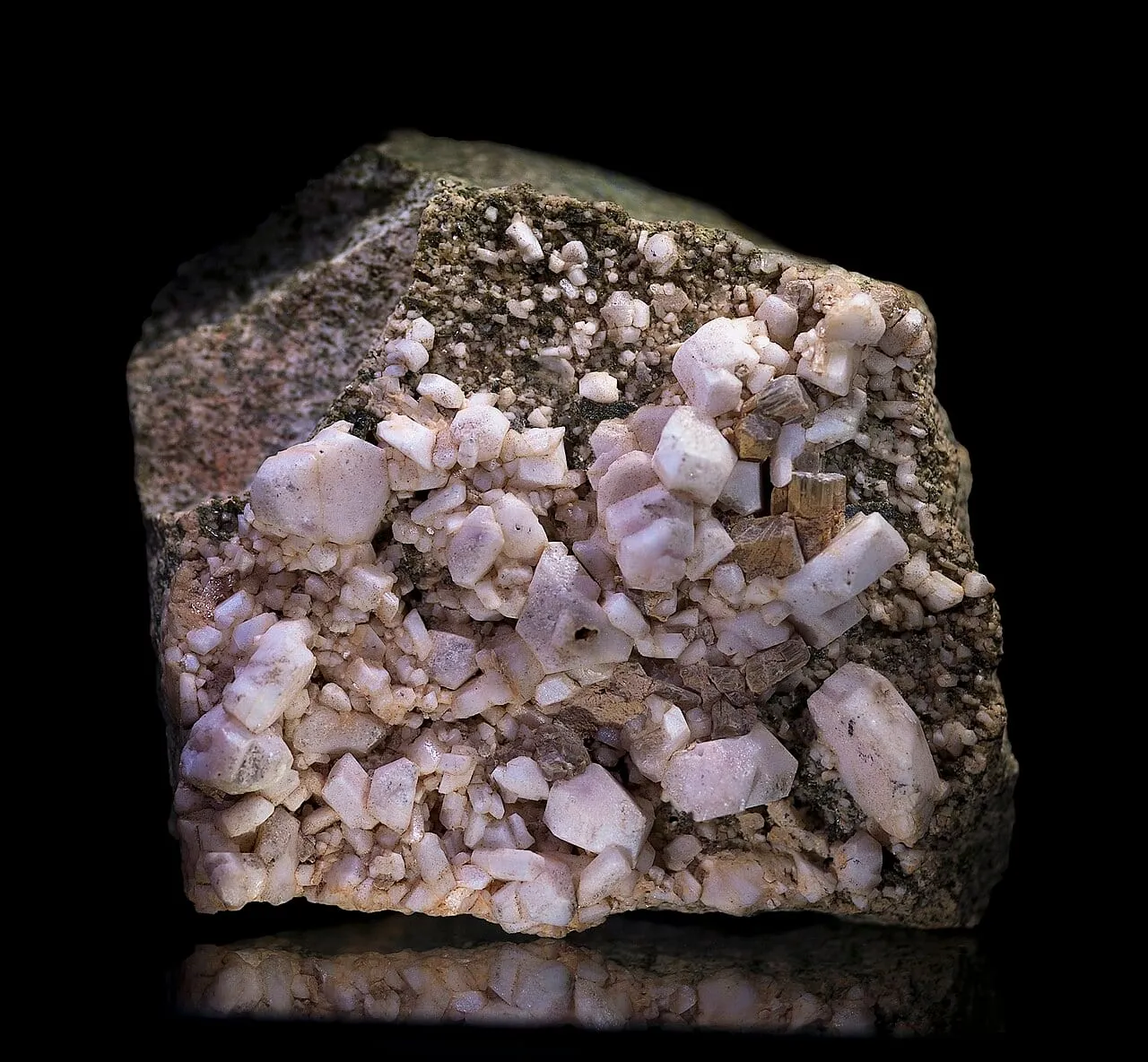
Albite
The white, sodium end of the feldspars: with its deposits at Çine–Milas, a glass and ceramics raw material that makes Türkiye one of the world’s main feldspar producers.
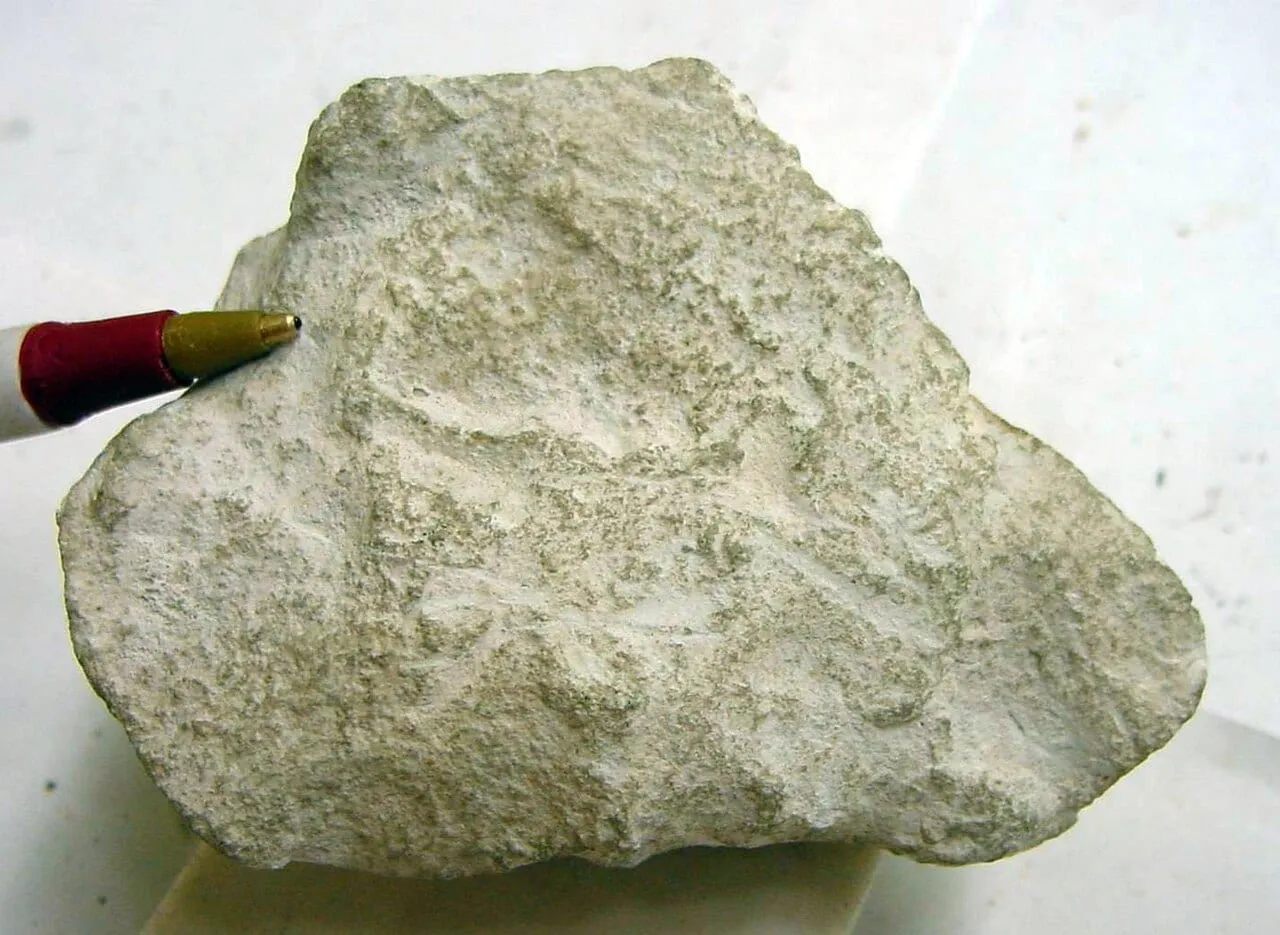
Alunite
The “alum stone” from which alum was made for centuries. Foça, Şaphane in Kütahya and Şebinkarahisar are Türkiye's old alum homelands.

Anhydrite
Gypsum without its water: a calcium sulfate mineral, whose blue-grey Peruvian form is sold as “angelite”.