Mineral
Wulfenite
PbMoO₄Vulfenit
The orange lead mineral that grows as thin square plates: Arizona's state mineral and a secondary ore of molybdenum.
Also known as: Yellow lead ore
- Popularly: Ore and raw material

In short
Wulfenite is a mineral made of lead and molybdenum (lead molybdate, PbMoO₄). It usually forms thin, square, plate-like crystals, in colours from bright yellow to orange and red. It forms in the upper parts of lead deposits that are exposed to air. It is a secondary ore of molybdenum, but it is best known among collectors. It is named after Franz Xaver von Wulfen, who wrote a book on the lead ores of Bleiberg in Austria.
Photos

How does it form?
Wulfenite is a secondary mineral: it forms in the oxidised zone of lead deposits made by hot water solutions (hydrothermal deposits), the part near the surface that is exposed to air and groundwater. The lead comes from the primary minerals of the deposit; the molybdenum is commonly brought in from outside, from the surrounding rocks. That is why it occurs with minerals such as cerussite, anglesite, smithsonite, hemimorphite, vanadinite, pyromorphite and mimetite. In some wulfenites, tungsten takes the place of part of the molybdenum.
The shape and colour of the crystals vary from place to place. Crystals from Arizona’s Red Cloud mine are deep red and very well formed; Los Lamentos in Mexico produced very thick, orange tablets; and crystals from Mount Peca in Slovenia are yellow, often with well-developed pyramids.
What is it used for?
- Molybdenum ore: It is a secondary ore of molybdenum.
- Collecting: Its thin, bright orange square crystals make it a mineral sought by collectors.
- Symbol: It is the official state mineral of Arizona and has appeared on a Slovenian postage stamp.
What determines its value?
Wulfenite is a secondary ore of molybdenum, but its value is set mainly by collectors. They look for vividly coloured, thin square plates with unbroken edges, lustrous and well-formed crystals, and specimens from famous localities such as Red Cloud, Los Lamentos, Mežica or Tsumeb. Because the thin plates break so easily, large undamaged specimens are prized.
This information is educational, not buying, selling or investment advice. Value varies enormously with quality and treatment.
How to recognise it
- 1
Its crystals are mostly thin square plates; sometimes thick tablets or pyramids.
- 2
Bright yellow, orange or red-orange; its lustre is between resinous and adamantine.
- 3
Very heavy (specific gravity 6.5–7.5): about two and a half times as heavy as a piece of quartz the same size.
- 4
Soft (Mohs 2.75–3) and brittle; its thin plates break easily.
- 5
Usually found with cerussite, anglesite, smithsonite, vanadinite, pyromorphite and mimetite.
Fakes and imitations
What shops usually don’t tell you:
- Vanadinite is also a heavy, orange-red lead mineral; vanadinite, however, forms hexagonal prisms, while wulfenite mostly forms thin square plates.
Safety
Wulfenite contains lead: according to an analysis in the Handbook of Mineralogy, about 61% of its weight is lead oxide. Lead is a toxic metal that builds up in the body and can permanently harm the brain and nervous system, especially in children; according to the World Health Organization, there is no level of lead exposure known to be without harmful effects. Wash your hands after handling specimens and keep them out of reach of children. Do not put wulfenite in your mouth, grind or heat it, or put it in drinking water.
Myths and misconceptions
MythBright orange wulfenite is a precious stone used in jewellery.
FactWulfenite has a hardness of only 2.75–3, is very brittle and contains lead. It is a collector's mineral, not a jewellery stone; its thin crystals are kept untouched in display cases.
MythBecause wulfenite is a molybdenum mineral, it carries no lead risk.
FactMore than half of wulfenite's weight is lead (about 61% lead oxide in analyses). Like other lead minerals, it should be handled with care: never put it in your mouth or breathe its dust.
Did you know?
Wulfenite was made the official state mineral of Arizona in 2017. The deep red, very well-formed crystals of Arizona's Red Cloud mine are famous worldwide.
A wulfenite crystal from Mount Peca in Slovenia was pictured on a Slovenian postage stamp in 1997.
Some wulfenite crystals are piezoelectric: squeezing them builds up an electric charge on their surface.
Its crystals can grow up to 11 cm across.
Where is it found?
Loading map…
- Bad Bleiberg, Carinthia, Austria · Type localityWulfenite was first described in 1845 from specimens found here; the lead–zinc mines worked until 1993
- Mežica (Mount Peca), Slovenia · Known localityYields yellow crystals with well-developed pyramids; the mine, worked from 1665 to 1994, is now open to visitors
- Ojuela mine, Mapimí, Durango, Mexico · Known localityA famous collectors' mine that has yielded 117 mineral species, wulfenite among them
- Tsumeb, Oshikoto, Namibia · Known localityYields large crystals, according to the Handbook of Mineralogy
- Touissit mine, near Oujda, Morocco · Known localityOne of the places the Handbook of Mineralogy cites for fine wulfenite
Locations are approximate to protect sites. Red dots mark places in Türkiye. Open in the big map →
Frequently asked questions
What is wulfenite?
Wulfenite is a mineral made of lead and molybdenum (lead molybdate, PbMoO₄). It usually forms thin, square, plate-like crystals, in colours from bright yellow to orange and red. It forms in the upper parts of lead deposits that are exposed to air. It is a secondary ore of molybdenum, but it is best known among collectors. It is named after Franz Xaver von Wulfen, who wrote a book on the lead ores of Bleiberg in Austria.
Why is wulfenite a symbol of Arizona?
Wulfenite was approved as Arizona's official state mineral in 2017. The state's Red Cloud mine, with its deep red and very well-formed wulfenite crystals, is one of the most famous localities for this mineral in the world.
What is wulfenite used for?
Molybdenum ore: It is a secondary ore of molybdenum. Collecting: Its thin, bright orange square crystals make it a mineral sought by collectors. Symbol: It is the official state mineral of Arizona and has appeared on a Slovenian postage stamp.
How hard is wulfenite?
It has a hardness of 2.8–3 on the Mohs scale. A fingernail cannot scratch it, but a steel knife can. Its specific gravity is 6.5–7.5 g/cm³.
Where is wulfenite found?
Its best-known localities: Bad Bleiberg, Carinthia, Austria; Mežica (Mount Peca), Slovenia; Ojuela mine, Mapimí, Durango, Mexico; Tsumeb, Oshikoto, Namibia; Touissit mine, near Oujda, Morocco.
How can you tell if wulfenite is real?
Its crystals are mostly thin square plates; sometimes thick tablets or pyramids. Bright yellow, orange or red-orange; its lustre is between resinous and adamantine. Very heavy (specific gravity 6.5–7.5): about two and a half times as heavy as a piece of quartz the same size. Vanadinite is also a heavy, orange-red lead mineral; vanadinite, however, forms hexagonal prisms, while wulfenite mostly forms thin square plates.
Is wulfenite valuable?
On the “street to diamond” value ladder it sits on step 3 of nine: Building and industrial stone. Wulfenite is a secondary ore of molybdenum, but its value is set mainly by collectors. They look for vividly coloured, thin square plates with unbroken edges, lustrous and well-formed crystals, and specimens from famous localities such as Red Cloud, Los Lamentos, Mežica or Tsumeb. Because the thin plates break so easily, large undamaged specimens are prized.
Is wulfenite dangerous?
Wulfenite contains lead: according to an analysis in the Handbook of Mineralogy, about 61% of its weight is lead oxide. Lead is a toxic metal that builds up in the body and can permanently harm the brain and nervous system, especially in children; according to the World Health Organization, there is no level of lead exposure known to be without harmful effects. Wash your hands after handling specimens and keep them out of reach of children. Do not put wulfenite in your mouth, grind or heat it, or put it in drinking water.
Sources
- Wulfenite · Wikipedia
- Handbook of Mineralogy: Wulfenite · Mineralogical Society of America
- Bad Bleiberg · Wikipedia
- Mežica · Wikipedia
- Ojuela · Wikipedia
- Lead poisoning (fact sheet) · World Health Organization
External links
ReviewedLast checked: 4 October 2026
On the same step
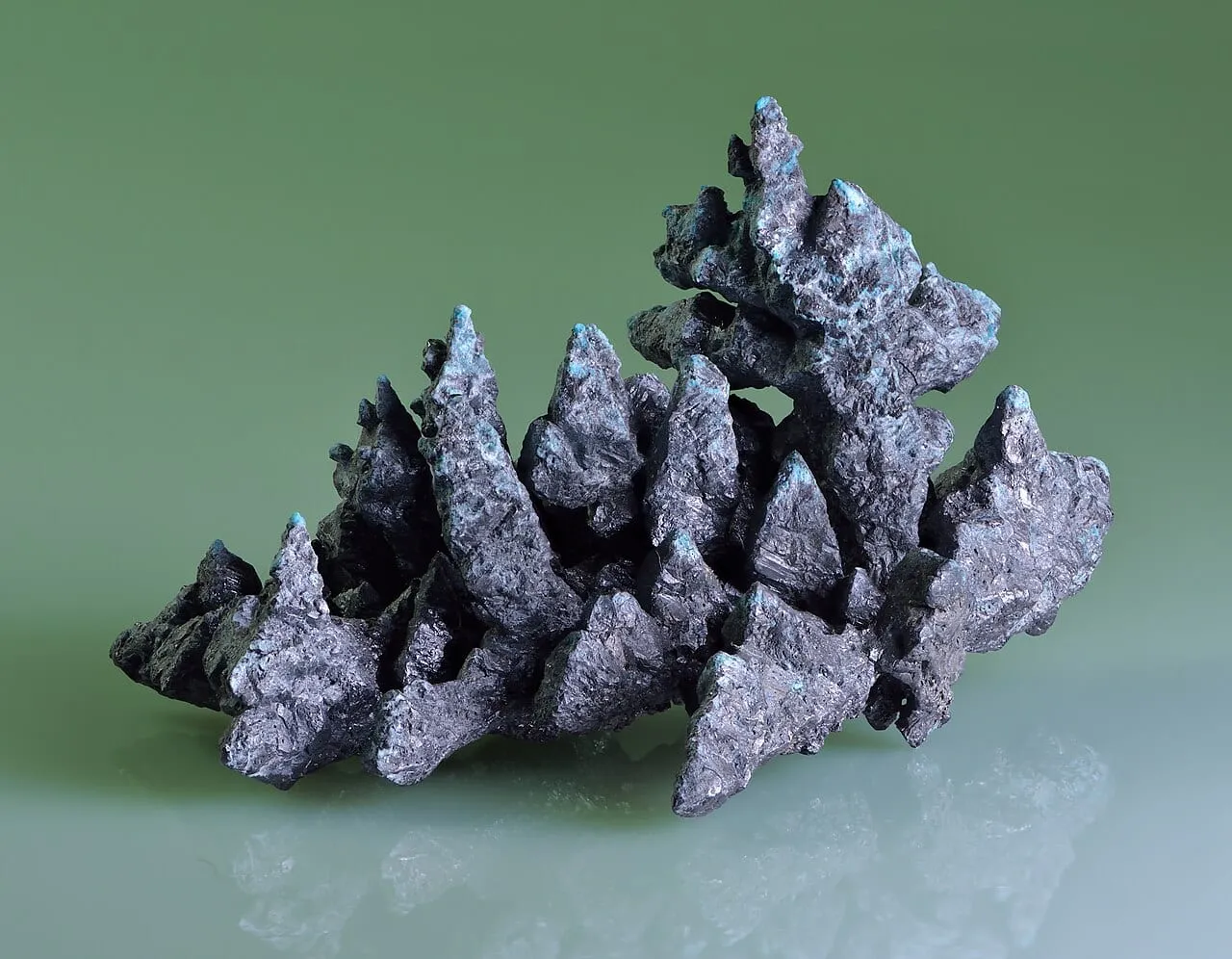
Acanthite
Silver's black sulfide: one of the world's main silver ores and the mineral that coats tarnished native silver.
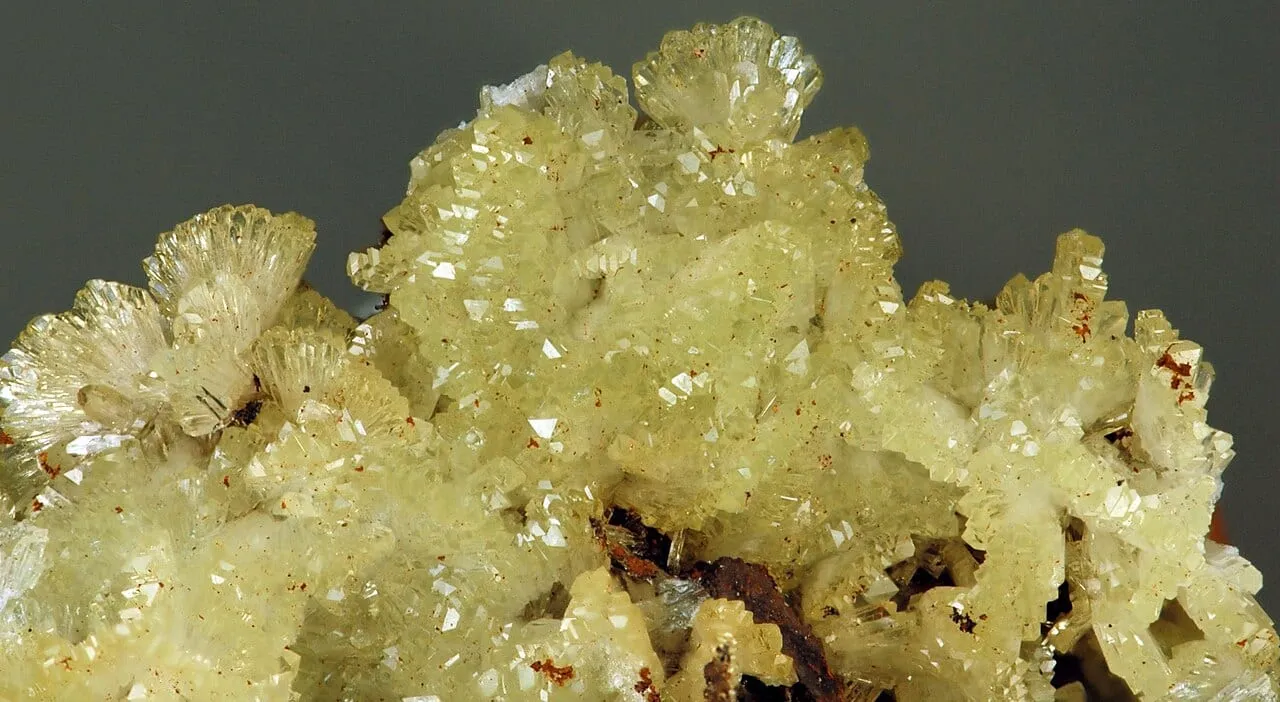
Adamite
Zinc arsenate in fan-shaped crystals from honey yellow to green: some specimens glow under ultraviolet light.
Albite
The white, sodium end of the feldspars: with its deposits at Çine–Milas, a glass and ceramics raw material that makes Türkiye one of the world’s main feldspar producers.