Meteorite
Winonaite
Winonait
Primitive achondrites whose type specimen was found buried like a child: winonaites, from the same planetesimal as the IAB iron meteorites.
- Popularly: Meteorite

In short
Winonaites are a group of primitive achondrite meteorites. Like all primitive achondrites they share features with both chondrites and achondrites: they show signs of metamorphism, partial melting, brecciation and relict chondrules. Their composition lies between those of E and H chondrites. The group is named after the Winona meteorite, found at a Sinagua site in Arizona in 1928. As of 2021, 54 meteorites belonged to the group.
How does it form?
Winonaites formed from a chondritic precursor unlike any known chondrite in its mineral and oxygen isotope composition, and perhaps varying in composition from place to place. Extensive heating caused metamorphism and partial melting of both the nickel–iron and iron sulphide and the silicates. During cooling, impacts brecciated and mixed rocks with different thermal histories. Later metamorphism caused recrystallisation and grain growth.
Argon–argon ages place the metamorphism on the parent body between 4.40 and 4.54 billion years ago. Research suggests that this body is the planetesimal from which the IAB iron meteorites also came: the irons from its core, the winonaites from nearer its surface.
What is it used for?
- Partly melted planetesimals: Winonaites show the stages between primitive chondrites that never melted and fully melted achondrites and irons.
- Different layers of one body: Studied together with IAB irons, they make it possible to compare the core of a single planetesimal with rocks from near its surface.
- Archaeology: The burial of the Winona meteorite at a Sinagua site is among the examples documenting ancient Americans’ interest in meteorites.
The Winona meteorite
The Winona meteorite is named after Winona, Arizona. It is said to have been taken from a stone cist in one of the rooms during the excavation of Elden Pueblo, a Sinagua village inhabited between 1150 and 1275, in September 1928; a later study, however, indicates that it was found at another Sinagua site. At 24 kg it is by far the largest member of the group. It consists of enstatite, olivine, nickel–iron metal, plagioclase and troilite, with alabandite, apatite, chromite, daubréelite, diopside and graphite.
What determines its value?
Winonaites are rare meteorites; as of 2021 only 54 had been classified. A specimen's value depends on its mass, its freshness and whether it belongs to a well-known specimen such as Winona, at 24 kg by far the group's largest member.
This information is educational, not buying, selling or investment advice. Value varies enormously with quality and treatment.
How to recognise it
- 1
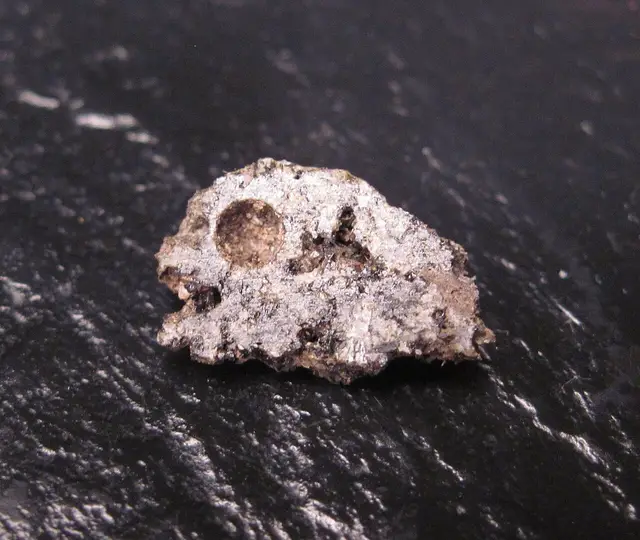
The fusion crust is dark brown; large areas of nickel–iron metal may be exposed on the surface.
- 2
A cut face shows a mixture of nickel–iron metal grains and silicate crystals; it is fine- to medium-grained.
- 3
Only oxygen isotope and mineral composition analyses can confirm the type; the oxygen isotopes resemble those of the silicate inclusions in IAB irons.
Myths and misconceptions
MythAncient peoples gave no special meaning to stones that fell from the sky.
FactThe Winona meteorite was found at a Sinagua site in a stone cist like those used for child burials. H. H. Nininger also cited other North American meteorites that had been buried wrapped in cloth or inside pottery.
Did you know?
The Winona meteorite was found in a stone cist like those in which the former inhabitants of Arizona buried their children. In a 1938 article in American Antiquity, H. H. Nininger counted it among examples of ancient Americans collecting meteorites.
Winona was so badly weathered that it fell apart when it was taken out of the cist. Those who first described it in 1929 could not classify it and thought it was probably a mesosiderite.
Cosmic-ray exposure ages show that winonaites took about 20 to 80 million years to travel from their parent body to the Earth.
Where is it found?
Loading map…
- Winona, Arizona, USA · Type localityThe 24 kg Winona meteorite, the group's type specimen and by far its largest member, was found in 1928 at a Sinagua site, in a stone cist like those used to bury children.
Locations are approximate to protect sites. Red dots mark places in Türkiye. Open in the big map →
Frequently asked questions
What is winonaite?
Winonaites are a group of primitive achondrite meteorites. Like all primitive achondrites they share features with both chondrites and achondrites: they show signs of metamorphism, partial melting, brecciation and relict chondrules. Their composition lies between those of E and H chondrites. The group is named after the Winona meteorite, found at a Sinagua site in Arizona in 1928. As of 2021, 54 meteorites belonged to the group.
How are winonaites connected to the IAB iron meteorites?
Both are thought to come from the same parent body. The silicate inclusions in IAB irons resemble winonaites, especially in their oxygen isotope ratios. The iron meteorites came from the core region of the planetesimal, the winonaites from closer to its surface. It is less clear whether the IIICD irons also belong to this body.
What is winonaite used for?
Partly melted planetesimals: Winonaites show the stages between primitive chondrites that never melted and fully melted achondrites and irons. Different layers of one body: Studied together with IAB irons, they make it possible to compare the core of a single planetesimal with rocks from near its surface. Archaeology: The burial of the Winona meteorite at a Sinagua site is among the examples documenting ancient Americans' interest in meteorites.
How hard is winonaite?
It has a hardness of 5–7 on the Mohs scale. It can scratch glass; a steel knife scratches it only with difficulty. Its specific gravity is 3.15–3.85 g/cm³.
Where is winonaite found?
Its best-known localities: Winona, Arizona, USA.
How can you tell if winonaite is real?
The fusion crust is dark brown; large areas of nickel–iron metal may be exposed on the surface. A cut face shows a mixture of nickel–iron metal grains and silicate crystals; it is fine- to medium-grained. Only oxygen isotope and mineral composition analyses can confirm the type; the oxygen isotopes resemble those of the silicate inclusions in IAB irons.
Is winonaite valuable?
On the “street to diamond” value ladder it sits on step 7 of nine: Precious stone. Winonaites are rare meteorites; as of 2021 only 54 had been classified. A specimen's value depends on its mass, its freshness and whether it belongs to a well-known specimen such as Winona, at 24 kg by far the group's largest member.
Sources
- Winonaite · Wikipedia
- Winona meteorite · Wikipedia
- A petrologic and isotopic study of winonaites: Evidence for early partial melting, brecciation, and metamorphism (G. K. Benedix, T. J. McCoy, K. Keil, D. D. Bogard, D. H. Garrison), Geochimica et Cosmochimica Acta 62 · Elsevier, 1998
- Meteorite collecting among ancient Americans (H. H. Nininger), American Antiquity 4 (1) · Society for American Archaeology, 1938
- In Ghar 001 (Meteoritical Bulletin no. 111) · Meteorite Studies
- Northwest Africa 13624 (Meteoritical Bulletin no. 109) · Meteorite Studies
- Physical properties of the stone meteorites: Implications for the properties of their parent bodies (G. J. Flynn, G. J. Consolmagno, P. Brown, R. J. Macke), Chemie der Erde – Geochemistry 78 · NASA Technical Reports Server, 2018
- Handbook of Mineralogy: Enstatite · Mineralogical Society of America
- Handbook of Mineralogy: Forsterite · Mineralogical Society of America
External links
Draft: awaiting expert reviewReport an error
On the same step
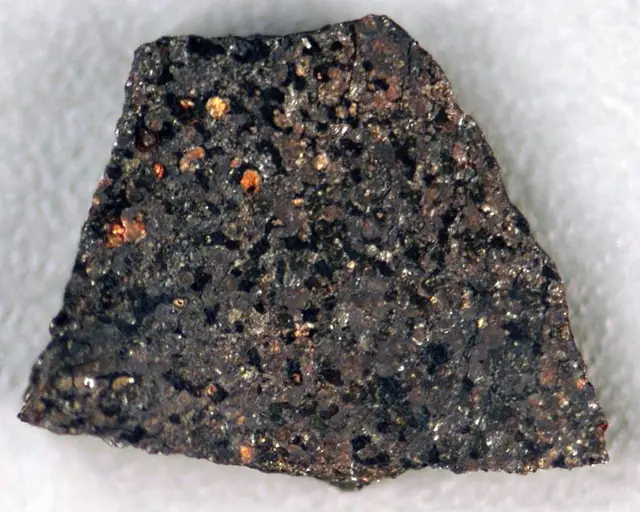
Acapulcoite
Stony meteorites that began to melt but never fully did: metal-veined primitive achondrites, named after a stone that fell near Acapulco in 1976.
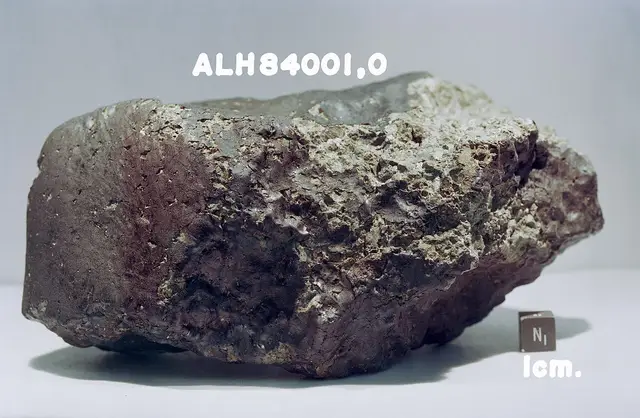
Allan Hills 84001
The stone that sparked the Mars-life debate: a 4-billion-year-old Martian meteorite from Antarctica whose tiny structures were likened to fossil bacteria in 1996.
Angrite
The oldest known igneous rocks: rare basaltic meteorites that crystallised about 4.56 billion years ago, in the very earliest days of the Solar System.