Meteorite
Ureilite
Üreilit
Rare stony meteorites that carry diamonds: achondrites whose olivine and pyroxene are cemented by graphite and nanodiamonds, from a parent body still unknown.
Also known as: Novo-Urei type achondrite
- Popularly: Meteorite

In short
Ureilites are rare achondrites whose mineral make-up is very different from that of other stony meteorites. They are named after the village of Novy Urey in the Republic of Mordovia, Russia, where a meteorite of this type fell on 4 September 1886. They consist mainly of olivine and pigeonite and carry on average about 3 per cent carbon by weight, partly as graphite and partly as nanodiamonds. Which body they come from is not known.
Photos

How does it form?
How ureilites formed is not certain. One idea is that they formed inside a parent body, where crystals settled in layers; some ureilites, whose grains are aligned in a preferred direction, support this. Another is that they are the solid residue left behind after the parent body partly melted and the liquid was drawn off. It has also been suggested that they are unprocessed material that never melted, or mixtures of carbonaceous chondrite and basaltic melt.
Some of their diamond may have formed from graphite in the shock waves of violent collisions, which points to a turbulent impact history for the parent body. Whether ureilites come from different regions of a single body or from different bodies is still an open question.
What is it used for?
- Planet formation: The diamonds in ureilites help trace large bodies and planetary embryos of the early Solar System.
- Linking asteroids and meteorites: 2008 TC3 was the first body to be observed and tracked before it reached the Earth. When its spectrum, measured in the sky, was compared with the fragments found on the ground, an asteroid class (F-type) and a meteorite type were linked for the first time.
- Organic chemistry: Amino acids were found in fragments of 2008 TC3 where none were expected, given the temperatures of about 1,000 °C reached in the explosion.
- Planetary defence: The discovery and tracking of 2008 TC3 were the first real test of the system for finding small bodies approaching the Earth and computing their orbits.
Famous ureilites
Novy Urey (Russia, 1886) is the fall that gave the group its name. According to an eyewitness, a fireball came down in daylight, with audible explosions, a few metres from some peasants, who found a black stone lying half-buried in the middle of a shallow hole. Goalpara is named after the town in Assam, India, where it landed. Almahata Sitta is the name of the fragments of asteroid 2008 TC3 recovered in the Nubian Desert of Sudan; it is Arabic for “Station Six”, a station on the railway between Wadi Halfa and Khartoum. The search was led by Peter Jenniskens of the SETI Institute and Muawia Shaddad of the University of Khartoum. More than 20 different meteorite types were found among them; most were ureilites, but there were also enstatite chondrites, ordinary chondrites and carbonaceous chondrites. It was the first time a single fall proved to be a mixed bag of meteorite types.
What determines its value?
Ureilites are rare meteorites. A specimen's value depends on its mass, its freshness, how well the texture shows on a cut face, and whether it belongs to an observed fall such as Novy Urey or Almahata Sitta. Almahata Sitta fragments draw extra interest because they come from the first asteroid whose impact was predicted.
This information is educational, not buying, selling or investment advice. Value varies enormously with quality and treatment.
How to recognise it
- 1
Dark grey or brownish; on a cut face, the spaces between large olivine and pyroxene grains are filled with material carrying graphite and diamond.
- 2
The diamond and graphite grains inside are usually smaller than a few micrometres and cannot be seen with the naked eye.
- 3
Only laboratory analysis can confirm that a stone is a ureilite.
Myths and misconceptions
MythThe diamonds in meteorites are big enough to be used as gems.
FactThe nanodiamonds in ureilites are rarely more than a few micrometres across and cannot even be seen with the naked eye. Their value is scientific: they tell us about collisions and planet formation in the early Solar System.
Did you know?
The first good evidence of diamond in a meteorite was published in 1888: the Russian scientists Jerofejev and Lachinov found greyish grains, regarded as diamonds, in the stone that fell near Novy Urey in 1886.
The small asteroid 2008 TC3 was discovered about 20 hours before it hit the Earth, the first asteroid whose impact was predicted in advance. Most of the fragments recovered in Sudan turned out to be ureilites.
Of the three stones found at Novy Urey, two were lost. According to Arizona State University's Center for Meteorite Studies, one of them was reportedly eaten by the villagers who found it.
Where is it found?
Loading map…
- Novy Urey, Mordovia, Russia · Type localityThe meteorite that fell in daylight on 4 September 1886 and gave the group its name. Three stones were recovered and two were lost; 1.9 kg is preserved in collections today. In 1888 meteoritic diamonds were first discovered in it. The point marks the Republic of Mordovia.
- Almahata Sitta, Nubian Desert, Sudan · Known localityFragments of the small asteroid 2008 TC3, which exploded 37 km up on 7 October 2008, the first asteroid whose impact was predicted. About 600 pieces (10.5 kg) were collected, most of them ureilites. The point marks the final explosion.
- Goalpara, Assam, India · Known localityOne of the best-known ureilites, named after the town where it landed.
Locations are approximate to protect sites. Red dots mark places in Türkiye. Open in the big map →
Frequently asked questions
What is ureilite?
Ureilites are rare achondrites whose mineral make-up is very different from that of other stony meteorites. They are named after the village of Novy Urey in the Republic of Mordovia, Russia, where a meteorite of this type fell on 4 September 1886. They consist mainly of olivine and pigeonite and carry on average about 3 per cent carbon by weight, partly as graphite and partly as nanodiamonds. Which body they come from is not known.
How did the diamonds in ureilites form?
This is not settled. For a long time they were thought to have formed from graphite in shock waves produced when the parent body collided with other asteroids. A 2018 study of diamond inclusions in fragments of 2008 TC3, however, concluded that they grew over a relatively long time at high pressure, suggesting that the parent body was a planetary embryo between Mercury and Mars in size.
What is ureilite used for?
Planet formation: The diamonds in ureilites help trace large bodies and planetary embryos of the early Solar System. Linking asteroids and meteorites: 2008 TC3 was the first body to be observed and tracked before it reached the Earth. When its spectrum, measured in the sky, was compared with the fragments found on the ground, an asteroid class (F-type) and a meteorite type were linked for the first time. Organic chemistry: Amino acids were found in fragments of 2008 TC3 where none were expected, given the temperatures of about 1,000 °C reached in the explosion.
How hard is ureilite?
It has a hardness of 6–7 on the Mohs scale. It can scratch glass; a steel knife scratches it only with difficulty. Its specific gravity is 2.83–3.27 g/cm³.
Where is ureilite found?
Its best-known localities: Novy Urey, Mordovia, Russia; Almahata Sitta, Nubian Desert, Sudan; Goalpara, Assam, India.
How can you tell if ureilite is real?
Dark grey or brownish; on a cut face, the spaces between large olivine and pyroxene grains are filled with material carrying graphite and diamond. The diamond and graphite grains inside are usually smaller than a few micrometres and cannot be seen with the naked eye. Only laboratory analysis can confirm that a stone is a ureilite.
Is ureilite valuable?
On the “street to diamond” value ladder it sits on step 6 of nine: Fine ornamental and collector stone. Ureilites are rare meteorites. A specimen's value depends on its mass, its freshness, how well the texture shows on a cut face, and whether it belongs to an observed fall such as Novy Urey or Almahata Sitta. Almahata Sitta fragments draw extra interest because they come from the first asteroid whose impact was predicted.
Sources
- Ureilite · Wikipedia
- 2008 TC3 · Wikipedia
- Novo-Urei · Meteorites.ru (Russian Academy of Sciences meteorite collection)
- Novo-Urei · Center for Meteorite Studies, Arizona State University
- Identification of diamond in the Canyon Diablo iron (C. J. Ksanda & E. P. Henderson), American Mineralogist 24 · Mineralogical Society of America, 1939
- Goalpara · Wikipedia
- Meteorite porosities and densities: a review of trends in the data (D. T. Britt & G. J. Consolmagno), Lunar and Planetary Science XXXV, abstract 2108 · Lunar and Planetary Institute, 2004
- Handbook of Mineralogy: Pigeonite · Mineralogical Society of America
- Handbook of Mineralogy: Forsterite · Mineralogical Society of America
External links
Draft: awaiting expert reviewReport an error
On the same step
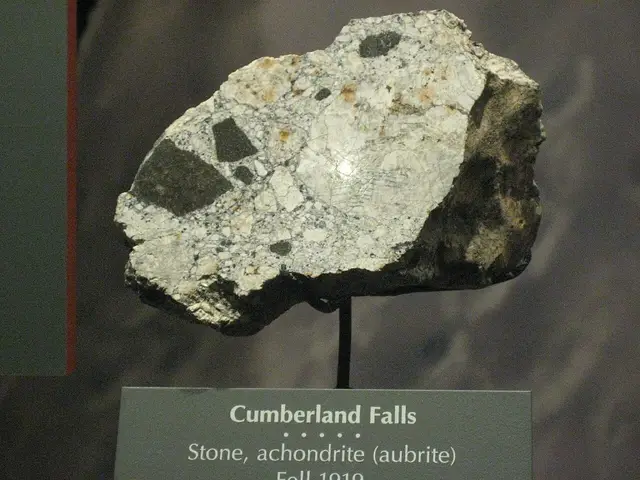
Achondrite
Stony meteorites with no chondrules: rock from melted asteroids, the Moon and Mars, and hard to recognise because they look like Earth rocks.
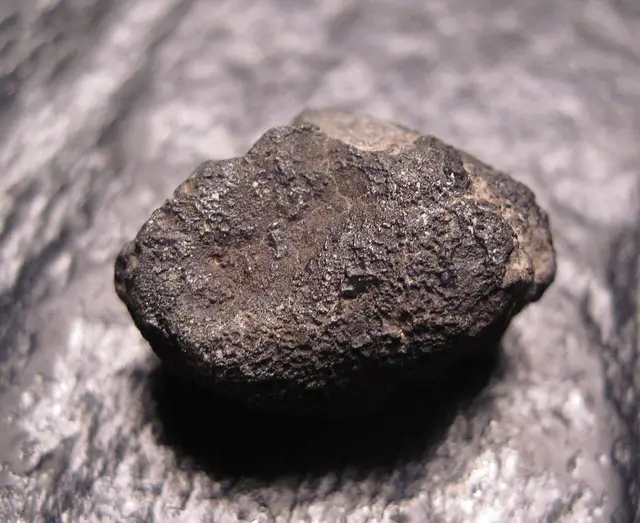
Allende meteorite
The most studied meteorite in history: the largest carbonaceous chondrite, which fell in Mexico in 1969 carrying the first solids of the Solar System.
Amber
Tree resin fossilised over millions of years: a light, warm organic gem that sometimes holds prehistoric insects.