Meteorite
Tagish Lake meteorite
Tagish Lake meteoriti
A meteorite that fell on a frozen lake and reached the lab still frozen: a carbonaceous chondrite holding pre-solar stardust and more nanodiamonds than any other.
Also known as: Tagish Lake
- Popularly: Meteorite

In short
The Tagish Lake meteorite is a carbonaceous chondrite that fell on 18 January 2000 on Tagish Lake in British Columbia, northwestern Canada. About 97% of the 4-metre, roughly 56-tonne body that entered the atmosphere vaporised; most fragments landed on the lake's frozen surface, and more than 500 were collected. The first pieces were taken to research laboratories frozen, without ever thawing. It is a very primitive meteorite, holding stardust from before the Solar System, amino acids and more nanodiamonds than any other meteorite.
Photos

How does it form?
Tagish Lake is a piece of an asteroid that formed at the start of the Solar System, never melted and stayed very primitive. It is about 4.55 billion years old. Stardust grains from the cloud that formed the Sun and the Solar System survive unchanged inside it. On its parent body, water altered the rock, forming water-bearing minerals and carbonates. It resembles the most primitive carbonaceous chondrites, the CI and CM types, but is clearly distinct from both, which is why it is called “ungrouped”.
The trail the fireball left behind and eyewitness accounts allowed the meteoroid’s orbit to be calculated. It turned out to have been on an Apollo-type orbit from the outer asteroid belt. Its reflectance spectrum suggests it may have come from 773 Irmintraud, a D-type asteroid.
What is it used for?
- The beginning of the Solar System: Its unchanged stardust and nanodiamonds are used to study material older than the Solar System.
- Organic chemistry: Amino acids, hexamethylenetetramine and bases like the building blocks of DNA and RNA have been found in it.
- Meteoroid orbits: It is one of the few meteorites whose pre-entry orbit could be accurately worked out.
History
The meteoroid exploded at 08:43 local time on 18 January 2000, at 50–30 kilometres altitude, with an energy of about 1.7 kilotons of TNT. In late January a local resident collected fragments and kept them frozen; these were studied together with NASA researchers. The remaining pieces lay under snow until April 2000. Researchers from the universities of Calgary and Western Ontario then collected them, buried a few centimetres to more than 20 centimetres in the ice, from meltwater holes or by cutting them out in blocks of ice.
What determines its value?
Tagish Lake's value is largely scientific: the first pieces, collected frozen and pristine, are unique for studying primitive organic matter. These “fresh” pieces are kept at the Royal Ontario Museum and the University of Alberta. A piece's value depends on its mass, how fresh it has stayed and its documented origin.
This information is educational, not buying, selling or investment advice. Value varies enormously with quality and treatment.
How to recognise it
- 1
A dark grey to almost black, crumbly stone; apart from its fusion crust it looks like a charcoal briquette.
- 2
Small light-coloured inclusions can be seen in it.
- 3
It is very light: its density is only about 1.6 times that of water, noticeably lighter than an ordinary stone of the same size.
Myths and misconceptions
MythWater inside meteorites is contamination picked up on Earth.
FactTagish Lake contains the water-bearing minerals serpentine and saponite. The isotopic make-up of this water differs from Earth's, so it is not contamination but comes from the meteorite's parent body.
MythThe organic molecules in Tagish Lake are signs of life.
FactThe meteorite is rich in amino acids and other organic matter, but these are thought to have formed in interstellar space or in the disk of gas and dust that gave birth to the Sun, and then been altered on the asteroid. They have nothing to do with life.
Did you know?
After the blast, local people described a sulfurous smell in the air, and many at first thought it had been caused by a missile.
Dust from the vaporised meteoroid spread into the stratosphere and was seen about 12 hours later as noctilucent clouds at sunset northwest of Edmonton.
The collected fragments total a little over 10 kilograms, only about 1% of the roughly 1.3 tonnes that reached the ground.
Where is it found?
Loading map…
- Taku Arm of Tagish Lake, northwestern British Columbia, Canada · Type localityOn 18 January 2000 most of the fragments landed on the lake's frozen surface; more than 500 were collected from the ice.
Locations are approximate to protect sites. Red dots mark places in Türkiye. Open in the big map →
Frequently asked questions
What is tagish Lake meteorite?
The Tagish Lake meteorite is a carbonaceous chondrite that fell on 18 January 2000 on Tagish Lake in British Columbia, northwestern Canada. About 97% of the 4-metre, roughly 56-tonne body that entered the atmosphere vaporised; most fragments landed on the lake's frozen surface, and more than 500 were collected. The first pieces were taken to research laboratories frozen, without ever thawing. It is a very primitive meteorite, holding stardust from before the Solar System, amino acids and more nanodiamonds than any other meteorite.
Why is Tagish Lake such a light meteorite?
According to measurements by Hildebrand and colleagues, Tagish Lake has a density of about 1.64 g/cm³ and a porosity of about 40%. It has the lowest density and highest porosity of any meteoroid studied in this way, values very close to those of interplanetary dust particles.
What is tagish Lake meteorite used for?
The beginning of the Solar System: Its unchanged stardust and nanodiamonds are used to study material older than the Solar System. Organic chemistry: Amino acids, hexamethylenetetramine and bases like the building blocks of DNA and RNA have been found in it. Meteoroid orbits: It is one of the few meteorites whose pre-entry orbit could be accurately worked out.
How hard is tagish Lake meteorite?
It has a hardness of 2.5–7 on the Mohs scale. It can scratch glass; a steel knife scratches it only with difficulty. Its specific gravity is 1.62–1.66 g/cm³.
Where is tagish Lake meteorite found?
Its best-known localities: Taku Arm of Tagish Lake, northwestern British Columbia, Canada.
How can you tell if tagish Lake meteorite is real?
A dark grey to almost black, crumbly stone; apart from its fusion crust it looks like a charcoal briquette. Small light-coloured inclusions can be seen in it. It is very light: its density is only about 1.6 times that of water, noticeably lighter than an ordinary stone of the same size.
Is tagish Lake meteorite valuable?
On the “street to diamond” value ladder it sits on step 6 of nine: Fine ornamental and collector stone. Tagish Lake's value is largely scientific: the first pieces, collected frozen and pristine, are unique for studying primitive organic matter. These “fresh” pieces are kept at the Royal Ontario Museum and the University of Alberta. A piece's value depends on its mass, how fresh it has stayed and its documented origin.
Sources
- Tagish Lake (meteorite) · Wikipedia
- The fall and recovery of the Tagish Lake meteorite (A. R. Hildebrand et al.), Meteoritics & Planetary Science 41, 407–431 · The Meteoritical Society, 2006
- Handbook of Mineralogy: Forsterite · Mineralogical Society of America
External links
Draft: awaiting expert reviewReport an error
On the same step
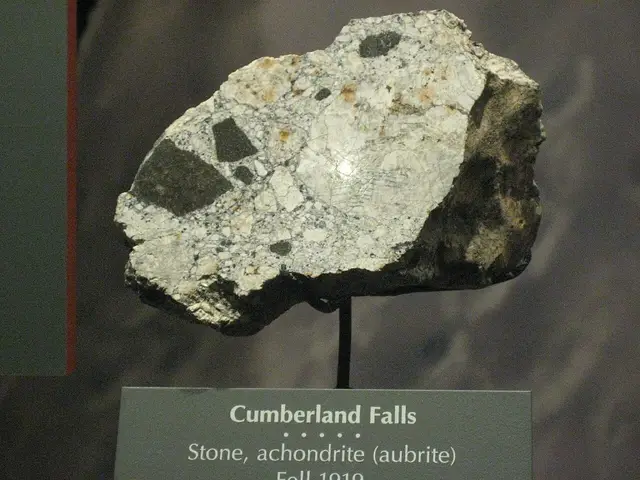
Achondrite
Stony meteorites with no chondrules: rock from melted asteroids, the Moon and Mars, and hard to recognise because they look like Earth rocks.
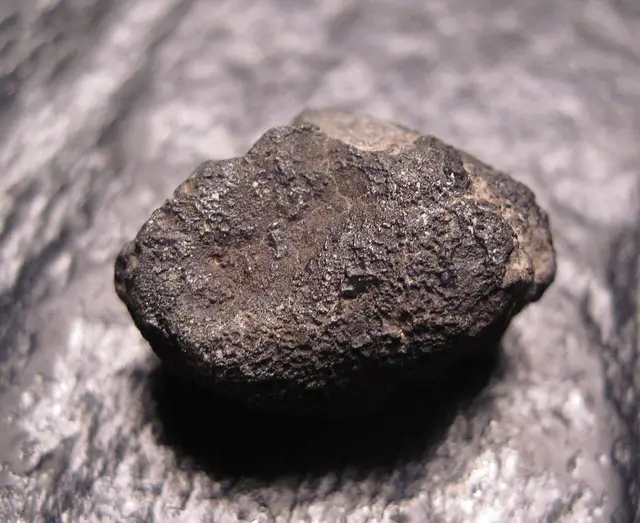
Allende meteorite
The most studied meteorite in history: the largest carbonaceous chondrite, which fell in Mexico in 1969 carrying the first solids of the Solar System.
Amber
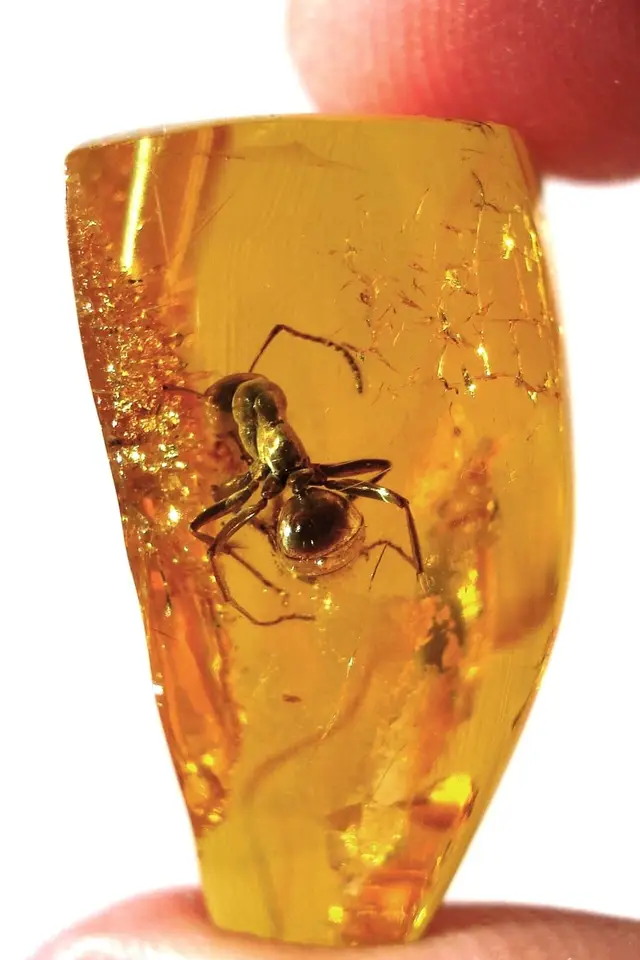
Tree resin fossilised over millions of years: a light, warm organic gem that sometimes holds prehistoric insects.