Mineral
Scheelite
CaWO₄Şelit
One of the main ores of tungsten: a heavy calcium tungstate that glows bright blue under short-wave ultraviolet light.
Also known as: Calcium tungstate (chemical name)
- Popularly: Ore and raw material
- Ore
- Important in Türkiye

In short
Scheelite is a mineral made of calcium, tungsten and oxygen (CaWO₄). It occurs in many colours, from colourless and white to yellow and brown, shines like glass or diamond and is very heavy. Its best-known feature is a bright blue glow under short-wave ultraviolet (UV) light. According to MTA, about two thirds of the world’s tungsten resources are scheelite and one third wolframite.
Photos

How does it form?
Scheelite mostly forms in skarns, contact-metamorphic rocks: when an igneous rock such as granite intrudes limestone or marble, hot, tungsten-rich fluids react with the carbonate rock, and scheelite is deposited together with minerals such as grossular–andradite garnet, diopside, vesuvianite and tremolite. It also forms in high-temperature hydrothermal veins and in greisen, the altered rock at the edge of a granite, accompanied by cassiterite, wolframite, topaz, fluorite, apatite and tourmaline.
More rarely it is found in granite pegmatites and medium-temperature veins. Because it is heavy and durable, it can also collect in river sediments when the host rock wears away.
What is it used for?
- Tungsten production: Together with wolframite, scheelite is one of the two ores that supply industrial tungsten. Tungsten is the metal with the highest known melting point (3,422 °C). According to the USGS, about 60% of the tungsten used in the United States goes into cemented carbide parts for cutting and wear-resistant uses (mining, drilling, metalworking, construction); the rest goes into alloys and special steels and into electrical and lighting parts.
- Light and detection: Calcium tungstate has been used in X-ray and gamma-ray detectors (scintillators), fluorescent lamp phosphors, cathode-ray tube screens and some laser materials.
- Collecting: Well-formed crystals are sought by collectors. Cut scheelite stones are very bright and fiery but brittle, so they are rarely worn.
- Prospecting: In a night survey with a UV lamp, a blue glow can point to an ore deposit.
Why does it glow under UV light?
Under short-wave UV light scheelite glows bright blue; according to Wikipedia the glow ranges from blue and bluish white to yellow. Specimens containing molybdenum (in the scheelite–powellite series) glow white or yellow. The glow stops when the light source is switched off: this is fluorescence, not radioactivity or light of its own.
In Türkiye
Türkiye’s most important tungsten deposit is the Uludağ scheelite deposit in Bursa. According to MTA, it lies in the Uludağ Massif about 600 m northeast of the western summit of Uludağ and is of skarn type. The ore, about 14 million tonnes in total at an average grade of 0.4% WO₃, was found in five separate zones. The mining right was given to Etibank in 1961, the decision to mine was taken in 1968, and concentrate production and export began in 1977 when the enrichment plants started up.
Because the plants were built on the summit, where climate and water supply are unfavourable, structural and technical problems arose; the grade varied from place to place, yields and ore prices fell, and the mine was closed in 1989 as uneconomic. In 1988, the last year of work, 89 thousand tonnes of ore were processed into 350 tonnes of concentrate (40% WO₃).
Apart from Uludağ, MTA lists the sites of Bursa-Kozbudaklar, Bilecik-Söğüt-Dudaş, Çanakkale-Yenice (Hamdibey), Elazığ-Keban, Niğde-Gümüşler, Kırklareli-Demirköy and Kırıkkale-Çelebidağ. Most of them are skarn-type formations at the contacts of granite or granodiorite with marble or limestone, with scheelite as the main mineral; their grades are low and their reserves small. Tungsten ore was first found in Türkiye in 1945 in the Söğüt-Dudaş antimony deposit in Bilecik, and the first mining took place in the 1960s at the Gümüşler antimony-tungsten-mercury deposit in Niğde (about 100 tonnes of tungsten from a site averaging 1% WO₃).
According to MTA there is no tungsten mining in Türkiye today; industry’s needs (about 50 tonnes of ferrotungsten and 25 tonnes of tungsten carbide a year) are met by imports. For the other, rarer tungsten mineral at Uludağ, see the wolframite page.
What determines its value?
Scheelite is an ore, and its value depends on the proportion of tungsten oxide (WO₃) in the ore, the size of the deposit and the cost of processing (scheelite is usually concentrated by gravity separation and flotation). Because supply is concentrated in a few countries, trade restrictions matter too: according to the USGS, China supplied 67,000 tonnes of the roughly 85,000 tonnes mined worldwide in 2025. For collectors, large, undamaged crystals with transparent terminations and famous localities such as Xuebaoding count. Cut scheelite stones are collector’s items rather than jewellery because of their low hardness and cleavage, and since they may be synthetic, a laboratory report matters.
This information is educational, not buying, selling or investment advice. Value varies enormously with quality and treatment.
How to recognise it
- 1
It feels surprisingly heavy: its specific gravity is about 6, more than twice that of a piece of quartz of the same size.
- 2
Its hardness is 4.5–5: a steel knife scratches it, and it cannot scratch glass. The streak (powder colour) is white; the lustre ranges from glassy to diamond-like.
- 3
Under short-wave UV light it glows bright blue or bluish white; specimens containing molybdenum glow white or yellow. Wear eye protection when using a UV lamp.
- 4
Crystals often look like two pyramids joined at the base (pseudo-octahedra). In granite-related veins it occurs with quartz, fluorite, apatite, cassiterite and wolframite; in skarns with garnet and diopside.
Fakes and imitations
What shops usually don’t tell you:
- It can be confused with similar-looking minerals: the dark, heavy tungsten mineral that often shares the same vein is wolframite, while the pale tungsten mineral that glows blue under UV is scheelite. Calcite and quartz are pale too, but far lighter than scheelite.
- Synthetic scheelite: lab-grown scheelite was often sold as a diamond imitation in the 1960s and 70s, and according to the International Gem Society it may still be offered as a rare, natural “collector’s” stone. Natural scheelite almost always shows internal growth marks and inclusions; synthetic stones are usually spotless.
Safety
Scheelite is harmless to handle. In some deposits the ore occurs with arsenic-bearing minerals such as arsenopyrite, so do not break or crush raw specimens, do not breathe the dust, do not put them in water to drink and wash your hands after handling. Short-wave UV lamps emit the wavelengths that cause sunburn and eye injury; wear eye protection when using one.
Myths and misconceptions
MythScheelite and wolframite are the same mineral; tungsten ore is a single stone.
FactThey are two different minerals: scheelite contains calcium (CaWO₄), is pale and glows blue under UV, while wolframite contains iron and manganese and is dark. According to MTA, about two thirds of the world’s tungsten resources are scheelite and one third wolframite; the two often sit side by side in the same vein.
MythA sparkling scheelite gem is as durable in a ring as a diamond.
FactScheelite has a hardness of only 4.5–5 and distinct cleavage. According to the International Gem Society, this is why it is seen more in collections than in jewellery and needs a protective setting as a ring stone. Clear scheelite sold in place of diamond is mostly lab-grown synthetic material.
What is it believed to be good for?
This section reports beliefs; it is not health information. There is no scientific evidence for these claims and no stone replaces medical treatment.
The meanings people give this stone, and who holds them:
- Crystal-therapy websites claim that scheelite increases mental clarity and insight and balances the body’s “chakras”.
What science says
No study shows that scheelite clarifies thinking or balances the body’s “energy centres”, and “chakra” claims cannot be measured. The real, visible property of scheelite is its blue glow under UV light, which comes from the chemistry of the mineral. Because raw scheelite specimens can occur with arsenic-bearing minerals, the stone should not be put in “stone water” and that water should not be drunk.
Did you know?
The Swedes called this mineral “tung sten” (“heavy stone”) because of its weight, and that is where the element tungsten gets its name. The mineral’s own name honours the Swedish chemist Carl Wilhelm Scheele (1742–1786), who determined that it contained tungsten. Scheelite was first described in 1751 at Bispberg in Sweden.
Geologists prospecting for scheelite sometimes walk the ground at night with a UV lamp: a blue glow on the rock can point to ore. As molybdenum replaces tungsten, the glow shifts from blue to white and yellow.
Thomas Edison’s fluoroscope, which made X-rays visible, used screens coated with calcium tungstate.
Where is it found?
Loading map…
- Bispbergs klack, Säter, Dalarna, Sweden · Type localityWhere scheelite was first found in 1751; the old Bispberg mine lies at the foot of the mountain
- Xuebaoding, Pingwu, Sichuan, China · Known localityLarge scheelite crystals with transparent terminations from the mines of the Pingwu area are famous among collectors; according to the USGS, China supplies the large majority of world tungsten output
- Mittersill (Felbertal), Salzburg, Austria · Major depositIn the large tungsten mine south of Mittersill the ore is mainly scheelite; Austria appears in the USGS world tungsten production table
- Altenberg, Saxony, Germany · Historic sourceAccording to the Handbook of Mineralogy, Altenberg and Schwarzenberg in Saxony are among the places known for fine and large scheelite crystals
- King Island, Tasmania, Australia · Known localityThe Dolphin mine holds one of the largest tungsten reserves in Australia; open-cut scheelite mining ended in 1974 and the underground mines closed in 1990
- Currais Novos, Rio Grande do Norte, Brazil · Known localityWikipedia's scheelite article lists the Currais Novos mine among the places where scheelite is mined
- Chungju, Tae-hwa mine, South Korea · Known localityAccording to the Handbook of Mineralogy, large scheelite crystals come from the Tae-hwa mine at Chungju
- Uludağ, Bursa, Türkiye · Major depositTürkiye's most important tungsten deposit: a skarn-type scheelite deposit, worked from 1977 to 1989
Locations are approximate to protect sites. Red dots mark places in Türkiye. Open in the big map →
Frequently asked questions
What is scheelite?
Scheelite is a mineral made of calcium, tungsten and oxygen (CaWO₄). It occurs in many colours, from colourless and white to yellow and brown, shines like glass or diamond and is very heavy. Its best-known feature is a bright blue glow under short-wave ultraviolet (UV) light. According to MTA, about two thirds of the world’s tungsten resources are scheelite and one third wolframite.
What is scheelite used for?
Tungsten production: Together with wolframite, scheelite is one of the two ores that supply industrial tungsten. Tungsten is the metal with the highest known melting point (3,422 °C). According to the USGS, about 60% of the tungsten used in the United States goes into cemented carbide parts for cutting and wear-resistant uses (mining, drilling, metalworking, construction); the rest goes into alloys and special steels and into electrical and lighting parts.
How hard is scheelite?
It has a hardness of 4.5–5 on the Mohs scale. A fingernail cannot scratch it, but a steel knife can. Its specific gravity is 5.9–6.1 g/cm³.
Where is scheelite found?
Its best-known localities: Bispbergs klack, Säter, Dalarna, Sweden; Mittersill (Felbertal), Salzburg, Austria; Uludağ, Bursa, Türkiye; Altenberg, Saxony, Germany; Xuebaoding, Pingwu, Sichuan, China.
Where is scheelite found in Türkiye?
Known localities in Türkiye: Uludağ, Bursa, Türkiye.
How can you tell if scheelite is real?
It feels surprisingly heavy: its specific gravity is about 6, more than twice that of a piece of quartz of the same size. Its hardness is 4.5–5: a steel knife scratches it, and it cannot scratch glass. The streak (powder colour) is white; the lustre ranges from glassy to diamond-like. Under short-wave UV light it glows bright blue or bluish white; specimens containing molybdenum glow white or yellow. Wear eye protection when using a UV lamp. It can be confused with similar-looking minerals: the dark, heavy tungsten mineral that often shares the same vein is wolframite, while the pale tungsten mineral that glows blue under UV is scheelite. Calcite and quartz are pale too, but far lighter than scheelite.
Is scheelite valuable?
On the “street to diamond” value ladder it sits on step 4 of nine: Fine dimension stone and ore. Scheelite is an ore, and its value depends on the proportion of tungsten oxide (WO₃) in the ore, the size of the deposit and the cost of processing (scheelite is usually concentrated by gravity separation and flotation). Because supply is concentrated in a few countries, trade restrictions matter too: according to the USGS, China supplied 67,000 tonnes of the roughly 85,000 tonnes mined worldwide in 2025. For collectors, large, undamaged crystals with transparent terminations and famous localities such as Xuebaoding count. Cut scheelite stones are collector’s items rather than jewellery because of their low hardness and cleavage, and since they may be synthetic, a laboratory report matters.
What is scheelite good for?
Crystal-therapy websites claim that scheelite increases mental clarity and insight and balances the body’s “chakras”. No study shows that scheelite clarifies thinking or balances the body’s “energy centres”, and “chakra” claims cannot be measured. The real, visible property of scheelite is its blue glow under UV light, which comes from the chemistry of the mineral. Because raw scheelite specimens can occur with arsenic-bearing minerals, the stone should not be put in “stone water” and that water should not be drunk. This section reports beliefs; it is not health information. There is no scientific evidence for these claims and no stone replaces medical treatment.
Is scheelite dangerous?
Scheelite is harmless to handle. In some deposits the ore occurs with arsenic-bearing minerals such as arsenopyrite, so do not break or crush raw specimens, do not breathe the dust, do not put them in water to drink and wash your hands after handling. Short-wave UV lamps emit the wavelengths that cause sunburn and eye injury; wear eye protection when using one.
Sources
- Handbook of Mineralogy: Scheelite · Mineralogical Society of America
- Scheelite · Wikipedia
- Scheelite (Webmineral) · Webmineral
- Scheelite Value, Price, and Jewelry Information · International Gem Society
- Fluorescent Minerals · Geology.com
- Scheelite under shortwave ultraviolet light · U.S. Geological Survey
- Mineral Commodity Summaries 2026: Tungsten · U.S. Geological Survey, 2026
- Tungstenin Dünya ve Türkiye'deki yeri (MTA Doğal Kaynaklar ve Ekonomi Bülteni 30) · MTA Genel Müdürlüğü, 2020
- Bispbergs klack · Wikipedia (Swedish)
- Mittersill · Wikipedia
- Altenberg, Saxony · Wikipedia
- King Island (Tasmania) · Wikipedia
- Currais Novos · Wikipedia
- Scheelite-224167.jpg (specimen locality: Mt Xuebaoding, Pingwu County) · Wikimedia Commons
External links
Draft: awaiting expert reviewReport an error ↗
On the same step
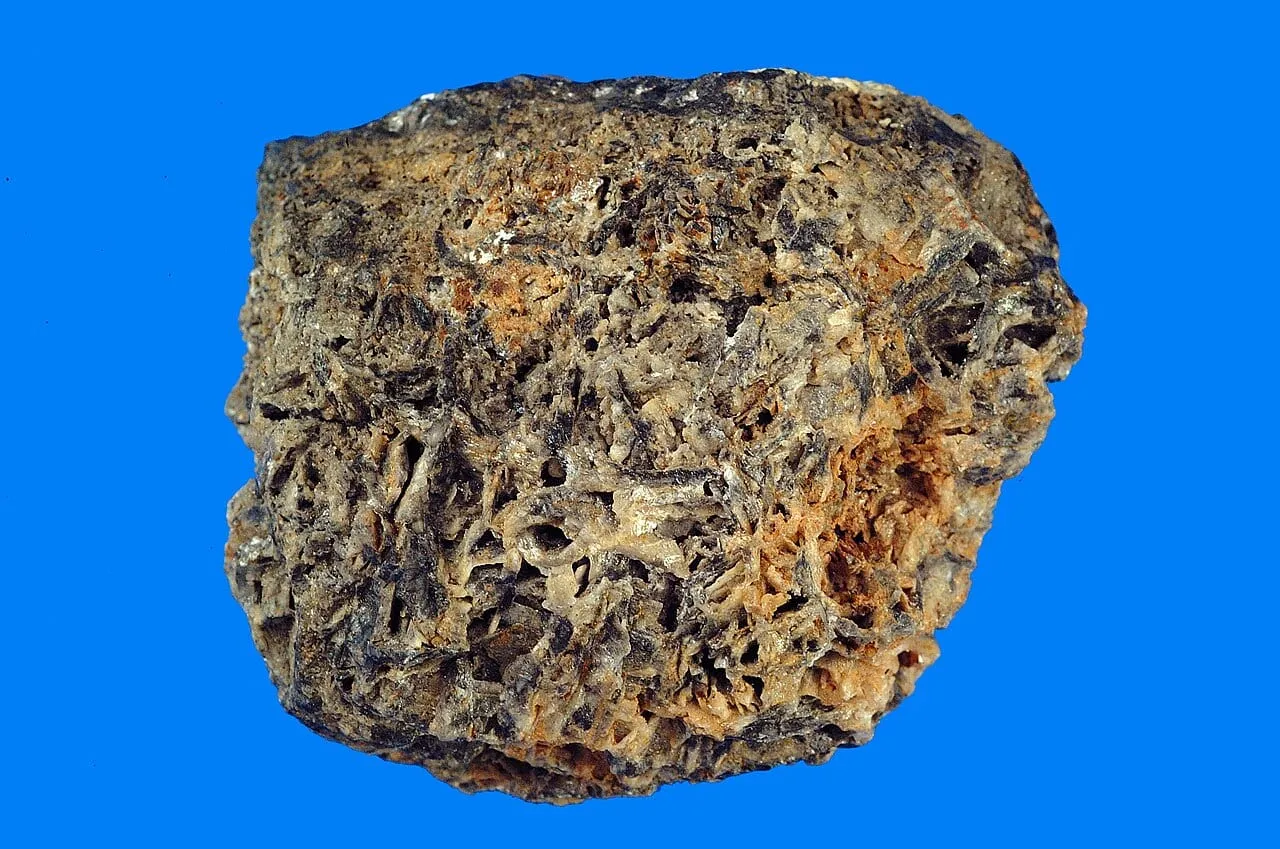
Anglesite
A heavy lead sulfate mineral with a diamond-like shine that grows as a crust around galena; it is named after the island of Anglesey in Wales.
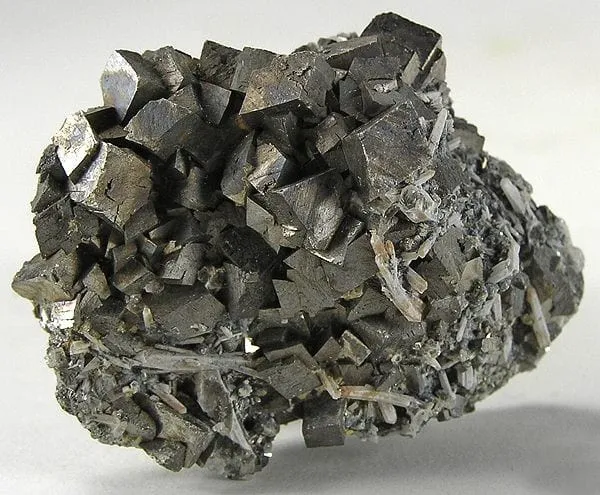
Arsenopyrite
A widespread silvery-grey sulfide containing arsenic: it smells of garlic when struck and is poisonous.
Banded iron formation
An ancient rock of alternating iron-oxide and chert bands: the record of oxygen beginning to build up on Earth, and the main source of iron ore.