Mineral
Pyrrhotite
Fe₁₋ₓSPirotin
A bronze-yellow iron sulfide, also called “magnetic pyrite”: a magnet attracts it, and in crushed stone it can crack foundations if it gets into concrete.
Also known as: Magnetic pyrite
- Popularly: Ore and raw material
- Ore
- Important in Türkiye

In short
Pyrrhotite is a sulfide mineral made of iron and sulfur in a slightly iron-poor composition (Fe₁₋ₓS), bronze-yellow to bronze-brown with a metallic lustre. It is shiny and yellowish like pyrite but magnetic: a magnet attracts it, which is why it is also called “magnetic pyrite”. It occurs in mafic igneous rocks, particularly in nickel and copper ores together with pentlandite and chalcopyrite. In the crushed stone used for concrete, it oxidises and makes the concrete crack.
How does it form?
Pyrrhotite mostly forms in mafic igneous rocks, as the magma cools and separates (magmatic segregation). It also occurs in pegmatites, in high-temperature hot-water (hydrothermal) and replacement veins, in sedimentary and metamorphic rocks and in iron meteorites. Pyrite, marcasite, chalcopyrite, pentlandite, magnetite, calcite and dolomite are found with it.
What is it used for?
Pyrrhotite itself is rarely worked; its main importance is as a component of nickel and copper deposits. The nickel ore is intergrown with pentlandite and is mined with it. According to MTA, nickel-bearing pyrrhotite–chalcopyrite deposits are important copper producers: the nickel in them is present as pentlandite, closely intergrown with pyrrhotite, and the ore is sent to the smelter to make a nickel–copper matte. In the past it was a source of iron and sulfur, but sulfur production has now ceased. Fine crystals are sought by collectors.
Why does it damage concrete?
If pyrrhotite is present in the crushed stone inside concrete, it reacts with moisture and oxygen, producing sulfate minerals and sulfuric acid. Because these take up more volume than the pyrrhotite, the concrete is damaged, first by fine cracks and then more seriously. The Connecticut Department of Consumer Protection concluded in its investigation that “the mineral pyrrhotite must be present” for the foundations to deteriorate in the way observed, and found more than trace amounts of pyrrhotite in one quarry. That is why, when choosing a quarry for building stone, one must make sure the rock contains no pyrrhotite.
In Türkiye
Pyrrhotite has been reported from several mineralisations in Türkiye. In the Ergani copper deposit in the Maden district of Elazığ, according to researchers from Hacettepe University, pyrrhotite occurs at Anayatak in the magnetite-bearing chloritites and in the mottled flow-textured ore of the ore-bearing black mudstones; it is found with chalcopyrite and pyrite, has been partly replaced by pyrite and locally contains pentlandite exsolutions. A little pyrrhotite is reported beside magnetite in the Karabaşvengi iron mineralisation in the Divriği district of Sivas, and a small pyrrhotite–pentlandite±chalcopyrite association in the ultramafic and mafic rocks of the Dağküplü ophiolite (Eskişehir).
What determines its value?
Pyrrhotite is not a valuable ore by itself; the nickel and copper in and beside it decide its worth. Some pyrrhotite contains up to 5 per cent nickel by weight; in nickel and copper deposits it is worked together with pentlandite and chalcopyrite. For collectors, well-formed, lustrous, undamaged crystals and specimens from famous localities are sought. In crushed building stone it creates problems rather than value: quarries containing pyrrhotite are not considered suitable for concrete aggregate.
This information is educational, not buying, selling or investment advice. Value varies enormously with quality and treatment.
How to recognise it
- 1
Its colour is bronze-yellow to bronze-brown and it tarnishes quickly; its streak (powder colour) is dark grayish black.
- 2
It reacts to a magnet: a small magnet attracts pyrrhotite, whereas pyrite is not attracted. The strength varies from specimen to specimen; the greater the iron deficiency, the stronger the magnetism.
- 3
It is soft (hardness 3.5–4.5): a steel knife scratches it, whereas pyrite is too hard for a knife to scratch (6–6.5).
- 4
Crystals are mostly hexagon-like plates (up to 40 cm), sometimes forming rosettes; it is often massive or granular.
- 5
It has no cleavage but shows a distinct parting along the {0001} plane.
Fakes and imitations
What shops usually don’t tell you:
- Brass-yellow masses with a metallic lustre can be pyrite, chalcopyrite or pyrrhotite. A magnet (only pyrrhotite is attracted), hardness and streak help tell them apart. For a certain identification, ask a specialist or a laboratory.
Safety
Pyrrhotite is an iron sulfide; handling it is generally harmless. In air and damp it oxidises over time: sulfates and sulfuric acid form, so specimens stored in a damp place can decay and corrode nearby labels and specimens. The real danger lies in building materials: if pyrrhotite is present in the crushed stone (aggregate) used for concrete, it oxidises and cracks the concrete from within. In the US states of Connecticut and Massachusetts and in Quebec, Canada, the concrete foundations of houses poured with aggregate from pyrrhotite-bearing quarries have cracked and crumbled. Do not heat it; irritating sulfur dioxide gas is released. Do not put it in your mouth, and do not put it in water to make “gem water” or an “elixir”: acid forms as it decays. Keep specimens dry and away from children.
Myths and misconceptions
MythPyrite is magnetic; a magnet-attracting brass-yellow stone is pyrite.
FactPyrite does not react to a magnet. If a yellowish stone is attracted by a magnet it is often pyrrhotite, which is why it is called “magnetic pyrite”.
MythPyrrhotite is only a collector’s mineral; it does no harm to buildings.
FactIf pyrrhotite gets into the crushed stone of concrete, it reacts with air and water and swells, cracking the concrete. In Connecticut a pyrrhotite-bearing quarry has been identified in the cracking of some houses’ concrete foundations.
Did you know?
Its name comes from the Greek pyrrhos, meaning “flame-coloured”; the mineral was named in 1847 by Ours-Pierre-Armand Petit-Dufrénoy.
After magnetite it is the second most common magnetic mineral. It also occurs in iron meteorites.
Its magnetism depends on its composition: the more iron deficiency (vacancies), the more magnetic pyrrhotite is. Troilite, whose composition is FeS, is not magnetic.
Where is it found?
Loading map…
- Sudbury Basin, Ontario, Canada · Major depositAccording to Wikipedia, the magma in the 1.85-billion-year-old impact structure at Sudbury formed pyrrhotite, chalcopyrite and pentlandite rocks; the region is known for nickel and copper mining
- Herja (Kisbánya), Baia Mare district, Romania · Known localityThe Handbook of Mineralogy mentions well-crystallised pyrrhotite from Herja in the Baia Mare district (coordinate is the city of Baia Mare)
- Dalnegorsk, Primorsky Krai, Russia · Known localityThe Handbook of Mineralogy mentions very large pyrrhotite crystals from Dalnegorsk (coordinate is the town centre)
- Morro Velho gold mine, Nova Lima, Minas Gerais, Brazil · Known localityThe Handbook of Mineralogy mentions large pyrrhotite crystals from the Morro Velho gold mine (coordinate is the town of Nova Lima)
- Santa Eulalia, Chihuahua, Mexico · Known localityThe mining district from which the Handbook of Mineralogy took its X-ray pattern for pyrrhotite (coordinate is the town of Santa Eulalia)
- Falun, Dalarna, Sweden · Historic sourceA town famous for its copper mine that the Handbook of Mineralogy names for pyrrhotite in Sweden (coordinate is the town centre)
- Riondel, British Columbia, Canada · Known localityThe place of the Bluebell mine, which the Handbook of Mineralogy names for pyrrhotite (coordinate is the settlement centre)
- Maden (Ergani copper deposit, Anayatak), Elazığ, Türkiye · Known localityAt Anayatak, pyrrhotite is reported in the magnetite-bearing chloritites and the ore-bearing black mudstones; it locally contains pentlandite exsolutions (coordinate is the district centre)
- Karabaşvengi, Divriği, Sivas, Türkiye · Known localityA little pyrrhotite is reported beside magnetite in the Karabaşvengi iron mineralisation, about 5 km north-east of the main Divriği iron deposit (coordinate is the district centre)
- Dağküplü ophiolite, Eskişehir, Türkiye · Known localityA small pyrrhotite-pentlandite±chalcopyrite association is reported in the ophiolite’s ultramafic and mafic rocks; the source gives the place only as “Eskişehir” (coordinate is the provincial centre)
Locations are approximate to protect sites. Red dots mark places in Türkiye. Open in the big map →
Frequently asked questions
What is pyrrhotite?
Pyrrhotite is a sulfide mineral made of iron and sulfur in a slightly iron-poor composition (Fe₁₋ₓS), bronze-yellow to bronze-brown with a metallic lustre. It is shiny and yellowish like pyrite but magnetic: a magnet attracts it, which is why it is also called “magnetic pyrite”. It occurs in mafic igneous rocks, particularly in nickel and copper ores together with pentlandite and chalcopyrite. In the crushed stone used for concrete, it oxidises and makes the concrete crack.
What is pyrrhotite used for?
Pyrrhotite itself is rarely worked; its main importance is as a component of nickel and copper deposits. The nickel ore is intergrown with pentlandite and is mined with it. According to MTA, nickel-bearing pyrrhotite–chalcopyrite deposits are important copper producers: the nickel in them is present as pentlandite, closely intergrown with pyrrhotite, and the ore is sent to the smelter to make a nickel–copper matte. In the past it was a source of iron and sulfur, but sulfur production has now ceased. Fine crystals are sought by collectors.
How hard is pyrrhotite?
It has a hardness of 3.5–4.5 on the Mohs scale. A fingernail cannot scratch it, but a steel knife can. Its specific gravity is 4.58–4.65 g/cm³.
Where is pyrrhotite found?
Its best-known localities: Sudbury Basin, Ontario, Canada; Falun, Dalarna, Sweden; Herja (Kisbánya), Baia Mare district, Romania; Dalnegorsk, Primorsky Krai, Russia; Morro Velho gold mine, Nova Lima, Minas Gerais, Brazil.
Where is pyrrhotite found in Türkiye?
Known localities in Türkiye: Maden (Ergani copper deposit, Anayatak), Elazığ, Türkiye; Karabaşvengi, Divriği, Sivas, Türkiye; Dağküplü ophiolite, Eskişehir, Türkiye.
How can you tell if pyrrhotite is real?
Its colour is bronze-yellow to bronze-brown and it tarnishes quickly; its streak (powder colour) is dark grayish black. It reacts to a magnet: a small magnet attracts pyrrhotite, whereas pyrite is not attracted. The strength varies from specimen to specimen; the greater the iron deficiency, the stronger the magnetism. It is soft (hardness 3.5–4.5): a steel knife scratches it, whereas pyrite is too hard for a knife to scratch (6–6.5). Brass-yellow masses with a metallic lustre can be pyrite, chalcopyrite or pyrrhotite. A magnet (only pyrrhotite is attracted), hardness and streak help tell them apart. For a certain identification, ask a specialist or a laboratory.
Is pyrrhotite valuable?
On the “street to diamond” value ladder it sits on step 3 of nine: Building and industrial stone. Pyrrhotite is not a valuable ore by itself; the nickel and copper in and beside it decide its worth. Some pyrrhotite contains up to 5 per cent nickel by weight; in nickel and copper deposits it is worked together with pentlandite and chalcopyrite. For collectors, well-formed, lustrous, undamaged crystals and specimens from famous localities are sought. In crushed building stone it creates problems rather than value: quarries containing pyrrhotite are not considered suitable for concrete aggregate.
Is pyrrhotite dangerous?
Pyrrhotite is an iron sulfide; handling it is generally harmless. In air and damp it oxidises over time: sulfates and sulfuric acid form, so specimens stored in a damp place can decay and corrode nearby labels and specimens. The real danger lies in building materials: if pyrrhotite is present in the crushed stone (aggregate) used for concrete, it oxidises and cracks the concrete from within. In the US states of Connecticut and Massachusetts and in Quebec, Canada, the concrete foundations of houses poured with aggregate from pyrrhotite-bearing quarries have cracked and crumbled. Do not heat it; irritating sulfur dioxide gas is released. Do not put it in your mouth, and do not put it in water to make “gem water” or an “elixir”: acid forms as it decays. Keep specimens dry and away from children.
Sources
- Handbook of Mineralogy: Pyrrhotite · Mineralogical Society of America
- Pyrrhotite · Wikipedia
- Pyrrhotite · Geology.com
- Deteriorating Concrete Foundations · Connecticut Department of Consumer Protection
- Türkiye ve Dünyada Bakır · MTA Genel Müdürlüğü, Fizibilite Etütleri Dairesi Başkanlığı, 2021
- Ergani (Maden) bakır yatağı ve plaka tektoniği (S. İleri, B. Salancı, M. Bitem, R. Doğan) · Türkiye Jeoloji Kurumu Bülteni 19: 133–142, 1976
- Murmano Granitoidi'nin (Divriği-Sivas) Kuzeyindeki Karabaşvengi Demir Cevherleşmesi ve Divriği Demir Yataklarının Kökeninin İrdelenmesi (A. R. Çolakoğlu, T. Arıkal, U. Akın) · 56. Türkiye Jeoloji Kurultayı bildiri özü (Maden Yatakları oturumu)
- Dağküplü (Eskişehir) Ofiyoliti Ultrabazik ve Bazik Kayaçlarına Bağlı Nabit Metal ve Metalik Cevher Minerallerine Kökensel Açıdan Bir Yaklaşım (H. Erdal ve ark.) · 56. Türkiye Jeoloji Kurultayı bildiri özü (Maden Yatakları oturumu)
- Sudbury Basin · Wikipedia
- Baia Mare · Wikipedia
- Dalnegorsk · Wikipedia
- Nova Lima · Wikipedia
- Santa Eulalia, Chihuahua · Wikipedia
- Falun · Wikipedia
- Riondel · Wikipedia
- Maden, Elazığ · Wikipedia
- Divriği · Wikipedia
- Eskişehir · Wikipedia
External links
Draft: awaiting expert reviewReport an error ↗
On the same step
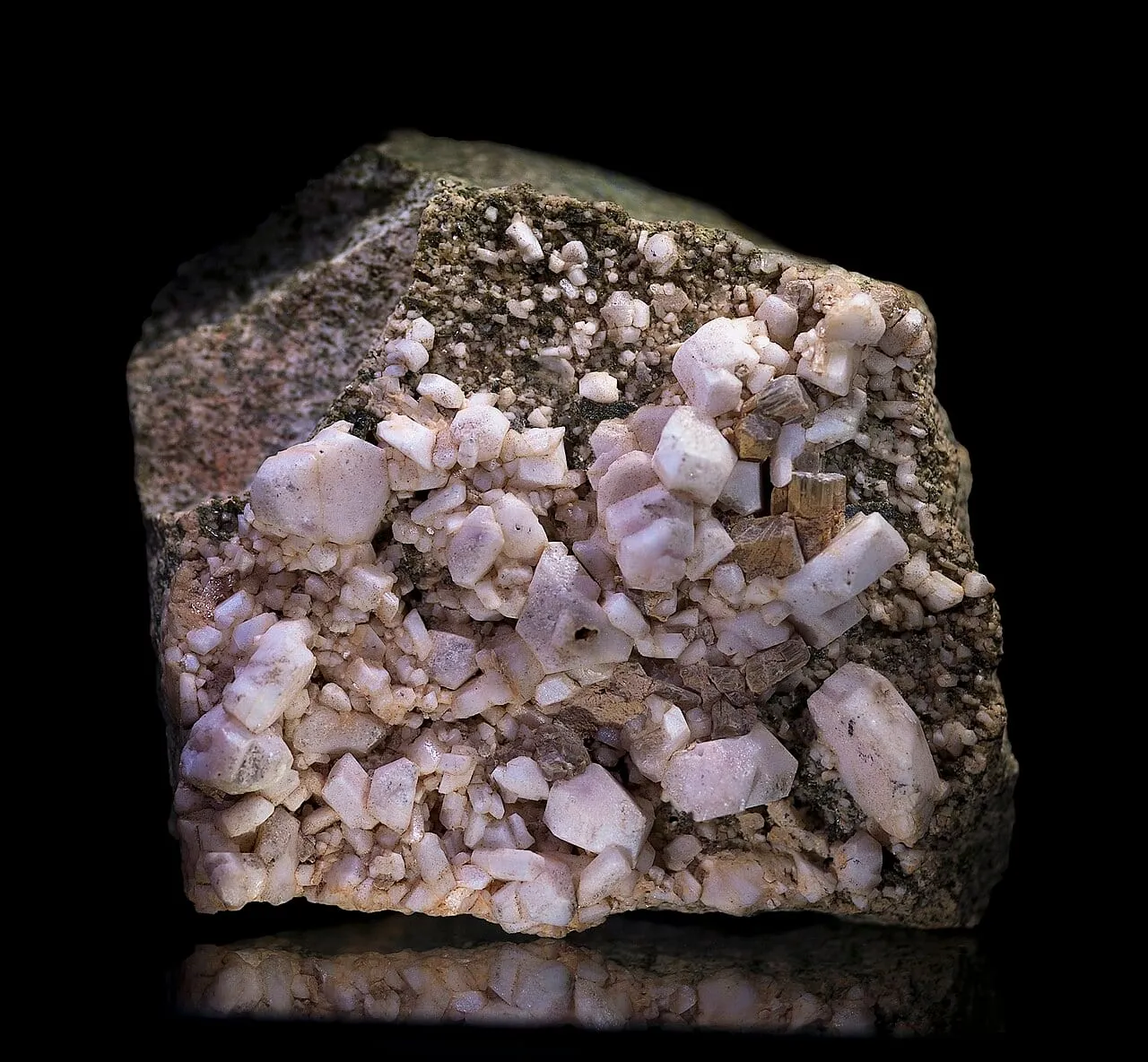
Albite
The white, sodium end of the feldspars: with its deposits at Çine–Milas, a glass and ceramics raw material that makes Türkiye one of the world’s main feldspar producers.
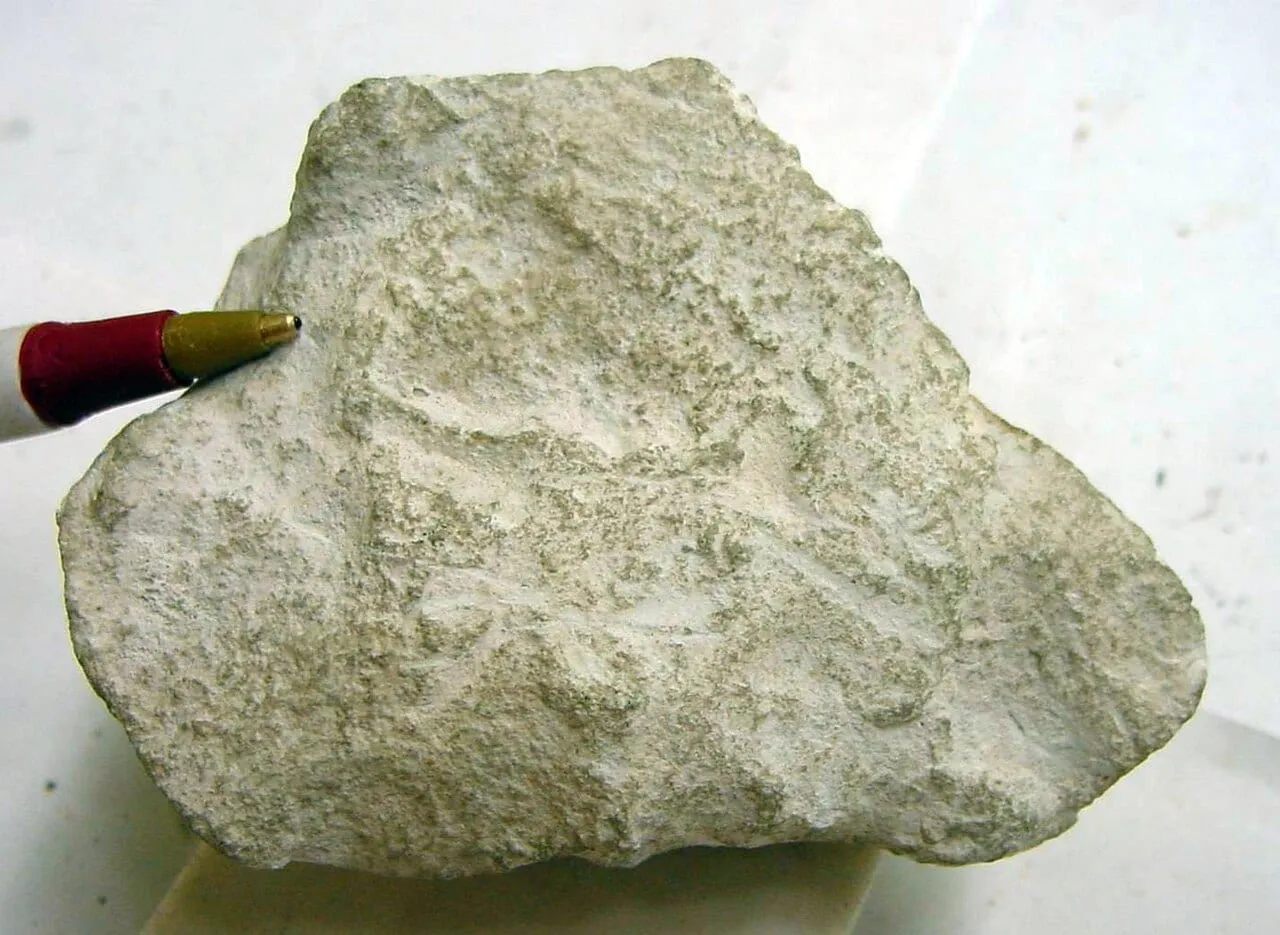
Alunite
The “alum stone” from which alum was made for centuries. Foça, Şaphane in Kütahya and Şebinkarahisar are Türkiye's old alum homelands.
Anhydrite
Gypsum without its water: a calcium sulfate mineral, whose blue-grey Peruvian form is sold as “angelite”.