Mineral
Orpiment
As₂S₃Orpiment
A soft, golden-yellow mineral used as a paint for thousands of years; it contains arsenic and is highly poisonous.
Also known as: Yellow arsenic · King’s yellow (as a pigment)
- Popularly: Ore and raw material
- Ore
- Handle with care
- Important in Türkiye
_(18287143943).jpg)
In short
Orpiment is a vivid yellow mineral, between lemon and gold in colour, made of arsenic and sulfur. It usually occurs as foliated or fibrous masses. Its name means “gold paint” in Latin: from ancient Egypt to medieval Europe, artists used it as a yellow pigment. But it is very toxic, so it is no longer used as a paint and needs care even when held as a specimen.
Photos
_(18720354540).jpg)
How does it form?
Orpiment forms in volcanic gas vents (fumaroles), in low-temperature hydrothermal veins and in hot springs; it can also form by sublimation, when a vapour turns straight into a solid. It is usually found with realgar, stibnite, calcite, barite and gypsum, and it also appears as other arsenic minerals, realgar among them, alter. Well-crystallised specimens are rare.
What is it used for?
- Yellow paint: Lumps of orpiment were found in an ancient Egyptian tomb of the 14th century BC. It was used on Central Asian wall paintings, on Chinese lacquer and on medieval European icons. Mixed with indigo dye it gives a deep green. Because it is poisonous and does not mix with lead- or copper-based paints, it was abandoned in the 19th century when cadmium and chromium yellows appeared.
- Hair remover: In rural India orpiment is mixed with slaked lime and used to remove hair. It has also been used in tanning to strip the hair from hides. The “hamam otu” powder sold in Türkiye as a hair remover belongs to the same tradition.
- Poison and medicine: It has been used as fly poison and arrow poison, and in China as a medicine despite its toxicity.
- Industry: It has been used in infrared-transmitting glass, semiconductors and fireworks.
Its name and “zırnık”
The Latin name is auripigmentum (“gold paint”), and the old Greek name was arsenikon. In Persian orpiment is zarnikh (zar: gold). The Turkish word “zırnık” also goes back to Persian zirnīḫ, according to the Turkish Language Association (TDK), and in today’s dictionary it means “arsenic”.
In Türkiye
Britannica lists Çölemerik in Türkiye among orpiment localities, and the Handbook of Mineralogy records orpiment from “Jelamerk”. Çölemerik is the old name of today’s Hakkâri city; the sources do not say where exactly the mine lies. Small amounts of orpiment and realgar have also been reported from the historic Balya lead-zinc-silver mine in Balıkesir, western Anatolia. According to Wikipedia, medieval European artists imported orpiment from Asia Minor (Anatolia).
The hair-removing powder known among the public in Türkiye as “hamam otu” is also linked to orpiment. But the name should not make you think it is a plant; the contents of what is sold vary from product to product, so it should not be rubbed on the skin.
What determines its value?
Orpiment is sought as a collector’s specimen; its value depends on the vividness of its colour, the beauty of its crystals or sheets, size, freedom from damage and decay, and a famous source such as Quiruvilca (Peru), Shimen (China) or Twin Creeks (USA). Because it can break down into powder with light and humidity, well-preserved, bright specimens are scarcer. As a pigment, it gave way in the 19th century to safer yellows because of its toxicity and its incompatibility with other paints.
This information is educational, not buying, selling or investment advice. Value varies enormously with quality and treatment.
How to recognise it
- 1
Its colour lies between vivid lemon-yellow and golden yellow; its streak (powder colour) is pale lemon-yellow. Realgar, which is almost always found with it, is orange-red.
- 2
It is very soft (hardness 1.5–2) and can be scratched with a fingernail. Its perfect cleavage splits it into paper-thin sheets, and these sheets are flexible.
- 3
Its lustre is resinous, and pearly on cleavage surfaces.
- 4
Crystals are rare; it is mostly seen as foliated or fibrous masses, kidney- or grape-shaped crusts, and powdery coatings.
Fakes and imitations
What shops usually don’t tell you:
- The contents of powders sold in Türkiye as “hamam otu” (bath herb) are not guaranteed. In a Turkish study published in 2021, a sample bought from an herbalist turned out to be calcite and barium sulfate, with no arsenic detected; so the label tells you little about what is inside.
- Yellow sulfur and other yellow minerals can be mistaken for orpiment. Orpiment’s pale lemon-yellow streak and its flexible, sheet-like cleavage help tell it apart, but a specialist or a laboratory should make the final identification.
Safety
Orpiment contains arsenic. It is highly toxic if swallowed or if its dust is breathed in, and it can irritate the skin. Do not lick it, put it in your mouth or eat it; never put it in water to make “gem water” or an “elixir”; never use it as a medicine, cosmetic or hair remover. Do not heat it (arsenic fumes are released), crush it to powder or sand it. With light and humidity it can slowly turn into a white, crumbly powder (arsenic trioxide); do not touch specimens that have begun to decay with bare hands, and do not breathe the dust. Wash your hands after handling. Keep specimens away from children and pets, in a closed container in a dark, dry place. Orpiment pieces sold as ornaments (bookends, for example) have been recalled in the United Kingdom because they are toxic; do not keep such items in a child’s room or the kitchen.
Myths and misconceptions
MythHamam otu is a plant, and because it is natural it is harmless.
FactDespite its name, “hamam otu” (bath herb) is not a plant: the substance known by this name among the public and used as a hair remover is the mineral orpiment (arsenic sulfide). The composition of powders on the market varies, and one Turkish study found no arsenic in a sample; but rubbing a powder of unknown content on the skin is not safe.
MythOrpiment contains gold, or can be turned into gold.
FactOrpiment contains no gold; it is a compound of arsenic and sulfur. Its bright golden-yellow colour led people in ancient times to think so, and its name comes from the Latin auripigmentum, “gold paint”.
MythOrpiment pieces sold in shops as ornaments are safe.
FactOrpiment is arsenic sulfide. Yellow orpiment bookends sold by a UK store chain were recalled in 2023 because they contain arsenic sulfide, which can irritate the skin and is toxic if swallowed or breathed in.
What is it believed to be good for?
This section reports beliefs; it is not health information. There is no scientific evidence for these claims and no stone replaces medical treatment.
The meanings people give this stone, and who holds them:
- Its Latin name (auripigmentum, “gold paint”) reflects an old belief that orpiment contained gold, and Pliny (1st century CE) used the name. In China and Europe, alchemists searching for a way to make gold were drawn to orpiment by its bright yellow colour.
- In traditional Chinese medicine and in medieval Arabic pharmacy, orpiment was used as a medicine, that is, it was believed to help against some illnesses.
What science says
Orpiment is arsenic sulfide; arsenic is a toxic element linked to cancer. That it was once used as a medicine does not show that it is safe or effective. Never put orpiment in drinking water (“gem water”), in the mouth or over heat, never breathe its dust, and never rub it on the skin as “hamam otu” or under any other name.
Did you know?
In Chinese, orpiment is “female yellow” (ci huang) and realgar “male yellow” (xiong huang); the two always occur together in nature, so their names came as a pair.
Raphael used orpiment for the yellow of the clothing and the background in his Sistine Madonna (1513–14).
Orpiment is reported from the wall decorations of Tutankhamun’s tomb and from ancient Egyptian scrolls, and from the walls of the Taj Mahal.
Where is it found?
Loading map…
- Twin Creeks mine, Potosi district, Nevada, USA · Major depositA gold mine known for fine orpiment crystals
- Quiruvilca, La Libertad, Peru · Major depositA mine that, according to the Handbook of Mineralogy, has produced “exceptional specimens”
- Shimen, Hunan, China · Major depositThe Shimen mine, famous for large orpiment crystals (coordinates at county level)
- Zarshuran, Takab, West Azerbaijan, Iran · Known localityFine crystals from the gold deposit about 35 km north of Takab
- Tajov, Banská Bystrica, Slovakia · Known localityA central Slovak locality the Handbook of Mineralogy lists among its crystallised orpiment sites
- Baia Sprie, Maramureş, Romania · Historic sourceThe classic locality from which the Handbook of Mineralogy’s orpiment X-ray pattern was taken
- Racha region, Georgia · Known localityA Caucasus region that Wikipedia and the Handbook of Mineralogy list for orpiment specimens (the coordinate is the region’s centre)
- Çölemerik (Hakkâri city), Hakkâri, Türkiye · Known localityBritannica and the Handbook of Mineralogy name “Çölemerik / Jelamerk”, the old name of Hakkâri city, as an orpiment locality (the coordinate is the city centre; the exact site is not given)
- Balya, Balıkesir, Türkiye · Known localitySmall amounts of orpiment and realgar in the historic lead-zinc-silver mine (coordinate is the district centre)
Locations are approximate to protect sites. Red dots mark places in Türkiye. Open in the big map →
Frequently asked questions
What is orpiment?
Orpiment is a vivid yellow mineral, between lemon and gold in colour, made of arsenic and sulfur. It usually occurs as foliated or fibrous masses. Its name means “gold paint” in Latin: from ancient Egypt to medieval Europe, artists used it as a yellow pigment. But it is very toxic, so it is no longer used as a paint and needs care even when held as a specimen.
What is orpiment used for?
Yellow paint: Lumps of orpiment were found in an ancient Egyptian tomb of the 14th century BC. It was used on Central Asian wall paintings, on Chinese lacquer and on medieval European icons. Mixed with indigo dye it gives a deep green. Because it is poisonous and does not mix with lead- or copper-based paints, it was abandoned in the 19th century when cadmium and chromium yellows appeared. Hair remover: In rural India orpiment is mixed with slaked lime and used to remove hair. It has also been used in tanning to strip the hair from hides.
How hard is orpiment?
It has a hardness of 1.5–2 on the Mohs scale. It is soft enough to scratch with a fingernail. Its specific gravity is 3.48–3.49 g/cm³.
Where is orpiment found?
Its best-known localities: Twin Creeks mine, Potosi district, Nevada, USA; Quiruvilca, La Libertad, Peru; Shimen, Hunan, China; Baia Sprie, Maramureş, Romania; Zarshuran, Takab, West Azerbaijan, Iran.
Where is orpiment found in Türkiye?
Known localities in Türkiye: Çölemerik (Hakkâri city), Hakkâri, Türkiye; Balya, Balıkesir, Türkiye.
How can you tell if orpiment is real?
Its colour lies between vivid lemon-yellow and golden yellow; its streak (powder colour) is pale lemon-yellow. Realgar, which is almost always found with it, is orange-red. It is very soft (hardness 1.5–2) and can be scratched with a fingernail. Its perfect cleavage splits it into paper-thin sheets, and these sheets are flexible. Its lustre is resinous, and pearly on cleavage surfaces. The contents of powders sold in Türkiye as “hamam otu” (bath herb) are not guaranteed. In a Turkish study published in 2021, a sample bought from an herbalist turned out to be calcite and barium sulfate, with no arsenic detected; so the label tells you little about what is inside.
Is orpiment valuable?
On the “street to diamond” value ladder it sits on step 4 of nine: Fine dimension stone and ore. Orpiment is sought as a collector’s specimen; its value depends on the vividness of its colour, the beauty of its crystals or sheets, size, freedom from damage and decay, and a famous source such as Quiruvilca (Peru), Shimen (China) or Twin Creeks (USA). Because it can break down into powder with light and humidity, well-preserved, bright specimens are scarcer. As a pigment, it gave way in the 19th century to safer yellows because of its toxicity and its incompatibility with other paints.
What is orpiment good for?
Its Latin name (auripigmentum, “gold paint”) reflects an old belief that orpiment contained gold, and Pliny (1st century CE) used the name. In China and Europe, alchemists searching for a way to make gold were drawn to orpiment by its bright yellow colour. In traditional Chinese medicine and in medieval Arabic pharmacy, orpiment was used as a medicine, that is, it was believed to help against some illnesses. Orpiment is arsenic sulfide; arsenic is a toxic element linked to cancer. That it was once used as a medicine does not show that it is safe or effective. Never put orpiment in drinking water (“gem water”), in the mouth or over heat, never breathe its dust, and never rub it on the skin as “hamam otu” or under any other name. This section reports beliefs; it is not health information. There is no scientific evidence for these claims and no stone replaces medical treatment.
Is orpiment dangerous?
Orpiment contains arsenic. It is highly toxic if swallowed or if its dust is breathed in, and it can irritate the skin. Do not lick it, put it in your mouth or eat it; never put it in water to make “gem water” or an “elixir”; never use it as a medicine, cosmetic or hair remover. Do not heat it (arsenic fumes are released), crush it to powder or sand it. With light and humidity it can slowly turn into a white, crumbly powder (arsenic trioxide); do not touch specimens that have begun to decay with bare hands, and do not breathe the dust. Wash your hands after handling. Keep specimens away from children and pets, in a closed container in a dark, dry place. Orpiment pieces sold as ornaments (bookends, for example) have been recalled in the United Kingdom because they are toxic; do not keep such items in a child’s room or the kitchen.
Sources
- Handbook of Mineralogy: Orpiment · Mineralogical Society of America
- Orpiment · Wikipedia
- Orpiment · Encyclopaedia Britannica
- Güncel Türkçe Sözlük: zırnık, arsenik · Türk Dil Kurumu
- A spectroscopic investigation of orpiment (yellow arsenic), used as a depilatory (Z. Aygun) · Journal of Amasya University the Institute of Sciences and Technology 2(1): 11–18, 2021
- Product Recall: Yellow Orpiment Mineral Bookends sold by TK Maxx · GOV.UK, Office for Product Safety and Standards, 2023
- Batı Anadolu Kurşun-Çinko Yataklarının Jeoloji-Mineraloji Etüdü ve Kökenleri Hakkında Görüşler (A. Çağatay) · Türkiye Jeoloji Kurumu Bülteni 23: 119–132, 1980
- Hakkâri (city) · Wikipedia
- Twin Creeks gold mine · Wikipedia
- Shimen County · Wikipedia
External links
Draft: awaiting expert reviewReport an error ↗
On the same step
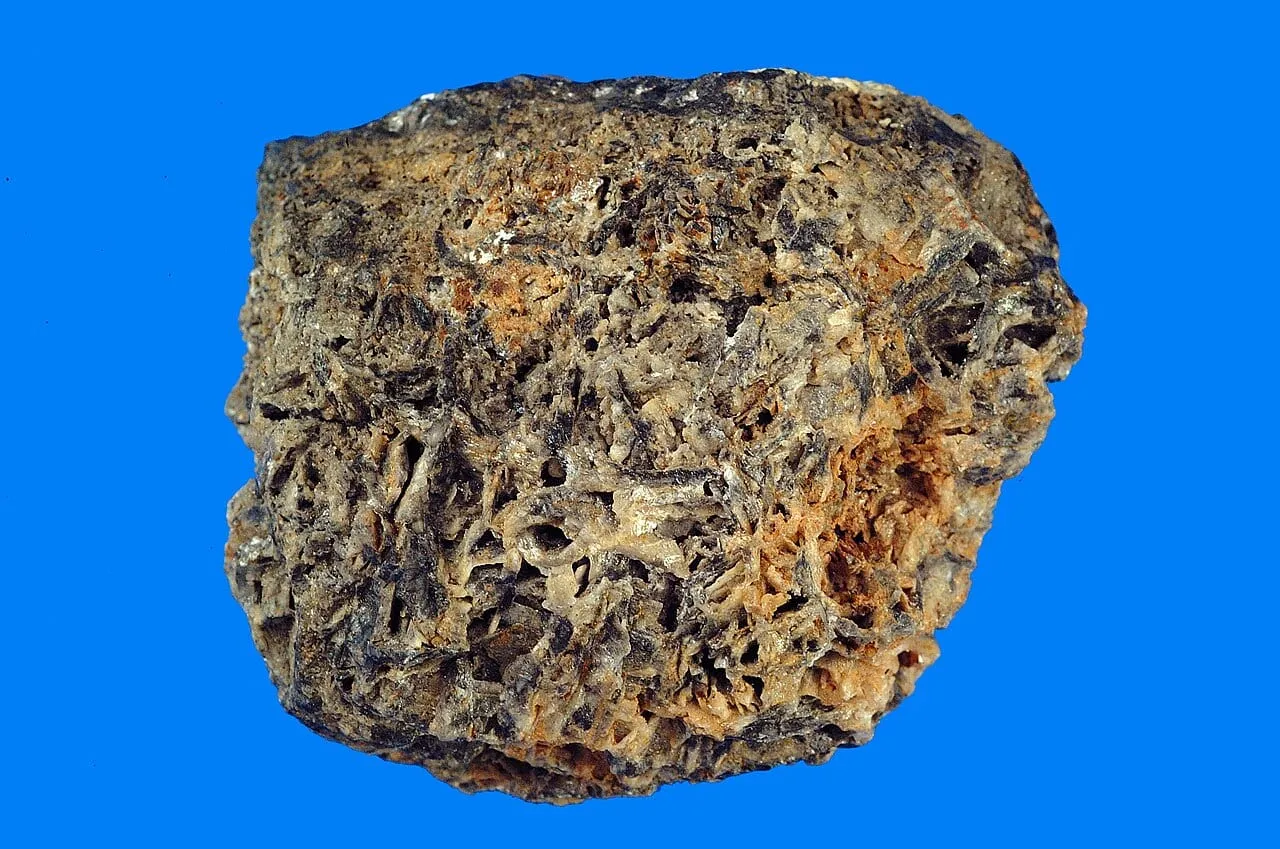
Anglesite
A heavy lead sulfate mineral with a diamond-like shine that grows as a crust around galena; it is named after the island of Anglesey in Wales.
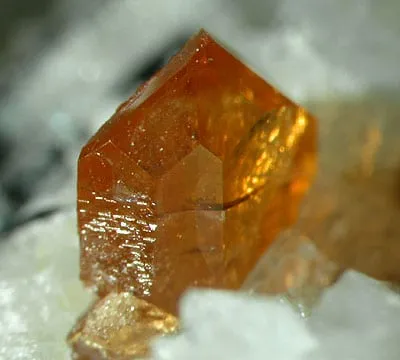
Bastnäsite
One of the main ore minerals of the “rare earth” elements such as cerium, lanthanum and neodymium; a raw material for magnets and electronics.
Borax (tincal)
A sodium borate that dissolves in water and crumbles to white powder in dry air; one of the world’s key tincal deposits is at Kırka in Eskişehir.