Rock
Naxian marble
Naksos mermeri
One of ancient Greece's first island marbles: the coarse-grained marble of Naxos, with crystals up to 15 millimetres that shimmer bluish grey in the light.
Also known as: Naxos marble
- Popularly: Natural stone (building and decor)

In short
Naxian marble is a coarse-crystalled white marble quarried on Naxos, one of the Cycladic islands in the Aegean. It is over 98% calcite, and its transparent crystals grow up to 15 millimetres, making it one of the coarsest-grained marbles on Earth. It was among the most important marbles of ancient Greece, used for statues, temples and the roof tiles of Olympia and the Athenian Acropolis. It is still quarried today.
Photos

How does it form?
Naxian marble formed by high-grade metamorphism around dome-shaped bodies of migmatite that rise in the middle of the island. Migmatite is a rock that was partly melted and solidified again, somewhere between granite and gneiss. The heat and pressure of these domes recrystallised old limestone beds into coarse-grained marble.
Marble and migmatite alternate in layers. The marble reaches 30 metres thick in old fissures, and the layers strike to the northeast. The large size of the crystals reflects a long time spent at high temperature.
What is it used for?
- Antiquity: It served as a stone for statues, temples and ornament. The Naxians began carving giant statues, such as the famous Kouros of Apollonas, right in the quarry. Ancient roof tiles at Olympia and on the Athenian Acropolis were also made of it.
- On the island: The remains of the Temple of Apollo, the emblem of Naxos town, and of the Temple of Demeter at Sangri are of this marble. In the villages it is used for window and door frames, walls and marble plaster, and quarry waste goes into road building and gravel.
- Today: It is used for sculpture and decoration, often outdoors in the Mediterranean region. About 5,000 cubic metres of high-grade Naxian marble are exported each year.
Where is it found?
The ancient quarries lie in the north of the island near Apollonas and in the Melanes area in the middle of the island. At Flerio near Melanes, two unfinished kouroi still lie in the quarry. Today’s quarries are around the village of Kinidaros in the centre of the island, about 400 metres above sea level, where much of the population works in the marble quarries.
History
Naxian marble has been used from antiquity to the present day. It was among the first Cycladic “island marbles” to be used, and the coarsest-grained marble of antiquity. In Roman times it lost its importance: the Roman author Pliny the Elder does not mention Naxian marble once in his Natural History.
What determines its value?
Whiteness matters most: the whiter parts of the stone are preferred in the quarry, and this directly affects its price in trade. The depth and shimmer of its large crystals and its resistance to frost and weathering also make it a favoured ornamental and sculpture stone for outdoor use. Grey, striped kinds go mostly into building, and quarry waste is sold as gravel.
This information is educational, not buying, selling or investment advice. Value varies enormously with quality and treatment.
How to recognise it
- 1
Its crystals are large enough to pick out easily with the naked eye; a broken surface looks like sugar crystals.
- 2
Because its calcite crystals are transparent, the stone shows a bluish-grey shimmer that changes with the angle of the light.
- 3
Some kinds are grey and clearly striped; these hold more impurities.
- 4
Being calcite, it is scratched by a steel knife and fizzes in dilute acid.
Myths and misconceptions
MythThe white marble of ancient Greece always came from Paros.
FactParian marble is very famous, but it was not the only source. Naxian marble was among the first Cycladic “island marbles” to be used, and the coarsest-grained marble used in antiquity.
Did you know?
In the ancient quarry in the north of Naxos lies an unfinished kouros (statue of a young man) about 10.7 metres long and 80 tonnes in weight. According to the archaeologist Gottfried Gruben, it was abandoned because it was too heavy to move.
The stone gives off a faint bitumen-like smell while being worked; it comes from minor organic impurities in the marble and fades once work is done.
Richard Lepsius suggested in 1890 that ancient roof tiles at Olympia and on the Athenian Acropolis were made of Naxian marble; later research confirmed it.
Where is it found?
Loading map…
- Ancient quarry near Apollonas, Naxos, Greece · Historic sourceThe ancient quarry at the island's northern tip. The unfinished Kouros of Apollonas, about 10.7 metres long and 80 tonnes, carved from light grey Naxian marble, still lies here.
- Quarries around Kinidaros and Melanes, central Naxos, Greece · Type localityThe marble district in the middle of the island. Flerio near Melanes has ancient quarries and two unfinished kouroi; today's quarries lie around the village of Kinidaros. The point marks the island in general.
Locations are approximate to protect sites. Red dots mark places in Türkiye. Open in the big map →
Frequently asked questions
What is naxian marble?
Naxian marble is a coarse-crystalled white marble quarried on Naxos, one of the Cycladic islands in the Aegean. It is over 98% calcite, and its transparent crystals grow up to 15 millimetres, making it one of the coarsest-grained marbles on Earth. It was among the most important marbles of ancient Greece, used for statues, temples and the roof tiles of Olympia and the Athenian Acropolis. It is still quarried today.
Why does Naxian marble shimmer bluish grey?
Its calcite crystals are large and mostly transparent. Light enters the stone a few millimetres and reflects off the crystals, so the marble looks deep and gives a bluish-grey shimmer that changes with the angle of the light.
What is naxian marble used for?
Antiquity: It served as a stone for statues, temples and ornament. The Naxians began carving giant statues, such as the famous Kouros of Apollonas, right in the quarry. Ancient roof tiles at Olympia and on the Athenian Acropolis were also made of it. On the island: The remains of the Temple of Apollo, the emblem of Naxos town, and of the Temple of Demeter at Sangri are of this marble. In the villages it is used for window and door frames, walls and marble plaster, and quarry waste goes into road building and gravel.
How hard is naxian marble?
It has a hardness of 3 on the Mohs scale. A fingernail cannot scratch it, but a steel knife can. Its specific gravity is 2.7 g/cm³.
Where is naxian marble found?
Its best-known localities: Quarries around Kinidaros and Melanes, central Naxos, Greece; Ancient quarry near Apollonas, Naxos, Greece.
How can you tell if naxian marble is real?
Its crystals are large enough to pick out easily with the naked eye; a broken surface looks like sugar crystals. Because its calcite crystals are transparent, the stone shows a bluish-grey shimmer that changes with the angle of the light. Some kinds are grey and clearly striped; these hold more impurities.
Is naxian marble valuable?
On the “street to diamond” value ladder it sits on step 4 of nine: Fine dimension stone and ore. Whiteness matters most: the whiter parts of the stone are preferred in the quarry, and this directly affects its price in trade. The depth and shimmer of its large crystals and its resistance to frost and weathering also make it a favoured ornamental and sculpture stone for outdoor use. Grey, striped kinds go mostly into building, and quarry waste is sold as gravel.
Sources
- Naxian marble · Wikipedia
- Kouros of Apollonas · Wikipedia
- Naxos · Wikipedia
- Kynidaros village · Municipality of Naxos and Small Cyclades (naxos.gr)
- Calcite · Wikipedia
External links
Draft: awaiting expert reviewReport an error
On the same step
Alabaster
The fine-grained, translucent form of gypsum: a white stone soft enough to scratch with a fingernail, carved into statues, vessels and lamps for thousands of years.

Anglesite
A heavy lead sulfate mineral with a diamond-like shine that grows as a crust around galena; it is named after the island of Anglesey in Wales.
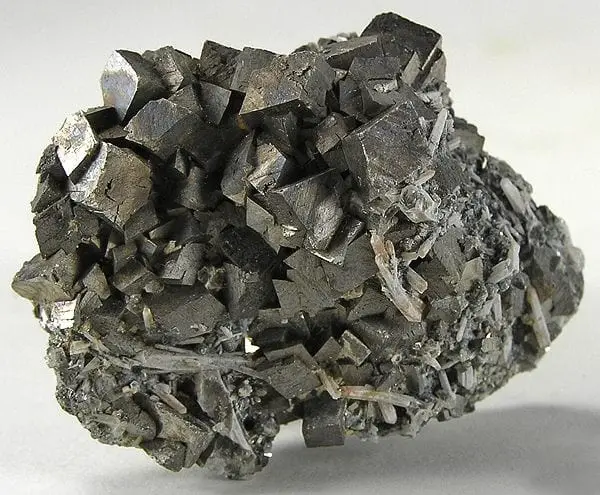
Arsenopyrite
A widespread silvery-grey sulfide containing arsenic: it smells of garlic when struck and is poisonous.