Meteorite
Murchison meteorite
Murchison meteoriti
The meteorite carrying life's building blocks: a carbonaceous chondrite that fell in Australia in 1969, holding amino acids, sugars and grains older than the Sun.
Also known as: Murchison
- Popularly: Meteorite

In short
The Murchison meteorite is a carbonaceous chondrite that fell near the town of Murchison in Victoria, Australia, on 28 September 1969. Because its fall was observed and more than 100 kilograms were collected, it is one of the most studied meteorites. Tens of thousands of organic compounds have been found in it, including 70 amino acids, sugars such as ribose, and bases like those that make up DNA and RNA. It also holds silicon carbide grains older than the Solar System, the oldest material ever found on Earth.
Photos

How does it form?
Murchison is a CM carbonaceous chondrite. Meteorites like this come from small asteroids that formed at the start of the Solar System and never melted, which is why they are among the most chemically primitive meteorites. Long before it fell to Earth, water-rich fluids extensively altered the rock on Murchison’s parent body; its “type 2” label reflects this.
The organic molecules in the meteorite are thought to have formed through chemical reactions on this parent body and earlier in space. Its silicon carbide grains are older still than the Solar System: they are “presolar” dust that formed around other stars before the Sun was born.
What is it used for?
- Origin-of-life research: Common amino acids such as glycine, alanine and glutamic acid, unusual ones such as isovaline, five-carbon sugars including ribose, and bases such as uracil and xanthine have been found in it. They suggest that life’s building blocks may have been delivered to Earth from space.
- Chirality: Most amino acids in living things are “left-handed”. An excess of the left-handed form in some of Murchison’s amino acids has fuelled research on where this imbalance came from.
- Stardust: Presolar grains are used to study the stars and the galaxy before the Solar System formed.
History
At about 10:58 a.m. on 28 September 1969 a bright fireball was seen near Murchison. Fragments were scattered over more than 13 square kilometres, the largest up to 7 kilograms, and the total collected mass exceeds 100 kilograms. Together with the Allende meteorite, which fell the same year, Murchison became one of the most studied specimens in meteorite science.
What determines its value?
Murchison's value is above all scientific: an observed fall, a large recovered mass and pristine interiors make it unique for organic chemistry research. Carbonaceous chondrites are a small share of all meteorites, so they are also sought by collectors. A piece's value depends on its mass, whether it has fusion crust and its documented origin.
This information is educational, not buying, selling or investment advice. Value varies enormously with quality and treatment.
How to recognise it
- 1
Its outside is covered by a thin black fusion crust; inside it is dark grey to black and crumbly.
- 2
Small round chondrules and light-coloured calcium–aluminium-rich inclusions can be seen in the dark matrix.
- 3
Only documentation and laboratory analysis can show that a piece really comes from Murchison.
Myths and misconceptions
MythLife from space was found in Murchison.
FactMurchison contains building blocks of life such as amino acids, sugars and bases, but no living things or traces of them. These molecules are thought to have formed chemically in space without life, suggesting that early Solar System bodies may have delivered life's raw materials to Earth.
MythThe oldest material on Earth is Earth's own rock.
FactThe oldest material found on Earth is the silicon carbide grains inside the Murchison meteorite. The oldest is about 3 ± 2 billion years older than Earth's 4.54-billion-year age; they formed around other stars before the Sun existed.
Did you know?
During the fall a bright fireball split into three and vanished, leaving a cloud of smoke; about 30 seconds later a tremor was heard.
A 2010 study found 14,000 different molecules in a small sample and estimated that the meteorite may hold millions of distinct organic compounds.
In 2020 some silicon carbide grains in Murchison were reported to be about 7 billion years old, roughly 2.5 billion years older than Earth and the Solar System.
Where is it found?
Loading map…
- Murchison, Victoria, Australia · Type localityThe fall was seen on the morning of 28 September 1969; fragments were scattered over more than 13 square kilometres. One 680-gram piece broke through a roof and landed in hay.
Locations are approximate to protect sites. Red dots mark places in Türkiye. Open in the big map →
Frequently asked questions
What is murchison meteorite?
The Murchison meteorite is a carbonaceous chondrite that fell near the town of Murchison in Victoria, Australia, on 28 September 1969. Because its fall was observed and more than 100 kilograms were collected, it is one of the most studied meteorites. Tens of thousands of organic compounds have been found in it, including 70 amino acids, sugars such as ribose, and bases like those that make up DNA and RNA. It also holds silicon carbide grains older than the Solar System, the oldest material ever found on Earth.
Could Murchison's amino acids be contamination from Earth?
Scientists debated this for a long time. But the meteorite contains amino acids such as isovaline that are not found in living things on Earth, while serine and threonine, usually signs of earthly contamination, are absent. The carbon isotope ratios of bases such as uracil and xanthine also point to an origin beyond Earth, and several lines of evidence show that the interiors of well-preserved fragments are pristine.
What is murchison meteorite used for?
Origin-of-life research: Common amino acids such as glycine, alanine and glutamic acid, unusual ones such as isovaline, five-carbon sugars including ribose, and bases such as uracil and xanthine have been found in it. They suggest that life's building blocks may have been delivered to Earth from space. Chirality: Most amino acids in living things are "left-handed". An excess of the left-handed form in some of Murchison's amino acids has fuelled research on where this imbalance came from. Stardust: Presolar grains are used to study the stars and the galaxy before the Solar System formed.
How hard is murchison meteorite?
It has a hardness of 2.5–7 on the Mohs scale. It can scratch glass; a steel knife scratches it only with difficulty. Its specific gravity is 1.86–2.38 g/cm³.
Where is murchison meteorite found?
Its best-known localities: Murchison, Victoria, Australia.
How can you tell if murchison meteorite is real?
Its outside is covered by a thin black fusion crust; inside it is dark grey to black and crumbly. Small round chondrules and light-coloured calcium–aluminium-rich inclusions can be seen in the dark matrix. Only documentation and laboratory analysis can show that a piece really comes from Murchison.
Is murchison meteorite valuable?
On the “street to diamond” value ladder it sits on step 6 of nine: Fine ornamental and collector stone. Murchison's value is above all scientific: an observed fall, a large recovered mass and pristine interiors make it unique for organic chemistry research. Carbonaceous chondrites are a small share of all meteorites, so they are also sought by collectors. A piece's value depends on its mass, whether it has fusion crust and its documented origin.
Sources
- Murchison meteorite · Wikipedia
- Murchison meteoriti · Vikipedi
- CM chondrite · Wikipedia
- Meteorite porosities and densities: a review of trends in the data (D. T. Britt & G. J. Consolmagno), Lunar and Planetary Science XXXV, abstract 2108 · Lunar and Planetary Institute, 2004
External links
Draft: awaiting expert reviewReport an error
On the same step
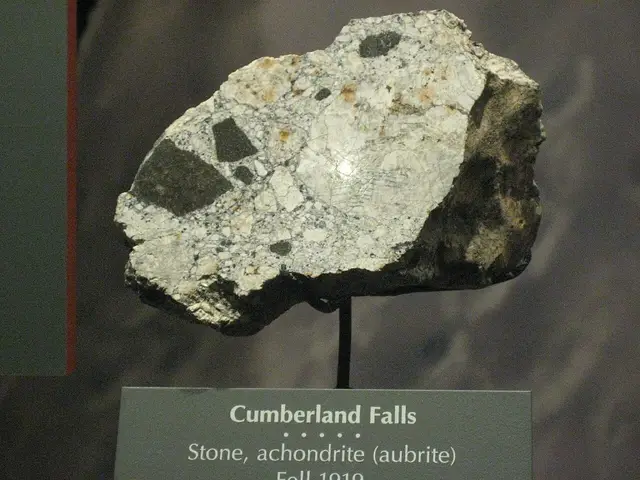
Achondrite
Stony meteorites with no chondrules: rock from melted asteroids, the Moon and Mars, and hard to recognise because they look like Earth rocks.
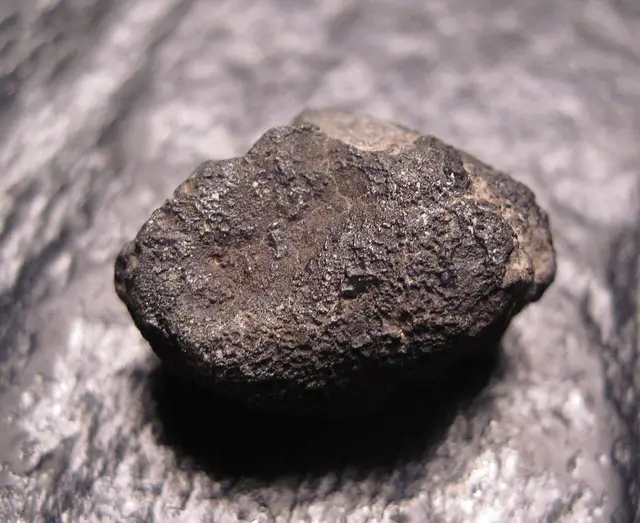
Allende meteorite
The most studied meteorite in history: the largest carbonaceous chondrite, which fell in Mexico in 1969 carrying the first solids of the Solar System.
Amber
Tree resin fossilised over millions of years: a light, warm organic gem that sometimes holds prehistoric insects.