Rock
Kimberlite
Kimberlit
The rock that brings diamonds up from the depths: the pipe left behind by a rare, violent eruption from the mantle.
- Popularly: Ore and raw material
- Ore
- Industrial
_1.jpg)
In short
Kimberlite is a dark, olivine-rich rock formed hundreds of kilometres below the surface. It erupts to the surface very fast and violently along vertical pipes, carrying up pieces of rock torn from the mantle on the way and, sometimes, diamonds. It is the main source of the primary diamonds mined today, and it is named after the town of Kimberley in South Africa. But not every kimberlite contains diamonds.
Photos
_3.jpg)
How does it form?
Kimberlite magma forms in the mantle, roughly 150 to 450 kilometres below the surface. It contains plenty of water and carbon dioxide, and it shatters the rock in its way as it rises to the surface in a very fast, violent eruption, picking up pieces of mantle and surrounding rock (xenoliths) and, if there are any, diamonds. It leaves behind a pipe that narrows downwards and is roughly round or oval in plan; pipes range from 75 metres to 1.5 kilometres across. More rarely, kimberlite also occurs as dikes and sills (sheet-like intrusions).
Near the surface the pipe weathers through contact with air and water: the top becomes yellow ground, crumbly and yellowish brown, and below it lies hard, serpentinised, bluish blue ground. To free diamonds from blue ground it must be crushed in rock crushers.
What is it used for?
- Diamonds: Kimberlite is the most important primary source of natural diamond. For more about the gem, see the diamond page.
- Prospecting guide: Indicator minerals such as reddish-purple pyrope garnet, chromium diopside and magnesian ilmenite, found in stream sand and soil, show that a kimberlite may be nearby and are followed up in exploration.
- Science: The pieces of rock that kimberlite brings up from the mantle are studied to learn about the composition and temperature of the deep Earth.
Where is it found?
The rock is named after the town of Kimberley in South Africa, where the finding of the 83.5-carat “Star of South Africa” diamond in 1869 started a great diamond rush. Famous kimberlite sources include Cullinan (Premier mine) in South Africa, the Mir and Udachnaya pipes in Yakutia, Russia, Jwaneng and Orapa in Botswana, and the Lac de Gras area in Canada. Rocks called kimberlite do not always bring diamonds: around Ithaca in New York State there are more than eighty of them, and none contains any.
What determines its value?
Kimberlite itself is worthless; its value is set by the diamonds it holds. Whether a pipe can be mined depends on its diamond grade (carats per tonne), the size of the stones and the share of gem quality, the depth of the pipe and the strength of the surrounding rock, the cost of mining and transport, and demand in the diamond market. Of the roughly 6,400 known pipes, only a small fraction are mined economically.
This information is educational, not buying, selling or investment advice. Value varies enormously with quality and treatment.
How to recognise it
- 1
Fresh “blue ground” is a dark grey-green, heavy, hard rock; in a fine-grained groundmass you can see rounded grains of olivine, garnet and pyroxene and fragments of foreign rock.
- 2
Weathered “yellow ground” is yellowish brown and crumbles; at first sight it looks like soil.
- 3
It contains indicator minerals that most other rocks lack: reddish-purple pyrope garnet, bright green chromium diopside and black magnesian ilmenite.
- 4
Diamonds are far too scarce to be seen with the naked eye in the rock; they occur at a scale of carats per tonne.
Fakes and imitations
What shops usually don’t tell you:
- Another rock that can contain diamonds but is not kimberlite is lamproite; some large diamond mines, such as Argyle in Australia, worked lamproite.
- Serpentinised peridotite and other dark green ultramafic rocks resemble kimberlite; a firm identification needs the mineral assemblage and chemical analysis.
Myths and misconceptions
MythKimberlite always contains diamonds; every kimberlite pipe is a diamond mine.
FactOf about 6,400 kimberlite pipes known by 2014, only around 900 contain diamonds and about 30 are mined for them. None of the more than eighty kimberlitic dikes in New York has any diamonds.
MythDiamonds form inside kimberlite or in a kimberlite volcano.
FactDiamonds form roughly 150-200 kilometres down, mostly more than a billion years ago. Kimberlite magma does not make them; it merely carries them up like a very fast elevator.
Did you know?
At the hand-dug Big Hole in Kimberley, up to 50,000 workers with picks and shovels removed more than 22 million tons of rock between 1871 and 1914, recovering about 14 million carats of diamonds.
The 3,106-carat Cullinan, found in 1905 in the kimberlite pipe of South Africa's Premier mine, is the largest gem-quality rough diamond ever found.
Rocks like those of South Africa were noticed around Ithaca, New York, in 1837, about fifty years before they were recognised at Kimberley; but not one of those dikes has ever yielded a diamond.
Where is it found?
Loading map…
- Kimberley, Northern Cape, South Africa · Type localityThe town that gave the rock its name. The hand-dug “Big Hole” is a kimberlite pipe: between 1871 and 1914 more than 22 million tons of rock were dug out and about 14 million carats of diamonds recovered.
- Premier Mine, Cullinan, Gauteng, South Africa · Major depositA carrot-shaped kimberlite pipe; the 3,106-carat Cullinan, found in 1905, is the largest gem-quality rough diamond ever found.
- Mir pipe, Mirny, Sakha (Yakutia), Russia · Major depositFound in 1955, the pipe left a giant open pit more than 525 metres deep and 1,200 metres across; underground mining began again in 2009.
- Udachnaya pipe, Daldyn-Alakit field, Sakha (Yakutia), Russia · Major depositA kimberlite pipe discovered in 1955, two days after Mir; it was worked as an open-pit mine about 640 metres deep.
- Jwaneng, Southern District, Botswana · Major depositOpened in 1982 on three kimberlite pipes; described as the richest diamond mine in the world by value.
- Orapa, Central District, Botswana · Major depositFound in 1967, the mine sits on two kimberlite pipes that merge near the surface and is the world's largest diamond mine by area.
- Lac de Gras (Diavik), Northwest Territories, Canada · Known localityThe kimberlite pipes lie beneath the shallow water of Lac de Gras; the Diavik mine, which began production in 2003, took diamonds from them.
- Ithaca and the Cayuga Lake area, New York, USA · Historic sourceMore than eighty kimberlitic dikes emplaced about 160-135 million years ago are known; none has yielded diamonds, because they come from the uppermost mantle, too cool for diamonds to be stable.
Locations are approximate to protect sites. Red dots mark places in Türkiye. Open in the big map →
Frequently asked questions
What is kimberlite?
Kimberlite is a dark, olivine-rich rock formed hundreds of kilometres below the surface. It erupts to the surface very fast and violently along vertical pipes, carrying up pieces of rock torn from the mantle on the way and, sometimes, diamonds. It is the main source of the primary diamonds mined today, and it is named after the town of Kimberley in South Africa. But not every kimberlite contains diamonds.
What is kimberlite used for?
Diamonds: Kimberlite is the most important primary source of natural diamond. For more about the gem, see the diamond page. Prospecting guide: Indicator minerals such as reddish-purple pyrope garnet, chromium diopside and magnesian ilmenite, found in stream sand and soil, show that a kimberlite may be nearby and are followed up in exploration. Science: The pieces of rock that kimberlite brings up from the mantle are studied to learn about the composition and temperature of the deep Earth.
How hard is kimberlite?
It has a hardness of 2.5–6 on the Mohs scale. It can scratch glass; a steel knife scratches it only with difficulty. Its specific gravity is 2.4–2.9 g/cm³.
Where is kimberlite found?
Its best-known localities: Kimberley, Northern Cape, South Africa; Premier Mine, Cullinan, Gauteng, South Africa; Mir pipe, Mirny, Sakha (Yakutia), Russia; Udachnaya pipe, Daldyn-Alakit field, Sakha (Yakutia), Russia; Jwaneng, Southern District, Botswana.
How can you tell if kimberlite is real?
Fresh “blue ground” is a dark grey-green, heavy, hard rock; in a fine-grained groundmass you can see rounded grains of olivine, garnet and pyroxene and fragments of foreign rock. Weathered “yellow ground” is yellowish brown and crumbles; at first sight it looks like soil. It contains indicator minerals that most other rocks lack: reddish-purple pyrope garnet, bright green chromium diopside and black magnesian ilmenite. Another rock that can contain diamonds but is not kimberlite is lamproite; some large diamond mines, such as Argyle in Australia, worked lamproite.
Is kimberlite valuable?
On the “street to diamond” value ladder it sits on step 4 of nine: Fine dimension stone and ore. Kimberlite itself is worthless; its value is set by the diamonds it holds. Whether a pipe can be mined depends on its diamond grade (carats per tonne), the size of the stones and the share of gem quality, the depth of the pipe and the strength of the surrounding rock, the cost of mining and transport, and demand in the diamond market. Of the roughly 6,400 known pipes, only a small fraction are mined economically.
Sources
- Kimberlite · Wikipedia
- Kimberlite · Encyclopaedia Britannica
- Big Hole · Wikipedia
- Cullinan Diamond Mine (Premier Mine) · Wikipedia
- Mir Mine · Wikipedia
- Udachnaya pipe · Wikipedia
- Jwaneng diamond mine · Wikipedia
- Orapa diamond mine · Wikipedia
- Diavik Diamond Mine · Wikipedia
- Kimberlitic Rocks of New York State · Rochester Academy of Science
- Density Measurement of the Kelvin and Faraday Kimberlites in the Northwest Territories of Canada (Bloem, Hetman, Arseneau & Hrkac) · 11th International Kimberlite Conference, Extended Abstract 11IKC-4680, 2017
External links
Draft: awaiting expert reviewReport an error ↗
On the same step

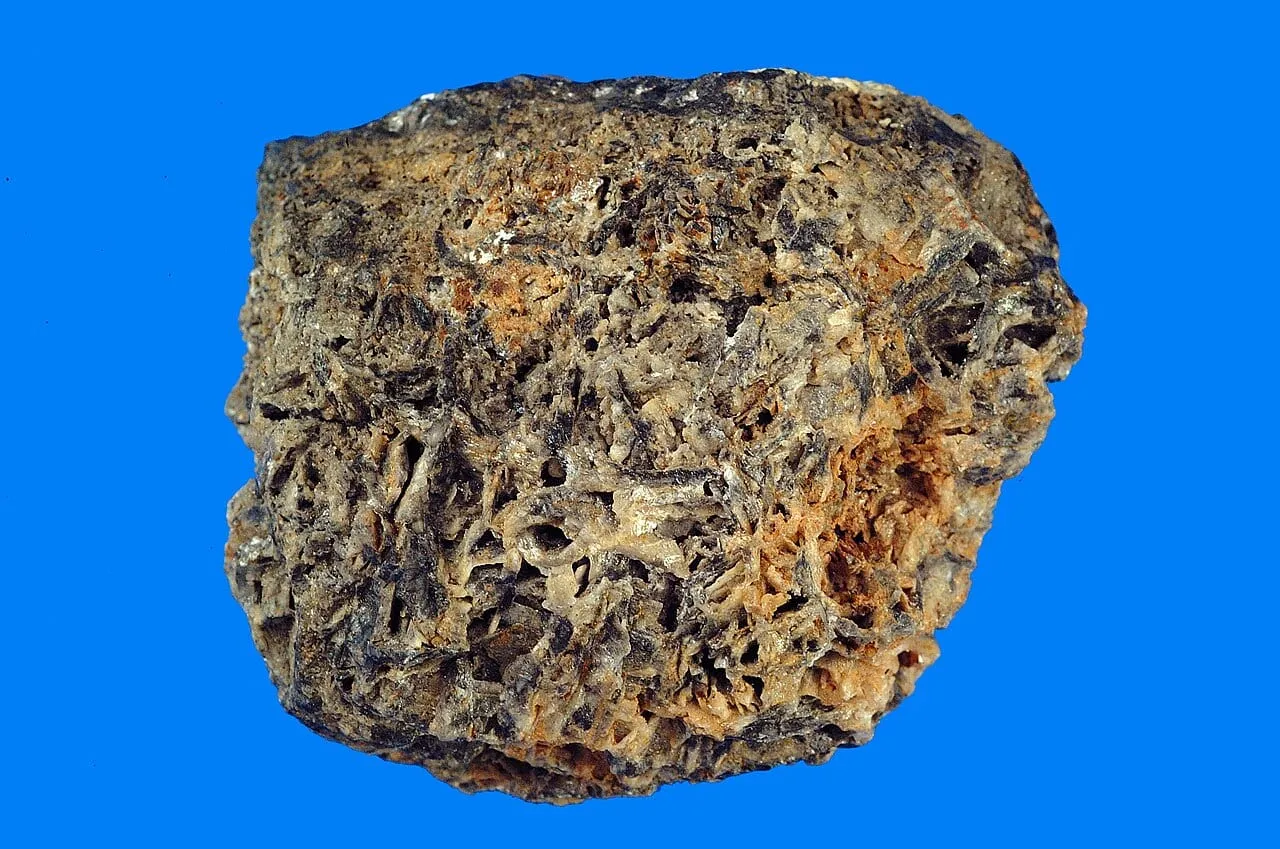
Anglesite
A heavy lead sulfate mineral with a diamond-like shine that grows as a crust around galena; it is named after the island of Anglesey in Wales.

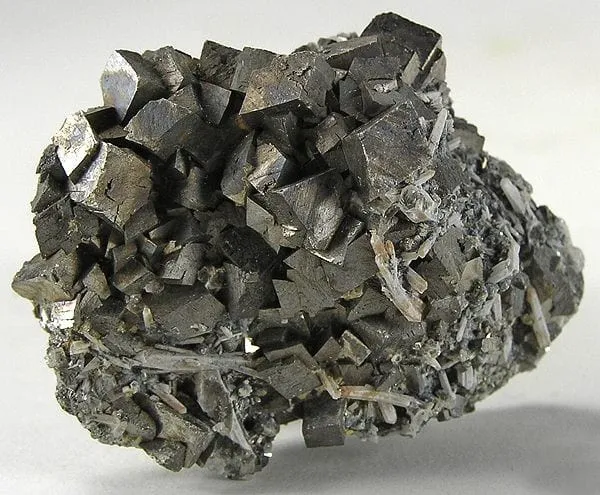
Arsenopyrite
A widespread silvery-grey sulfide containing arsenic: it smells of garlic when struck and is poisonous.

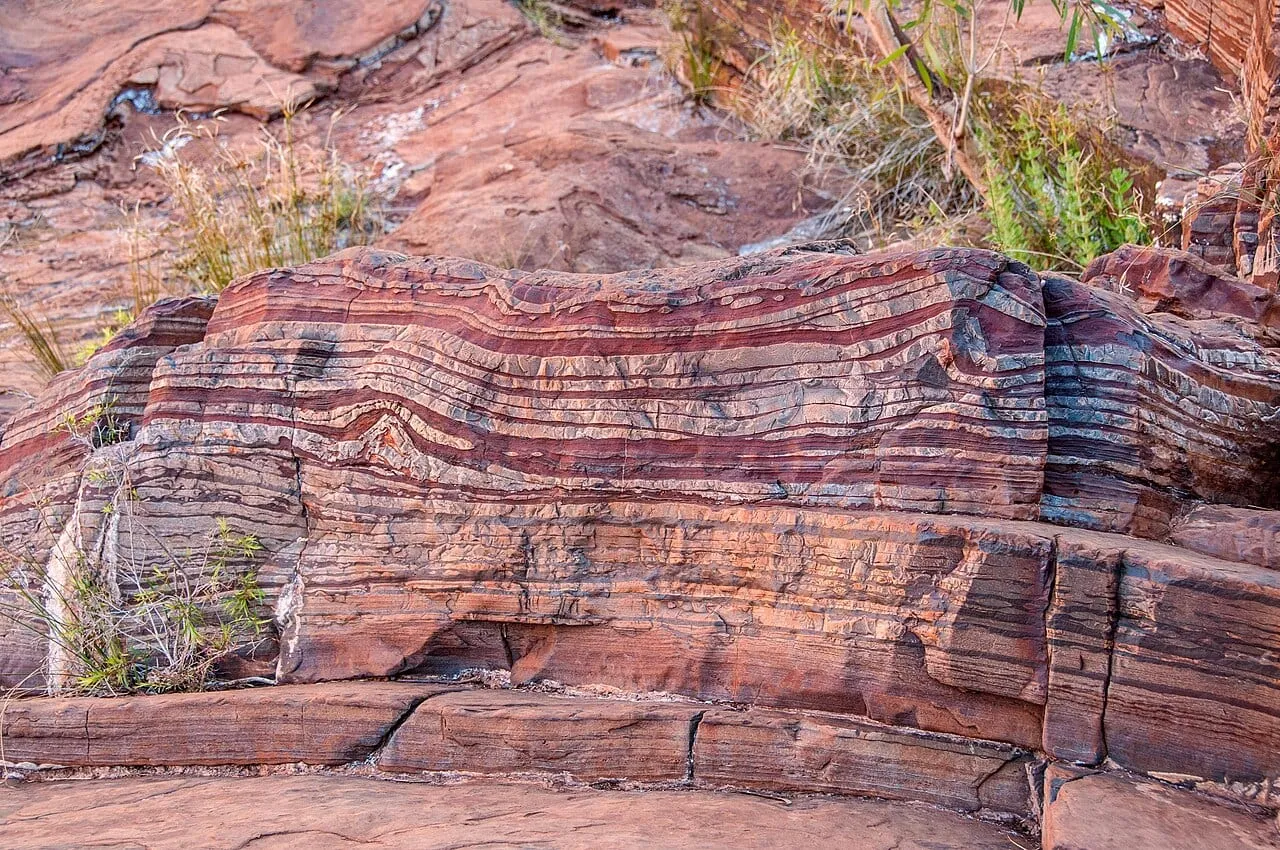
Banded iron formation
An ancient rock of alternating iron-oxide and chert bands: the record of oxygen beginning to build up on Earth, and the main source of iron ore.