Meteorite
Chelyabinsk meteorite
Çelyabinsk meteoriti
The stones that fell from the asteroid that exploded over the Urals in 2013, brighter than the Sun for a moment, shattering thousands of windows.
Also known as: Chelyabinsk meteor · Chebarkul meteorite
- Popularly: Meteorite

In short
The Chelyabinsk meteorite is the pieces that reached the ground from an asteroid about 18 metres across and roughly 10,000 tonnes that entered the atmosphere over Russia's southern Urals on the morning of 15 February 2013. The asteroid exploded at about 30 kilometres altitude; its light was briefly brighter than the Sun, and its shock wave damaged some 7,200 buildings in six cities, sending 1,491 people for treatment. It is the largest object to enter Earth's atmosphere since the 1908 Tunguska event. The recovered pieces are LL5 ordinary chondrites; the largest, 654 kilograms, was raised from Lake Chebarkul.
Photos

How does it form?
The Chelyabinsk asteroid is thought to have come from the asteroid belt between Mars and Jupiter. The meteorite’s structure shows that the rock was once several kilometres below the surface of a much larger LL chondrite asteroid and went through many collisions. Parts that were shocked to high pressure and partly melted in an earlier collision now appear as black shock veins in the stone. Jupiter’s gravity is thought to have changed the asteroid’s orbit until it crossed Earth’s path.
On 15 February 2013 the asteroid entered the atmosphere at a shallow angle of about 18 degrees and a speed of about 19 kilometres per second. It broke up at about 30 kilometres altitude with an energy equal to 400–500 kilotonnes of TNT, most of which the atmosphere absorbed. The remaining fragments kept falling without glowing and were scattered as meteorites over snow-covered fields.
What is it used for?
Chelyabinsk let scientists study, with images and measurements, how a large asteroid breaks up in the atmosphere. Dashcam and security camera recordings helped calculate the height and energy of the explosion. Research also showed that the widely used method for estimating airburst damage does not match the observations. The recovered meteorites are used to study LL chondrites and the collision history of asteroids.
History
The fireball was seen at 09:20 local time, a few minutes after sunrise in Chelyabinsk, and was watched across a wide area as far as Kazakhstan. The centre of the explosion was south of Chelyabinsk, around Yemanzhelinsk and Yuzhnouralsk. The same day a 6-metre hole was found in the frozen surface of Lake Chebarkul, and scientists from Ural Federal University collected the first small meteorites around it. After weeks of work, the 654-kilogram main mass was raised from the lake bed on 16 October 2013; it tipped over and broke the scales while being weighed, splitting into three pieces.
What determines its value?
Chelyabinsk pieces gain value from coming from one of the most famous and best-documented meteorite events of the past century. The completeness of the fusion crust, the mass, a visible interior (shock veins, chondrules) and a documented find site also matter.
This information is educational, not buying, selling or investment advice. Value varies enormously with quality and treatment.
How to recognise it
- 1
Most pieces are covered by a thin, black, dull fusion crust; broken faces show a light or dark grey interior.
- 2
Thin black shock veins and small round chondrules can be seen inside.
- 3
Only documentation and laboratory analysis can show that a piece really comes from Chelyabinsk.
Myths and misconceptions
MythThe injuries in Chelyabinsk were caused by falling meteorite pieces.
FactAll the injuries were indirect. Most came from window glass blown inwards by the explosion's shock wave; the intense light also caused eye pain and sunburn-like burns in some people. No one died.
MythChelyabinsk was a piece of asteroid 367943 Duende, which passed Earth the same day.
FactDuende passed about 16 hours later, and the two objects had completely different orbits; they were unrelated. The Chelyabinsk asteroid most likely came from the asteroid belt.
Did you know?
The shock wave from the explosion reached the ground about two and a half minutes after the flash. Most of the injured were cut by window glass blown inwards by the shock wave.
When the teacher Yulia Karbysheva saw the flash, she told her pupils to keep away from the windows and duck under their desks; none of the 44 children was cut, while she herself was badly injured.
The infrasound waves from the explosion circled the globe several times and were recorded by 20 stations that monitor nuclear tests, one of them 15,000 kilometres away in Antarctica.
Where is it found?
Loading map…
- Lake Chebarkul, Chelyabinsk Oblast, Russia · Type localityThe piece that punched a 6-metre hole in the frozen lake was raised from the bottom on 16 October 2013: at 654 kg, the largest fragment of the meteorite found.
- South of Chelyabinsk (Korkino, Yemanzhelinsk), Russia · Known localityThe area beneath the centre of the explosion; numerous small meteorites were scattered over snow-covered fields. The point marks Yemanzhelinsk.
Locations are approximate to protect sites. Red dots mark places in Türkiye. Open in the big map →
Frequently asked questions
What is chelyabinsk meteorite?
The Chelyabinsk meteorite is the pieces that reached the ground from an asteroid about 18 metres across and roughly 10,000 tonnes that entered the atmosphere over Russia's southern Urals on the morning of 15 February 2013. The asteroid exploded at about 30 kilometres altitude; its light was briefly brighter than the Sun, and its shock wave damaged some 7,200 buildings in six cities, sending 1,491 people for treatment. It is the largest object to enter Earth's atmosphere since the 1908 Tunguska event. The recovered pieces are LL5 ordinary chondrites; the largest, 654 kilograms, was raised from Lake Chebarkul.
Why wasn't the Chelyabinsk asteroid seen in advance?
The asteroid approached Earth from a direction close to the Sun, so telescopes could not spot it before it entered the atmosphere. The well-publicised close pass of the larger asteroid 367943 Duende happened the same day, but the two objects had very different orbits.
What is chelyabinsk meteorite used for?
Chelyabinsk let scientists study, with images and measurements, how a large asteroid breaks up in the atmosphere. Dashcam and security camera recordings helped calculate the height and energy of the explosion. Research also showed that the widely used method for estimating airburst damage does not match the observations. The recovered meteorites are used to study LL chondrites and the collision history of asteroids.
How hard is chelyabinsk meteorite?
It has a hardness of 5–7 on the Mohs scale. It can scratch glass; a steel knife scratches it only with difficulty. Its specific gravity is 2.99–3.43 g/cm³.
Where is chelyabinsk meteorite found?
Its best-known localities: Lake Chebarkul, Chelyabinsk Oblast, Russia; South of Chelyabinsk (Korkino, Yemanzhelinsk), Russia.
How can you tell if chelyabinsk meteorite is real?
Most pieces are covered by a thin, black, dull fusion crust; broken faces show a light or dark grey interior. Thin black shock veins and small round chondrules can be seen inside. Only documentation and laboratory analysis can show that a piece really comes from Chelyabinsk.
Is chelyabinsk meteorite valuable?
On the “street to diamond” value ladder it sits on step 6 of nine: Fine ornamental and collector stone. Chelyabinsk pieces gain value from coming from one of the most famous and best-documented meteorite events of the past century. The completeness of the fusion crust, the mass, a visible interior (shock veins, chondrules) and a documented find site also matter.
Sources
- Chelyabinsk meteor · Wikipedia
- 2013 Rusya Meteor Olayı · Vikipedi
- Meteorite porosities and densities: a review of trends in the data (D. T. Britt & G. J. Consolmagno), Lunar and Planetary Science XXXV, abstract 2108 · Lunar and Planetary Institute, 2004
- Handbook of Mineralogy: Forsterite · Mineralogical Society of America
- Lake Chebarkul · Wikipedia
- Yemanzhelinsk · Wikipedia
External links
Draft: awaiting expert reviewReport an error
On the same step
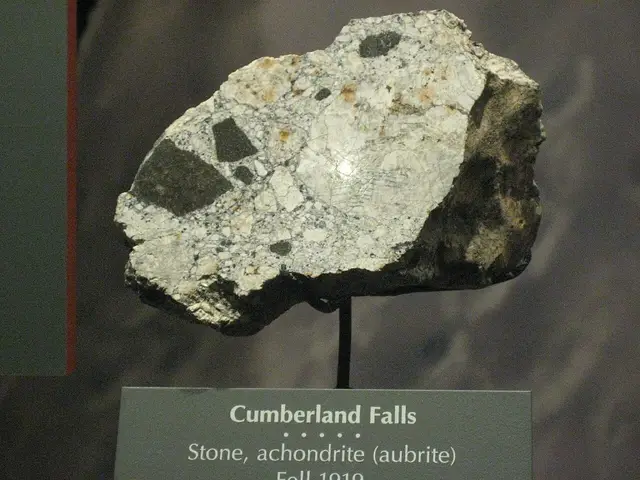
Achondrite
Stony meteorites with no chondrules: rock from melted asteroids, the Moon and Mars, and hard to recognise because they look like Earth rocks.
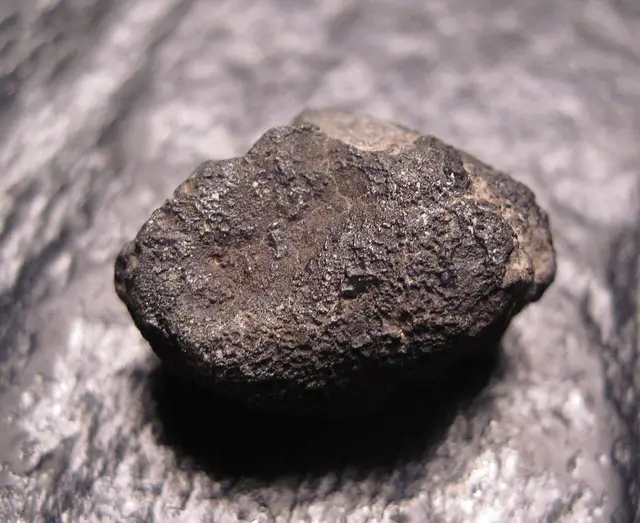
Allende meteorite
The most studied meteorite in history: the largest carbonaceous chondrite, which fell in Mexico in 1969 carrying the first solids of the Solar System.
Amber
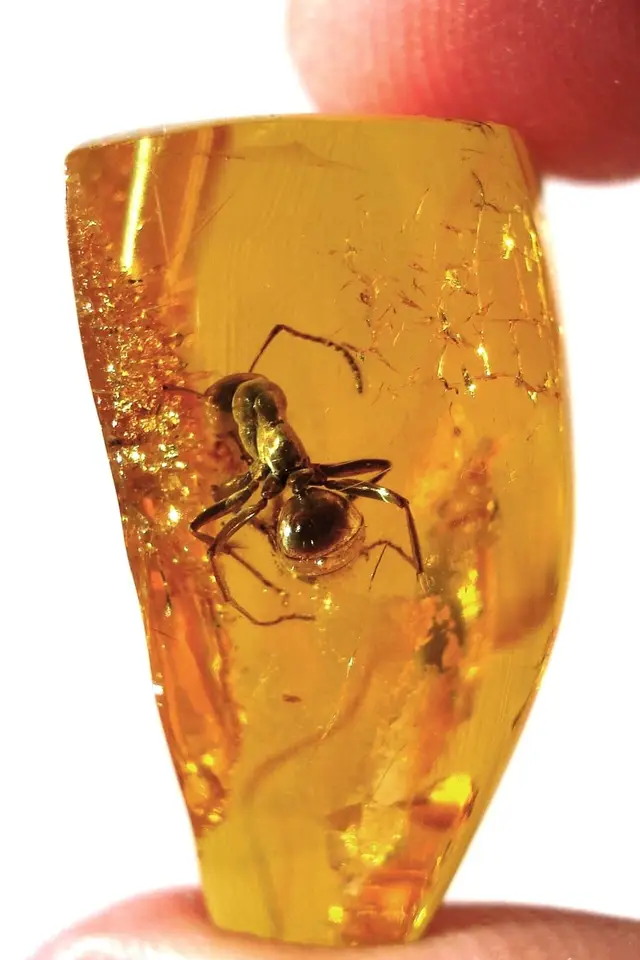
Tree resin fossilised over millions of years: a light, warm organic gem that sometimes holds prehistoric insects.